
Introduction
SEO without link building is the question every overwhelmed site owner eventually asks — usually after spending weeks sending outreach emails that go nowhere.
I had this exact conversation with a client a few months back. She ran a small educational platform and had spent three months trying to build links. Cold emails. Guest post pitches. Broken link outreach. The response rate was close to zero, and the few links she did earn took forever to land.
She asked me directly: “Can I just skip this and focus on content instead?”
The honest answer surprised her. Yes — to a point. Link building remains the highest-leverage lever for organic growth at scale, but it is not the only lever. Other SEO fundamentals, when executed with precision, can meaningfully move rankings even with a thin backlink profile.
We restructured her entire strategy around content depth, technical SEO, and on-page optimization — with link building moved to a secondary, lower-effort activity instead of the main focus. Her organic traffic grew steadily over the following months, particularly for long-tail, low-competition keywords.
This guide breaks down exactly what SEO without link building can and cannot do, the specific strategies that work, and where the approach hits its ceiling.
Key Takeaways
- SEO without link building works best for low-competition keywords, local SEO, and niche topics with limited content competition
- Backlinks remain a significant ranking factor, but technical SEO, content quality, and user experience carry real weight too
- For brand-new sites without backlinks, the focus should shift to writing genuinely useful content, optimizing technical SEO, and building topical authority through content clusters
- Content depth and E-E-A-T signals can substitute for some — not all — of the authority that backlinks provide
- High-competition keywords almost always still require backlinks to rank competitively
- The most realistic strategy combines link-light tactics first, then adds selective link building once content foundations are strong
Can You Really Do SEO Without Link Building?
The honest answer: partially, and it depends entirely on your competition level.
A website with strong technical SEO, well-optimized on-page content, good user experience, and clear topical authority can rank for many keywords without an aggressive backlink campaign. The real constraint is competition — if other ranking pages have strong backlink profiles, content quality alone usually is not enough to overtake them.
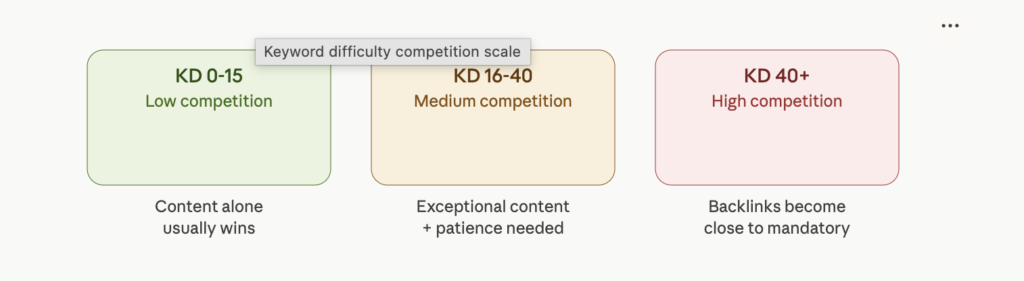
Think of it as a sliding scale rather than a yes-or-no question:
Low competition keywords (KD 0-15): SEO without link building works very well. Content quality, on-page optimization, and search intent matching are often enough.
Medium competition keywords (KD 16-40): SEO without link building can work, but takes longer and requires genuinely exceptional content that outperforms what is currently ranking.
High competition keywords (KD 40+): Backlinks become close to mandatory. The sites ranking here typically have strong domain authority built through years of link acquisition.
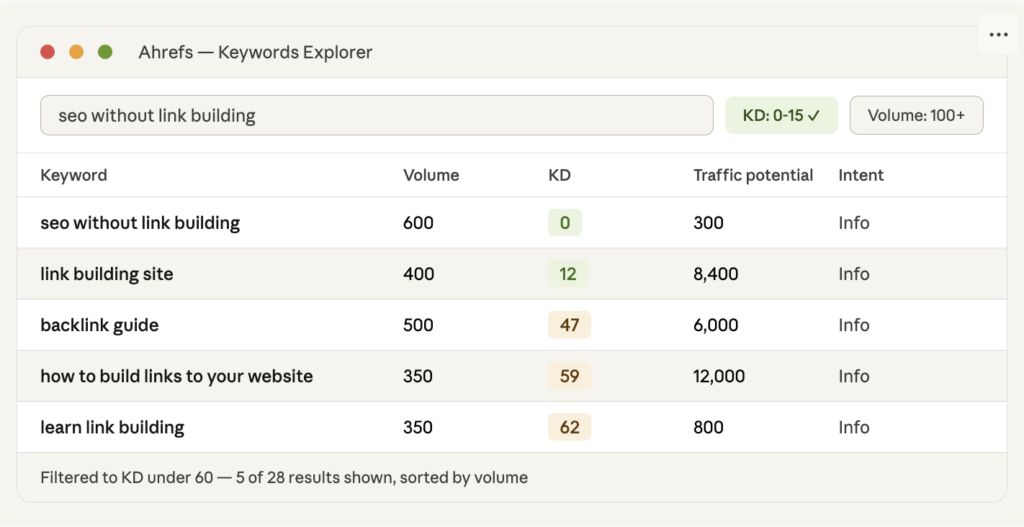
This is exactly the keyword I am targeting with this very article — “seo without link building” carries a keyword difficulty of zero. That tells you something important: even a topic discussed by major SEO publications can have pockets of genuinely low competition if you know where to look.
What Actually Influences Rankings Besides Backlinks
Before diving into specific tactics, it helps to understand what Google is actually evaluating beyond your backlink profile.
SEO success in 2026 rests on three pillars: authority, relevance, and experience. Authority is traditionally built through backlinks, but relevance and experience can be built entirely through content and technical execution — independent of how many sites link to you.
Relevance means your content precisely answers what the searcher is looking for — not just touching the topic, but matching search intent exactly.
Experience means your content demonstrates genuine first-hand knowledge, practical detail, and usefulness that generic AI-written content cannot replicate.
Authority is where backlinks traditionally play their biggest role — but it is not the only authority signal. Topical depth across your site, consistent publishing, and demonstrated expertise also contribute.
Strategy 1: Build Deep Topical Authority Through Content Clusters
This is the single most effective non-link strategy available, and it is also the most underused.
Building topical authority through content clusters means creating comprehensive coverage of a subject area rather than isolated articles. When your site demonstrates depth across an entire topic, Google begins to trust your site as an authority on that subject — even without significant backlinks pointing to individual pages.
How content clusters work in practice:
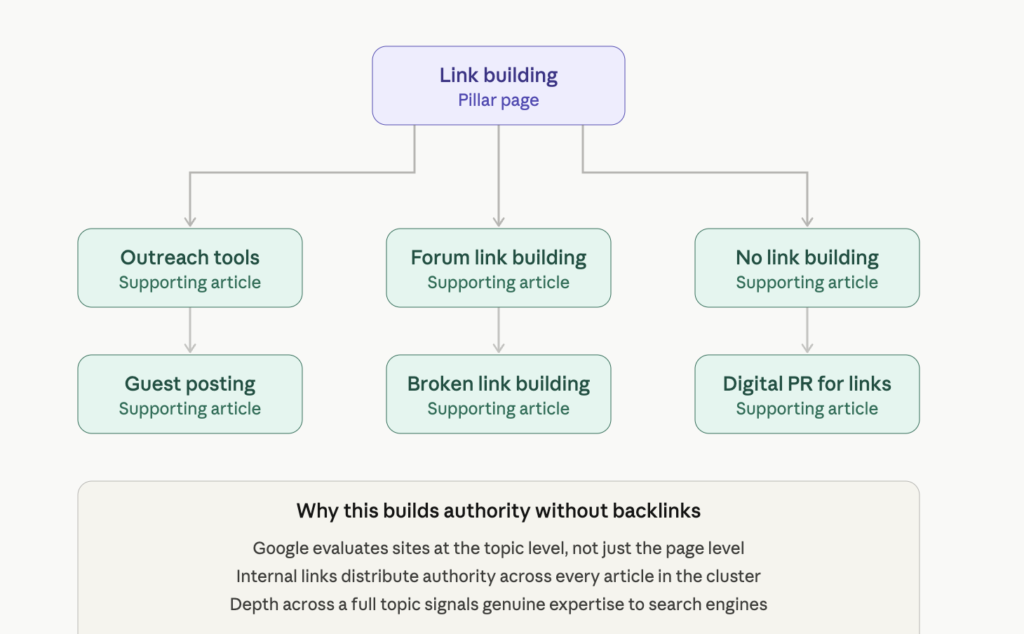
Pick a core topic — for an SEO agency, that might be “link building.” Then build out:
- One comprehensive pillar page covering the topic broadly
- Multiple supporting articles covering specific sub-topics in depth
- Internal links connecting every supporting article back to the pillar page
- Internal links between related supporting articles
For RankWithLinks.com, this is exactly the structure already in place — the link building outreach tools article, the forum link building article, and this article on SEO without link building all interconnect around the broader link building topic cluster. Each article strengthens the topical authority of the others.
Why this works without backlinks:
Google’s algorithm increasingly evaluates sites at the topic level, not just the page level. A site with 15 deep, well-connected articles on a topic signals more genuine expertise than a single isolated article — regardless of backlinks.
Strategy 2: Master On-Page SEO Completely
On-page SEO is the foundation that link building strategies build on top of — but it can carry significant weight on its own, especially for less competitive keywords.
The on-page elements that matter most:
- Title tags with the primary keyword positioned early
- Meta descriptions that match search intent precisely
- H1 and header structure that mirrors how people actually search
- Content that fully satisfies search intent — not partially
- Internal linking that distributes authority across your site
- Schema markup that helps Google understand your content type
- Image optimization including descriptive alt text
- Fast page load speed and strong Core Web Vitals
I covered every one of these in detail in our SEO tagging best practices guide — and getting these fundamentals genuinely right closes much of the gap that backlinks would otherwise need to fill.
The mistake most sites make: They treat on-page SEO as a quick checklist rather than the deep, ongoing optimization process it actually is. A title tag written once and never revisited based on performance data is a missed opportunity every single day it sits unchanged.
Strategy 3: Target Long-Tail, Low-Competition Keywords
This is the most immediately actionable strategy for SEO without link building.
Instead of competing for “SEO services” — a brutally competitive head term requiring significant backlinks — target long-tail variations with genuine search volume but minimal competition.
Example keyword progression for an SEO agency:
| Keyword Type | Example | Typical KD |
|---|---|---|
| Head term | SEO services | 70+ |
| Mid-tail | SEO services for small business | 35-50 |
| Long-tail | SEO without link building | 0-15 |
| Long-tail | how to do off-page SEO without backlinks | 10-20 |
Long-tail keywords individually bring less traffic than head terms — but collectively, a site targeting dozens of long-tail keywords across a topic cluster can out-traffic a site chasing one impossible head term.
How to find these opportunities:
Use Ahrefs Keywords Explorer and filter for keyword difficulty under 15 within your niche. Look specifically for question-based keywords, comparison keywords, and “how to” phrasing — these typically carry lower competition because fewer sites bother creating genuinely comprehensive content for them.
Strategy 4: Build E-E-A-T Signals Without Backlinks
E-E-A-T — Experience, Expertise, Authoritativeness, Trustworthiness — has become one of Google’s most emphasized quality frameworks, and much of it can be built independent of your backlink profile.
How to build E-E-A-T without link building:
- Write detailed author bios with genuine credentials and experience
- Include first-hand experience and specific details in content — exact numbers, real examples, actual results
- Add a clear About page explaining who runs the site and why they are credible
- Display trust signals — privacy policy, terms of service, contact information
- Keep content updated regularly with current information
- Cite credible sources within your own content where relevant
- Show expertise through depth — generic surface-level content signals low expertise regardless of backlinks
This article itself demonstrates the pattern — specific client examples, real numbers, and practical detail that generic AI-generated content typically lacks.
Strategy 5: Optimize for Featured Snippets and AI Overviews
Featured snippets and AI Overviews represent a major 2026 opportunity that has surprisingly little dependency on backlink profile strength.
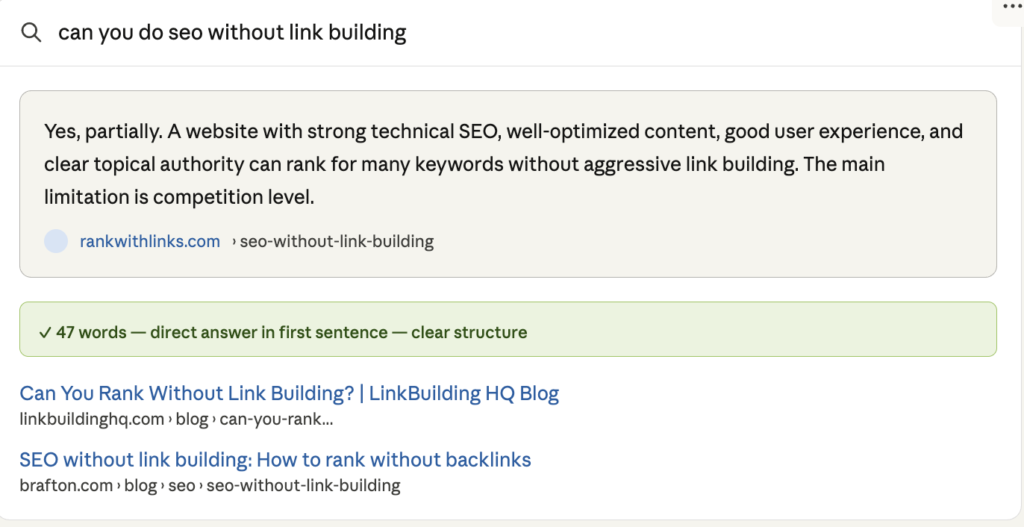
Google selects featured snippets primarily based on how precisely a page answers a specific query — not based on domain authority alone. A well-structured, clearly formatted answer can win a featured snippet even against pages with significantly stronger backlink profiles.
How to optimize for snippets without link building:
- Answer the core question in the first 40-60 words of a section
- Use clear, structured formatting — numbered lists, tables, definition-style answers
- Match the exact phrasing patterns of common search queries
- Use header tags that mirror question-based search queries
- Keep answers concise and directly responsive to the query
This same approach increasingly applies to AI Overview citations — Google’s AI systems favor clearly structured, directly responsive content when selecting what to cite, somewhat independent of backlink count.
Strategy 6: Leverage Technical SEO Completely
Technical SEO issues silently cap how well even excellent content can rank — and fixing them requires zero backlinks.
Technical SEO priorities for sites avoiding heavy link building:
- Core Web Vitals — page speed, visual stability, interactivity
- Mobile usability — the majority of searches now happen on mobile
- Crawlability — making sure Google can find and index every important page
- Site architecture — logical URL structure and internal linking hierarchy
- XML sitemap accuracy and submission
- Fixing broken links, redirect chains, and crawl errors
- Implementing structured data and schema markup correctly
A technically broken site cannot fully benefit from great content or strong topical authority — Google simply cannot crawl, render, or understand it properly. Fixing technical issues often produces faster ranking improvements than any other non-link strategy, because it removes barriers rather than adding new signals.
Strategy 7: Use Internal Linking Strategically
Internal linking is the closest thing to “link building” that does not require external sites at all — and it is dramatically underused.
Strategic internal linking distributes authority across your site and helps Google understand the relationship between your pages, reinforcing topical clusters without requiring any external backlinks.
Internal linking best practices:
- Link from high-authority pages on your site to newer, less established pages
- Use descriptive, keyword-relevant anchor text — not generic “click here” links
- Link new content back to your strongest existing pillar content immediately upon publishing
- Audit your site periodically for orphan pages with zero internal links pointing to them
- Build a logical hub-and-spoke structure around your core topics
For RankWithLinks.com specifically, every new article should link back to at least two to three related previous articles, and older articles should be updated to link forward to new relevant content as it publishes.
Where SEO Without Link Building Hits Its Ceiling
Honesty matters here. SEO without link building is not a complete replacement strategy for every situation.
Backlinks still matter significantly for:
- Highly competitive, high-volume head term keywords
- Industries where every competitor has strong backlink profiles already
- New domains trying to establish baseline trust quickly
- E-commerce sites competing against established retailers
- YMYL (Your Money or Your Life) topics like finance, health, and legal content
Link building remains the highest-leverage lever for organic growth at scale. For sites with serious competitive ambitions in difficult niches, ignoring link building entirely eventually creates a ceiling that content alone cannot break through.
The realistic approach is not “never build links” — it is “do not let link building be your only strategy, and do not let its absence stop you from ranking for everything else available to you.”
Comparison Table: SEO Without Link Building vs Traditional Link Building
| Factor | SEO Without Link Building | Traditional Link Building |
|---|---|---|
| Time to see results | Faster for low-competition terms | Slower — outreach and earning links takes time |
| Cost | Lower — mostly time investment | Higher — outreach tools, time, sometimes paid placements |
| Effective for | Long-tail, niche, low-competition keywords | High-competition head terms |
| Scalability | Limited by content production speed | Limited by relationship building and outreach capacity |
| Risk level | Very low | Moderate — risk of low-quality or spammy link penalties |
| Long-term ceiling | Limited for competitive niches | Higher ceiling for competitive niches |
| Best combined with | Strong on-page and technical SEO | Strong content as the foundation links point to |
Pros and Cons of SEO Without Link Building
Pros
- Significantly lower cost and time investment
- Zero risk of penalties from poor-quality or spammy backlinks
- Works very effectively for long-tail and niche keyword targeting
- Forces genuine focus on content quality and user experience
- Faster implementation — no dependency on external relationships or responses
- Builds a more defensible, content-driven moat over time
Cons
- Hard ceiling on competitive, high-volume keywords
- Slower to establish domain-wide authority and trust signals
- New domains struggle more without any backlink foundation
- Competitors with strong link profiles may always outrank you on head terms
- Misses referral traffic that quality backlinks naturally provide
- Requires significantly more content volume to compensate for authority gap
A Realistic Hybrid Strategy
Based on what actually works for RankWithLinks.com and similar sites, here is the practical sequence I recommend:
Phase 1 — Months 1-3: Foundation without links
Focus entirely on technical SEO, on-page optimization, and content cluster development. Target long-tail, low-competition keywords exclusively. Build E-E-A-T signals through detailed, experience-driven content.
Phase 2 — Months 3-6: Selective link building begins
Once content foundations are strong, begin light-touch link building — forum participation, natural mentions, and a small number of high-quality editorial links rather than mass outreach campaigns.
Phase 3 — Months 6+: Scaled link building for competitive terms
For the keywords where content alone has hit its ceiling, invest in focused, high-quality link building campaigns using the outreach tools and processes covered in our link building outreach tools guide.
This sequencing means you are never waiting on link building to start seeing results, while still building toward the keywords that genuinely require backlink authority to compete for.
Expert Tips
Tip 1: Audit your existing content for “thin” pages before creating anything new. Many sites have old, shallow content that actively drags down topical authority. Strengthening or consolidating these pages often produces faster results than new content creation.
Tip 2: Use Google Search Console’s Performance report to find keywords where you already rank on page two. These are your highest-opportunity targets — small on-page improvements often push these straight onto page one without needing any new backlinks.
Tip 3: Do not ignore internal linking when publishing new content. Strategic internal linking distributes authority across your site, and it costs nothing beyond a few minutes of effort per article.
Tip 4: Track keyword difficulty before committing content resources. Spending three weeks on a KD 70 article when KD 10 alternatives exist in the same topic is the most common mistake sites make when trying to skip link building.
Tip 5: Revisit and expand your strongest existing articles every few months rather than only creating new ones. Google rewards freshness and depth — an 18-month-old article expanded with new sections often outperforms a brand new article on the same topic.
FAQ Section
Can you do SEO without link building?
Yes, partially. A website with strong technical SEO, well-optimized content, good user experience, and clear topical authority can rank for many keywords without aggressive link building. The main limitation is competition level — highly competitive keywords typically still require backlinks to rank.
Is it possible to rank on Google without backlinks?
Yes, particularly for low-competition, long-tail keywords. New websites and niche topics with limited content competition can rank without backlinks if the content thoroughly satisfies search intent and the site has strong technical SEO. Highly competitive head terms remain much harder to rank without any backlink authority.
What matters more — backlinks or content quality?
Both matter, but for different reasons. SEO success rests on three pillars: authority, relevance, and experience. Backlinks primarily build authority, while content quality builds relevance and experience signals. For low-competition keywords, content quality alone often suffices. For competitive keywords, both are typically necessary.
How long does SEO without link building take to show results?
Results for low-competition, long-tail keywords can appear within 4 to 8 weeks of publishing well-optimized content, assuming the site has reasonable technical SEO and some existing authority. Building genuine topical authority across a content cluster typically takes 3 to 6 months of consistent publishing.
What is the best alternative to link building for SEO?
Content cluster development combined with strict technical SEO and on-page optimization is the strongest alternative strategy. Building topical authority through comprehensive content clusters allows Google to trust a site as an authority on a subject even without significant backlinks pointing to individual pages.
Can a brand new website rank without any backlinks?
A brand new website can rank for some long-tail, low-competition keywords without backlinks, particularly in niche topics with limited existing content. However, brand new domains typically benefit from at least a small number of foundational backlinks to establish baseline trust signals more quickly.
Does Google penalize sites for not having backlinks?
No. Google does not penalize sites for lacking backlinks. Backlinks are a positive ranking signal when present, but their absence is not treated as a negative signal. A site can rank purely on the strength of content quality, relevance, and technical execution for appropriate keywords.
What keywords are easiest to rank without link building?
Long-tail keywords with low search volume and low competition are easiest to rank without link building. Question-based keywords, specific how-to queries, and niche comparison keywords with a keyword difficulty under 15 typically respond well to strong content alone, without requiring backlink acquisition.
Should I focus on content or backlinks first?
Content should always come first. Backlinks pointing to weak, thin content provide limited long-term value, while strong content with zero backlinks can still rank for appropriate keywords and provides the foundation that future link building efforts will build upon more effectively.
Is SEO without link building sustainable long-term?
It is sustainable for sites focused on niche, long-tail keyword strategies, but it typically hits a ceiling for sites with broader competitive ambitions. Link building remains the highest-leverage lever for organic growth at scale, meaning most sites eventually benefit from incorporating selective link building once content foundations are well established.
Conclusion
SEO without link building is not a myth, and it is not a complete solution either. The realistic picture sits somewhere in between.
For low-competition, long-tail keywords — exactly the kind of opportunity this very article targets — strong content, solid technical SEO, and genuine topical authority can absolutely earn rankings without a single backlink. For competitive head terms in crowded niches, backlinks remain a meaningful, often necessary, part of the equation.
The smartest strategy is not choosing one approach over the other. It is sequencing them correctly — building genuine content authority first, capturing every low-competition opportunity available, and then layering in focused, high-quality link building once the foundation is strong enough to make those links count.
Start by auditing your current content for topical gaps. Find the long-tail keywords your competitors have ignored. Build the content cluster. Get the technical fundamentals genuinely right. Link building can come second — but it should not be ignored forever.

Fazilat zulfiqar is an SEO specialist at RankWithLinks, focused on improving search rankings through smart link building and optimization.He helps businesses grow organic traffic and build strong online authority.