
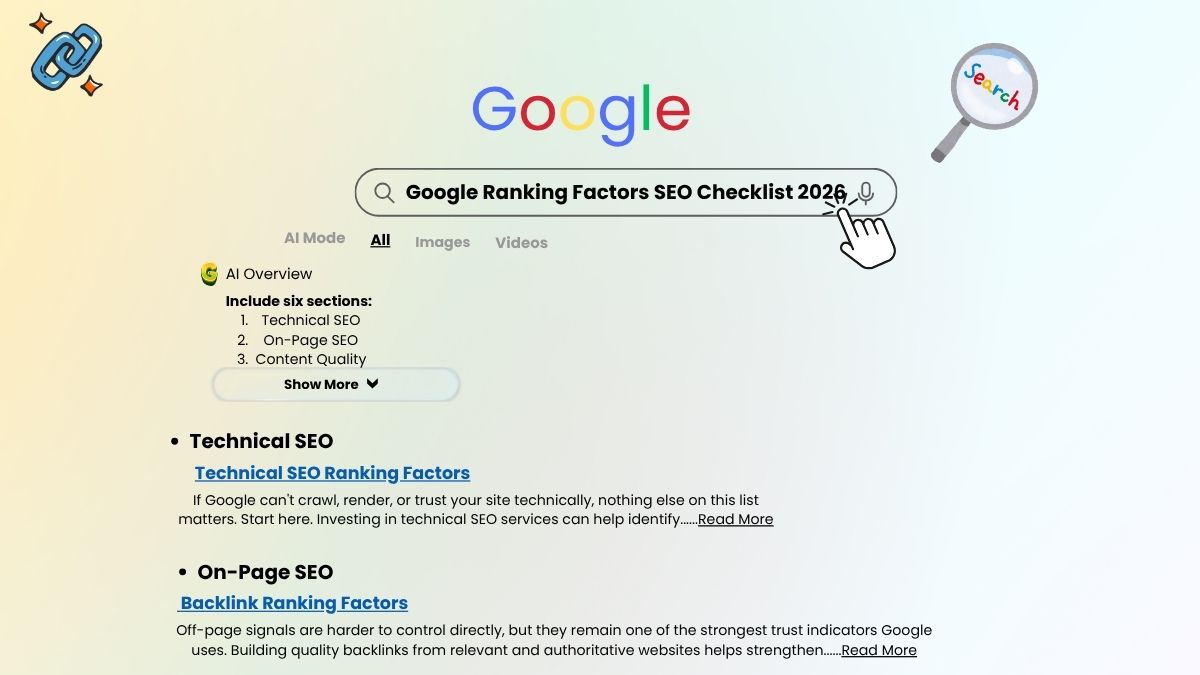
Google ranking factors seo checklist requests usually return one of two things: an outdated list from 2019, or a 4,000-word essay that never tells you what to actually do. Neither helps when you’re staring at a site that isn’t ranking and need to know what’s broken.
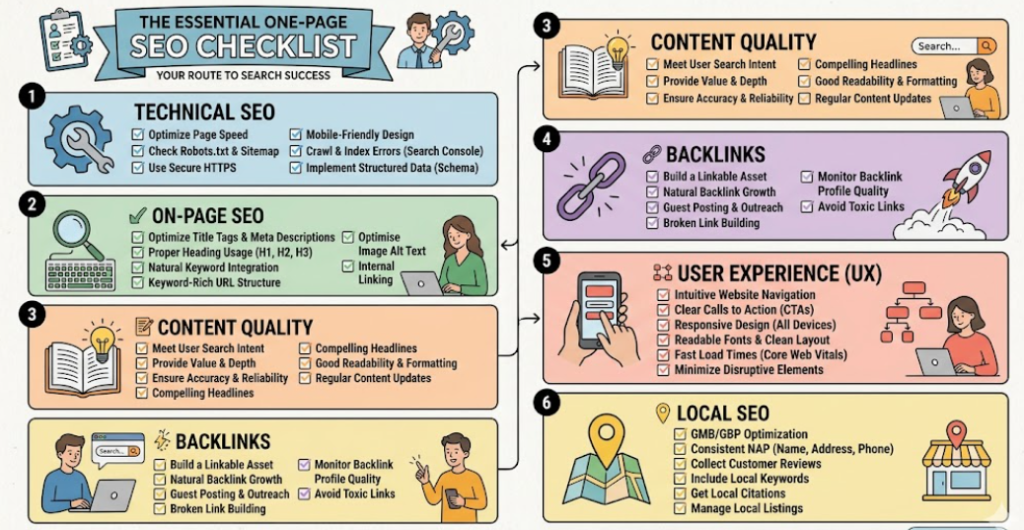
Google uses hundreds of signals to decide where a page lands in search results. But almost all of them cluster into six categories you can actually check, one by one. This guide is built as a checklist, not a theory lesson, so you can go through your own site section by section and mark what’s missing.
By the end, you’ll have audited your site against every major ranking factor Google currently weighs — technical, on-page, content, off-page, UX, and (if relevant) local and entity signals.
Why a Checklist Format Works Better Than a Theory List
Most “ranking factors” content describes what Google looks at without telling you whether your site has it. That’s fine for understanding SEO in the abstract. It’s useless when you’re trying to fix a page that dropped in rankings last month.
This guide flips that. Every item below is a yes/no check. Either your site has it, or it doesn’t — and if it doesn’t, that’s your next task.
One thing ties almost everything together: Google’s E-E-A-T framework (Experience, Expertise, Authoritativeness, Trust) and the Helpful Content System. These aren’t separate ranking factors sitting alongside the others — they’re the lens Google’s systems use to evaluate nearly everything on this list, from content quality to backlink relevance.
Category 1: Technical SEO Ranking Factors
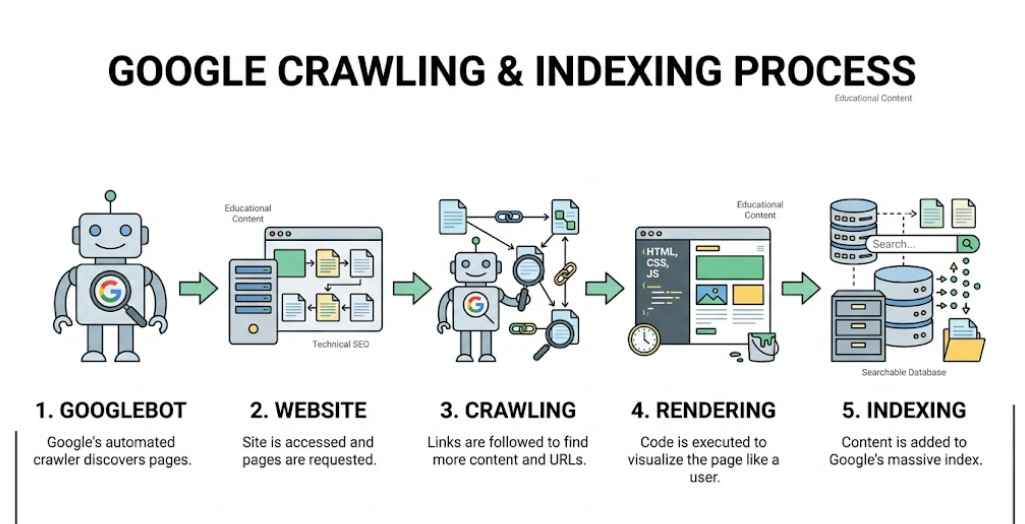
If Google can’t crawl, render, or trust your site technically, nothing else on this list matters. Start here. Investing in technical SEO services can help identify crawlability issues, improve site performance, and ensure search engines can properly access and understand your content.
☐ Site is crawlable — no important pages or resources blocked in robots.txt. Google can’t rank what it can’t access.
☐ XML sitemap submitted and up to date — this helps Google discover new and updated pages faster, especially on larger sites.
☐ HTTPS/SSL enabled sitewide — this has been a baseline trust and ranking signal for years; sites without it are flagged as “Not Secure” in browsers.
☐ Core Web Vitals pass — LCP (loading speed), INP (responsiveness), and CLS (visual stability) all need to hit “good” thresholds for at least 75% of real visitors, measured in the 75th percentile of Chrome User Experience Report data.
☐ Mobile-friendly / responsive design — Google uses mobile-first indexing, meaning the mobile version of your site is what gets evaluated and ranked, not the desktop version.
☐ No duplicate content / proper canonical tags — duplicate or near-duplicate pages confuse Google about which version to rank, often diluting both.
☐ Clean URL structure — short, descriptive, keyword-relevant URLs are easier for both users and crawlers to understand.
☐ No broken internal links or redirect chains — broken links waste crawl budget and create dead ends for both users and bots.
Category 2: On-Page SEO Ranking Factors
These are the signals tied directly to a specific page’s content and structure — the things you control every time you publish.
☐ Focus keyword in title tag — still one of the clearest relevance signals you can send.
☐ Focus keyword in the first 100 words — confirms topical relevance early, both for users skimming and for crawlers parsing the page.
☐ Keyword in at least one H2/H3 — reinforces topic structure without forcing it into every heading.
☐ Meta description written for CTR — this doesn’t directly boost rankings, but a compelling description increases click-through rate, which correlates with better performance.
☐ Image alt text present and descriptive — supports accessibility and gives Google additional context about page content.
☐ Internal linking to relevant pages — helps distribute authority across your site and helps Google understand site structure.
☐ Content matches search intent — informational, transactional, or navigational. Ranking for a keyword means nothing if your content type doesn’t match what searchers actually want.
☐ Schema markup implemented where relevant — structured data helps Google understand content type and can unlock rich results like FAQ snippets or review stars.
Category 3: Content Quality Ranking Factors
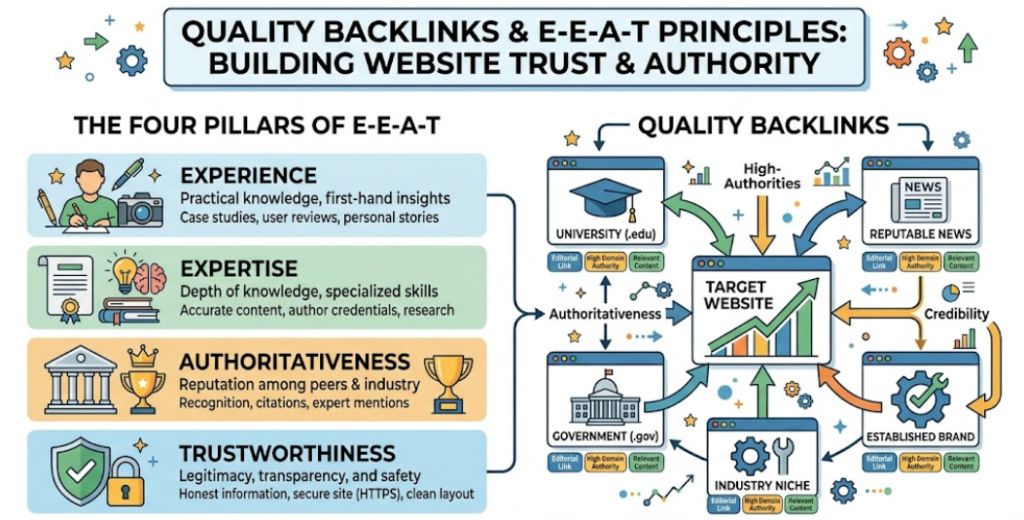
This is the category Google has invested the most in over the past few years, especially since the rollout of the Helpful Content System. Much of what Google considers high-quality content aligns with the principles outlined in the Google Search Quality Rater Guidelines, which emphasize Experience, Expertise, Authoritativeness, and Trust (E-E-A-T) when evaluating content quality.
☐ Content demonstrates E-E-A-T — real experience, subject-matter expertise, authority in the space, and trustworthy presentation.
☐ Content is more comprehensive than top-ranking competitors — not longer for the sake of length, but covering gaps competitors leave open.
☐ Content is original — not rewritten, spun, or lightly reworded from existing sources.
☐ Author bio / byline present — a named, credentialed author signals real expertise behind the content, which matters more under E-E-A-T.
☐ Content is kept updated — a visible “last updated” date, paired with actually refreshed information, signals ongoing maintenance rather than a stale, abandoned page.
☐ No low-value AI-generated content — Google’s Helpful Content System doesn’t penalize AI-assisted writing specifically; it penalizes content that lacks genuine value or originality, regardless of how it was produced.
This entire category maps closely to Google’s Search Quality Rater Guidelines, the document human evaluators use to assess page quality. While quality raters don’t directly affect rankings, the guidelines reveal exactly what Google’s algorithms are trained to detect.
Category 4: Off-Page / Backlink Ranking Factors
Off-page signals are harder to control directly, but they remain one of the strongest trust indicators Google uses. Building quality backlinks from relevant and authoritative websites helps strengthen your site’s credibility, improve rankings, and establish long-term trust with search engines.
☐ Referring domains from topically relevant sites — a link from a site in your niche carries more weight than a generic, unrelated one.
☐ Natural anchor text distribution — a healthy backlink profile has varied anchor text; over-optimized exact-match anchors across many links looks manipulative.
☐ No spammy or toxic backlinks — links from link farms, PBNs, or clearly low-quality sites can drag down trust signals.
☐ Link velocity looks natural — backlinks acquired gradually over time read as organic; sudden, unexplained spikes can trigger scrutiny.
☐ Brand mentions across the web — unlinked mentions of your brand name still contribute to Google’s understanding of your entity and reputation, even without a clickable link.
Worth flagging: an unnatural spike in backlinks — even ones that look “good” on the surface — can suppress rankings rather than help them, if the pattern looks artificial to Google’s spam systems. We’ll cover what that recovery process looks like in a separate guide on backlink audits and disavow strategy.
Category 5: User Experience (UX) Ranking Factors
Google increasingly uses real-world user behavior signals to validate whether a page actually satisfies the query it ranks for.
☐ Low bounce rate / high dwell time — visitors staying and engaging signals the page delivered on its promise.
☐ Easy navigation and clear site structure — users (and crawlers) should be able to find related content without friction.
☐ No intrusive interstitials or pop-ups — especially on mobile, where aggressive pop-ups can directly hurt rankings under Google’s intrusive interstitial guidelines.
☐ Fast page load speed — overlaps with Core Web Vitals, but worth checking independently across your most important pages.
☐ Accessible design — readable font sizes, sufficient color contrast, and clear visual hierarchy benefit all users, not just those using assistive technology.
Category 6: Local & Entity-Based Ranking Factors
If you’re a local or service-area business, this category matters as much as anything above.
☐ Google Business Profile optimized — complete categories, accurate hours, photos, and regular updates all factor into local pack visibility.
☐ NAP consistency — Name, Address, and Phone number need to match exactly across your site, directories, and citations.
☐ Entity clarity — structured data (like Organization or LocalBusiness schema) helps Google clearly understand who you are and what you offer.
☐ Topical authority — content organized into clear topic clusters, rather than scattered across unrelated subjects, helps establish your site as an authority in its niche.
The Complete Checklist: Quick Reference
Save or screenshot this section for a fast self-audit.
Technical: Crawlable • Sitemap submitted • HTTPS sitewide • Core Web Vitals pass • Mobile-friendly • No duplicate content • Clean URLs • No broken links/redirects
On-Page: Keyword in title • Keyword in first 100 words • Keyword in H2/H3 • CTR-optimized meta description • Descriptive alt text • Internal linking • Matches search intent • Schema markup
Content Quality: Demonstrates E-E-A-T • More comprehensive than competitors • Original content • Author bio present • Regularly updated • No low-value AI content
Off-Page: Topically relevant referring domains • Natural anchor text • No toxic backlinks • Natural link velocity • Brand mentions present
UX: Low bounce / high dwell time • Easy navigation • No intrusive pop-ups • Fast load speed • Accessible design
Local & Entity: Google Business Profile optimized • NAP consistency • Entity clarity via schema • Topical authority
How Many of These Factors Do You Actually Need?
You don’t need a perfect score across all 30+ items to rank. Realistically, no page does — not even the ones sitting at position one.
What matters more is prioritization. Technical SEO and content quality form the foundation; if either is broken, everything built on top of it underperforms. On-page factors are quick wins that compound once the foundation is solid. Off-page, UX, and local/entity signals tend to matter most at the margins, separating similarly strong pages from each other.
A practical order: fix Category 1 (technical) and Category 3 (content quality) first. Then move to Category 2 (on-page), and treat Categories 4 through 6 as ongoing, ranking pages from “good” to “competitive.”
Common Mistakes That Tank Multiple Ranking Factors at Once
Some mistakes don’t just hurt one category — they cascade across several at once.
Sudden unnatural backlink spikes. A burst of new links in a short window — especially from low-relevance or low-quality sites — can simultaneously hurt your off-page trust signals and trigger broader scrutiny of the entire site. Recovery from this usually requires a structured audit and, in some cases, a disavow process.
Thin or duplicate content across many pages. This hits Category 1 (duplicate content) and Category 3 (content quality) simultaneously, and on larger sites it can suppress rankings sitewide, not just on the affected pages.
Ignoring mobile experience. Since Google evaluates mobile-first, a site that’s polished on desktop but broken on mobile is effectively showing Google its worst version.
Over-optimized anchor text. Exact-match anchors used too consistently across your backlink profile is one of the more obvious manipulative-link patterns Google’s spam systems are built to catch.
FAQ Section
What are the top 3 Google ranking factors in 2026?
Content quality and relevance (tied to E-E-A-T), technical health (crawlability, Core Web Vitals, mobile-friendliness), and backlink quality remain the three foundational pillars. Google doesn’t rank by a single formula, but pages weak in any of these three rarely outrank well-rounded competitors.
Does Google still use backlinks as a ranking factor?
Yes. Backlinks remain a significant trust and authority signal, though quality and relevance now matter far more than raw quantity. A handful of links from topically relevant, authoritative sites typically outperforms a large volume of generic or low-quality links.
How often does Google update its ranking algorithm?
Google rolls out thousands of small changes per year, plus several named “core updates” that can meaningfully shift rankings. Staying informed about major Google algorithm updates can help website owners understand ranking fluctuations and adapt their SEO strategies accordingly.
Can a site rank well with weak backlinks but strong content?
Yes, particularly for less competitive keywords with lower search volume. For competitive terms, strong content alone often isn’t enough — some level of topical authority and backlink trust is usually still required to compete.
What is the fastest ranking factor to fix?
On-page factors like title tags, meta descriptions, and header structure are typically the fastest to fix and can show movement within days to weeks. Technical and content-quality fixes take longer but tend to have a bigger overall impact.
Conclusion
Ranking well in Google was never about nailing one factor — it’s about compounding signals across all six categories above. A technically perfect site with thin content won’t outrank a comprehensive one, and brilliant content sitting behind broken technical SEO may never get the chance to be seen.
Run this checklist against your own site, category by category, and you’ll know exactly where your gaps are. For most sites, the hardest category to fix without dedicated expertise is off-page SEO and backlinks. Building topically relevant, natural-looking links at scale takes time most teams don’t have. If you’re planning a long-term SEO strategy, reviewing different SEO pricing plans can help you understand the level of investment needed to compete effectively in your niche.

I am a dedicated SEO Expert and Content Specialist with a passion for driving organic growth. With a deep understanding of link building, domain metrics, and on-page optimization, I help brands bridge the gap between technical search requirements and engaging user experiences. Whether it’s crafting SEO-optimized articles or managing complex backlink strategies, my goal is always the same: sustainable, high-ranking results.