
White hat link building techniques is the only link building strategy that produces rankings you can actually keep.
White hat link building is the opposite of that. It is slower, yes. But the results compound over time and the rankings stick. At RankWithLinks, every backlink we build for clients uses white hat methods exclusively. These are the exact techniques we use — ranked from easiest to most advanced.
I have been doing link building for over six years. And in that time, I have watched hundreds of websites get penalized, deindexed, or wiped out overnight — not because their content was bad, but because they took shortcuts with their backlinks.
If you are tired of hearing about link building in theory and want to know what actually works in 2026, this guide is for you.
What You Will Learn
- What white hat link building actually means
- Why it still matters in 2026 despite all the algorithm changes
- 15 specific techniques with step-by-step instructions
- Real tips from our experience running a link building agency
- What to avoid so you never risk a Google penalty
What Is White Hat Link Building?
White hat link building means earning backlinks through legitimate, Google-approved methods. You create real value for real websites, and they link to you because your content genuinely deserves it.
It is the opposite of buying links, using private blog networks, or any other manipulation that violates Google’s guidelines.
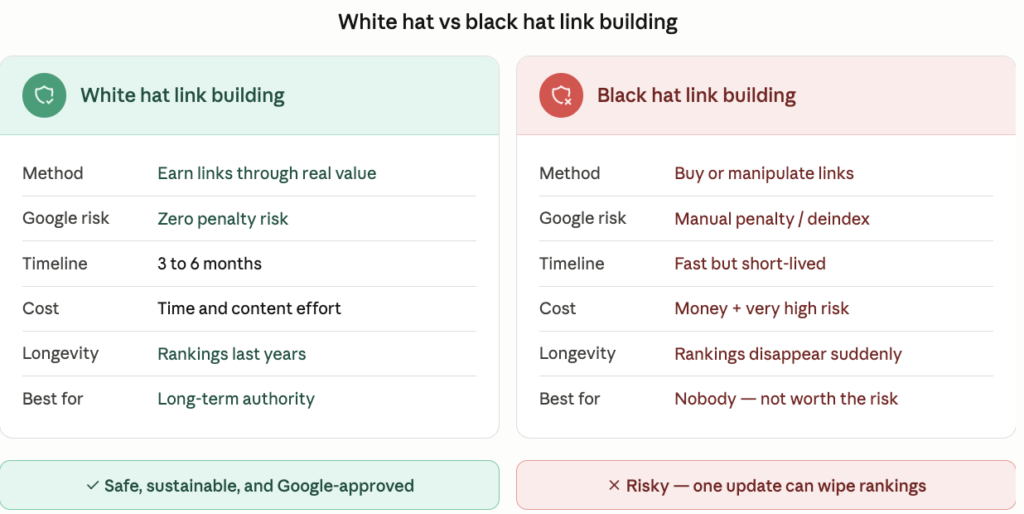
Here is a quick comparison so you can see exactly why white hat is the only approach worth using in 2026:
| Factor | White Hat Link Building | Black Hat Link Building |
|---|---|---|
| Method | Earn links through value | Buy or manipulate links |
| Google penalty risk | Zero | High — manual action possible |
| Timeline | 3 to 6 months | Fast but short-lived |
| Cost | Time and content effort | Money, but very high risk |
| Longevity | Rankings last years | Rankings disappear suddenly |
| Best for | Long-term authority building | Nobody — not worth the risk |
The bottom line: black hat link building is a loan you will have to pay back with interest. White hat link building is an investment that keeps paying you.
Why White Hat Link Building Still Works in 2026
A lot of people ask whether link building is still relevant after all of Google’s recent updates.
The answer is yes — but with an important shift.
Google’s core updates in 2024 and 2025 aggressively targeted manipulative link schemes. Sites using PBNs, paid link networks, and spammy directories saw dramatic ranking drops. But sites with genuine editorial backlinks from relevant, real websites saw their positions hold or improve.
Google’s own documentation still lists links as one of the top three ranking signals. The difference in 2026 is that quality matters far more than quantity. One editorial backlink from a DR 65 blog in your niche is worth more than fifty links from irrelevant directories.
White hat link building is not just safer — it is now the only strategy that produces consistent, long-term results.
15 White Hat Link Building Techniques That Actually Work
Below are the exact white hat link building strategies we use at RankWithLinks. Start with the ones marked Beginner if you are just getting started. Move to the Intermediate and Advanced techniques as your site gains authority.
1. Guest Posting on Relevant Blogs
Difficulty: Beginner to Intermediate
You write a high-quality article for another website in your niche. In exchange, they publish it with a backlink to your site inside the content body — not just the author bio.
What makes it white hat: The link is editorial, relevant, placed inside real content on a real website.
How to find guest post opportunities:
Search Google for your niche plus “write for us” or your niche plus “guest post guidelines.” Check that the site has real organic traffic — DR alone is not enough. A DR 50 site with zero traffic gives you almost no value.
Target DR 40 and above using Ahrefs free DR checker.
Pitch tip from our experience: Send three specific article title ideas, not a generic “I want to write for your blog” email. Specific pitches get three times more responses. Explain why each topic is a gap in their existing content.
What to avoid: Do not guest post on sites that publish anything from anyone with no editorial standards. Google can identify link schemes disguised as guest posting, and those links can actually hurt you.
Internal link: If you want us to do guest posting for your site, see our guest posting service.
2. Link Insertion and Niche Edits
Difficulty: Beginner
Link insertion means finding existing articles on real websites that are already ranking on Google, then reaching out to ask the site owner to add your link to that existing content where it genuinely adds value.
Why this is so powerful: the page is already indexed, already trusted by Google, and already getting traffic. Your link inherits that existing authority immediately rather than waiting for a new page to build authority from scratch.
How to do it:
Find relevant articles ranking on page one for keywords related to your content. Check that the article has a genuine gap your page fills. Send a short, personalized email explaining exactly where your link fits and why it helps their readers.
Our experience: link insertion outreach converts at 15 to 25% when the placement is genuinely relevant. When it feels forced or self-serving, conversion drops to near zero. Relevance is everything.
Internal link: See our link insertion service if you want this done for your site.
3. The Skyscraper Technique
Difficulty: Intermediate
Find a piece of content in your niche that has earned many backlinks. Create a significantly better, more up-to-date, and more comprehensive version. Then reach out to every site that linked to the original and let them know yours exists.
Step by step:
Use Ahrefs Site Explorer to find a competitor page with 20 or more referring domains. Analyze every section. Note what they missed, what is outdated, what questions they did not fully answer. Build a version that is clearly superior — better structure, more depth, updated data, cleaner visuals.
Export the backlink list from Ahrefs. Send personalized outreach to each linking site explaining specifically what makes your version better.
Reality check: This technique requires genuine content investment. If your version is not significantly better, outreach will fail completely. The content quality is 80% of the work. The outreach is only 20%.
4. HARO and Journalist Outreach
Difficulty: Beginner
Cost: Free
Journalists and bloggers post requests for expert sources on specific topics. You reply with a useful, quotable insight. They include your name, expertise, and a link in their published article.
Best platforms in 2026:
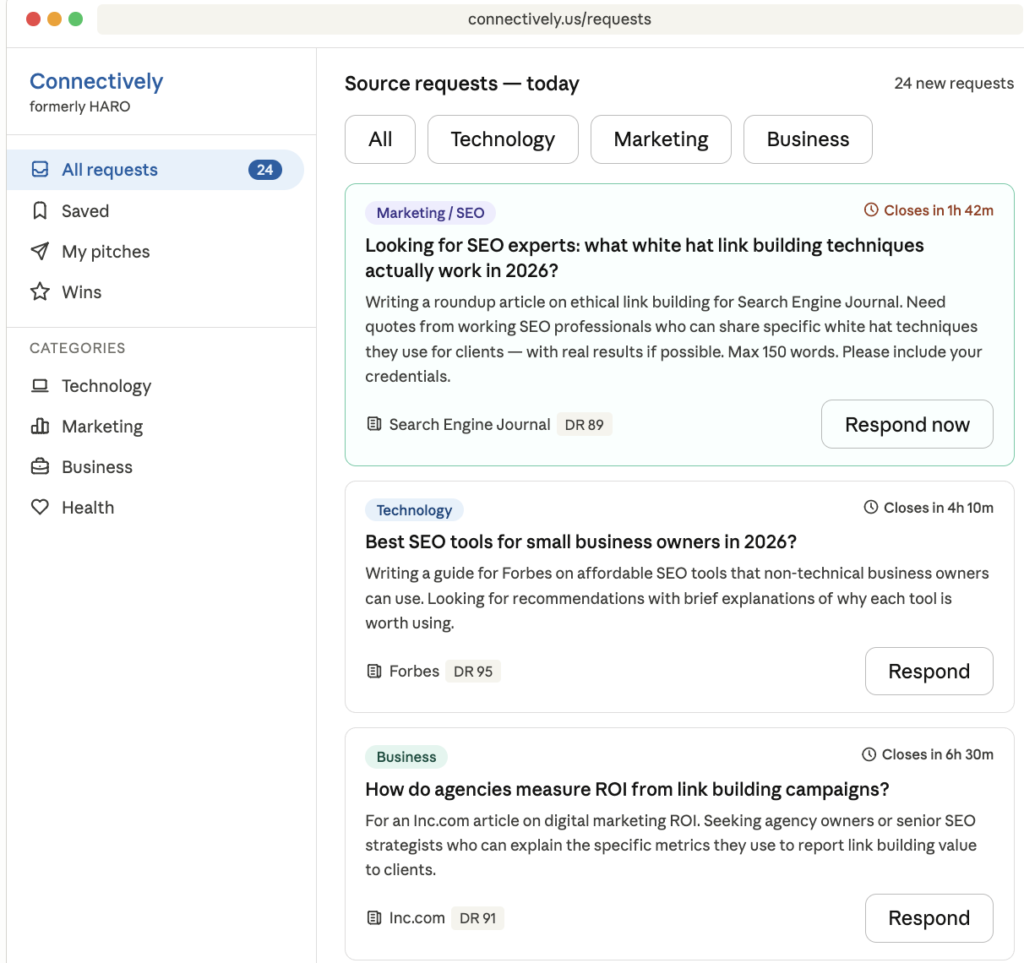
Connectively (formerly HARO), Featured.com, Qwoted, SourceBottle, and Terkel are all active in 2026.
How to get accepted:
Reply within two hours of the request going out — speed is critical. Keep responses under 150 words and make them direct and quotable. Lead with your credentials: “As an SEO agency owner with six years of experience building backlinks across 30+ niches…” Do not pitch your services. Just answer the question well.
Our results: We respond to three to five requests per week at RankWithLinks. A good month produces four to six DR 70 plus backlinks with zero cost except time. Some of the best links we have ever earned came from HARO — publications that would never accept a cold guest post pitch regularly quote sources from journalist outreach platforms.
5. Broken Link Building
Difficulty: Intermediate
Find links on other websites that are broken — pointing to 404 pages that no longer exist. Contact the site owner, tell them about the broken link, and suggest your relevant content as a replacement.
How to find broken links:
Use Ahrefs Content Explorer to search for broken pages with backlinks in your niche. Use the Check My Links Chrome extension while browsing any page in your niche. Use Screaming Frog to crawl a competitor’s outbound links and filter by 4xx status codes.
Outreach approach:
Lead with the favor. “I was reading your article on [topic] and noticed one of your links is returning a 404 error.” Then suggest your page as a replacement only if it is genuinely relevant to what the broken link was pointing to.
Why it works: You are helping the site owner fix a real problem before asking for anything. That framing makes the link request feel natural and low-pressure.
6. Resource Page Link Building
Difficulty: Beginner
Many websites maintain resource pages — curated lists of useful tools, guides, or services in their niche. Getting listed on these pages earns you a clean editorial backlink that looks completely natural to Google.
How to find resource pages:
Search Google for your niche plus “useful resources” or your niche plus “recommended tools” or your niche plus “best blogs” or your niche plus inurl:resources.
Pitch approach:
Short email. Explain why your page genuinely belongs on their list and what value it adds to their readers. Resource page owners get these requests regularly and appreciate directness over a lengthy pitch.
7. Create Linkable Assets
Difficulty: Advanced
Timeline: 1 to 3 months to create, then links come in passively
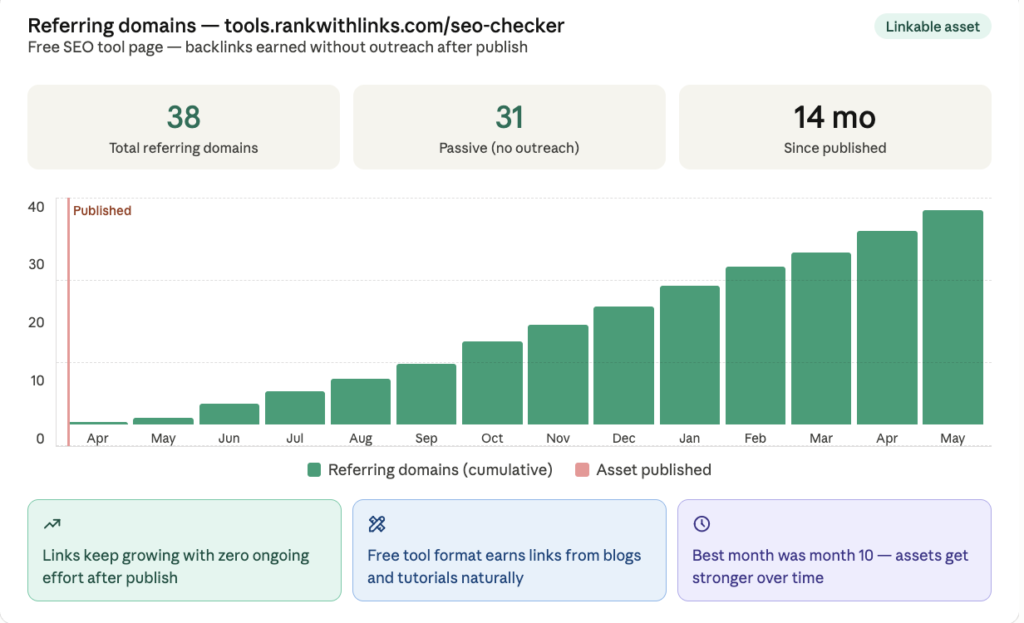
Linkable assets are pieces of content so genuinely valuable that other sites link to them without being asked. This is the most sustainable white hat link building strategy that exists.
Types of linkable assets that earn links naturally:
Original industry surveys and data studies, free tools and calculators, comprehensive original statistics pages, detailed infographics with data nobody else has published, and ultimate guides that become the definitive resource on a topic.
Our example: We built a free SEO tool on tools.rankwithlinks.com. That single asset has earned passive backlinks from 30 plus sites because it is genuinely useful. No outreach required — people find it, use it, and link to it.
The compounding effect of linkable assets is why advanced SEO agencies invest heavily in them. A good piece of original research can earn links for three to five years after it is published.
8. Podcast Guest Appearances
Difficulty: Beginner to Intermediate
Appear as a guest on podcasts in your niche. Show notes almost always include a link to your website. Podcast backlinks tend to come from real, high-DR domains and are completely natural — Google never penalizes them.
How to find podcasts to pitch:
Search Spotify or Apple Podcasts for your niche keywords. Look for shows with regular guest episodes. Use ListenNotes.com to filter by niche and episode frequency.
Pitch approach:
Short email explaining who you are, what specific value you bring to their audience, and two or three concrete topic ideas. Podcast hosts are looking for guests who will be interesting to their audience — not guests who want to pitch their services.
Bonus benefit: Podcast appearances build your personal E-E-A-T signals alongside the backlink. They establish you as a recognized voice in your niche, which matters more and more as Google evaluates author authority in 2026.
9. Unlinked Brand Mention Reclamation
Difficulty: Beginner
Conversion rate: High
Other websites have already mentioned your brand name, your product, or your content without linking to you. These are the easiest links you will ever earn — you just need to ask.
How to find unlinked mentions:
Set up Google Alerts for your brand name. Use Ahrefs Content Explorer and search your brand name, then filter to show pages with no link to your site. Use Brand24 or Mention.com for ongoing monitoring.
Outreach message:
Keep it short and friendly. “Hi, I noticed you mentioned RankWithLinks in your article — thank you for that! Would you mind adding a link so your readers can find us easily?” That is genuinely all it needs to be.
From our experience: unlinked mention outreach converts at 30 to 40 percent — much higher than cold guest post pitches. These sites already know who you are. The link request feels natural because it is natural.
10. Internal Link Building
Difficulty: Beginner
Cost: Zero
Most people treat internal links as an afterthought. This is a mistake. Internal links from your own existing pages pass authority between your pages and help Google understand which pages on your site are most important.
Every new page you publish should receive links from at least three existing pages on your site. Use keyword-rich anchor text in those internal links. The anchor text tells Google what the linked page is about.
How to find internal linking opportunities:
In Google Search Console, check which existing pages rank for keywords related to your new page. Link from those pages to your new page. Use Screaming Frog to find orphan pages — pages with no internal links pointing to them — and fix them.
Internal links are a white hat technique that costs nothing and takes thirty minutes per new article. The SEO value is consistently underestimated.
11. Competitor Backlink Replication
Difficulty: Intermediate
Find out exactly where your competitors are getting backlinks. Go after the same sources.
How to do it with Ahrefs:
Open Site Explorer and enter a competitor URL. Click Referring Domains. Filter by DR 40 to 80 and dofollow links only. Look for patterns — are they getting links from guest posts on specific blogs? Resource pages in your niche? Industry directories?
Target those same sites with your own outreach. Someone already validated that these sites give links in your niche. You are not guessing, you are following a proven map.
This is one of the most time-efficient white hat strategies because all the research has already been done by your competitors. You are just following their trail.
12. Digital PR and Newsjacking
Difficulty: Advanced
Create content tied to breaking news or trends in your industry. Pitch it to journalists covering that topic. When they publish, they link to your data or analysis.
Works best for: agencies, SaaS companies, or anyone with original data or a genuinely unique perspective on industry developments.
Example from our niche: When Google releases a major algorithm update, publishing a fast analysis piece with original ranking data and pitching it to Search Engine Journal, Moz, or Search Engine Land gives you a real shot at a high-DR editorial link. Journalists covering that story need sources. Be the source.
Speed is critical in newsjacking. Publish within 24 hours of the news breaking. Pitches sent three days later go to journalists who have already filed their stories.
13. Testimonials and Case Studies
Difficulty: Beginner
Write genuine testimonials for tools and services you actually use. Many companies display these testimonials on their website with a link back to the reviewer.
How to execute:
Make a list of every tool or service you currently use in your business. Check their website to see if they have a testimonials page or case study section. Reach out and offer a detailed testimonial or agree to be featured in a case study.
At RankWithLinks we use tools like Ahrefs, Screaming Frog, and various outreach platforms. Detailed, genuine testimonials on those sites produce backlinks that are completely natural and require zero ongoing effort.
14. Forum and Community Participation
Difficulty: Beginner
Participate genuinely in niche communities — Reddit, Quora, Facebook groups, Slack communities, and industry forums. Over time, links from these platforms contribute to your overall link profile diversity.
Important distinction: this is about genuine participation, not spam. Dropping links in every post will get you banned and flagged. Providing real value for months, then occasionally mentioning your content when it is directly relevant, is what works.
Reddit links are nofollow but drive real traffic and build real brand awareness. Quora answers rank independently on Google and bring passive traffic for years.
15. Scholarship and Educational Link Building
Difficulty: Intermediate
Create a scholarship for students in your industry. Promote it to university and college financial aid pages. These .edu backlinks are among the most authoritative you can earn.
How it works:
Set up a simple scholarship page on your website. Offer a modest award — even a few hundred dollars is enough to get listed. Reach out to university financial aid offices and scholarship listing pages asking them to list your opportunity.
Educational institution links are white hat, natural, and have high DR consistently. They are also long-lasting — universities update scholarship pages rarely, so your link stays up for years.
Pros and Cons of White Hat Link Building
| Factor | Pros | Cons |
|---|---|---|
| Safety | Zero Google penalty risk | Requires patience |
| Cost | Many techniques are free | Time investment is high |
| Longevity | Rankings last years | Results take 3 to 6 months |
| Scalability | Can scale with systems | Harder to scale than paid links |
| Quality | High-authority editorial links | Harder to get than buying links |
| Brand benefit | Builds real authority and reputation | No shortcut option |
White Hat Link Building Checklist
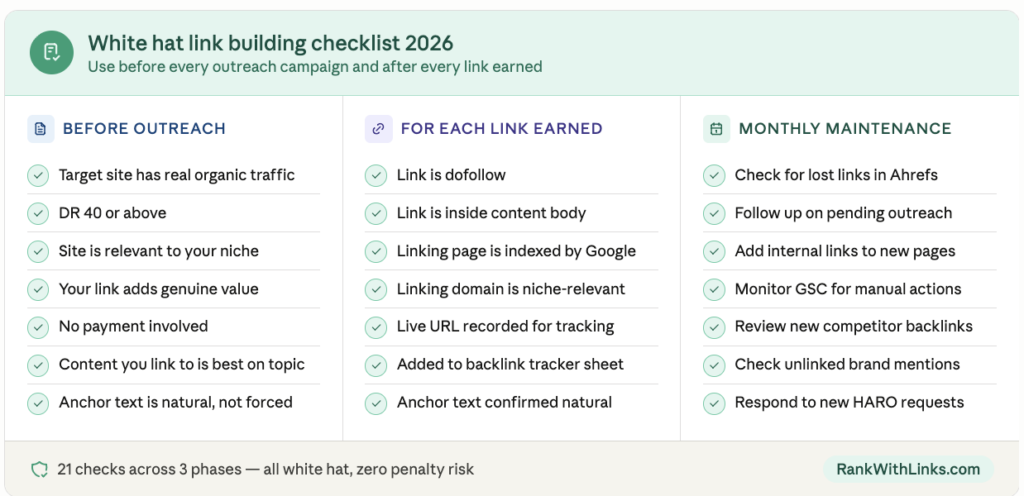
Before starting any outreach:
- Target site has real organic traffic, not just high DR
- Your link genuinely adds value to their readers
- The content you are linking to is the best available on that topic
- Anchor text is natural and keyword-relevant
- You are not paying for the link directly
For each link earned:
- Link is dofollow and inside the content body
- The linking page is indexed by Google
- The linking domain is relevant to your niche
- You have a record of the live URL for tracking
Monthly maintenance:
- Check for lost backlinks in Ahrefs
- Follow up on pending outreach
- Add new internal links to your most recent pages
- Monitor Google Search Console for any manual action warnings
Frequently Asked Questions
What is the difference between white hat and black hat link building?
White hat link building earns links through genuine value — guest posts, original research, outreach to relevant sites. Black hat link building manipulates links through buying, private blog networks, or automated schemes. White hat carries zero penalty risk. Black hat can result in manual actions from Google that are extremely difficult to recover from.
How many white hat backlinks do I need to rank on page one?
It depends entirely on your niche and the competition for your target keyword. In low-competition niches, ten to twenty quality backlinks can put you on page one. In highly competitive niches like finance or SaaS, you may need hundreds of referring domains. The best approach is to check how many referring domains the current top-ranking pages have and target a similar number with higher-quality links.
How long does white hat link building take to show results?
Most white hat link building campaigns show measurable ranking improvements within two to four months. New pages on new websites may take six months or longer. The timeline depends on your site’s existing authority, how competitive your target keywords are, and the quality and relevance of the links you build.
Is guest posting still a white hat technique in 2026?
Yes, when done correctly. Guest posting on real blogs with real audiences and editorial standards is completely white hat. The problem Google has targeted is large-scale guest posting purely for links on sites that exist only to sell guest posts. Writing genuinely useful content for real publications in your niche is still one of the most effective link building strategies available.
Can I do white hat link building myself or do I need an agency?
You can absolutely do it yourself, especially techniques like HARO, unlinked mention reclamation, internal linking, and resource page outreach. These require no budget, just time. For more scalable approaches like guest posting campaigns or link insertion at volume, an agency can speed up results significantly because they already have relationships with site owners.
How do I know if a backlink is white hat?
Ask these questions: Did you earn the link through value rather than payment? Is the linking site real with real traffic and real editorial standards? Is your link placed naturally inside relevant content? Is the anchor text natural and not over-optimized? If yes to all four, the link is white hat.
Conclusion
White hat link building is not the fastest path to rankings. But it is the only path that does not eventually blow up in your face.
The fifteen techniques in this guide are exactly what we use at RankWithLinks for our own site and for every client we work with. Some of them — like HARO, unlinked mentions, and internal linking — you can start today at zero cost. Others — like original research and digital PR — take more investment but produce links that competitors cannot replicate easily.
Start with two or three techniques. Build a consistent outreach system around them. Add more techniques as you scale.
If you want our team to handle white hat link building for your site, our link building service covers guest posting, link insertion, and niche-relevant outreach — all fully white hat with full reporting. And if you want to know exactly which links your site needs, our SEO audit service identifies your biggest link gap opportunities within 48 hours.
Build links the right way. The rankings will follow.

Fazilat zulfiqar is an SEO specialist at RankWithLinks, focused on improving search rankings through smart link building and optimization.He helps businesses grow organic traffic and build strong online authority.