

Most guest post pitches fail not because the content is bad — but because the outreach is blind. Using SERP insights before you pitch changes everything. Here’s exactly how to do it, with real tactics I’ve tested across dozens of campaigns
What Is a SERP Insight Guest Post?
A SERP insight guest post is a guest article strategy where you use search engine results page (SERP) data to select target sites, choose the right topic angle, and build links that actually move rankings.
Instead of guessing which blogs accept guest posts, you let the SERP tell you. You look at who is already ranking for your target keywords, identify which of those sites accept contributor content, and pitch angles that fill gaps in the existing content.
I’ve seen SEOs spend weeks chasing links from sites that had zero relevance — sites that looked good on paper but meant nothing to Google for their niche. SERP-driven guest posting kills that problem at the root.
Quick Definition: SERP insight guest posting = using keyword ranking data + competitor backlink analysis + content gap research to place authoritative articles on sites that already rank in your niche.
72%of SEOs say topical relevance outweighs DA in link value
3.8×more ranking lift from contextual vs. sidebar guest post links
60%of outreach emails never get a reply — bad targeting is the #1 cause
Why SERP Data Makes Guest Posts More Powerful
Here is the uncomfortable truth: most link builders treat guest posting like a numbers game. More pitches, more links. But the quality of where you’re pitching matters far more than volume.
When a site already ranks for your target keyword cluster — or for closely related terms — Google has signaled that it trusts that site’s authority in that space. A backlink from that site is not just a vote. It’s a vote from someone the judge already respects.
SERP data gives you three unfair advantages:
1. You Know the Site Has Topical Authority
If a site ranks on page one for keywords in your niche, Google already sees it as relevant. A link from that domain carries topical signals, not just domain authority metrics.
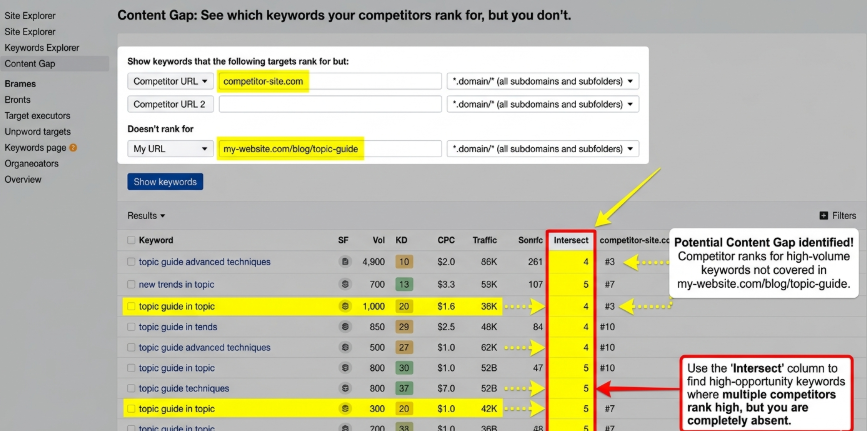
2. You Can See What Content Is Missing
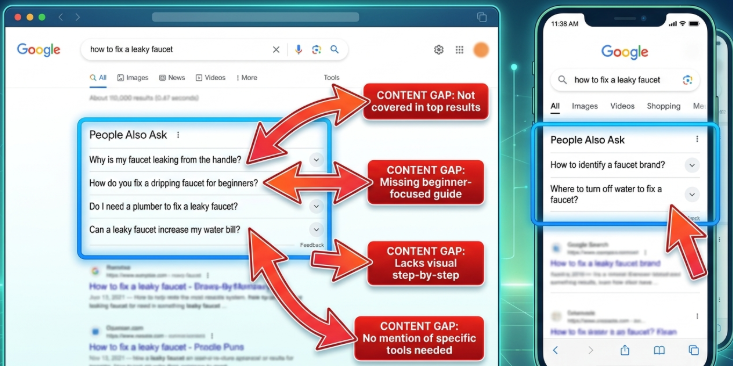
Look at the top 10 results for a keyword. What angle hasn’t been covered? What question keeps showing up in “People Also Ask” but isn’t answered well? That’s your guest post pitch. You’re not guessing — the SERP is telling you what to write.
3. You Know the Audience Already Searches for Your Topic
Sites that rank for your keywords already attract your target readers. Your guest post lands in front of people who are actively looking for what you offer. That’s referral traffic that converts.
Step-by-Step: The SERP Insight Guest Post Framework
This is the exact process I use. It takes more upfront work than mass outreach, but the acceptance rate is dramatically higher — and the links actually move the needle.
Step 1 — Build Your Target Keyword List
Start with 10–20 keywords that matter to your site. Not just your primary keywords — include long-tail variants and related semantic terms. Use a tool like Ahrefs, Semrush, or even Google Search Console if you’re on a budget.
Filter by keywords where you’re on page 2 or 3. These are your “promotion zone” terms — pages that just need a few authoritative links to break through to page one.
Step 2 — Run the SERP for Each Keyword
For each keyword, manually look at the top 10–15 results. Note every domain. You are building a shortlist of sites that Google trusts for this topic.
Step 3 — Filter for Guest Post Opportunities
Now cross-reference your SERP list with sites that accept guest contributions. Use these Google search operators to find them fast:
site:domain.com "write for us"site:domain.com "guest post"site:domain.com "contributor guidelines"
Pro tip: Also search "[keyword]" + "by [author name]" across multiple posts — if a site has bylined contributors who aren’t staff, they almost certainly accept pitches.
Step 4 — Analyze Content Gaps on the Target Site
Before pitching, check what the site has already published on your topic. Use site:targetdomain.com [your keyword] to see existing coverage. Your pitch should NOT duplicate what’s already there.
Look at their SERP rankings too. If a site ranks #5 for “best project management tools” but has no article on “project management for remote teams,” that’s your angle.
Step 5 — Create a SERP-Informed Pitch
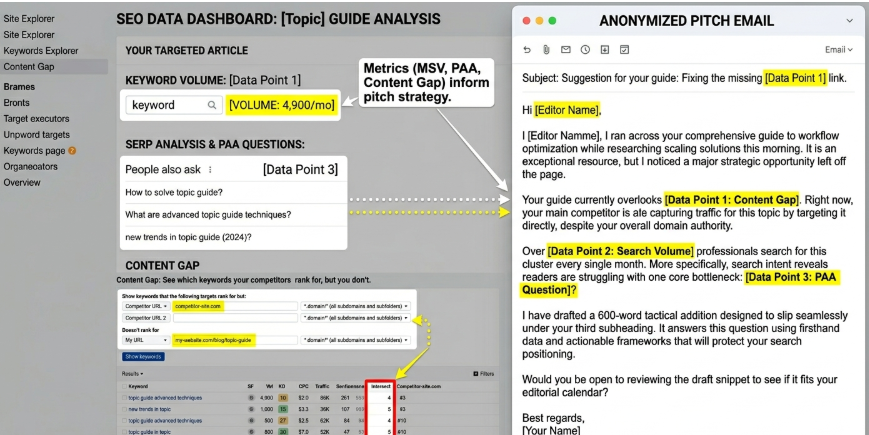
Reference the gap directly in your pitch. Something like: “I noticed your site ranks well for [topic A], but there’s a lot of search demand for [topic B] that you haven’t covered yet. I’d love to write that piece for you.”
Editors respond to this because you’ve shown you understand their site and you’re offering something genuinely useful — not just a link-building favor.
Finding the Right Sites Using SERP Analysis
Not every site on page one is a good guest post target. Here’s the filter I use before spending any time on outreach:
| Filter Criteria | What to Look For | Why It Matters |
|---|---|---|
| Organic traffic | 10,000+ monthly visits (Ahrefs/Semrush estimate) | Low-traffic sites carry less link weight and send no referral visitors |
| Content freshness | Site publishes at least 2–4 posts/month | Active sites get crawled more, links pass equity faster |
| Bylined authors | Posts have individual author names and bios | Strong EEAT signal; editor is used to managing contributors |
| Niche match | At least 40–60% of content in your topic area | Topical relevance multiplies the link’s ranking impact |
| Outbound links | Articles link out naturally to external sources | Editors who link out freely will let your link stay |
| No PBN signals | Varied backlink profile, real social engagement | Links from PBNs or link farms can hurt more than help |
Platform Comparison: Best Tools for SERP-Based Guest Post Research
You don’t need to spend a fortune to do this well. Here’s an honest breakdown of the tools that work best for SERP insight guest posting, from free to enterprise:
| Tool | Best For | SERP Analysis | Backlink Data | Content Gaps | Price Range |
|---|---|---|---|---|---|
| Ahrefs | All-round SERP + link research | Excellent | Excellent | Strong | $99–$399/mo |
| Semrush | Keyword & competitor research | Excellent | Good | Strong | $129–$449/mo |
| Moz Pro | DA scoring + link prospecting | Good | Good | Moderate | $99–$299/mo |
| Google Search Console | Your own keyword & ranking data | Limited | None | Moderate | Free |
| Hunter.io | Finding editor contact emails | None | None | None | Free–$49/mo |
| BuzzSumo | Content performance + trend research | Moderate | None | Strong | $99–$299/mo |
| Google (manual) | Free SERP research with operators | Good | None | Moderate | Free |
For most users starting out, the combination of Google Search Console + manual SERP research + a free Ahrefs or Semrush trial is enough to get your first 10–15 quality guest post targets identified.
Pros and Cons of SERP-Driven Guest Posting
Like any SEO strategy, SERP insight guest posting has real tradeoffs. Here’s the honest picture:
Pros
- Links come from topically relevant, ranking sites — higher SEO value
- Pitch angles are data-driven, not guesswork — higher acceptance rates
- You fill real content gaps, making editors more likely to say yes
- Referral traffic is highly targeted and more likely to convert
- Builds genuine relationships with authoritative publishers
- Scales over time as your niche authority grows
- Protects against algorithm updates that punish low-quality links
Cons
- Takes more time upfront than mass cold outreach
- Requires access to SEO tools for full SERP analysis
- Competitive niches have fewer open slots — some sites are flooded with pitches
- Writing high-quality content for each placement is resource-intensive
- Results can take 2–4 months to show in rankings
- Some top-ranking sites charge placement fees
How to Craft Pitches That Convert
The average editor at a busy blog gets 50–100 pitches a week. Most of them read like this: “Hi, I’m a passionate writer who would love to contribute to your amazing blog.” Delete.
A SERP-informed pitch looks totally different. Here’s the structure that gets replies:
The 4-Part SERP Pitch Formula
Part 1 — Proof you know their site. Reference a specific article they published and why it performed well or what it’s missing. Don’t fake this — they’ll know.
Part 2 — The gap from SERP data. Tell them there’s a keyword they’re not ranking for, or a “People Also Ask” question their existing content doesn’t answer. This is your hook.
Part 3 — Your specific angle. Give them a proposed title and a three-line outline. Make it easy to say yes. Editors don’t want to imagine your article — they want to see it.
Part 4 — Your credibility signal. One link to your best published piece in a similar niche. Not five links. One strong one.
Real Example Pitch Opener:
Follow-Up Timing
Send one follow-up 5–7 business days after your first email if you get no reply. Keep it very short: “Just bumping this in case it got buried. Happy to adjust the angle if needed.” After a second non-reply, move on. Editors respect persistence but not harassment.
Common Mistakes That Kill Your Guest Post ROI
Even experienced SEOs make these errors. Knowing them upfront saves you months of wasted effort.
Targeting DA Instead of Topical Relevance
A DA 70 site about pet supplies is worth almost nothing for your B2B SaaS link profile. A DA 45 site that ranks for your exact keywords? That’s gold. Stop chasing vanity metrics and start chasing relevance.
Writing Generic Content to “Play It Safe”
The safest-sounding guest posts are also the ones least likely to get published or to drive traffic. Editors have seen every listicle about “10 ways to improve your SEO.” Write something specific, contrarian, or data-backed instead.
Burying Your Link Too Deep
A link in paragraph 18 of a 2,000-word post passes less equity and gets almost zero referral clicks. Aim to earn your link naturally in the first third of the article — where it serves the reader and gets seen.
Ignoring the “Also Ask” and “Related Searches” Sections
These boxes are Google telling you what the audience actually wants to read. If your guest post title matches a “People Also Ask” question, it has a much higher chance of ranking — and earning a featured snippet placement.
Accepting Placements Without Checking Indexation
Check with site:targetdomain.com that the site’s pages are actually indexed. Some sites have noindex tags across large sections of their blog — meaning your link will never be seen by Google’s crawlers.
Written by the RankWithLinks Editorial Team
Our team has spent 8+ years building links for clients across SaaS, e-commerce, and publishing. Every strategy in this guide has been tested on real campaigns — not theoretical playbooks. We only publish what we’ve actually proven to work.
Frequently Asked Questions
What is a SERP insight guest post?
A SERP insight guest post is a guest article strategy that uses search engine results page data — including keyword rankings, content gaps, and competitor backlink profiles — to identify the best target sites, craft relevant content angles, and build links with genuine ranking power. Rather than pitching randomly, you use the SERP itself to guide every decision: where to pitch, what to write, and how to frame your outreach.
How do I find sites accepting guest posts in my niche?
Start by searching your target keyword in Google and noting every domain that appears in the top 15 results. Then run a Google search for each domain combined with “write for us,” “guest post guidelines,” or “contributor.” You can also look for sites where multiple articles are written by different named authors — this is a clear signal that the site accepts outside contributions, even if they don’t have a formal “Write for Us” page.
Does guest posting still work for SEO in 2025?
Yes — but only when done with genuine relevance and editorial quality. Google’s Helpful Content updates and link spam policies have made low-effort, mass-scale guest posting much less effective. However, high-quality guest posts on topically relevant, actively maintained sites still build strong backlinks and domain authority. The key is relevance over volume: one well-placed article on a niche site that ranks for your keywords is worth more than ten generic placements on high-DA but off-topic blogs.
How many guest posts do I need to rank for a competitive keyword?
There’s no fixed number — it depends on keyword difficulty, your site’s existing authority, and the quality of the links you build. For low-competition keywords (KD under 20), even 2–5 strong guest post links can push a page to page one. For highly competitive terms, you may need 15–30+ high-quality placements combined with strong on-page SEO and internal linking. Use a tool like Ahrefs’ Keyword Difficulty score to benchmark what the top-ranking pages currently have in terms of referring domains.
Should I use exact-match anchor text in my guest post links?
Use exact-match anchor text sparingly — as a rule of thumb, no more than 20–25% of your guest post links should use the exact target keyword as the anchor. The rest should be branded, partial-match, or natural variations. Over-optimized anchor text profiles are a red flag to Google’s Penguin algorithm and can trigger manual penalties. A natural anchor profile looks like: your brand name, generic phrases like “this article” or “learn more,” and occasional partial-match anchors.
How is RankWithLinks different from typical link building services?
RankWithLinks focuses on SERP-informed placements — meaning every link is placed on a site that is already ranking for relevant keywords in your niche. This is fundamentally different from services that simply source high-DA sites with no regard for topical relevance. Every placement is manually vetted for traffic, content quality, indexation, and editorial standards before outreach begins.
Conclusion
SERP insight guest posting is not a hack. It’s what smart link building has always been: putting the right content on the right sites in front of the right audience — and letting the data tell you what “right” actually means.
The SEOs who win in 2025 and beyond are not the ones sending 500 cold emails a week. They’re the ones who spend 30 extra minutes analyzing the SERP, identifying a genuine content gap, and writing a pitch that makes an editor’s life easier.
Start with five high-relevance targets from your SERP research. Pitch one strong angle to each. Measure your acceptance rate. Iterate. Over time, SERP-driven outreach becomes the most efficient use of your link building budget — because almost every link you place actually matters.
If you want help building a SERP-informed guest post campaign, RankWithLinks.com offers fully managed outreach with transparent placement reporting and real topical authority vetting. No PBNs, no filler sites — just links that rank.
RankWithLinks.com

Fazilat zulfiqar is an SEO specialist at RankWithLinks, focused on improving search rankings through smart link building and optimization.He helps businesses grow organic traffic and build strong online authority.