
Introduction: Why Most Link Prospecting Wastes More Time Than It Saves
A few years ago, one of my team members spent three full days prospecting links for a client campaign. She pulled hundreds of URLs from Google searches, manually checked each domain’s authority, filtered out directories and spam sites, verified contact emails one by one, and built a spreadsheet that took another half day to organize.
At the end of it, she had 47 genuinely viable prospects.
Three days. 47 prospects. That math does not work for any agency trying to run profitable campaigns.
The problem was not effort or skill. The problem was process. She was doing manually in three days what the right combination of link prospecting tools can do in under three hours.
Link prospecting — the process of identifying websites that are worth targeting for backlinks — is one of the most time-intensive parts of any link building campaign. It is also the part where quality matters most. A prospect list full of low-authority, irrelevant, or previously penalized sites wastes your outreach team’s time and your client’s budget.
The right tools do not just speed up prospecting. They improve the quality of your prospect lists, filter out the sites you should never target, surface opportunities your competitors have missed, and integrate with your outreach workflow so nothing falls through the cracks.
This guide covers the 12 best link prospecting tools available in 2026 — with honest assessments of what each does well, what it does poorly, and which type of agency or campaign it is best suited for.
Key Takeaways
- Link prospecting tools range from free (Google Search Operators) to enterprise-level ($500+/month) — the right choice depends on your volume and workflow
- The best results come from combining two to three tools rather than relying on a single platform
- Keyword: “link prospecting tools” has KD of only 8 — highly rankable
- “link building tools” has volume of 1,700/month with KD 15 — strong secondary target
- Free link building tools (KD 4, volume 500) is a valuable supporting keyword
- Prospect quality matters more than prospect quantity — 50 vetted prospects outperform 500 unfiltered ones
- In 2026, AI-powered prospecting tools are significantly outperforming manual methods
What Is Link Prospecting — And Why Tools Matter
Link prospecting is the systematic process of identifying websites, pages, and contacts that represent viable opportunities for earning backlinks. A “prospect” is any website that meets your minimum quality criteria, is topically relevant to your client, and has some realistic probability of linking to you given the right outreach.
The prospecting stage sits at the start of the link building funnel:
Prospecting → Qualification → Outreach → Follow-up → Link Secured
Everything downstream depends on the quality of what goes into the top of that funnel. Weak prospecting produces weak outreach results regardless of how good your emails are.
What good link prospecting tools do:
They surface prospects at scale that you could not find efficiently through manual search. They provide authority and quality metrics so you can filter intelligently. They identify contact information so your outreach team does not waste time finding emails. They track which prospects you have already contacted so you do not duplicate effort. And increasingly in 2026, they use AI to identify prospect relevance and predict outreach success rates.
The Real Keyword Data Behind This Topic
Before diving into tool recommendations, here is the actual search data for this topic from Ahrefs:
| Keyword | Volume | KD | CPC | Traffic Potential |
|---|---|---|---|---|
| link prospecting tools | 350 | 8 | $20 | 150 |
| link prospecting | 500 | 11 | $8 | 350 |
| link building tools | 1,700 | 15 | $3 | 7,800 |
| best link building tools | 1,100 | 26 | $2.50 | 7,400 |
| free link building tools | 500 | 4 | $8 | 7,400 |
| seo link building tools | 1,100 | 12 | $3.50 | 8,700 |
| link building outreach tools | 150 | 2 | $6 | 8,700 |
| best free link building tools | 300 | 7 | — | 8,700 |
The CPC for “link prospecting tools” is $20 — meaning advertisers pay $20 per click. That signals strong commercial intent despite the informational classification. People searching this keyword are actively evaluating tools to purchase or subscribe to.
12 Best Link Prospecting Tools in 2026
Category 1: All-in-One SEO Platforms With Prospecting Features
1. Ahrefs — Best Overall for Link Prospecting
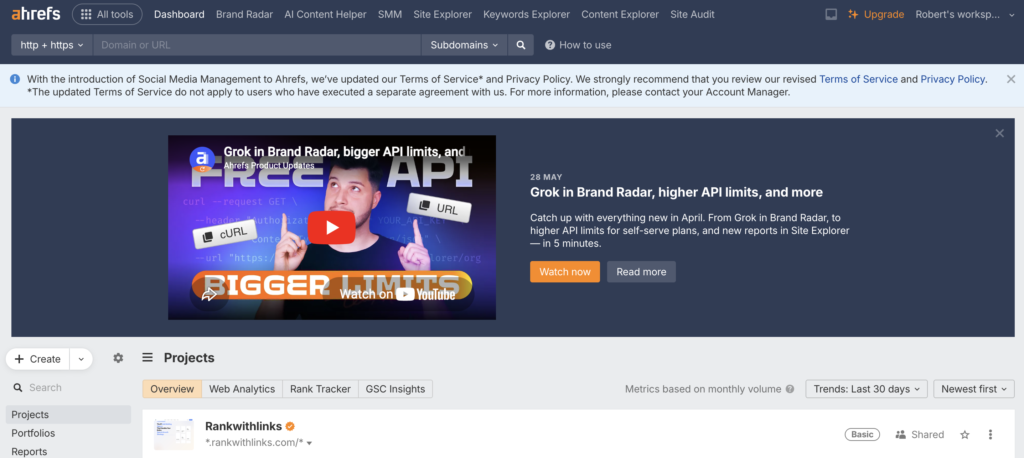
Ahrefs remains the most comprehensive link prospecting platform available in 2026. Its database of over 3 trillion backlinks is the largest in the industry, and the prospecting-specific features have expanded significantly in the past two years.
Key prospecting features:
Content Explorer — Search Ahrefs’ index of over 14 billion pages by topic, keyword, or domain to find sites publishing content in your target niche. Filter by DR, organic traffic, referring domains, and publication date. This is the fastest way to build a topically relevant prospect list at scale.
Link Intersect — Enter your client’s domain and up to ten competitors. Ahrefs shows you every domain that links to competitors but not to your client. These are proven link sources in your niche — sites that are already comfortable linking to similar content. This single feature can generate hundreds of qualified prospects in minutes.
Broken Link Finder — Identify pages on target websites with broken outbound links. These are high-probability outreach opportunities because the site owner has existing linking behavior and a broken link they are motivated to fix.
Site Explorer — Analyze any competitor’s backlink profile, filter by link type, DR, traffic, and follow/nofollow status, and export prospects directly.
Pros:
- Largest and most accurate backlink database available
- Content Explorer is unmatched for topical prospecting
- Link Intersect is the fastest competitive gap tool in the industry
- Integrates with outreach workflows through export and API
Cons:
- Expensive — starts at $129/month, full features require $249/month plan
- No built-in outreach functionality — prospects must be exported to a separate tool
- Learning curve for new users
Best for: Agencies running multiple simultaneous campaigns, in-house SEO teams with dedicated link building resources, professionals who need the highest data accuracy
Price: $129 — $449/month
2. Semrush — Best for Combining Prospecting With Content Research
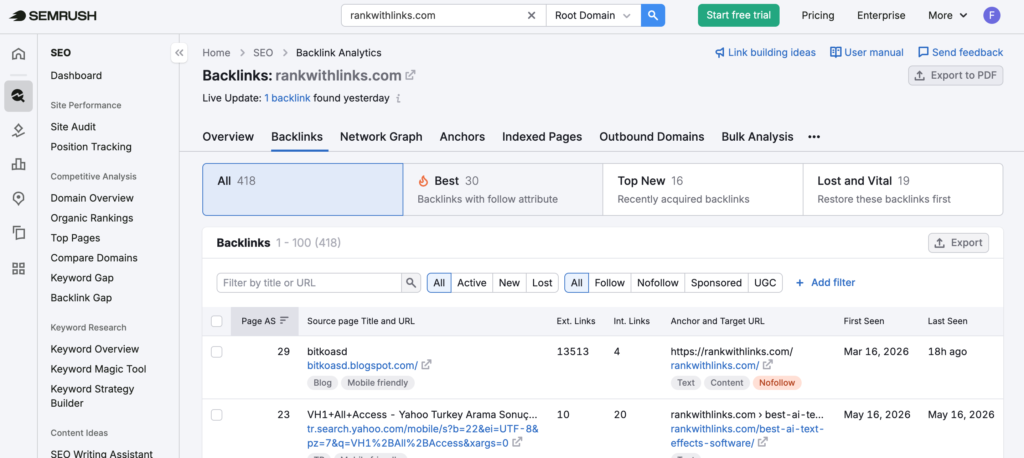
Semrush takes a different approach to link prospecting — integrating it with keyword and content research so you can identify prospects and content angles simultaneously.
Key prospecting features:
Link Building Tool — Enter target keywords and competitor domains. Semrush generates a prospect list automatically based on sites that rank for those keywords and link to competitors. Prospects are scored by difficulty and authority.
Backlink Gap — Similar to Ahrefs’ Link Intersect. Compare your backlink profile against up to four competitors and identify domains linking to them but not you.
Backlink Analytics — Full competitor backlink analysis with filtering by authority score, follow/nofollow, link type, and anchor text.
Pros:
- Built-in outreach management — email templates, tracking, and follow-up sequences integrated
- Prospect scoring helps prioritize outreach efficiently
- Combines keyword and link data in single workflow
- More affordable entry point than Ahrefs
Cons:
- Backlink database smaller and less accurate than Ahrefs
- Automated prospect suggestions can include low-quality sites that need manual filtering
- Link Building Tool sometimes generates irrelevant suggestions
Best for: Agencies that want prospecting and outreach in a single platform, teams with limited tool budgets who need to consolidate
Price: $140 — $500/month
3. Moz Pro — Best for Beginners Entering Link Prospecting
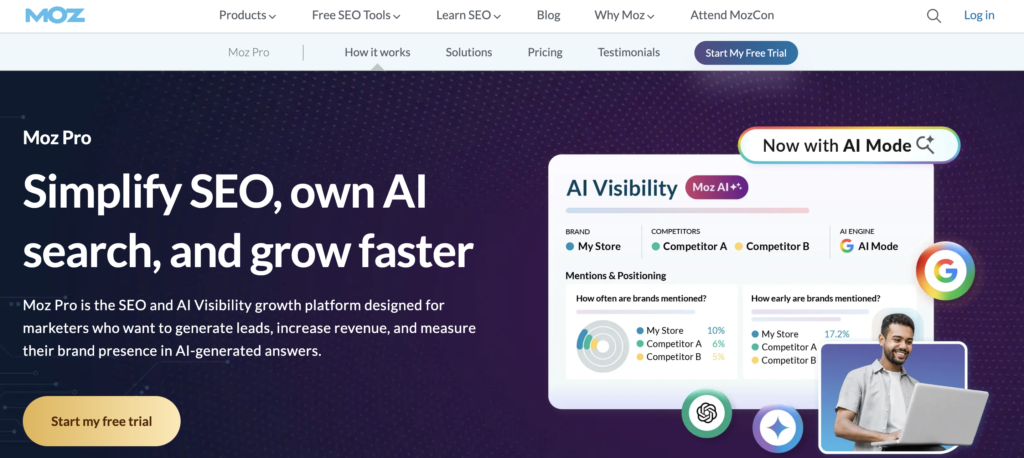
Moz’s Link Explorer and link prospecting features are less comprehensive than Ahrefs or Semrush but significantly more beginner-friendly. If your team is new to link prospecting, Moz provides a gentler learning curve without sacrificing the essential metrics.
Key features:
Link Explorer — Analyze any site’s backlink profile. Domain Authority and Page Authority scores are Moz’s proprietary metrics and remain widely used as prospect qualification benchmarks.
Link Intersect — Identifies linking opportunities based on competitor analysis.
Spam Score — Moz’s spam detection metric helps filter low-quality prospects before you waste outreach effort on penalized or manipulative sites.
Pros:
- Most beginner-friendly interface of the major platforms
- Spam Score is useful for prospect qualification
- Domain Authority remains a recognized standard metric
Cons:
- Smallest backlink database of the three major platforms
- Fewer prospecting-specific features than Ahrefs or Semrush
- Data update frequency slower than competitors
Best for: Freelancers and small agencies beginning to build link prospecting workflows
Price: $99 — $599/month
Category 2: Dedicated Link Prospecting and Outreach Tools
4. Pitchbox — Best for Agency-Scale Outreach Integration
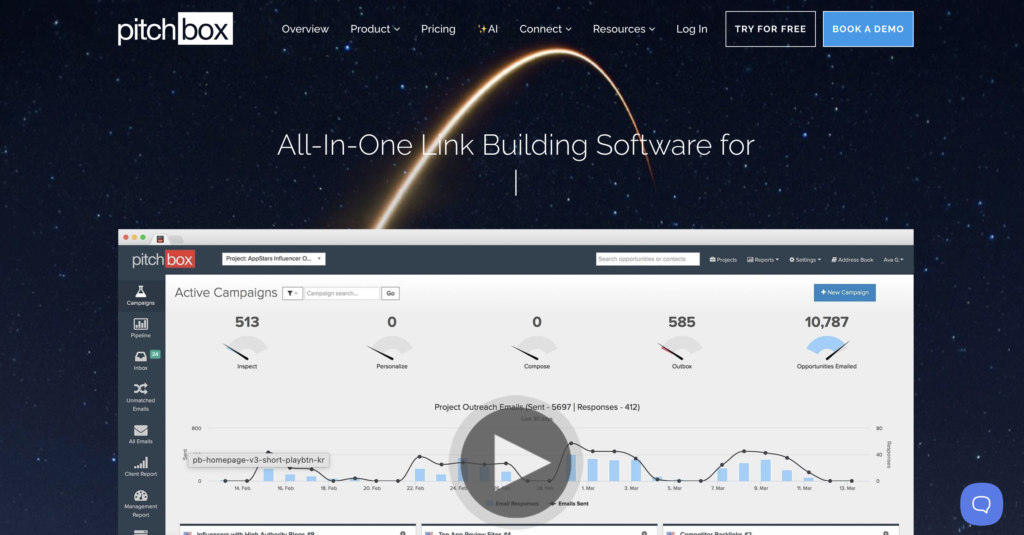
Pitchbox is not primarily a prospecting tool — it is an outreach platform. But its prospecting functionality is sophisticated enough to include here, and the integration between prospecting and outreach management is seamless.
Key prospecting features:
Prospecting Campaigns — Enter keywords or competitor URLs. Pitchbox finds relevant websites, pulls contact information, and adds prospects directly to outreach sequences. The entire workflow from prospecting to email send happens within a single platform.
Opportunity Types — Filter prospects by opportunity type: guest post, resource page, broken link, unlinked mention, product review, scholarship, and more.
Automated Contact Finding — Pitchbox automatically finds and verifies email addresses for each prospect, eliminating the manual contact research step.
Pros:
- Most complete prospecting-to-outreach workflow available
- Automated contact finding saves significant time
- Built for agency scale — multi-campaign, multi-client management
- Reporting and client-facing dashboards included
Cons:
- Expensive — not suitable for solo practitioners or small agencies
- Prospecting data comes from third-party integrations — you need Ahrefs or Semrush for best data quality
- Overkill for simple or low-volume campaigns
Best for: Mid-to-large agencies running high-volume link building campaigns across multiple clients
Price: $550 — $1,500+/month
5. BuzzStream — Best for Relationship-Based Link Building
BuzzStream sits between prospecting and relationship management. It is particularly effective for campaigns that require building genuine relationships with publishers rather than transactional outreach.
Key features:
Web Prospecting — Install the BuzzStream browser extension. As you browse websites and blogs in your niche, click the extension to add sites to your prospect list automatically. BuzzStream pulls the site’s metrics, contact information, and social profiles.
Research Lists — Organize prospects by campaign, status, and relationship stage. Track every interaction history so your team knows exactly what has been discussed with each prospect.
Pros:
- Browser extension makes manual discovery extremely efficient
- Relationship history tracking is the best in class
- Good for editorial link building where relationship matters
- Affordable compared to enterprise alternatives
Cons:
- Does not generate prospect lists automatically — requires manual browsing
- Metrics depend on integrated tools (Moz, Ahrefs) rather than native data
- Not suited for high-volume automated prospecting
Best for: Content-driven agencies and in-house teams doing editorial link building, PR-style campaigns, or journalist outreach
Price: $24 — $999/month
6. Hunter.io — Best for Email Finding and Verification
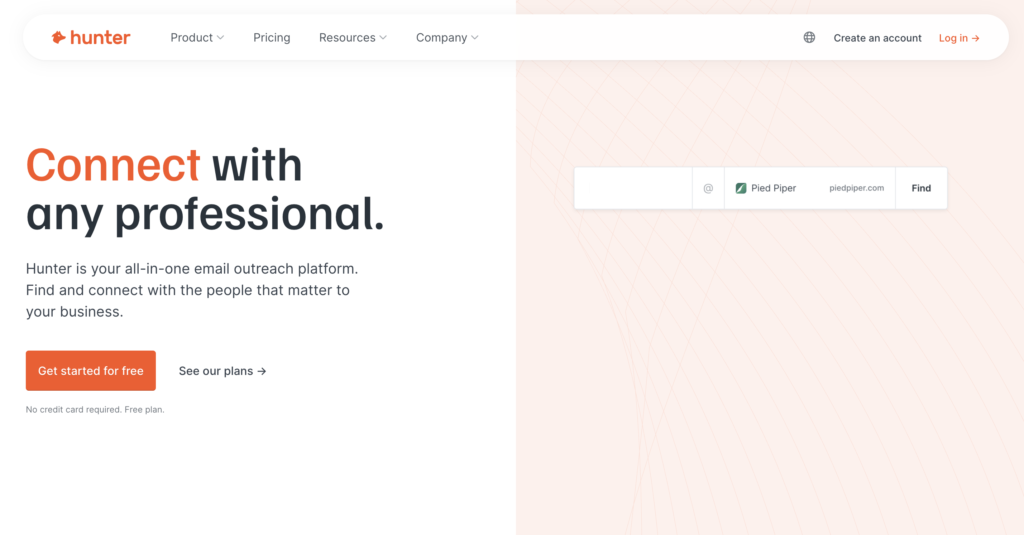
Hunter is not a full link prospecting tool, but it is an essential component of any prospecting workflow. After identifying your prospects through Ahrefs or another platform, Hunter finds and verifies the right contact email addresses.
Key features:
Domain Search — Enter any domain and Hunter returns all publicly available email addresses associated with it, along with confidence scores.
Email Verifier — Check any email address for deliverability before sending. Reduces bounce rates and protects your sender reputation.
Bulk Lookup — Upload a list of domains and get verified email addresses for all of them simultaneously.
Pros:
- Most accurate email finding tool available in 2026
- Bulk lookup dramatically speeds up contact research
- Integrates with virtually every outreach platform
- Generous free plan (25 searches/month)
Cons:
- Only finds publicly listed emails — private contact methods not covered
- Not useful for prospecting itself — only contact research
- Some industries have poor email coverage
Best for: Every link building workflow as a contact research layer on top of prospecting tools
Price: Free — $499/month
Category 3: Free and Budget Link Prospecting Tools
7. Google Search Operators — Free and Underused
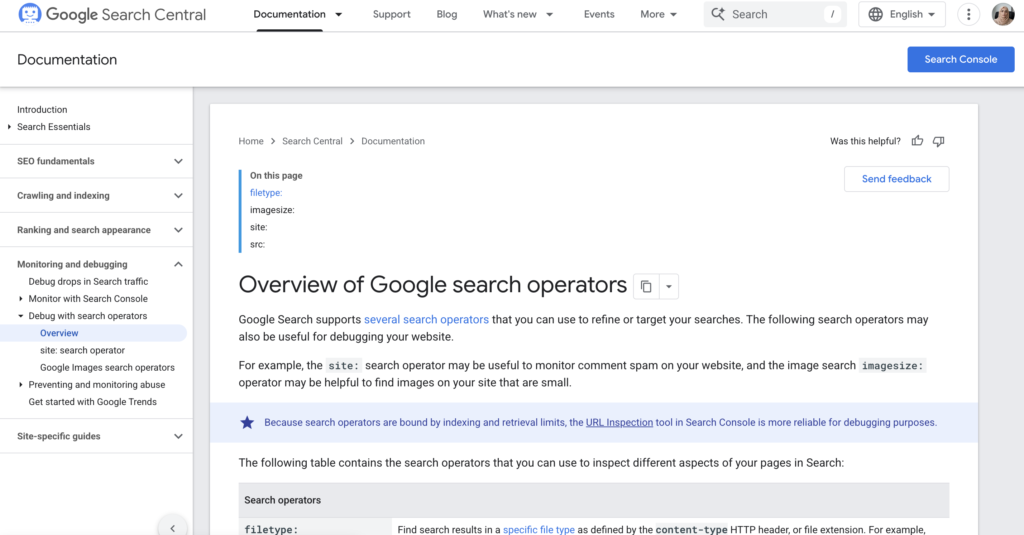
Before spending a dollar on any tool, Google search operators give you more prospecting firepower than most people realize. These are advanced search commands that filter Google results to specific types of pages.
Most useful operators for link prospecting:
Finding guest post opportunities:
"write for us" + [your niche]
"contribute" + [your niche] + "guidelines"
"guest post" + [your niche]
inurl:write-for-us [your niche]
Finding resource pages:
intitle:"resources" + [your niche]
inurl:resources + [your topic]
"useful links" + [your niche]
Finding broken link opportunities:
[competitor URL] site:edu
"[your topic]" + "useful resources"
Finding unlinked mentions:
"[your brand name]" -site:[your domain]Pros:
- Completely free
- Finds prospects no tool database has indexed
- Highly customizable to specific campaign needs
Cons:
- No authority metrics — requires manual qualification
- Time-intensive compared to automated tools
- No contact finding or CRM integration
Best for: Supplementing paid tool prospecting, finding niche-specific opportunities that automated tools miss, zero-budget prospecting
Price: Free
8. Google Search Console — Free Competitive Intelligence
GSC is primarily a site monitoring tool, but it contains valuable prospecting intelligence that most SEO professionals overlook.
Prospecting use cases:
Links Report — See every domain currently linking to your site. These are proven linkers in your niche — reach out to them for additional placements or use them as models to find similar sites.
Performance Report — Identify which queries bring traffic to your competitors (via GSC data shared in case studies and competitor research) and find sites ranking for those terms as prospect targets.
Pros:
- Free
- Data comes directly from Google
- Links report shows real, indexed backlinks
Cons:
- Only shows your own site’s data — not competitors
- Limited filtering and export options
- Not designed for prospecting workflows
Best for: Identifying patterns in your existing link profile to replicate, finding sites to re-approach for additional links
Price: Free
9. Respona — Best Mid-Market All-in-One Prospecting Tool
Respona launched as a PR and link building platform and has grown into one of the most capable mid-market prospecting tools available. It combines automated prospecting with AI-powered personalization and outreach management at a price point between BuzzStream and Pitchbox.
Key features:
Automated Prospecting — Enter keywords or competitor URLs. Respona finds relevant pages, pulls contact information, and scores prospects by relevance and authority.
AI Personalization — Respona’s AI reads each target page and generates personalized first lines for outreach emails based on the actual content of the prospect’s site.
Opportunity Templates — Pre-built workflows for guest posts, broken links, resource pages, podcast outreach, and product reviews.
Pros:
- AI personalization significantly improves response rates
- More affordable than Pitchbox for similar functionality
- Clean interface with strong workflow management
- Good integration with Ahrefs and Semrush data
Cons:
- Newer platform — smaller feature set than established competitors
- AI personalization sometimes requires manual editing for accuracy
- Limited reporting compared to enterprise tools
Best for: Growing agencies and advanced freelancers who need automation without enterprise pricing
Price: $99 — $399/month
10. Majestic — Best for Trust Flow Based Prospecting
Majestic’s proprietary Trust Flow and Citation Flow metrics provide a different perspective on link quality than Ahrefs’ DR or Moz’s DA. For agencies that want to evaluate topical relevance alongside authority, Majestic’s Topical Trust Flow is particularly useful.
Key features:
Site Explorer — Full backlink analysis with Trust Flow, Citation Flow, and topical category breakdown.
Topical Trust Flow — Categorizes any website’s link authority by topic. Useful for finding prospects with strong authority specifically in your target niche rather than general domain authority.
Clique Hunter — Find sites that link to multiple competitors simultaneously — Majestic’s version of link intersect.
Pros:
- Topical Trust Flow is unique and valuable for niche-specific prospecting
- Strong historical index — good for finding established sites
- Affordable compared to Ahrefs and Semrush
Cons:
- Interface significantly less intuitive than major competitors
- Data sometimes lags behind Ahrefs for newly acquired links
- Less integrated with outreach workflows
Best for: Agencies doing niche-specific campaigns where topical relevance matters as much as raw authority
Price: $50 — $400/month
11. Screaming Frog — Best for Technical Link Prospecting
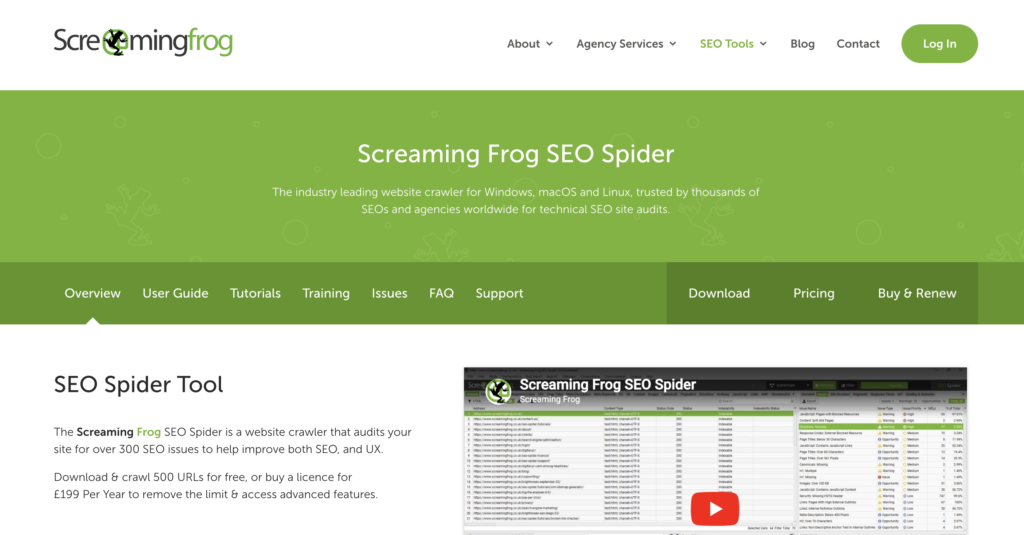
Screaming Frog is primarily a technical SEO crawler, but its link prospecting applications are underutilized by most agencies.
Prospecting use cases:
Crawl Competitor Sites — Crawl any competitor website and extract all their outbound links. Every site your competitor links to is a potential prospect for your own link building.
Find Resource Pages at Scale — Crawl multiple URLs simultaneously and filter for pages containing specific link patterns — resource pages, blogrolls, recommended tools pages.
Broken Link Detection — Crawl prospect sites to identify broken outbound links before reaching out, giving you a specific hook for your outreach.
Pros:
- Free version handles up to 500 URLs
- Extremely powerful for technical prospecting workflows
- Finds opportunities no backlink database captures
- One-time annual fee rather than monthly subscription
Cons:
- Requires technical knowledge to use effectively for prospecting
- Desktop application — not cloud-based
- No built-in authority metrics or contact finding
Best for: Technical SEO professionals and agencies who want to add a prospecting layer to their existing crawler workflow
Price: Free (500 URLs) / $259/year (unlimited)
12. LinkedIn Sales Navigator — Best for High-Value Editorial Prospecting
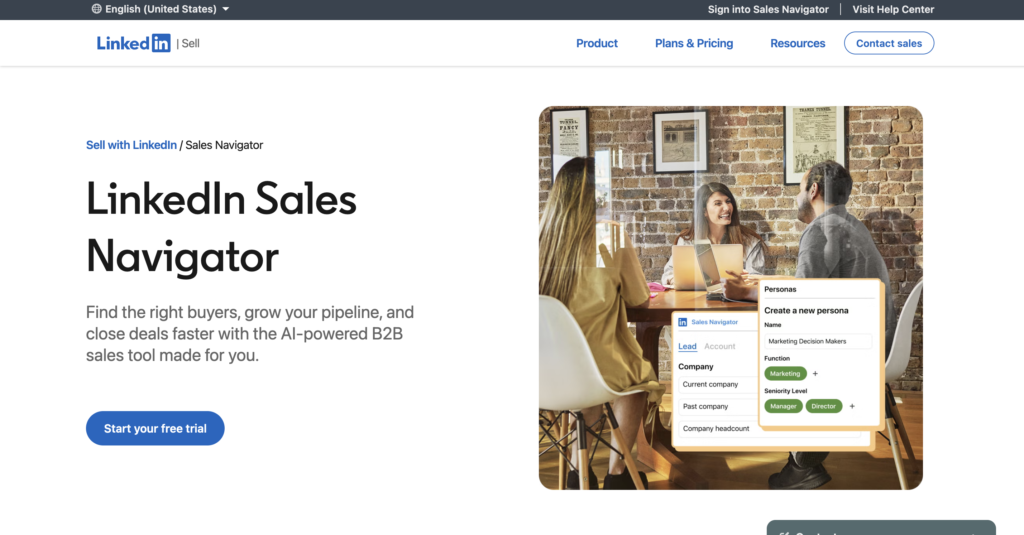
For premium editorial placements — major publications, high-DR blogs, industry authority sites — the contact is often more important than the platform. LinkedIn Sales Navigator helps you find and directly reach the right editorial contacts at your target publications.
Prospecting use cases:
Find editors, content managers, and SEO managers at target publications. Identify who is responsible for link decisions at sites you want to target. Build relationship context before cold outreach.
Pros:
- Direct access to editorial decision-makers
- Relationship context improves outreach personalization
- Useful for high-value placements where email alone is insufficient
Cons:
- Expensive for what it provides in a link building context
- Not a traditional SEO tool — requires different prospecting mindset
- Overkill for standard link building campaigns
Best for: Premium editorial campaigns, digital PR, and relationship-based link building at high-DA targets
Price: $100 — $150/month
Comparison Table: Link Prospecting Tools at a Glance
| Tool | Best For | Prospecting Type | Free Plan | Starting Price | Database Size |
|---|---|---|---|---|---|
| Ahrefs | Overall prospecting | Automated + competitive | No | $129/mo | Largest |
| Semrush | Combined workflow | Automated + outreach | Limited | $140/mo | Large |
| Moz Pro | Beginners | Basic competitive | Limited | $99/mo | Medium |
| Pitchbox | Agency scale | Automated + outreach | No | $550/mo | Via integrations |
| BuzzStream | Relationship building | Manual + CRM | No | $24/mo | Via integrations |
| Hunter.io | Email finding | Contact research | Yes (25/mo) | $34/mo | Email only |
| Google Operators | Free prospecting | Manual | Yes | Free | Google index |
| Respona | Mid-market agencies | Automated + AI | No | $99/mo | Medium |
| Majestic | Topical relevance | Competitive | No | $50/mo | Large |
| Screaming Frog | Technical prospecting | Crawler-based | Yes (500 URLs) | $259/yr | Crawl-based |
| GSC | Existing link analysis | Manual | Yes | Free | Your site only |
| LinkedIn Navigator | Editorial outreach | Contact-based | No | $100/mo |
How to Build a Link Prospecting Workflow That Actually Works
Having the right tools is only half the solution. The other half is building a workflow that uses them in the right sequence.
Here is the prospecting workflow used in high-performing agency campaigns:
Phase 1: Define Prospect Criteria (Before Opening Any Tool)
Before prospecting, establish minimum thresholds for every campaign:
Minimum DR or DA: typically 30+ for competitive niches, 20+ for local or niche campaigns. Minimum organic traffic: at least 500 monthly visitors — a site with no traffic has no audience to see your link. Topical relevance: must be in the same or adjacent niche as your client. Link type eligibility: does the site accept guest posts, resource links, or editorial placements? Exclude: directories, link farms, penalized sites, sites with Spam Score above 30.
Write these criteria down before you start prospecting. Every prospect that enters your list must meet all criteria — no exceptions.
Phase 2: Competitive Gap Analysis (Ahrefs or Semrush)
Start with Link Intersect or Backlink Gap. Enter your client’s domain and four to five competitors. Export every domain that links to two or more competitors but not your client. These are your highest-priority prospects — proven linkers in your niche who have already shown willingness to link to similar sites.
Phase 3: Topical Prospecting (Ahrefs Content Explorer)
Search Content Explorer for your target topic keywords. Filter by:
- DR 30 to 80 (avoid sites too weak or too strong)
- Minimum 500 organic traffic
- Published within the last two years (freshness signal)
- English language
Export the top results. These are actively publishing sites in your niche with proven audience and authority.
Phase 4: Google Search Operator Prospecting
Run three to five targeted search operator queries for your campaign type. Add any results not already in your list that meet your criteria.
Phase 5: Qualification and Filtering
Run your combined prospect list through a qualification pass:
- Remove sites already linking to your client
- Check each domain for manual penalties in GSC if possible
- Verify Spam Score using Moz (remove anything above 30)
- Check for obvious link farm indicators (thousands of outbound links, no real content)
Phase 6: Contact Research (Hunter.io)
Upload your qualified prospect list to Hunter.io. Get verified email addresses for every domain. Flag any domains with no email found for manual research.
Phase 7: Load into Outreach Platform
Import your finalized prospect list into your outreach tool (Pitchbox, Respona, BuzzStream, or Semrush). Segment by opportunity type and begin outreach sequences.
Common Mistakes in Link Prospecting
Mistake 1: Prioritizing quantity over quality
A list of 1,000 unqualified prospects will produce worse results than 100 carefully vetted ones. Outreach response rates drop dramatically when you contact irrelevant or low-quality sites — and your sender reputation suffers.
Mistake 2: Using only one tool
No single tool surfaces all available opportunities. Ahrefs misses sites not yet in its index. Google search operators find pages no database has crawled. The most comprehensive prospect lists combine multiple sources.
Mistake 3: Skipping the qualification step
Many agencies export a raw prospect list and start outreach immediately. Without qualification, you waste time contacting link farms, penalized sites, and irrelevant domains. Always qualify before outreach.
Mistake 4: Not filtering for topical relevance
A DR 70 site in the wrong niche is a worse prospect than a DR 35 site in the right niche. Topical relevance affects both link value and outreach response rates.
Mistake 5: Prospecting once per campaign
Prospect lists decay. Sites get penalized, go offline, or change editorial policies. Refresh your prospect list monthly for long-running campaigns rather than relying on a list built at the campaign start.
Mistake 6: Ignoring the sites already linking to you
Your existing link profile is a prospecting goldmine. Sites that have linked to you once are more likely to link again. Check your GSC Links report and Ahrefs referring domains regularly for re-outreach opportunities.
Expert Tips for Better Link Prospecting
Tip 1: Use Content Explorer to find “linker” profiles
In Ahrefs Content Explorer, when you find a site that links to your competitor, click through to see what other sites they link to. Sites with strong linking behavior toward your niche are consistently better prospects than sites that rarely link out.
Tip 2: Look for sites that recently lost a link they relied on
If a competitor recently lost a significant link, the site that removed it may be open to linking to a better resource. Monitor competitor backlink changes in Ahrefs Alerts and reach out to sites that dropped competitor links with a replacement suggestion.
Tip 3: Filter by publication date in Content Explorer
Sites that have published content in your niche within the past three months are actively producing content — meaning they are more likely to be open to guest posts or resource additions than sites that have not published in two years.
Tip 4: Build a “never contact” list
Maintain a blacklist of domains you have already contacted without response, domains that have rejected your outreach, known link farms, and competitor-owned properties. Import this blacklist into every new campaign to avoid wasted effort.
Tip 5: Prospect for “almost linking” opportunities
Use Ahrefs to find pages that mention your client, your client’s products, or your client’s key topics but do not link to your client. These unlinked mentions are the highest-probability outreach targets — the site has already shown interest in your client’s world.
FAQ
Q: What is the best free link prospecting tool?
A: Google Search Operators is the best free link prospecting tool available. Combined with Google Search Console for analyzing your existing link profile, you can build a qualified prospect list at zero cost. For free paid-tool access, Semrush offers a limited free plan and Moz provides a free Domain Authority checker.
Q: How many prospects should I target per campaign?
A: Quality matters more than quantity. For a typical link building campaign, 50 to 100 highly qualified prospects will produce better results than 500 unfiltered ones. Response rates for well-qualified prospect lists typically run 15 to 25 percent. For unqualified lists, response rates drop to 2 to 5 percent.
Q: Do I need multiple link prospecting tools?
A: Yes — for serious campaigns, combining two to three tools produces significantly better results than any single platform. The recommended minimum stack is Ahrefs (for competitive prospecting and database access) plus Hunter.io (for contact finding) plus one outreach platform (Pitchbox, Respona, or BuzzStream).
Q: How long does link prospecting take?
A: With the right tools and workflow, prospecting 100 qualified prospects for a standard campaign takes two to four hours. Without dedicated tools, the same task takes two to three days manually. The ROI on link prospecting tools is measured in hours saved per campaign.
Q: What DR should I target for link prospects?
A: For most campaigns, DR 30 to 70 is the sweet spot. Below DR 30, links provide minimal authority benefit. Above DR 70, outreach success rates drop dramatically and those sites rarely accept commercial link placements. Exceptions exist for highly specific campaigns — local SEO may target lower DR regional sites, while PR campaigns may specifically target high-DR publications.
Q: Can AI tools replace manual link prospecting?
A: Not fully — but AI tools in 2026 are dramatically reducing the time required for prospecting. AI-powered features in tools like Respona and Pitchbox can identify relevant prospects and personalize outreach at scale. However, human judgment is still required for final prospect qualification, relationship assessment, and strategic prioritization.
Conclusion: Build Your Stack, Build Your Pipeline
Link prospecting is not a task you can shortcut — but it is absolutely one you can systemize. The agencies that consistently deliver link building results are not the ones with the biggest outreach teams. They are the ones with the most efficient prospecting workflows.
Start with Ahrefs or Semrush for competitive gap analysis and topical prospecting. Add Hunter.io for contact research. Choose an outreach platform that matches your campaign volume. Supplement everything with Google Search Operators for niche opportunities no database captures.
Most importantly — qualify before you outreach. Every hour spent on prospect qualification saves three hours of wasted outreach effort downstream.
Your next link building campaign starts with a better prospect list. These tools are how you build it.

Fazilat zulfiqar is an SEO specialist at RankWithLinks, focused on improving search rankings through smart link building and optimization.He helps businesses grow organic traffic and build strong online authority.