
INTRODUCTION
In 2026, SEOs still debate two of the most widely used third-party metrics in the industry: Domain Rating (DR) from Ahrefs and Domain Authority (DA) from Moz. Both are used to measure a website’s ability to rank and attract backlinks — but which one actually matters for your SEO strategy?
The honest answer is this: neither DR nor DA is a direct Google ranking factor. Google has confirmed this repeatedly. But both metrics still influence how SEOs evaluate link quality, identify outreach targets, and build authority strategies — which means understanding them properly is still essential for anyone doing serious SEO work.
This guide breaks down exactly what DR and DA are, how they differ, where each one is useful, and — most importantly — what you should actually be focused on to build real SEO authority in 2026.
WHAT IS DOMAIN RATING (DR)?
Domain Rating is a proprietary metric created by Ahrefs. It scores websites on a scale from 0 to 100 based entirely on the strength and quantity of a website’s backlink profile. The higher the DR, the stronger the backlink profile relative to every other site in Ahrefs’ index.
How DR is Calculated:
DR is determined by the total number of unique referring domains pointing to a website, the quality and authority of those referring domains, the ratio of followed versus nofollowed links, and how those linking domains distribute their own link equity across the sites they link to.
Pros of Domain Rating:
DR is highly focused on backlink strength, which makes it one of the clearest indicators of how competitive a domain is in terms of link acquisition. It updates frequently, reflecting recent changes to a site’s backlink profile relatively quickly. It is widely regarded as one of the best tools available for link prospecting, competitive backlink analysis, and identifying guest post or niche edit opportunities.
Limitations of Domain Rating:
DR does not consider content quality, organic traffic, user experience, or topical relevance in any way. It can be artificially inflated through the purchase of cheap, low-quality backlinks from link farms. Most critically, it is entirely a third-party metric — Google does not use DR in its ranking algorithm in any form.
WHAT IS DOMAIN AUTHORITY (DA)?
Domain Authority is a proprietary metric created by Moz. Like DR, it scores websites on a scale from 1 to 100 and is designed to predict a site’s overall ranking potential in search engines. It was one of the first widely adopted authority metrics in SEO and remains popular today, particularly among agencies and content marketers.
How DA is Calculated:
DA takes into account a site’s overall backlink profile, the number of unique linking root domains, Moz’s internal spam score signals, and various other algorithm signals within Moz’s proprietary system.
Pros of Domain Authority:
DA includes spam indicators that DR does not, making it somewhat useful for identifying potentially risky or low-quality link sources. It provides a broad general comparison of domain authority across websites and is widely recognized, making it a useful common language for agencies communicating with clients about site authority.
Limitations of Domain Authority:
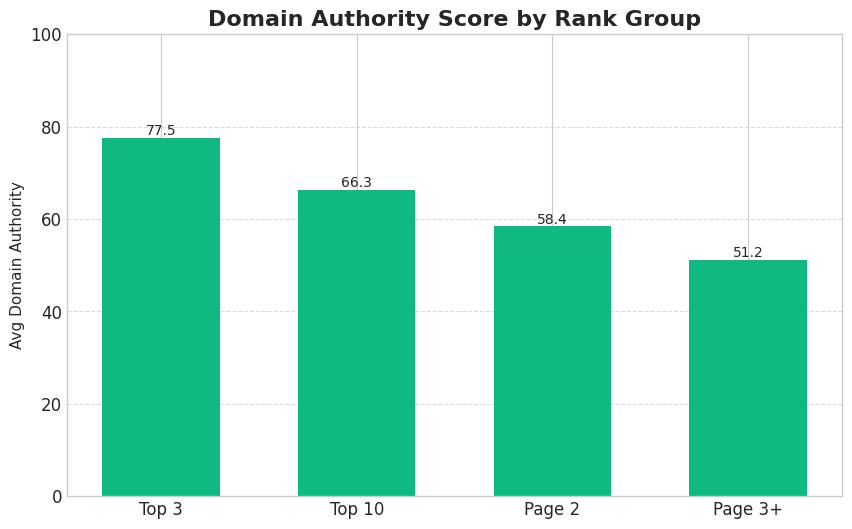
DA updates more slowly than DR, meaning it can lag behind actual changes to a site’s backlink profile by weeks or even months. It is heavily influenced by Moz’s link index, which is significantly smaller than Ahrefs’ index, meaning Moz may not be aware of many of the links pointing to a domain. Like DR, it is not used by Google and is not a ranking factor.
DR VS. DA: KEY DIFFERENCES AT A GLANCE
Tool Source — DR comes from Ahrefs. DA comes from Moz.
Main Focus — DR focuses specifically on backlink strength. DA attempts to predict overall ranking ability.
Update Frequency — DR updates faster and more frequently. DA updates more slowly.
Spam Detection — DR has minimal spam detection built in. DA includes moderate spam scoring signals.
Link Index Size — Ahrefs has a very large link index. Moz’s index is comparatively smaller.
Relevance to Google — Both are indirect only. Neither is used by Google in its ranking algorithm.
WHICH METRIC MATTERS MORE IN 2026?
Neither one on its own. Google ignores both DR and DA entirely, but each metric serves a different practical purpose depending on what you are trying to accomplish.
When DR is More Useful:
DR is the better metric when you are doing link building outreach and want to quickly assess the backlink strength of a potential linking domain. It is also more useful for competitive backlink analysis, identifying guest post opportunities, and evaluating niche edit placements. Because Ahrefs has a larger link index and updates more frequently, DR tends to be a more reliable real-time snapshot of link authority.
When DA is More Useful:
DA is the better metric when you want to check for spam risk on a potential link source, do a general authority comparison across a large number of domains, or track long-term domain trust trends. It can also be useful in commercial contexts such as selling backlink placements, where DA remains a commonly used benchmark.
THE REAL SEO PRIORITY IN 2026: RELEVANCE AND TRAFFIC OVER METRICS
Here is the truth that many SEOs still overlook: whether a site has a DR of 70 or a DA of 65 means very little in isolation. A high metric score does not automatically make a backlink valuable — and a lower metric score does not automatically make a backlink worthless.
A backlink from a high-DR or high-DA site provides almost no real SEO value if that site has no genuine organic traffic, its topic is completely unrelated to your niche, its content is thin, outdated, or low quality, it is filled with dozens of outbound paid links with no editorial standards, or its pages are not properly indexed by Google.
In 2026, the factors that actually determine the value of a backlink are topical relevance between the linking page and your page, the quality and volume of real organic traffic the linking site receives, the editorial context of the link placement, the trust and indexability of the linking page, natural and varied anchor text usage, and the absence of spammy link patterns, paid link farms, or private blog networks.
A DR 30 website in your exact niche with 15,000 monthly organic visitors will almost always deliver more SEO value than a DR 70 general blog with zero organic traffic and no topical relevance to your site.
HOW TO USE DR AND DA THE SMART WAY
The most effective approach is to use DR and DA as initial filters — not as final decision-makers. They help you quickly screen a large list of prospects, but they should never be the only criteria you evaluate.
When assessing any potential link source, combine the DR or DA score with the following additional checks:
Check the site’s organic traffic using Ahrefs, SEMrush, or SimilarWeb. A real website has real traffic. If a site has a high DR but negligible organic traffic, treat it with caution. Evaluate topical relevance — does the site cover topics closely related to your niche? Assess content quality — is the content well-written, regularly updated, and genuinely useful? Review the outbound link profile — how many external links does the average page contain, and are they editorial or paid? Check the index status in Google — are the site’s pages actually indexed and ranking? Look at engagement signals — do people actually visit, share, and interact with this site’s content? Check the spam score — particularly useful for identifying domains that have been used in link schemes.
Practical Example:
A bad link choice: DR 60 site, zero organic traffic, completely unrelated niche, multiple outbound paid links per page.
A good link choice: DR 25 site, 15,000 monthly organic visits, same niche as yours, clean editorial standards, strong content quality.
The second option will deliver more real SEO value every single time — despite the lower metric score.
VANITY METRICS VS. REAL AUTHORITY SIGNALS
One of the most important mindset shifts for SEOs in 2026 is moving away from chasing vanity metrics and toward building real authority signals that Google actually responds to.
Using elements that reinforce trust — such as branded anchor text, editorial link context, and consistent topical relevance — matters far more than hitting a specific DR or DA threshold. Natural anchor profiles, link placement within genuinely relevant content, and links from pages that real users visit and engage with are the signals that move rankings in a durable and sustainable way.
Chasing DR and DA numbers without these underlying quality signals produces short-term metric improvements that do not translate into actual ranking gains.
COMMON MISTAKES SEOs MAKE WITH DR AND DA
Rejecting every outreach opportunity from sites below a specific DR or DA threshold is one of the most common and costly mistakes in link building. Many genuinely authoritative niche sites operate at DR 20 to 40 simply because they are focused and relatively small — not because they are low quality.
Accepting links purely based on a high DR or DA score without checking traffic, relevance, or content quality leads to a backlink profile full of technically impressive but practically useless links.
Using DR or DA as the primary metric when reporting SEO progress to clients or stakeholders creates a misleading picture of success. Traffic, rankings, and conversions are the metrics that actually matter to a business.
Ignoring the difference between a site’s DR and the DR of the specific page linking to you is another overlooked mistake. Page-level authority, the number of outbound links on that page, and the indexing status of that page all affect the actual value of the link you receive.
WHAT GOOGLE ACTUALLY USES INSTEAD
While Google does not use DR or DA, it has its own internal systems for evaluating link quality and domain authority. These include PageRank — the original link authority algorithm that Google still uses internally, though it no longer publicly displays PageRank scores. Google also evaluates topical relevance of linking pages, the trustworthiness and editorial standards of linking domains, user engagement signals, content quality across the linking site, and the naturalness and diversity of a site’s overall backlink profile.
The best way to align your link building strategy with what Google actually values is to focus on earning links from real, editorially relevant, well-trafficked pages — not on chasing third-party metric thresholds.
FREQUENTLY ASKED QUESTIONS
Q: Is DR or DA a Google ranking factor? A: No. Google has confirmed multiple times that it does not use DR, DA, or any other third-party metric in its ranking algorithm. Both are proprietary estimates created by Ahrefs and Moz respectively.
Q: Which is more accurate — DR or DA? A: DR is generally considered more accurate for backlink analysis because Ahrefs has a larger link index and updates more frequently. DA can be useful for spam detection and general authority comparison.
Q: What DR or DA score should I aim for when building links? A: There is no universal threshold. A DR 25 site with strong organic traffic and topical relevance is more valuable than a DR 60 site with no traffic. Focus on relevance and traffic quality over metric scores.
Q: Can DR or DA be manipulated? A: Yes. Both can be artificially inflated through the purchase of cheap backlinks from link farms. This is exactly why neither metric should be used as a standalone indicator of quality.
Q: How often do DR and DA update? A: DR updates more frequently — often weekly or more. DA updates more slowly, sometimes taking several weeks to reflect recent changes to a site’s link profile.
Q: What should I actually focus on for link building in 2026? A: Focus on topical relevance, genuine organic traffic, editorial content quality, natural anchor diversity, and avoiding manipulative or paid link schemes. These are the factors that drive real, durable ranking improvements.
FINAL VERDICT: WHAT REALLY MATTERS FOR SEO IN 2026
DR and DA are useful tools in the right context — but they are widely misused and over-relied upon across the SEO industry.
Google does not use either metric. Relevance, real organic traffic, content quality, and editorial trust are the signals that actually move rankings. A high DR or DA score tells you one thing about one dimension of a domain — it tells you nothing about whether a link from that domain will actually help your site rank better.
Use DR and DA as quick initial filters to screen large lists of prospects. Then go deeper — check traffic, relevance, content quality, and link context before making any final decision.
The best link building strategy in 2026 is the same as it has always been at its core: earn contextual, high-quality backlinks from real websites that real users visit, trust, and engage with. Everything else is a shortcut that eventually stops working.
QUICK REFERENCE CHECKLIST
- Neither DR nor DA is used by Google — stop treating them as ranking factors
- Use DR for backlink prospecting and competitive analysis
- Use DA for spam detection and general authority comparison
- Always check organic traffic alongside DR or DA scores
- Prioritize topical relevance over metric scores every time
- Evaluate content quality and editorial standards of every link source
- Check outbound link profiles for signs of paid link schemes
- Verify that linking pages are properly indexed in Google
- Build natural, varied anchor text profiles
- Focus on earning links from real websites with real audiences

Abdullah Zulfiqar is Co-founder and Client Success Manager at RankWithLinks, an SEO agency helping businesses grow online. He specializes in client relations and SEO strategy, driving measurable results and maximizing ROI through effective link-building and digital marketing solutions.