
What Are AI Language Translation Tools?
AI language translation tools are software applications powered by machine learning and neural networks that automatically convert text or speech from one language to another. Unlike older rule-based systems, modern AI translation tools learn from vast multilingual datasets, enabling them to capture context, tone, idioms, and cultural nuance with remarkable accuracy.
The top 10 AI language translation tools in 2026 are DeepL, Google Translate, Microsoft Translator, ChatGPT, Amazon Translate, Reverso, Papago, ModernMT, Smartcat, and Unbabel. Each serves a different purpose — from casual everyday use to enterprise-level localization workflows requiring speed, accuracy, and scalability.
Choosing the right AI translation tool depends on your language pairs, use case, volume requirements, and whether you need a consumer-friendly interface or a developer-grade API.
Why AI Translation Tools Matter More Than Ever in 2026
The demand for fast, accurate language translation has never been higher. Businesses expanding into new markets, remote teams collaborating across borders, content creators reaching global audiences, and travelers navigating foreign countries all depend on reliable translation tools every single day.
Traditional human translation remains essential for high-stakes content, but AI translation tools have dramatically closed the quality gap. They deliver near-instant results, support dozens to hundreds of languages, and cost a fraction of professional translation services.
In 2026, AI translation technology has advanced to a point where the best tools handle not just words, but meaning, tone, and cultural context — making them genuinely useful for professional applications that would have required human translators just a few years ago.
Top 10 AI Language Translation Tools in 2026
1. DeepL Translator
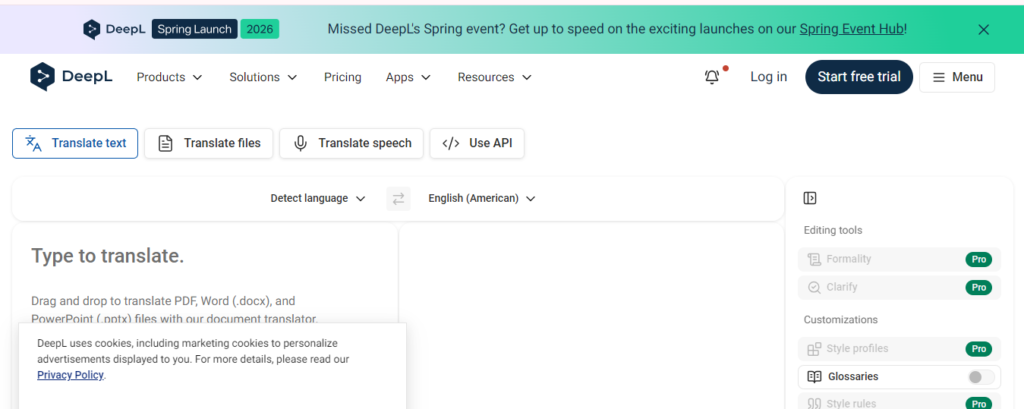
DeepL is widely regarded as the highest-quality AI translation tool available in 2026. Built on a proprietary neural network trained on carefully curated multilingual text, it consistently outperforms competitors in blind translation tests — particularly for European language pairs where its contextual accuracy is unmatched.
Key Features:
- Supports 33-plus languages with industry-leading accuracy
- Context-aware sentence reconstruction for natural-sounding output
- DeepL Write for grammar refinement and style improvement
- Glossary feature for maintaining brand-specific or technical terminology
- API access for developers and business workflow integration
- Document translation for Word, PDF, and PowerPoint files
- DeepL Pro for teams with advanced collaboration features
Best For: Professional writers, marketing teams, legal professionals, and businesses translating content where linguistic accuracy and natural flow are non-negotiable.
Weakness: More limited language coverage than Google Translate for Asian, African, and less common language pairs.
2. Google Translate
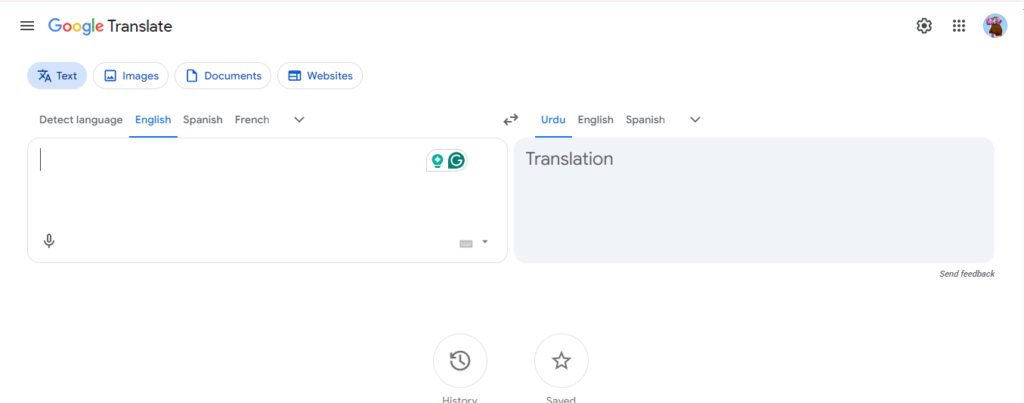
Google Translate remains the most widely used AI translation tool on the planet, supporting over 130 languages. While it may not always match DeepL’s literary finesse for European languages, its unmatched breadth and accessibility make it an indispensable everyday tool for hundreds of millions of users worldwide.
Key Features:
- 130-plus supported languages — the widest coverage of any tool
- Real-time camera translation using augmented reality overlay
- Offline translation packs for use without internet connectivity
- Conversation mode for live bilingual dialogue
- Website translation integrated directly into Chrome browser
- Handwriting input for languages with non-Latin scripts
- Free to use with no registration required
Best For: Everyday personal use, travel, quick lookups, and translation of languages where specialized tools have no coverage.
Weakness: Can struggle with complex sentence structures, technical terminology, and highly nuanced or literary content.
3. Microsoft Translator
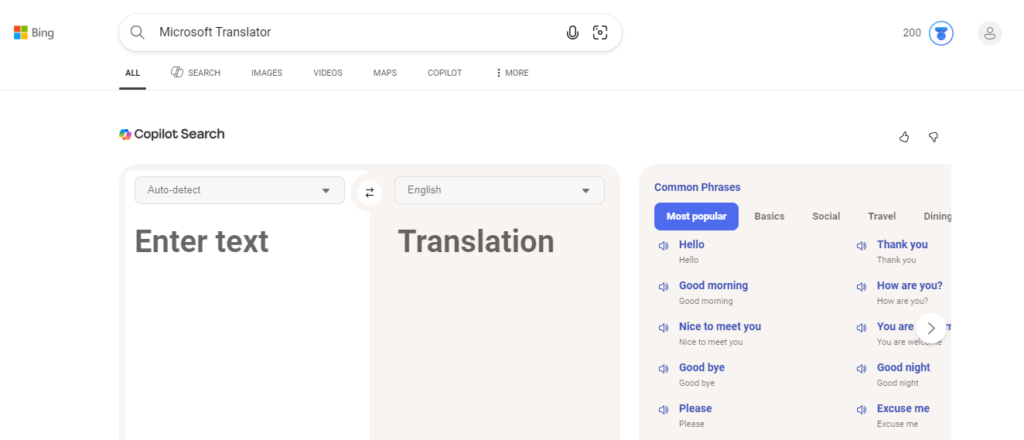
Microsoft Translator is a serious enterprise-grade AI translation tool that integrates deeply into the Microsoft 365 ecosystem. It powers translation across Word, Excel, PowerPoint, Teams, and Outlook — making it the natural default choice for organizations already running on Microsoft infrastructure.
Key Features:
- 100-plus language support with strong accuracy across major pairs
- Multi-person real-time conversation translation
- Azure Cognitive Services API for large-scale enterprise deployment
- Custom Translator for training domain-specific terminology models
- Native integration across the entire Microsoft 365 suite
- Offline mode for mobile translation without connectivity
- Free web interface alongside paid enterprise tiers
Best For: Enterprise teams, multilingual meeting environments, and organizations deeply embedded in the Microsoft ecosystem.
Weakness: The standalone web experience feels less polished than DeepL or Google Translate for casual individual users.
4. ChatGPT
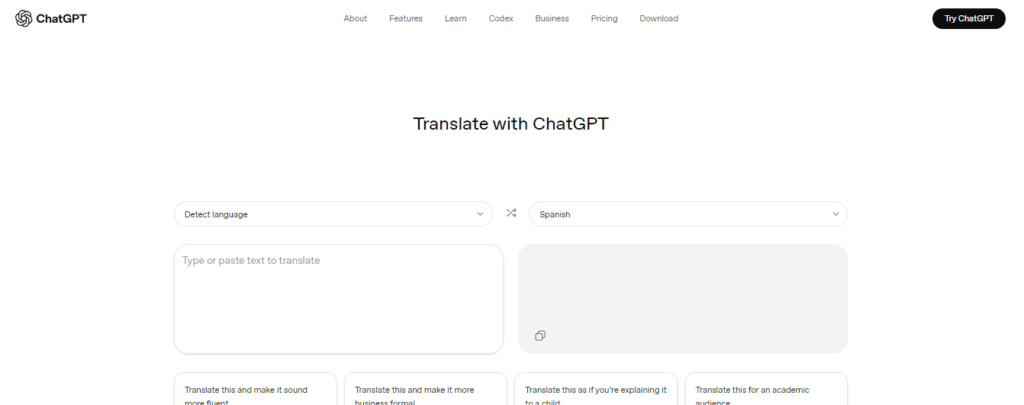
ChatGPT is not a dedicated translation tool, but its large language model foundation makes it one of the most flexible and context-aware translation assistants available in 2026. It translates, explains nuance, adapts tone, localizes idioms, and answers follow-up questions in the same conversation — something no dedicated translation tool can match.
Key Features:
- Translates with deep contextual and cultural awareness
- Adjusts formality, tone, and register on request
- Handles idiomatic expressions, slang, and specialized vocabulary naturally
- Excellent for literary and creative translation tasks
- Multi-turn conversation allows iterative refinement and clarification
- Can explain why specific translation choices were made
- Supports over 50 languages with strong performance across most
Best For: Writers, marketers, academics, and professionals who need translation with creative adaptation, cultural sensitivity, and explanatory depth — not just word-for-word conversion.
Weakness: Requires clear prompting for optimal results; no dedicated document upload or bulk translation workflow in the standard interface.
5. Amazon Translate
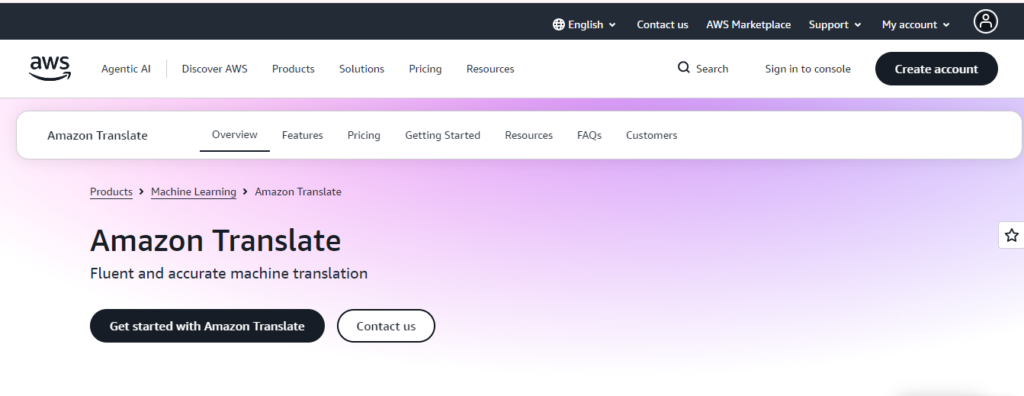
Amazon Translate is a cloud-based neural machine translation service designed specifically for developers and enterprises that need to embed translation capabilities directly into their own applications and data pipelines at scale.
Key Features:
- Supports 75-plus languages with consistent neural translation quality
- Real-time and batch translation via AWS infrastructure
- Custom terminology management for business-specific language
- Active Custom Translation for domain adaptation using your own data
- Content masking for privacy-sensitive information
- Pay-as-you-go pricing with no upfront commitment
- Deep integration with the broader AWS service ecosystem
Best For: Software developers, e-commerce platforms, SaaS companies, and enterprises building multilingual applications or processing large volumes of translated content programmatically.These teams often pair Amazon Translate with AI/ML enabled data integration software to automate how translated content flows across their entire application stack.
Weakness: Not designed for consumer use; requires technical knowledge to set up, integrate, and manage effectively.
6. Reverso
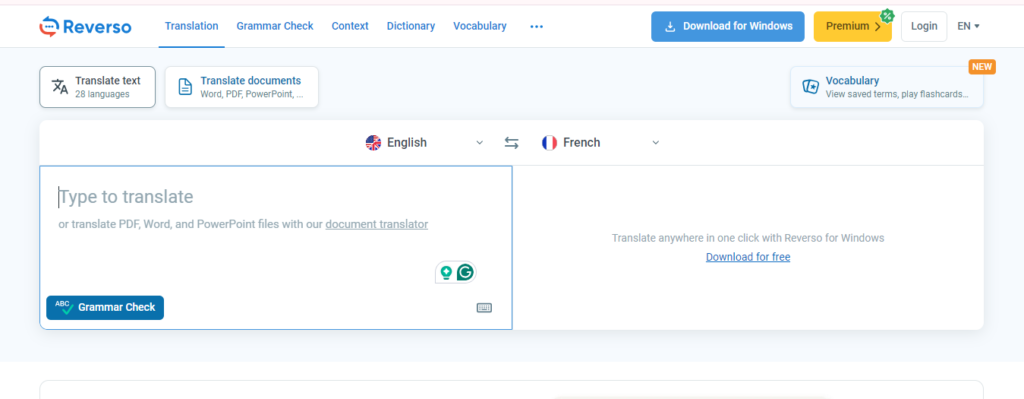
Reverso takes a uniquely educational approach to AI translation by combining accurate translation with contextual examples drawn from real published texts. It shows not just what a word or phrase means, but how it is actually used in authentic written and spoken contexts — making it invaluable for language learners and professionals who want to understand usage, not just meaning.
Key Features:
- Context-based translation with real-world usage examples
- Verb conjugation tool across multiple supported languages
- Grammar and spell checking with correction suggestions
- Personal vocabulary learning system with flashcards
- Browser extension for instant in-page translation
- Supports 25-plus languages with strong European coverage
- Available as web, desktop, and mobile application
Best For: Language learners, students, bilingual professionals, and anyone who wants to understand how phrases function in real contexts rather than receiving isolated translations.
Weakness: Not suited to translating large documents or processing high-volume content; limited utility for pure business translation workflows.
7. Papago
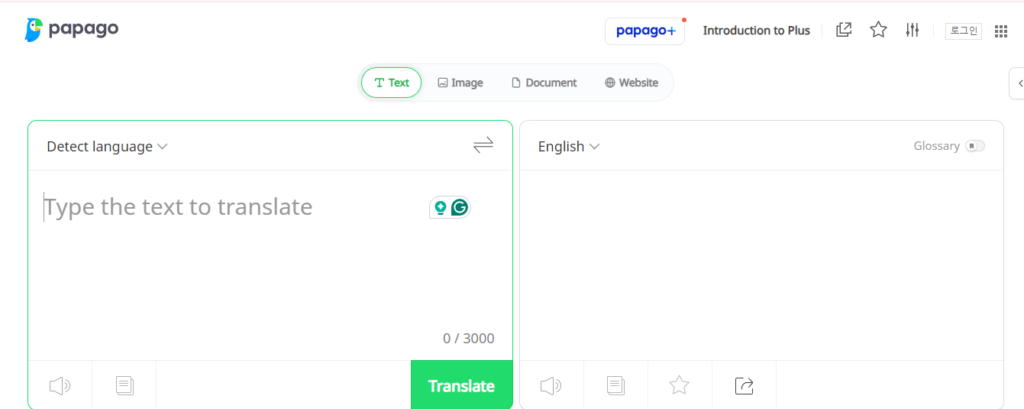
Papago is developed by Naver, South Korea’s dominant internet company, and is purpose-built for East Asian language translation. It handles Korean, Japanese, Chinese, and Vietnamese with a level of cultural and linguistic accuracy that Western-built tools consistently struggle to match — particularly for informal speech, honorifics, and culturally specific expressions.
Key Features:
- Exceptional accuracy for Korean, Japanese, Chinese, and Vietnamese
- Voice, image, and handwriting input support
- Real-time conversation mode for bilingual dialogue
- Built-in dictionary with example sentences and usage notes
- Website translation for full-page rendering in target language
- Free mobile app with offline translation support
- Regularly updated with Korean language developments and slang
Best For: Anyone working with East Asian languages — particularly Korean-English, Japanese-English, and Chinese-English translation — where cultural nuance matters as much as linguistic accuracy.
Weakness: Limited effectiveness and coverage for non-Asian language pairs compared to DeepL or Google Translate.
8. ModernMT
ModernMT is a professional-grade adaptive machine translation engine built for translators and localization teams who need a system that improves with use. Its defining feature is real-time learning — it adapts to human corrections made during translation, continuously refining its output to match the style, terminology, and preferences of each specific project.
Key Features:
- Adaptive learning engine that improves from translator feedback in real time
- Deep integration with professional CAT tools including SDL Trados, memoQ, and Phrase
- Domain-specific translation memory for consistent terminology
- High accuracy for technical, legal, and specialized content
- REST API for custom enterprise integration
- Human-in-the-loop workflow for hybrid translation pipelines
- Supports 45-plus languages with strong European and Asian coverage
Best For: Professional translators, localization agencies, and enterprise translation teams managing long-term projects where terminology consistency and continuous quality improvement are essential.
Weakness: Not designed for casual or individual use; requires integration into professional translation workflows to deliver its full value.
9. Smartcat
Smartcat is a comprehensive AI-powered translation management platform that combines machine translation with collaborative human review workflows, project management tools, and a marketplace of professional translators — making it a complete end-to-end solution for teams managing multilingual content at scale.
Key Features:
- AI translation with integrated human review and editing workflow
- Built-in marketplace connecting teams with professional translators globally
- Translation memory and centralized terminology management
- Integrations with major CMS platforms, GitHub, Figma, and marketing tools
- Project management dashboard for tracking translation jobs across teams
- Supports 280-plus languages
- Per-word pricing model with no subscription required for basic use
Best For: Content teams, marketing agencies, software companies, and global businesses managing continuous localization across multiple languages, content types, and team members simultaneously.
Weakness: Feature depth can feel overwhelming for individual users or small teams with straightforward, low-volume translation needs.
10. Unbabel
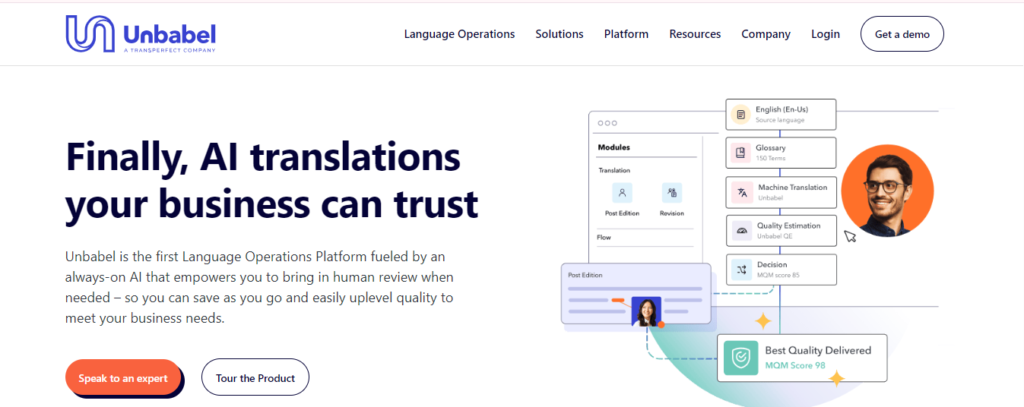
Unbabel combines AI translation with a layer of professional human post-editing to deliver what it calls human-quality translation at machine speed. It is purpose-built for customer service and support operations that need fast, accurate, multilingual communication at volume — without building large in-house language teams.
Key Features:
- AI plus human review hybrid model for verified translation quality
- Deep native integration with Zendesk, Salesforce, Freshdesk, and ServiceNow
- Real-time customer support message translation across 30-plus languages
- Quality Estimation scoring system for evaluating each translation automatically
- Enterprise SLA with guaranteed turnaround times and quality benchmarks
- Centralized translation memory across all customer conversations
- Detailed analytics dashboard for translation volume and quality tracking
Best For: Customer service operations, global support centers, and businesses handling high volumes of multilingual customer communications where quality, speed, and auditability all matter.
Weakness: The hybrid human-plus-AI model makes it significantly more expensive than purely automated tools — pricing reflects the added quality assurance layer.
How to Choose the Right AI Translation Tool in 2026
Define Your Use Case Before Anything Else
The best AI translation tool depends entirely on what you need it to do. A traveler needs something completely different from a software developer. A content marketer has different requirements from a customer support manager. And a language learner needs different features from an enterprise localization team.
Ask yourself these questions before evaluating any tool:
- Am I translating casual text or professional documents?
- Do I need real-time translation or batch processing?
- Which specific language pairs are most critical for my work?
- Do I need API access or a simple consumer interface?
- Is translation accuracy or processing speed the higher priority?
- Will translations be used externally or only internally?
Evaluate Language Pair Coverage Carefully
Not all AI translation tools perform equally across all language pairs. DeepL dominates European languages. Papago leads for East Asian pairs. Google Translate offers the widest overall coverage. Microsoft Translator performs strongly across business language pairs.
If your work consistently involves specific languages, never rely on general reputation alone. Test multiple tools on samples of your actual content before committing to a platform.
Consider Integration Requirements
For businesses, integration with existing tools matters as much as raw translation quality. Microsoft Translator is the clear winner for Office and Teams users. Amazon Translate is built for AWS-native application development. Smartcat and Unbabel offer the deepest integrations with content management and customer support platforms.
Always Test With Real Content
Every tool performs differently depending on subject matter. Legal documents, marketing copy, technical documentation, conversational customer support messages, and literary content each challenge AI translation systems in distinct ways. Run real samples from your actual workflow before making any final decision.
AI Translation Tools vs. Human Translators in 2026
AI translation has advanced dramatically, but it remains an imperfect replacement for skilled human translators in certain high-stakes contexts.
Where AI translation tools excel:
- High-volume, time-sensitive content requiring rapid turnaround
- Internal communications and informal business text
- First draft translations that will be reviewed and refined by humans
- Real-time customer support and conversational communication
- Languages and markets where human translators are scarce or expensive
Where human translators still lead:
- Legal and medical documents where a single mistranslation has serious consequences
- Literary and creative translation requiring deep cultural interpretation
- Certified translations required for government, legal, or immigration purposes
- High-value marketing campaigns where brand voice and cultural resonance are critical
- Languages with limited AI training data where model quality is inconsistent
The most effective professional approach in 2026 is a well-designed hybrid — AI handles the volume and speed, human expertise ensures quality and cultural accuracy where it matters most.
Key Features to Evaluate in Any AI Translation Tool
When assessing any AI translation tool for your specific needs, prioritize these capabilities:
- Translation accuracy and fluency — Does output read naturally in the target language?
- Language coverage — Does it support every language pair you need?
- Contextual understanding — Can it handle idioms, technical terms, and cultural references?
- Processing speed — How quickly does it handle large volumes of content?
- Data security and privacy — Is your content encrypted and protected from third-party access?
- Customization options — Can you train it on your own terminology, style guides, or domain data?
- Integration capabilities — Does it connect seamlessly with your existing tools and workflows?
- Cost structure — Is pricing predictable and scalable as your volume grows?
The Future of AI Language Translation
AI translation technology is advancing faster than at any previous point in history. Large language models are making context-aware, culturally sensitive translation more accessible and more accurate than ever before. Real-time speech translation is approaching a level where live multilingual conversations feel genuinely natural rather than mechanically processed.
Multimodal translation — handling text, images, audio, and video simultaneously — is the next major frontier. Tools are beginning to translate entire multimedia experiences, not just isolated written content.
For businesses and individuals alike, staying current with developments in AI translation means maintaining a genuine competitive advantage in an increasingly interconnected global economy.
Final Verdict: Best AI Translation Tool for Every Need in 2026
There is no single best AI language translation tool — the right choice depends entirely on your specific requirements, language pairs, and workflow.
- Best overall translation quality: DeepL
- Best language coverage: Google Translate
- Best for Microsoft and enterprise users: Microsoft Translator
- Best for contextual and creative translation: ChatGPT
- Best for developers and API integration: Amazon Translate
- Best for language learners: Reverso
- Best for East Asian languages: Papago
- Best for professional translators and localization teams: ModernMT
- Best for content and marketing localization: Smartcat
- Best for multilingual customer support: Unbabel
Start with free versions of your top two or three candidates. Test them against real content from your actual workflow. The right tool will become obvious quickly — and the wrong one will too.

Fazilat zulfiqar is an SEO specialist at RankWithLinks, focused on improving search rankings through smart link building and optimization.He helps businesses grow organic traffic and build strong online authority.