
Data integration has always been one of the most operationally demanding challenges in enterprise technology. Moving data across systems, transforming it into usable formats, and keeping it synchronized in real time is complex work — and traditional ETL tools were built for a slower, more predictable world.
AI and machine learning have fundamentally changed what data integration software can do. The best AI/ML enabled data integration software today doesn’t just move data — it understands it, learns from it, corrects errors automatically, and adapts pipelines without constant human intervention.
This guide covers the top platforms, key capabilities to evaluate, and how to choose the right solution for your organization’s data architecture.
What Is AI/ML Enabled Data Integration Software?
AI/ML enabled data integration software combines traditional data pipeline functionality — extraction, transformation, loading, and synchronization — with artificial intelligence and machine learning capabilities that automate, optimize, and improve the process over time.
Rather than relying entirely on manually coded rules, these platforms use intelligent automation to handle schema mapping, data quality enforcement, anomaly detection, and pipeline optimization. The result is faster deployment, fewer errors, and dramatically reduced maintenance burden for data engineering teams.
Key capabilities that distinguish AI-powered integration tools from legacy platforms include:
- Automated schema detection and mapping recommendations
- Intelligent data quality monitoring and anomaly alerts
- Natural language interfaces for pipeline creation and querying
- ML-driven transformation suggestions
- Predictive pipeline failure detection and self-healing workflows
- Continuous learning from historical data patterns
Why AI and ML Matter in Data Integration
Traditional data integration tools require significant manual effort at every stage. Mapping source fields to target schemas, writing transformation logic, debugging failed loads, and monitoring pipeline health all demand skilled engineers working continuously.
The scale of modern data environments has outpaced what manual approaches can handle. Organizations now integrate dozens of SaaS applications, cloud data warehouses, streaming sources, APIs, and legacy systems simultaneously. Without intelligent automation, the complexity becomes unmanageable.
AI and ML address this in several concrete ways:
Reduced time to deployment: Automated schema mapping and transformation recommendations cut pipeline build time from days to hours.
Improved data quality at scale: ML models detect anomalies, missing values, format inconsistencies, and duplicate records automatically — before bad data reaches downstream systems.
Lower maintenance overhead: Self-healing pipelines that detect and recover from failures without manual intervention reduce on-call burden for data teams.
Better business outcomes: When data flows reliably and cleanly, analytics, reporting, and AI model training all produce more accurate results.
Best AI/ML Enabled Data Integration Software in 2026
1. Informatica Intelligent Data Management Cloud (IDMC)
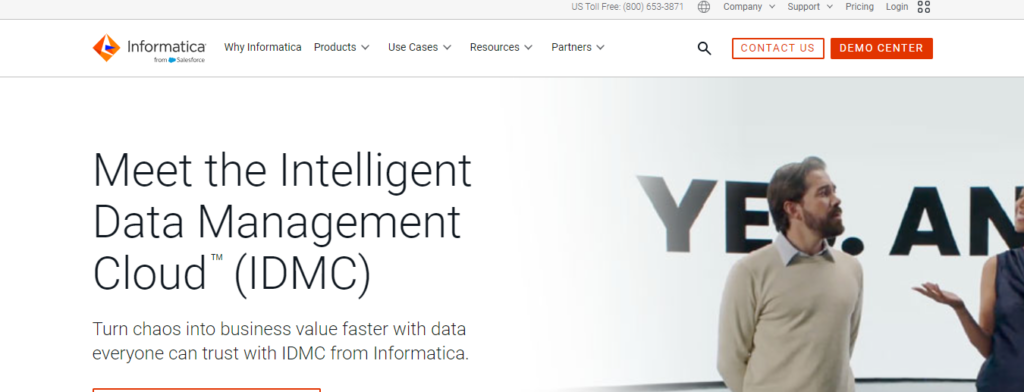
Informatica IDMC is widely regarded as the most feature-complete AI/ML enabled data integration platform available at enterprise scale. Its CLAIRE AI engine powers intelligent automation across the entire data management lifecycle — from discovery and integration to governance and quality.
Key AI/ML capabilities:
- CLAIRE GPT for natural language pipeline generation and data exploration
- Automated schema mapping and field-level transformation recommendations
- ML-driven data quality rules that learn from historical cleansing patterns
- Intelligent metadata discovery across cloud, on-premises, and hybrid environments
- Predictive impact analysis for schema changes
Informatica IDMC supports a vast connector library covering hundreds of cloud applications, databases, and file formats. Its AI capabilities are deeply embedded, not bolted on — making it the strongest choice for large enterprises with complex, heterogeneous data environments.
Best for: Large enterprises managing multi-cloud data ecosystems with strict governance requirements.
2. Talend Data Fabric
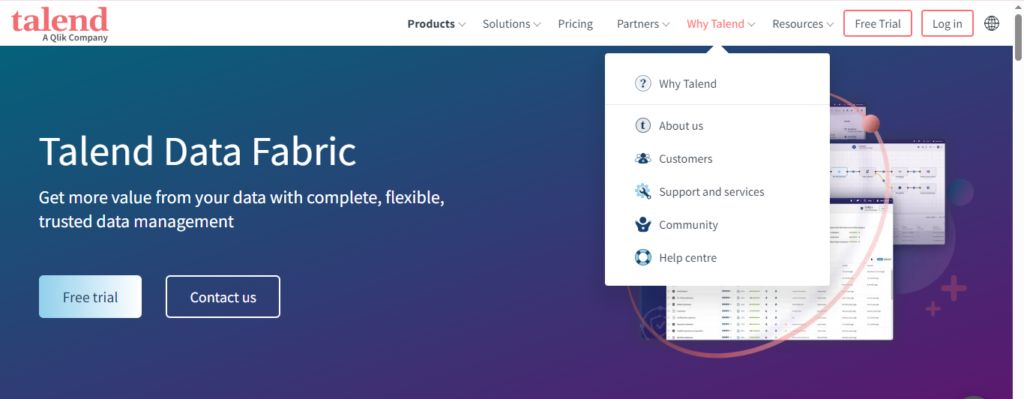
Talend Data Fabric brings AI-assisted data integration together with data quality, governance, and observability in a unified platform. Acquired by Qlik, Talend now benefits from enhanced analytics integration while retaining its strong open-source roots and broad connector ecosystem.
Key AI/ML capabilities:
- AI-powered data quality scoring with Trust Score for every dataset
- Automated anomaly detection in data pipelines
- Smart field mapping with ML-based suggestions during pipeline design
- Data health monitoring powered by machine learning models
- Integration with Qlik’s AI-driven analytics layer
Talend is particularly strong for organizations that need to combine integration with active data quality management. Its Trust Score feature gives business users and data engineers a shared, quantifiable measure of data reliability.
Best for: Organizations that treat data quality and integration as a unified discipline rather than separate concerns.
3. MuleSoft Anypoint Platform
MuleSoft Anypoint Platform is a leading API-led integration solution that has incorporated significant AI capabilities through Salesforce Einstein and the broader Salesforce AI ecosystem. It is especially powerful for organizations that need to integrate SaaS applications, APIs, and event-driven data sources at scale.
Key AI/ML capabilities:
- Einstein AI for intelligent API discovery and reuse recommendations
- Automated anomaly detection in API traffic and data flows
- Natural language interface for creating integration flows via MuleSoft Copilot
- ML-powered DataSense for automatic schema detection and mapping
- Predictive analytics on integration performance and failure patterns
MuleSoft’s strength lies in its API management layer combined with integration — making it uniquely effective for companies that manage complex API ecosystems alongside traditional data pipelines.
Best for: Salesforce-centric organizations and enterprises with large API integration footprints.
v4. Azure Data Factory with Azure AI Services
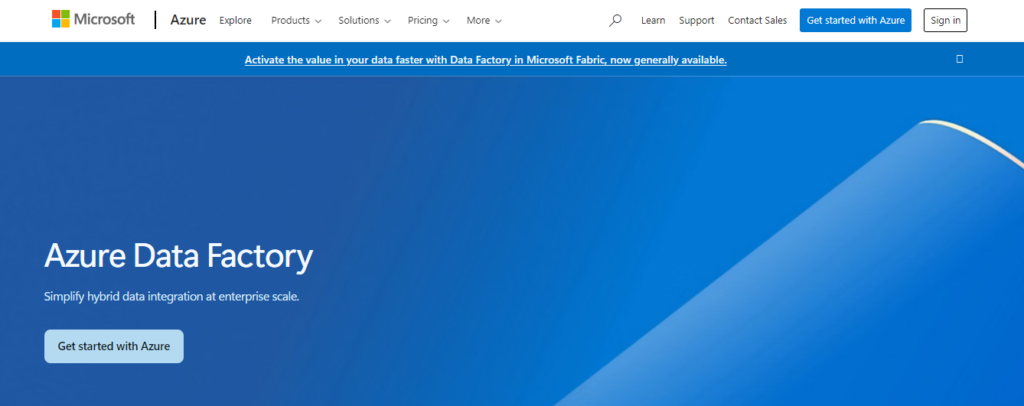
Microsoft Azure Data Factory is a cloud-native data integration service that becomes a genuinely AI/ML enabled platform when combined with Azure’s broader AI and Cognitive Services ecosystem. For organizations already invested in the Microsoft cloud, it offers deep native integration with Azure Synapse, Azure Machine Learning, and Microsoft Fabric.
Key AI/ML capabilities:
- Intelligent monitoring with ML-based anomaly detection on pipeline runs
- Mapping Data Flows with AI-assisted transformation logic
- Integration with Azure OpenAI for natural language data operations
- Automated schema drift detection and handling
- AI-powered data profiling through Azure Purview integration
Microsoft Fabric — Microsoft’s unified analytics platform — extends Azure Data Factory’s capabilities further, embedding Copilot AI assistance throughout the data engineering experience.
Best for: Enterprises standardized on the Microsoft Azure ecosystem seeking tightly integrated AI and data capabilities.
5. AWS Glue with Amazon SageMaker Integration
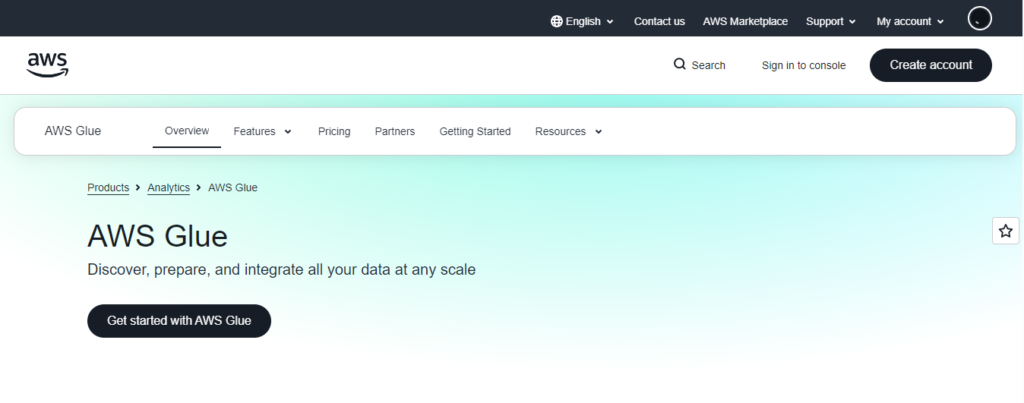
AWS Glue is Amazon’s serverless data integration service that, when combined with Amazon SageMaker and the broader AWS AI services portfolio, becomes a powerful AI/ML enabled data integration environment. It is especially compelling for organizations building data pipelines that feed directly into machine learning workflows.
Key AI/ML capabilities:
- Glue DataBrew for ML-powered data profiling and transformation recommendations
- Automatic schema inference and evolution handling
- Integration with Amazon SageMaker for ML-driven data preparation pipelines
- Anomaly detection on data quality metrics via Amazon Deequ integration
- Natural language query capabilities through Amazon Q integration
AWS Glue is serverless by design, meaning teams pay only for what they use and don’t manage infrastructure. This makes it highly scalable and cost-effective for variable workloads.
Best for: AWS-native organizations building end-to-end data and ML pipelines within the Amazon ecosystem.
Core Capabilities to Evaluate in AI/ML Enabled Data Integration Platforms
When assessing any platform in this category, go beyond feature checklists. Evaluate how deeply AI is embedded in the actual user workflow.
Intelligent Schema Mapping and Discovery
Manually mapping fields between source and target systems is one of the most time-consuming parts of data integration work. Look for platforms where AI automatically suggests mappings based on field names, data types, historical patterns, and semantic similarity — not just exact name matches.
Data Quality Intelligence
AI-driven data quality goes beyond simple rule checks. The best platforms learn what “normal” looks like for each dataset and alert teams when values, volumes, or distributions shift unexpectedly. This catches issues that predefined rules would miss entirely.
Natural Language Interfaces
Generative AI has made natural language pipeline creation a practical reality. Platforms with mature NL interfaces let data engineers describe what they want in plain language and receive working pipeline configurations in return — dramatically accelerating development.
Self-Healing Pipelines
ML models that predict pipeline failures before they occur — and automatically retry, reroute, or alert based on failure patterns — reduce operational overhead significantly. This capability separates mature AI platforms from those with surface-level AI features.
Lineage and Impact Analysis
AI-powered data lineage tracks how data flows from source to destination and identifies which downstream assets are affected by schema changes. This is critical for governing complex data environments and avoiding unexpected breakages.
AI/ML Enabled Data Integration vs. Traditional ETL Tools
Understanding the practical differences helps build the business case for upgrading legacy platforms:
| Capability | Traditional ETL | AI/ML Enabled Integration |
|---|---|---|
| Schema mapping | Manual | AI-suggested, ML-assisted |
| Data quality | Rule-based | ML anomaly detection |
| Pipeline creation | Coded or visual drag-drop | Natural language + AI generation |
| Error handling | Manual debugging | Self-healing with AI suggestions |
| Scalability | Often infrastructure-limited | Cloud-native, auto-scaling |
| Maintenance burden | High | Significantly reduced |
| Time to deployment | Days to weeks | Hours to days |
How to Choose the Best AI/ML Data Integration Software for Your Organization
No single platform wins across every use case. Choosing the right one requires honest assessment of your environment, team, and goals.
Step 1: Assess Your Data Environment
Inventory the systems you need to integrate — cloud apps, databases, streaming sources, APIs, legacy platforms. Some tools excel in SaaS connectivity, others in enterprise database transformation. Match platform strengths to your actual source landscape.
Step 2: Define Your Primary Use Case
Are you building data pipelines for analytics? Feeding ML model training? Synchronizing operational systems in real time? Platforms like Databricks excel for ML-centric pipelines. Fivetran and Matillion lead for analytics ELT. MuleSoft leads for API-driven integration.
Step 3: Evaluate Your Team’s Technical Depth
Tools like Informatica IDMC and IBM DataStage offer the most power but require experienced data engineers to operate effectively. Boomi and Matillion Copilot are more accessible for teams with mixed technical backgrounds.
Step 4: Consider Your Cloud Ecosystem
If your organization is standardized on AWS, Azure, or Google Cloud, evaluate the native integration services first. They offer deep ecosystem integration, favorable pricing, and simplified governance within your existing cloud contracts.
Step 5: Test AI Features Practically
During proof-of-concept evaluations, specifically test the AI features — not just the connectivity. How accurate are mapping suggestions? How fast does the anomaly detection catch a real quality issue? How useful is the natural language interface with your actual schemas?
Common Mistakes When Implementing AI/ML Data Integration Tools
Even with the best platform, implementation mistakes undermine value:
- Skipping data discovery: Deploying integration without a clear inventory of source systems leads to incomplete pipelines and missed dependencies.
- Treating AI as a replacement for data governance: AI features surface issues and suggest fixes, but governance policies, ownership definitions, and quality standards still require human decisions.
- Underestimating transformation complexity: Simple connectors are easy. Complex business logic transformations — even with AI assistance — require careful design and testing.
- Ignoring data lineage from day one: Lineage is much harder to reconstruct retroactively. Build lineage tracking into your integration architecture from the start.
- Not defining data quality thresholds: AI anomaly detection needs baselines. Invest time upfront in profiling your data and defining acceptable quality parameters.
The Future of AI/ML in Data Integration
The trajectory of AI capabilities in data integration is accelerating rapidly. Several developments will shape the next generation of platforms:
Autonomous pipelines: AI agent that design, deploy, monitor, and optimize entire integration workflows with minimal human input are moving from concept to early reality.
Semantic data understanding: Future platforms will move beyond syntactic field matching to genuine semantic understanding — knowing that “customer_id” and “client_number” represent the same entity across systems.
Generative data quality rules: Rather than writing quality rules manually, teams will describe outcomes in natural language and have AI generate the underlying logic automatically.
Real-time AI enrichment: Integration pipelines will increasingly apply AI enrichment — entity resolution, sentiment scoring, classification — as data flows through in real time rather than in batch.
Final Thoughts
The best AI/ML enabled data integration software in 2026 is defined not by the breadth of its connector library alone, but by how deeply intelligence is embedded in every stage of the integration lifecycle — from discovery and mapping through quality enforcement and operational monitoring.
Informatica IDMC leads for enterprise complexity. Fivetran and Matillion lead for modern cloud data stack efficiency. Databricks leads where integration and ML model development converge. MuleSoft leads for API-driven integration at scale. And for teams on specific clouds, Azure Data Factory and AWS Glue offer powerful AI capabilities within familiar ecosystems.
The organizations that invest in genuinely intelligent integration infrastructure today will build faster, more reliable, and more analytically powerful data platforms — and that advantage compounds over time as their AI-powered pipelines learn, adapt, and improve continuously.

Fazilat zulfiqar is an SEO specialist at RankWithLinks, focused on improving search rankings through smart link building and optimization.He helps businesses grow organic traffic and build strong online authority.