
In the early days of advertising, retail pioneer John Wanamaker famously remarked: “Half the money I spend on advertising is wasted; the trouble is I don’t know which half.”
For decades, traditional brand advertising operated under this uncomfortable uncertainty. Companies poured budget into billboards, print magazines, and television commercials, hoping to build brand awareness while struggling to track exact sales attribution.
Performance marketing eliminates that mystery.
Unlike traditional marketing campaigns that charge fixed rates for broad audience exposure, performance marketing is an outcome-driven discipline where advertisers pay only when a specific, verifiable action occurs—such as a click, a qualified lead, an app installation, or a completed sale.
Whether you manage an enterprise SaaS company, an eCommerce brand, or a growing digital agency, understanding how to structure, execute, and optimize performance marketing is essential for driving predictable revenue in modern digital markets.
In this comprehensive guide, we will unpack how performance marketing works, evaluate the core pricing models and advertising channels, master the essential financial metrics, and examine how pairing performance media with organic search authority creates a compounding competitive advantage.
What Is Performance Marketing?
The Core Principle: Paying for Results, Not Eyeballs
At its foundation, performance marketing is a top-to-bottom framework for digital advertising where advertisers tie financial commitments directly to measurable consumer behaviors.
In traditional advertising models, you pay a media buyer upfront based on impressions—the estimated number of people who might see your content. In performance marketing, ad spend is directly tied to conversions.
If an ad runs a million times but yields zero clicks or conversions under a Cost-Per-Acquisition agreement, the advertiser owes nothing for the unused impressions. The risk shifts from the buyer to the performance framework, incentivizing precision targeting, compelling creative, and seamless conversion funnel design.
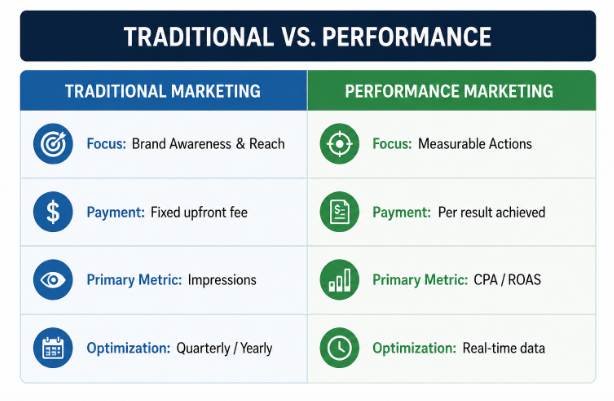
How Performance Marketing Differs from Traditional & Brand Marketing
It is crucial to note that performance marketing is not a replacement for brand building; rather, it is a complementary engine.
- Brand Marketing focuses on long-term brand positioning, emotional resonance, customer recall, and reputation. It establishes trust, increases baseline conversion rates, and reduces price sensitivity over time.
- Digital Marketing is the broad umbrella covering all online marketing activities, including content marketing, social media management, organic search, and public relations.
- Performance Marketing is the quantitative, transactional engine inside digital marketing. It prioritizes direct-response mechanisms with immediate feedback loops.
The Key Players in the Performance Marketing Ecosystem
A successful performance campaign relies on four primary groups working in tandem:
- The Retailer or Merchant (Advertiser): The business looking to sell a product, generate leads, or acquire users. Advertisers define conversion goals, set target acquisition costs, and provide budget.
- The Publisher or Affiliate (Media Seller): The platform or creator displaying the advertisement. This ranges from search engines like Google and social networks like Meta to specialized affiliate marketers, content websites, and programmatic ad networks.
- Networks & Tracking Platforms: Third-party tech stacks (such as Google Tag Manager, affiliate networks, or Attribution engines) that track clicks, record conversions, log user journeys, and facilitate accurate payouts.
- The Consumer: The end-user who sees the advertisement, interacts with the creative, and completes the desired conversion action.
Performance Marketing Pricing Models Explained
Choosing the correct pricing model depends on your business model, cash flow dynamics, and conversion funnel complexity. Below are the five primary financial structures used in performance marketing today.
| Pricing Model | Full Name | How Payment Works | Best Used For | Primary Risk Holder |
|---|---|---|---|---|
| CPC | Cost Per Click | Advertiser pays when a user clicks the ad. | Driving targeted website traffic; paid search. | Shared |
| CPL | Cost Per Lead | Advertiser pays when a user submits contact info. | B2B SaaS, consultation services, insurance. | Merchant |
| CPA | Cost Per Acquisition | Advertiser pays when a transaction/sale occurs. | eCommerce, digital products, direct-to-consumer. | Publisher |
| CPM | Cost Per Mille | Advertiser pays per 1,000 ad impressions. | Retargeting, brand reach, top-of-funnel social. | Merchant |
| RevShare | Revenue Sharing | Publisher receives a fixed % of generated revenue. | Affiliate marketing, high-margin software. | Publisher |
Cost Per Click (CPC)
With CPC, you pay strictly when a user clicks on your ad to visit a landing page. This is the cornerstone model for Search Engine Marketing (SEM) on platforms like Google Ads and Bing Ads.
- Advantage: You only pay for active interest, not passive views.
- Formula:
Total Ad Spend / Total Clicks = CPC
Cost Per Lead (CPL)
Common in B2B marketing, financial services, and SaaS industries, CPL requires the user to complete an explicit form—such as signing up for a product demo, downloading a whitepaper, or requesting a quote.
- Advantage: Guarantees contactable prospective customers for your sales team.
- Formula:
Total Ad Spend / Total Leads Generated = CPL
Cost Per Acquisition / Action (CPA)
Under a CPA model, you pay exclusively when a user completes a high-value action, usually a completed purchase or a paid subscription activation.
- Advantage: Maximum financial alignment; marketing expenditure directly correlates with sales revenue.
- Formula:
Total Ad Spend / Total Conversions = CPA
Cost Per Thousand Impressions (CPM)
CPM represents the cost for every 1,000 times an ad is rendered on screen (“mille” is Latin for thousand). While CPM is technically an impression-based model, performance marketers utilize optimized CPM (oCPM) on social platforms to allow platform algorithms to serve ads specifically to users likely to convert.
- Advantage: Excellent for scalable visual platforms (Meta, TikTok, Display) where algorithms handle conversion optimization.
- Formula:
(Total Ad Spend / Total Impressions) * 1,000 = CPM
Revenue Share / Commission-Based
Popularized in affiliate networks, RevShare grants publishers a negotiated percentage of every sale they refer. For instance, an affiliate promoting software might earn 20% of the recurring monthly subscription fee for every customer brought to the merchant.
Top Performance Marketing Channels & How to Use Them
Modern performance marketers rarely rely on a single source of traffic. Diversifying across complementary media channels builds resilience against algorithm shifts and rising ad costs.
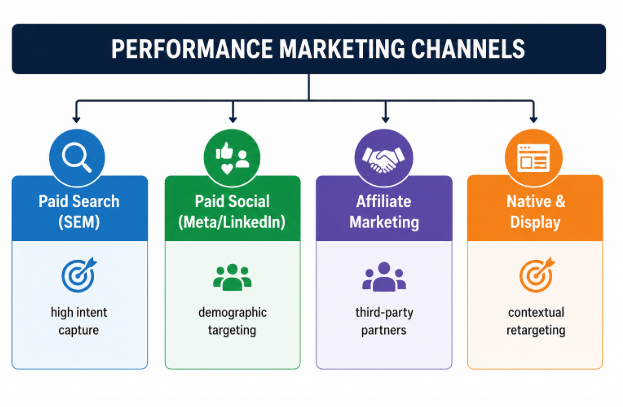
1. Search Engine Marketing (SEM) & Paid Search
Google Ads and Microsoft Advertising allow marketers to bid on explicit user queries. When a potential customer searches “best SEO agency for SaaS” or “buy link building service,” paid search ads capture users at the peak of their purchase intent.
- Key Strengths: Unmatched commercial intent, fast testing of keyword viability, immediate visibility.
- Best Practices: Use negative keyword lists liberally to prevent wasted ad spend; write ad copy that mirrors the exact problem identified in the search query.
2. Paid Social Media Advertising
Platforms like Meta (Facebook & Instagram), LinkedIn, TikTok, and YouTube combine granular demographic data with machine-learning algorithms to target specific audience segments.
- Key Strengths: Advanced visual storytelling, precise demographic and firmographic targeting (especially LinkedIn for B2B decision-makers), effective retargeting capabilities.
- Best Practices: Refresh creative frequently to avoid audience ad fatigue; focus heavily on the first 3 seconds of video content to hooks viewers.
3. Affiliate & Publisher Marketing
Affiliate marketing leverages external content creators, review sites, and niche publishers who promote your products to their existing audiences in exchange for a performance commission.
- Key Strengths: Low upfront financial risk, built-in audience trust from the publisher, scalable reach.
- Regulatory Compliance Note: All affiliate promotions must adhere to legal standards such as the Federal Trade Commission advertising guidance regarding clear disclosure of affiliate partnerships.
4. Native & Display Advertising
Native ads (facilitated by networks like Outbrain or Taboola) match the visual design and editorial voice of the host publication. Display ads appear as banners across web properties within advertising networks.
- Key Strengths: Wide reach, cost-effective top-of-funnel traffic, strong performance in retargeting visitors who previously browsed your website.
Essential Performance Marketing Metrics & Formulas
To succeed in performance marketing, you must track unit economics accurately. Relying solely on platform-reported metrics can lead to misallocated capital.
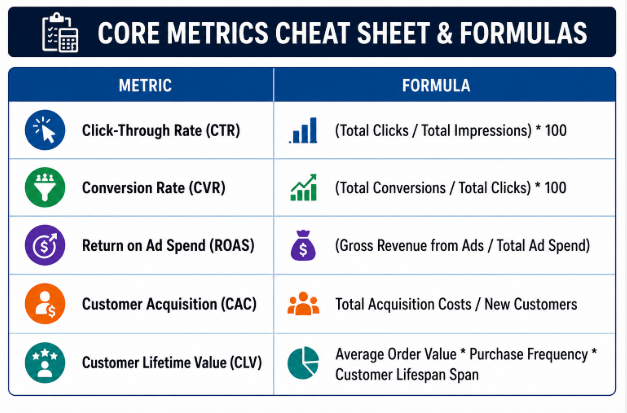
1. Click-Through Rate (CTR)
CTR measures the percentage of people who saw your ad and chose to click it. A low CTR indicates weak creative, uncompelling headlines, or poor audience targeting.
CTR (%)=(Total ImpressionsTotal Clicks)×100
2. Conversion Rate (CVR)
CVR measures the percentage of visitors who clicked your ad and went on to complete your target action on your landing page.
CVR (%)=(Total ClicksTotal Conversions)×100
3. Return on Ad Spend (ROAS)
ROAS evaluates the gross revenue generated for every dollar spent on advertising. For instance, if you spend 1,000onGoogleAdsandgenerate4,000 in direct revenue, your ROAS is 4.0 (or 400%).
ROAS=Total Ad SpendGross Revenue Generated from Ads
4. Customer Acquisition Cost (CAC)
CAC represents the total cost required to acquire a single paying customer. Unlike raw ad CPA, true CAC incorporates media spend, agency management fees, software tools, and creative production costs.
CAC=Number of New Customers AcquiredTotal Media Spend+Production & Management Expenses
5. Customer Lifetime Value (CLV or LTV)
CLV represents the total net revenue a customer generates over the entire duration of their relationship with your business. As highlighted in research published by Harvard Business Review on marketing ROI, evaluating customer acquisition strictly against initial purchase revenue obscures the true return on investment. High-growth SaaS and eCommerce companies routinely spend more on initial acquisition than the first purchase value if their LTV justifies it.
Healthy Business Benchmark:CACLTV≥3.0
How to Build a Winning Performance Marketing Strategy (5-Step Framework)
Executing a profitable performance marketing campaign requires a systematic process rather than random experimentation. Follow this 5-step operational framework:
Step 1: Define Clear Campaign Objectives & Unit Economics
Before launching a campaign, establish your firm financial parameters. What is the maximum acceptable CAC that maintains gross margin profitability?
For guidance on establishing sound budgetary benchmarks, consult resources provided by the U.S. Small Business Administration marketing guidelines.
Step 2: Choose and Segment Your High-Intent Channels
Match your audience profile to the appropriate advertising network. B2B software solutions often start with Google Paid Search and LinkedIn Ads, while direct-to-consumer lifestyle brands frequently scale fastest on Meta and TikTok.
Step 3: Build Conversion-Focused Creative & Landing Pages
An ad is only as good as the landing page behind it. Ensure message match: the headline on your landing page must directly reflect the promise made in your ad creative. Eliminate unnecessary navigation links and form fields to maximize conversion rates.
Step 4: Implement Robust Tracking & Attribution
Set up server-side conversion tracking (such as Meta Conversions API or Google Ads Enhanced Conversions) to combat client-side tracking loss caused by ad blockers and privacy updates. Follow platform guidance available in Google Ads campaign tracking documentation to ensure pixel validation.
Step 5: Test, Optimize, and Scale
Run structured A/B tests isolating a single variable at a time (e.g., ad headline, hero image, CTA button color, or audience interest group). Reallocate budget away from bottom-tier creative assets toward top performers once statistical significance is reached.
The Hidden Synergy: Combining Performance Marketing with Organic SEO & Link Building
While performance marketing provides immediate traffic and rapid conversion feedback, relying exclusively on paid advertising carries a significant strategic vulnerability: rising Customer Acquisition Costs (CAC).
Ad platforms operate on real-time bidding auctions. As more competitors enter your niche, ad impressions become increasingly expensive. If your business depends entirely on paid media, your profit margins compress over time as auction costs rise.
Why Paid Media Needs Organic Search Authority
To create long-term enterprise value, modern growth leaders pair paid performance media with organic search engine optimization.
When your website earns prominent organic search rankings alongside your paid ad placements, you achieve SERP dominance. Users who skip paid ads frequently click on top organic search results because organic listings carry higher perceived trust.
Furthermore, strong organic authority reduces your reliance on paid acquisition channels. By building topical authority and securing high-quality backlinks through full-service digital marketing and link building, you generate a perpetual stream of non-paid, high-intent traffic.
How Backlink Authority Lowers Long-Term Customer Acquisition Costs
Acquiring authoritative backlinks acts as an organic multiplier for your paid performance campaigns:
- Higher Retargeting Pool: High organic rankings bring steady top-of-funnel traffic to your site at zero incremental media cost. You can then retarget these organic visitors with low-cost performance ads, lowering overall CAC.
- Improved Brand Familiarity: When prospect users see your brand in both paid ad slots and organic search results, ad click-through rates improve due to familiarity.
- Margin Preservation: During seasonal ad spikes (such as Q4 Black Friday auctions), brands with strong organic search foundations maintain revenue stability while competitors get priced out of paid auctions.
Businesses looking to strengthen their organic search foundation can explore specialized SEO services to build sustainable long-term search authority.
Common Performance Marketing Pitfalls (And How to Avoid Them)
- Confusing ROAS with Profitability: High ROAS on paper does not guarantee profit if product fulfillment, shipping, return rates, and agency overhead are ignored. Always calculate Net Contribution Margin.
- Over-Attributing Bottom-of-Funnel Media: Attributing 100% of conversion credit to the final click overvalues brand search campaigns while undercrediting top-of-funnel channels that introduced the customer to your brand.
- Neglecting Creative Fatigue: Serving the exact same ad design to an audience audience repeatedly leads to ad blindness and soaring CPMs. Rotate ad creative every 2 to 4 weeks.
- Ignoring Landing Page Speed: A 1-second delay in page load time can reduce conversions by up to 7%. Optimize image compression and hosting infrastructure before spending heavily on media.
Conclusion & Strategic Takeaways
Performance marketing has transformed digital growth from a speculative expenditure into a predictable financial engine. By aligning ad spend directly with customer actions, businesses can test hypotheses quickly, optimize customer acquisition costs, and scale revenue with precision.
However, true market leadership requires a balanced growth portfolio. By pairing immediate paid acquisition campaigns with compounding organic search authority, you insulate your brand against rising ad auction costs and create a resilient revenue engine.
Ready to build a search foundation that lowers your customer acquisition costs? Connect with the growth team to contact the RankWithLinks strategy team and scale your domain authority today.
Frequently Asked Questions (FAQ)
What is performance marketing in simple terms?
Performance marketing is a form of digital advertising where the advertiser pays only when a specific result happens—such as when a customer clicks an ad, fills out a form, or buys a product.
What is the difference between performance marketing and affiliate marketing?
Affiliate marketing is actually a subset of performance marketing. In affiliate marketing, third-party publishers promote a company’s products and receive a commission on sales. Performance marketing is the broader umbrella that includes affiliate marketing, paid search (SEM), paid social ads, and native advertising.
Is SEO considered performance marketing?
Traditional SEO is usually classified as organic content marketing rather than performance marketing because you do not pay search engines directly per click or conversion. However, modern SEO operations are often managed with a performance mindset—tracking organic traffic, conversion rates, and CAC reductions carefully.
What is a good ROAS in performance marketing?
A “good” Return on Ad Spend depends heavily on your profit margins. For high-margin digital products or SaaS platforms, a ROAS of 2.5x (250%) may be highly profitable. For lower-margin physical eCommerce products, a minimum ROAS of 4.0x (400%) or higher may be required to break even after product costs.
What are the most common performance marketing channels?
The primary channels include Search Engine Marketing (Google & Bing Ads), Paid Social Media Advertising (Meta, LinkedIn, TikTok), Affiliate Marketing, Native Advertising (Outbrain, Taboola), and Programmatic Display Advertising.

I am a dedicated SEO Expert and Content Specialist with a passion for driving organic growth. With a deep understanding of link building, domain metrics, and on-page optimization, I help brands bridge the gap between technical search requirements and engaging user experiences. Whether it’s crafting SEO-optimized articles or managing complex backlink strategies, my goal is always the same: sustainable, high-ranking results.