

An SEO guest post is an article you write for another website in your field, published under your name, with a link back to your own site. Done well, it is one of the most reliable ways to earn a strong backlink, reach a new audience, and build your name in your niche. Done badly, it is a fast way to waste hours on outreach — or to earn links Google treats as spam. This guide explains what an SEO guest post is, what the research says about it, what Google’s rules allow, and how to find sites, pitch editors, and write a post that gets accepted.
What is an SEO guest post?
A guest post is an article written by someone who does not work for the site that publishes it. The writer gets a byline, usually a short author bio, and one or two links back to their own website. The host site gets a fresh article for its readers without having to write it. The “SEO” part is the link: when a trusted site in your field links to your page, search engines treat it as a vote of confidence in that page.
That is the whole exchange, and it works best when both sides gain something real. The host gets useful content its readers want. You get a link from a real site, in front of a real audience, in the context of a real article. When either side is missing — a post written only for the link, or a host that publishes anything for a fee — the value drops fast, and Google’s spam systems are built to spot exactly that pattern.
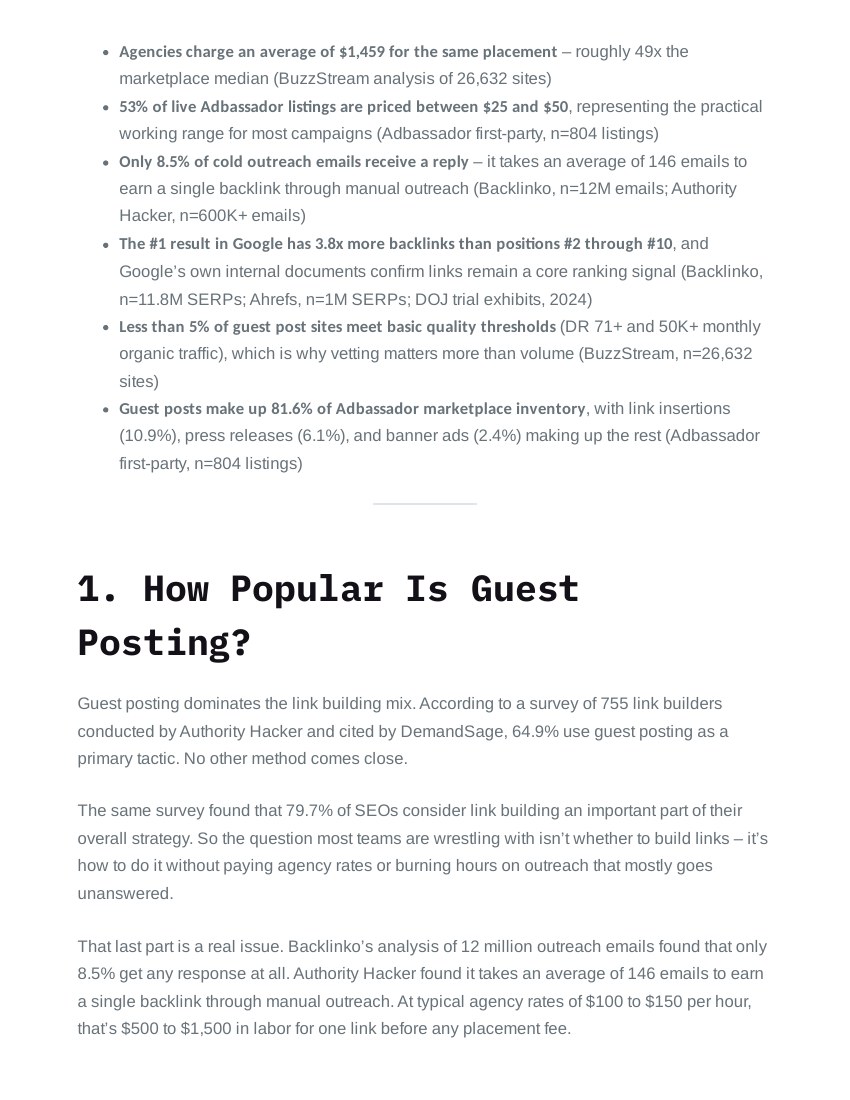
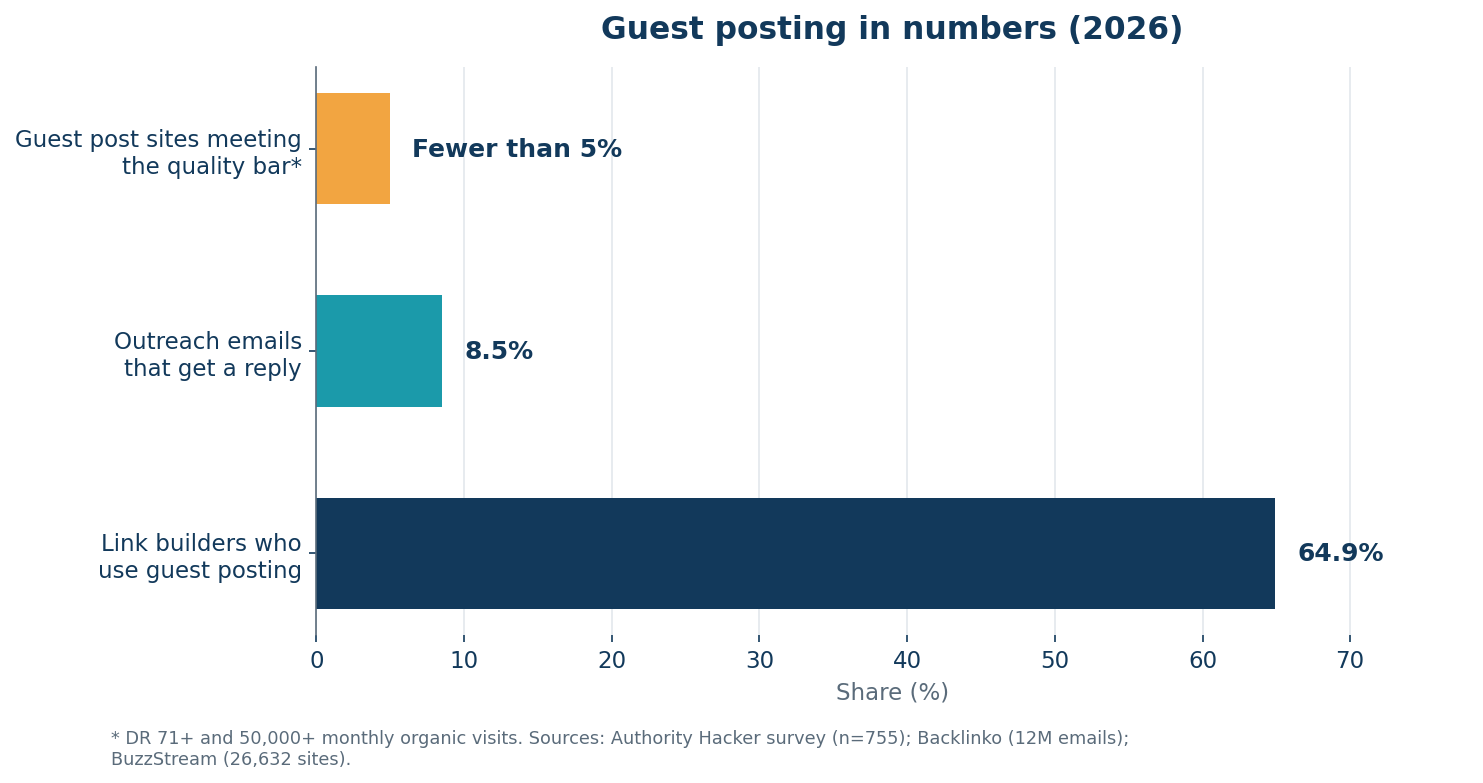
Guest posting is not a new tactic, and it is not a secret one. In a survey of 755 link builders by Authority Hacker, 64.9% said they use guest posting, making it the single most popular link building tactic, ahead of broken link building, digital PR, and resource page outreach. It has been declared dead many times since 2014. It keeps not being dead — because editorial links from real sites are still one of the clearest signals search engines have.
Why guest posts still work for SEO
The case for guest posting rests on large studies, not on opinion. Backlinko analysed 11.8 million Google search results and found that the page in first place has, on average, 3.8 times more backlinks than the pages in positions two to ten. Ahrefs’ own analysis of one million search results found the same figure. The number of different sites linking to a page — the referring domains — tracks rankings more closely than the raw count of links. One link each from ten different trusted sites beats ten links from a single site.
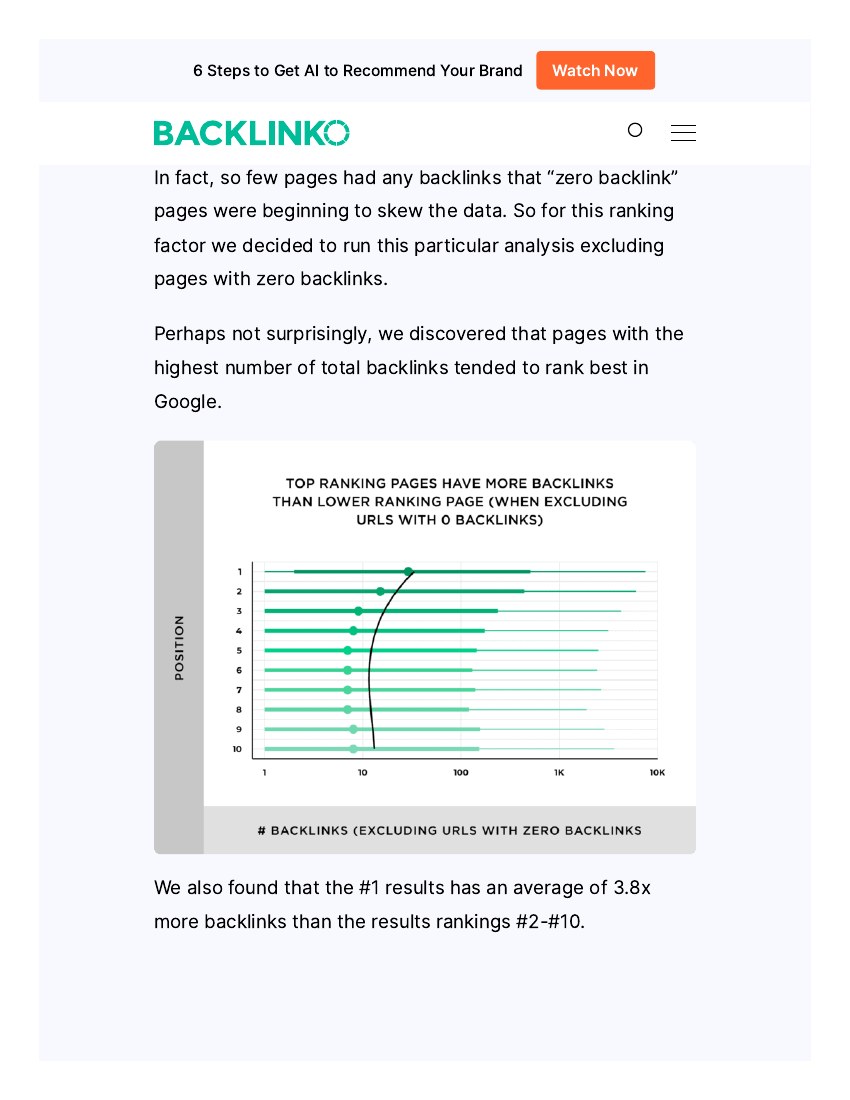
That is why guest posting matters: it is the most direct way for a small site to earn links from new referring domains. Each accepted post adds a new site to your link profile, on a page you chose, with anchor text and context you agreed with the editor. No other tactic gives you that much control over where your links come from.
The numbers also explain why so many people try it — and why so many fail at it. Backlinko’s study of 12 million outreach emails found that only 8.5% get any reply at all. Authority Hacker found it takes an average of 146 emails to earn a single backlink through manual outreach. Most pitches go unanswered, and the sites that do answer are often not worth the link. BuzzStream analysed 26,632 guest post sites and found that fewer than 5% meet basic quality thresholds: a Domain Rating of 71 or higher and more than 50,000 monthly organic visits. The other 95% range from useful mid-tier blogs to domains that will publish anything for a fee.
| Finding | Source | What it means for you |
|---|---|---|
| 64.9% of link builders use guest posting | Authority Hacker survey, 755 link builders | Guest posting is the most used tactic in link building |
| The #1 result has 3.8x more backlinks than positions 2–10 | Backlinko, 11.8 million Google search results | Top pages are also the most linked-to pages |
| Only 8.5% of outreach emails get a reply; 146 emails per earned link | Backlinko, 12 million emails; Authority Hacker, 600,000+ emails | Outreach is slow — expect most pitches to go unanswered |
| Fewer than 5% of guest post sites meet quality thresholds (DR 71+, 50,000+ monthly visits) | BuzzStream, 26,632 sites analysed | Vetting matters more than volume |
| 68% of bloggers accept guest posts | Orbit Media survey, 2023 | Most blogs are open to pitches — if the pitch is good |
None of this means guest posting guarantees rankings. A link helps a good page rank; it does not rescue a weak one. But the pattern is consistent across every large study published in the last decade: pages that rank well tend to have links from strong, relevant sites, and a guest post is still the most practical way for most businesses to earn those links.
What Google says about guest post links
Before you pitch anything, read Google’s own rules, because they draw a clear line. Google’s spam policies define link spam as creating links to or from a site mainly to manipulate search rankings. Two of the examples listed speak directly to guest posting: exchanging money for links or for posts that contain links, and links with optimised anchor text in articles, guest posts, or press releases distributed on other sites.
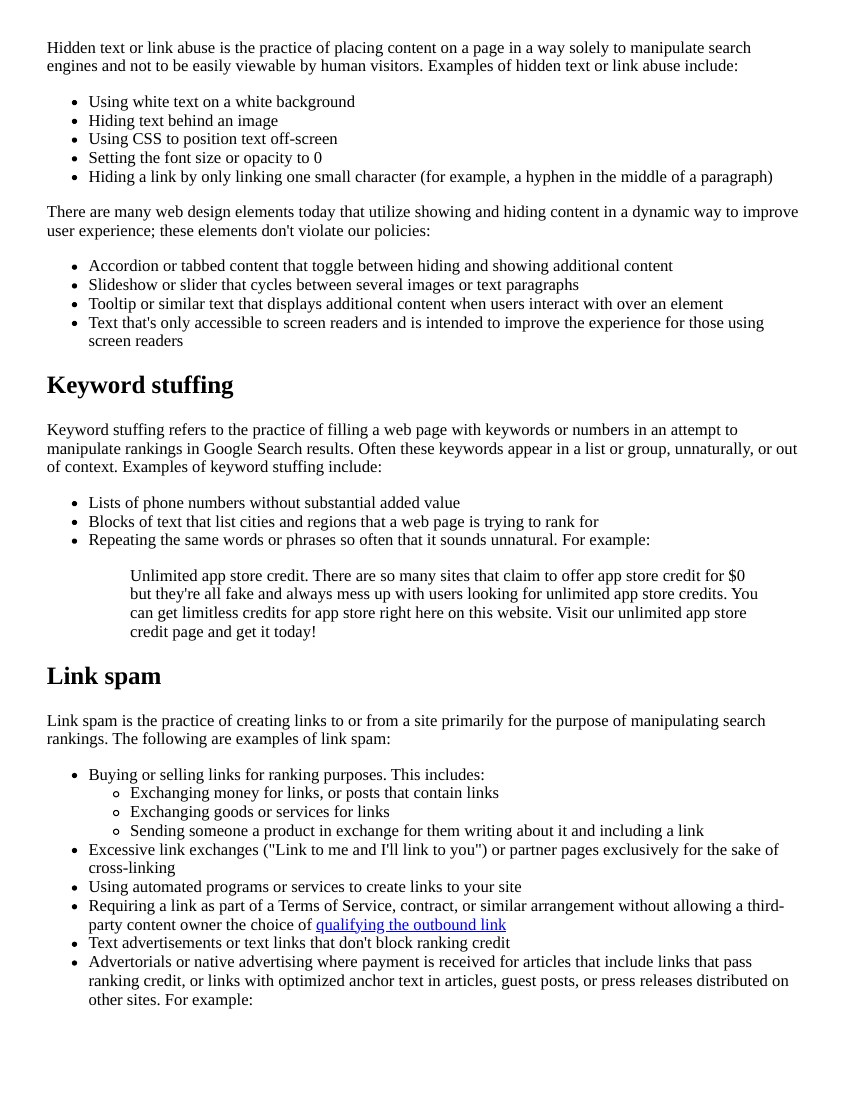
That does not mean guest posting is banned. Google’s webspam team has said since 2017 that it does not discourage guest articles that inform readers, educate another site’s audience, or raise awareness of a cause or company. The problem is scale and intent: articles placed mainly to build links, with keyword-rich anchor text, repeated across many sites. Google’s site reputation abuse policy, in force since May 2024, also covers third-party content published on a host site mainly to ride on that host’s rankings.
The practical rules are simple:
- Write for readers, not for the link. If the article would be worth publishing with no link in it at all, it is a genuine guest post.
- Keep anchor text natural. A brand name or a plain description of the linked page is safe. The same exact-match keyword phrase in every guest post is a pattern Google’s systems are built to catch.
- Mark paid links. If you paid for a placement, or were paid to publish one, the link must carry rel=”sponsored” or rel=”nofollow”. Google states plainly that buying and selling links is a normal part of the web for advertising — it is only a violation when paid links pass ranking credit unmarked.
- Vary your links. Link to different pages on your site, with different anchor text, from different host sites. A natural profile is a varied one.
Follow those four rules and a guest post is a normal, accepted part of SEO. Break them at scale and you are building the exact pattern Google calls link spam.
How to find sites that accept SEO guest posts
Finding sites is the easy part. Finding good ones takes more care. Start with these methods:
1. Search for sites that invite pitches
Search Google for your topic plus phrases editors use: “write for us”, “contribute”, “guest post guidelines”, “become a contributor”. A search for “marketing write for us”, for example, returns blogs that openly invite submissions. Check that the site still publishes guest posts — some pages are years old and the blog has moved on.
2. Look at where your competitors have guest posted
Search for a competitor’s brand name plus “guest post” or check their backlinks in a tool such as Ahrefs’ free backlink checker. Sites that published a competitor’s guest post are often open to yours, and they are already proven to be relevant to your field.
3. Use a directory, then check each site yourself
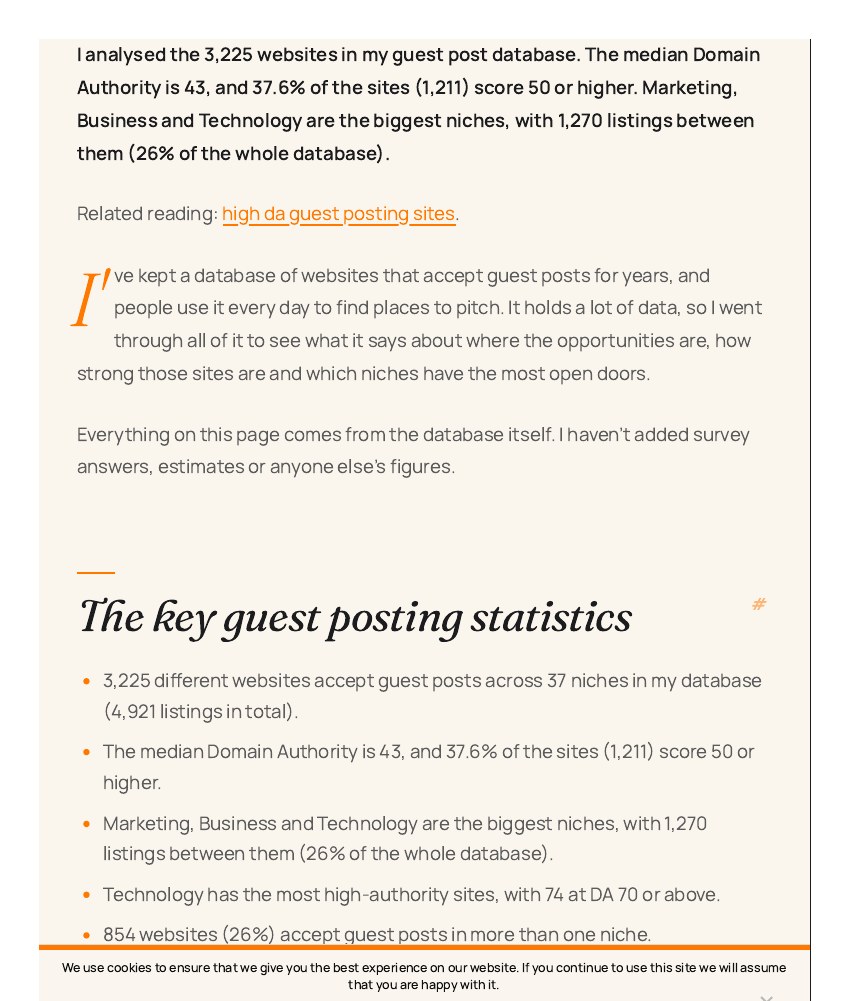
Directories list thousands of sites that accept guest posts. Lilach Bullock’s database, for instance, lists 3,225 different websites across 37 niches, with a median Domain Authority of 43. A directory is a starting list, not a shortlist: check every site yourself before you pitch it.
4. Vet every site before you pitch
Fewer than 5% of guest post sites clear a high quality bar, so vetting is the step that separates a useful link from a wasted afternoon. Check four things:
- Real traffic. Does the site get organic visits? A site with strong-looking domain scores and no traffic is a warning sign.
- Real readers. Are recent posts getting comments, shares, or discussion? A blog with no audience gives you a link nobody will ever click.
- Relevance. Is the site in your field, or close to it? A link from a related site counts for more than a link from an unrelated one, however strong that site looks.
- Clean outbound links. Look at the site’s recent posts. If every article links out to casinos, payday loans, and unrelated products, your link will sit in bad company. Walk away.
If a site fails any of these checks, skip it. One good placement beats ten weak ones.
How to pitch a guest post that gets accepted
Most pitches fail before the editor reads past the first line. An Orbit Media survey found that 68% of bloggers accept guest posts — but editors reject most of what they receive because the pitch ignores their guidelines, pitches a topic they have already covered, or is clearly sent to a hundred sites at once. A realistic acceptance rate for cold, personalised pitches to genuine sites is around 10% to 20%. That means ten good pitches should land one or two posts. Plan for that, and the numbers stop feeling like rejection.
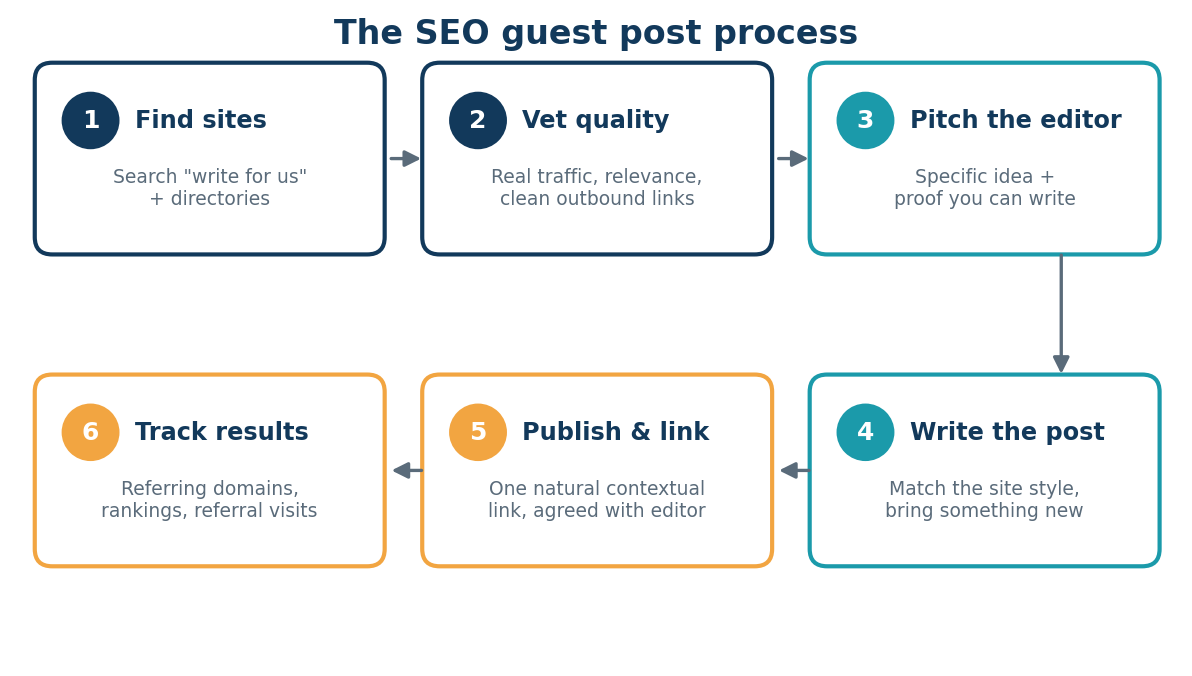
Follow this process:
Step 1: Read the site first
Read at least three recent posts and the site’s guest post guidelines. Note the topics they cover, the length and tone of their articles, and what they ask contributors to do. A pitch that shows you have read the site stands out at once, because most pitches do not.
Step 2: Pitch a specific idea, not a topic
Editors do not want “an article about SEO”. They want a headline and a short outline they can picture on their site. Offer two or three ideas, each with a working title and two or three bullet points on what the article will cover. Make the idea fill a gap: a question their readers ask that the site has not answered yet.
Step 3: Prove you can write it
Link to one or two published articles you have written — on your own site or elsewhere. If you have no published work, write the article on your own blog first and link to that. Editors need evidence, not promises.
Step 4: Keep the email short
Three short paragraphs are enough: who you are, the idea, and why it fits their readers. Put the idea in the subject line. Do not attach the full article unless the guidelines ask for it, and do not mention the link you want in the first email — that marks the pitch as link-first, which is the fastest way to be ignored.
Step 5: Follow up once, then move on
If you hear nothing in a week, send one short follow-up. If there is still no reply, move on. Chasing an editor who is not interested wastes time you could spend pitching the next site.
How to write a guest post that gets accepted
Once an editor says yes, the writing is where the link is earned. Write the best article you can, not the minimum the editor will accept:
- Match the site’s style. Use the same length, structure, and tone as their own posts. If their articles run to 1,500 words with examples and screenshots, a 400-word summary will be rejected.
- Bring something new. Original data, a worked example, or a clear step-by-step process beats a summary of what ten other articles already say. Editors remember writers who give their readers something they could not get elsewhere.
- Link out generously — to other sites too. A guest post that only links to your own site looks like an advert. Link to useful sources, including the host’s own articles where relevant. It shows confidence and it reads naturally.
- Place your link where it helps the reader. One contextual link inside the article, where it supports a point, is worth more than three links in an author bio. Agree the placement with the editor; do not hide extra links in the text.
- Follow the guidelines exactly. Word count, heading style, image rules, link limits — editors set them for a reason, and ignoring them is the most common reason an accepted pitch still ends in rejection.
How much does an SEO guest post cost?
Guest posts cost time, and sometimes money. The time cost is the larger one: research, outreach, writing, and follow-up. Backlinko’s outreach data puts the effort at around 146 emails per earned link, and a single post can take four to eight hours from pitch to publication. If you do it yourself, that time is the price. If you hire an agency, expect to pay for it: BuzzStream’s analysis of 26,632 sites found agencies charge an average of $1,459 per guest post placement, including outreach, writing, and management.
Direct marketplace prices are far lower. Adbassador’s analysis of 804 live publisher listings found a median guest post price of $30 and an average of $86, with 53% of listings priced between $25 and $50. The gap between the median and the average shows that a small number of premium placements on high-traffic sites pull the average up; most placements sit in the $25 to $50 range.
| Price range | Share of listings |
|---|---|
| $10–$25 | 1.4% |
| $25–$50 | 53.2% |
| $50–$100 | 13.2% |
| $100–$200 | 13.4% |
| $200–$500 | 16.9% |
| $500+ | 1.9% |
Source: Adbassador, State of Guest Posting 2026, 804 live listings.
Price alone tells you nothing about value. A $30 post on a real niche blog with engaged readers can be worth more than a $500 post on a site with inflated metrics and no traffic. Judge every placement by the vetting checks above, not by its price tag — and remember that any paid link must be marked rel=”sponsored” or rel=”nofollow” under Google’s rules.
Mistakes that get guest posts ignored — or penalised
- Pitching the same article to fifty sites. Editors can tell, and so can Google when the same article appears everywhere.
- Targeting sites by domain score alone. A high score with no traffic and no readers is a hollow link. Check traffic and relevance first.
- Using exact-match anchor text everywhere. Vary your anchors. Brand names, page titles, and plain descriptions are the natural mix.
- Writing thin content for the host. A weak guest post damages your name with that editor and wastes the link. If you would not publish it on your own site, do not send it to someone else’s.
- Paying for followed links. A paid link that passes ranking credit is link spam under Google’s policies. If money changes hands, the link must be marked sponsored or nofollow.
- Chasing volume over quality. Ten guest posts on weak sites will not do what one post on a respected site in your field does. The sites that get penalised are the ones building hundreds of low-quality links a month, not the ones earning a few good ones.
If you would rather have the outreach, vetting, and writing handled by a team that does it every day, our manual link building services cover guest posting as part of a wider, white-hat link building plan — manual outreach, real sites, and no PBNs.
FAQ
What is an SEO guest post?
An SEO guest post is an article you write for another website in your niche, published under your name with a link back to your site. The host gets fresh content for its readers, and you earn a backlink from a relevant site plus exposure to a new audience. It works best when the article is genuinely useful to the host’s readers, not just a vehicle for the link.
Does guest posting still work for SEO in 2026?
Yes, when it is done on real sites with real readers. Backlinko’s study of 11.8 million search results found the top-ranked page has 3.8 times more backlinks than pages in positions two to ten, and 64.9% of link builders still use guest posting. Google penalises scaled, low-quality guest posting, not genuine editorial contributions.
How do I find websites that accept guest posts?
Search Google for your topic plus “write for us” or “guest post guidelines”, check where competitors have guest posted, and use a directory such as Lilach Bullock’s database of 3,225 sites. Then vet every site yourself: check its organic traffic, recent posts, relevance to your field, and the quality of its outbound links before you pitch.
How much does a guest post cost?
It depends on how you get it. Doing it yourself costs your time — around 146 outreach emails per earned link, on average. Marketplace listings have a median price of $30 and an average of $86, with most between $25 and $50, according to Adbassador’s 2026 data. Agencies charge an average of $1,459 per placement, including outreach and writing.
Is paying for a guest post against Google’s rules?
Paying for a post is not banned, but a paid link that passes ranking credit is link spam under Google’s spam policies. Any link you pay for must carry rel=”sponsored” or rel=”nofollow” so it does not pass ranking value. Unpaid, editorial guest posts on relevant sites with natural anchor text are fine.
How many guest posts do I need to rank?
There is no fixed number. It depends on your niche, your competitors, and the quality of the sites linking to you. One link from a respected site in your field can matter more than twenty links from weak sites. Focus on earning links from sites your audience actually reads, and track your referring domains and rankings over months, not days.

Abdullah Zulfiqar is Co-founder and Client Success Manager at RankWithLinks, an SEO agency helping businesses grow online. He specializes in client relations and SEO strategy, driving measurable results and maximizing ROI through effective link-building and digital marketing solutions.