
A link building strategy is a plan for earning links from other websites on purpose, instead of hoping they appear. Most sites do link building backwards: they send a few outreach emails, get no replies, and give up. A strategy fixes that. It sets a target, finds the gap between your site and the pages outranking you, picks tactics that fit your site, and measures what happens each month. This guide walks through each step, with the numbers behind it.
Backlinks still carry real weight. Google has confirmed more than once that links sit among its top three ranking factors, alongside content and RankBrain. The data agrees: Backlinko’s study of 11.8 million Google search results found the page in position one has, on average, 3.8 times more backlinks than the pages in positions two to ten. A strategy is how you close that gap without guessing.
Link building strategy by the numbers
| Fact | Number | Source |
|---|---|---|
| More backlinks for the #1 Google result than positions 2–10 | 3.8x | Backlinko, study of 11.8 million search results |
| Web pages with no backlinks at all | 66.31% | Ahrefs, study of around 1 billion pages |
| Web pages that get no traffic from Google | 96.55% | Ahrefs, study of around 14 billion pages |
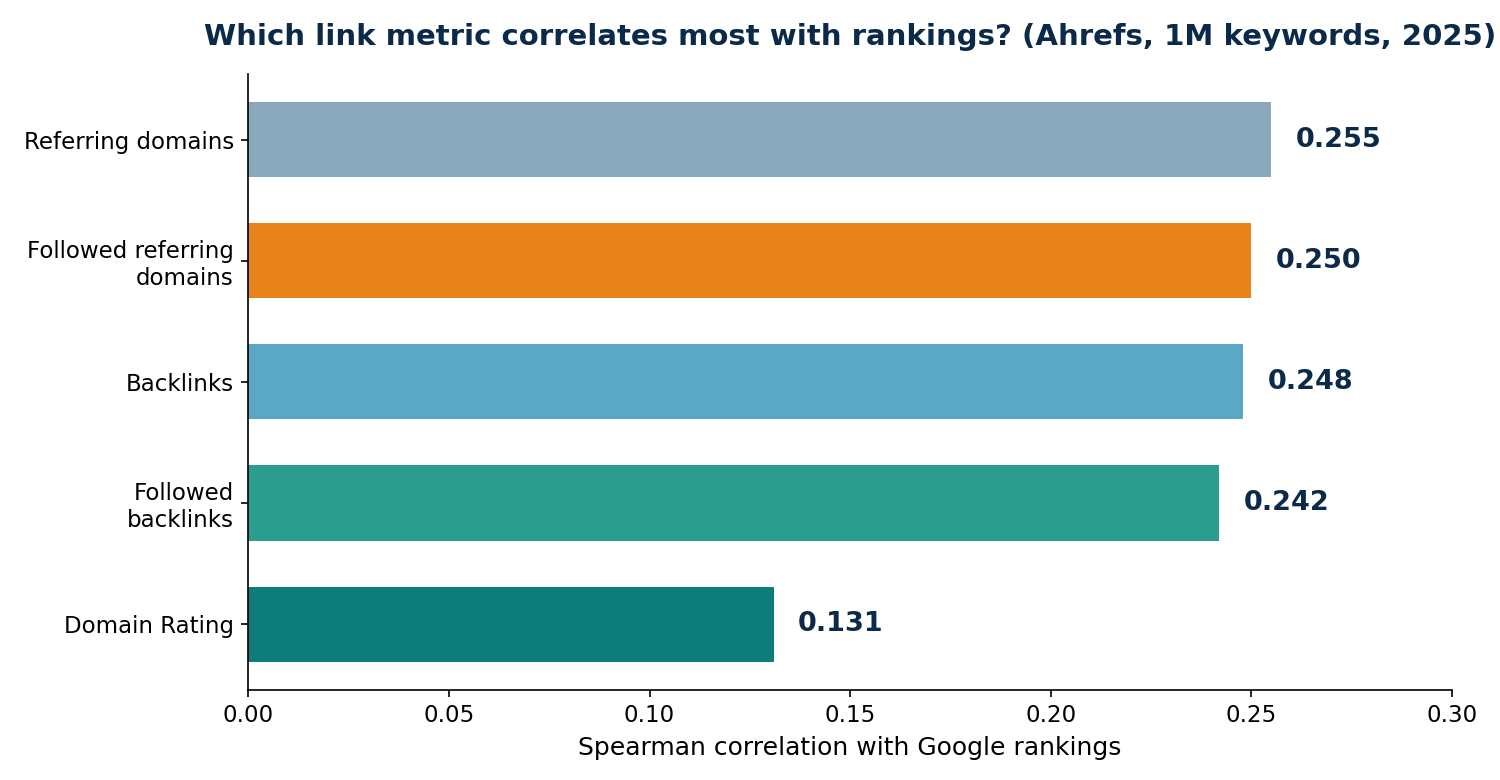
| Correlation between referring domains and rankings | 0.255 | Ahrefs, 1 million keywords (2025) |
| Outreach emails that get a reply | 8.5% | Backlinko and Pitchbox, study of 12 million emails |
| SEO professionals who call backlinks a top-3 ranking factor | 62.1% | uSERP State of Backlinks survey, 116 pros (Sept 2026) |
| Teams that increased their link building budget in 2026 | 58% | Reporter Outreach State of Link Building, 500 pros (2026) |
| Links to sampled sites that have rotted since 2013 | 66.5% | Ahrefs link rot study, 2 million sites (2024) |
Two rows in that table shape the whole strategy. First, the 0.255 correlation: referring domains — the number of different websites linking to a page — correlates with rankings more strongly than total backlink count or Domain Rating. So your target should count domains, not links. Second, the 66.5% link rot figure: two in three links disappear over time. A strategy that only chases new links, and never protects the ones it has, leaks value every month.
What a link building strategy actually is
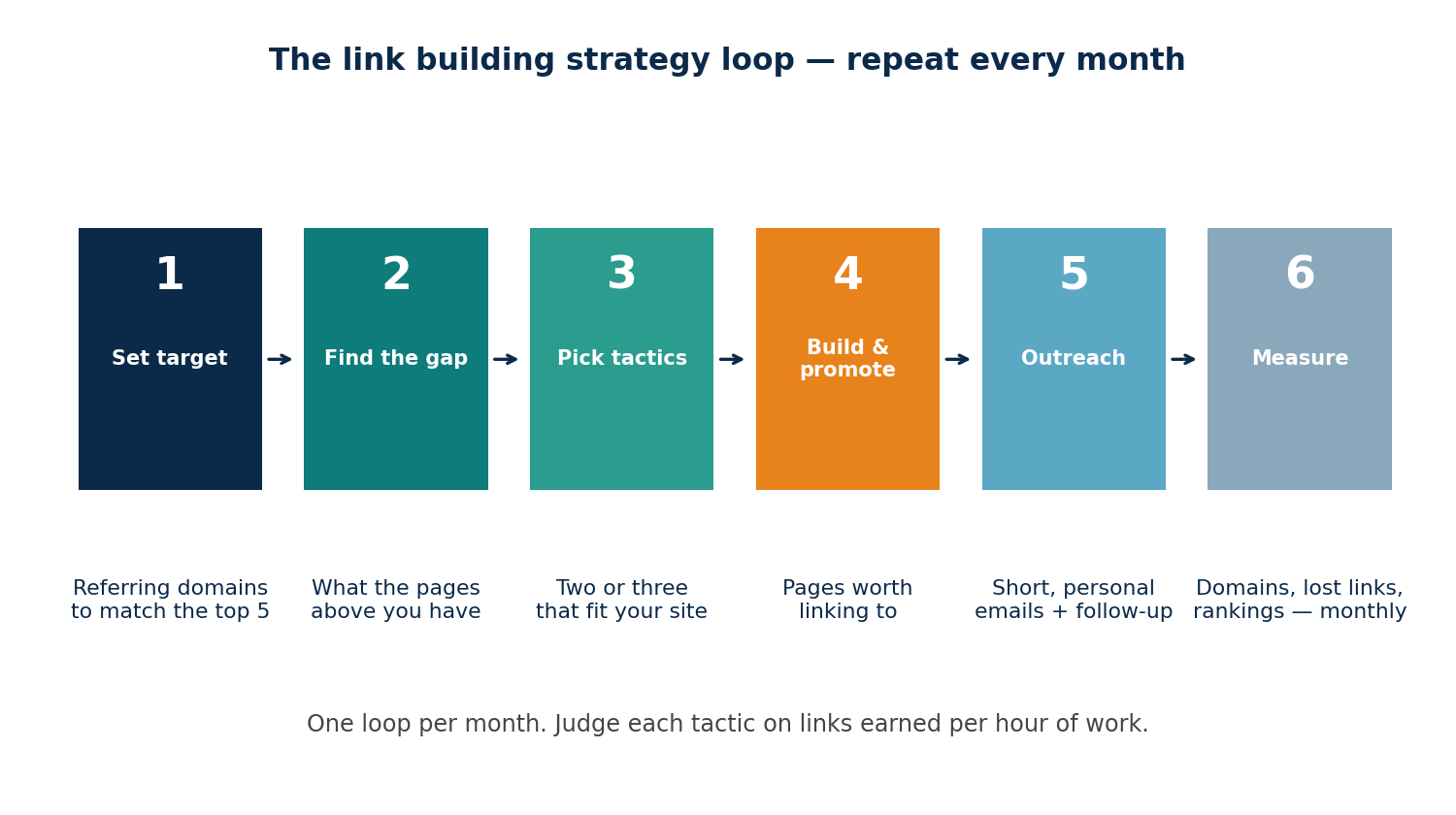
A link building strategy has four parts, and most failed campaigns are missing at least one of them. First, a target: how many referring domains you need, and by when. Second, a gap analysis: what the pages above you have that you do not. Third, tactics: the two or three methods you will actually use, chosen for your niche and budget. Fourth, measurement: a monthly check of referring domains, lost links, and rankings, so you know whether the plan is working or needs to change.
What a strategy is not: a list of fifty tactics, a monthly quota of links bought from a vendor, or a spreadsheet of email addresses. Keep it small enough to run every week. A plan with three tactics, done well for six months, beats a plan with twenty tactics that stops after three weeks.
Step 1: Set a target you can measure
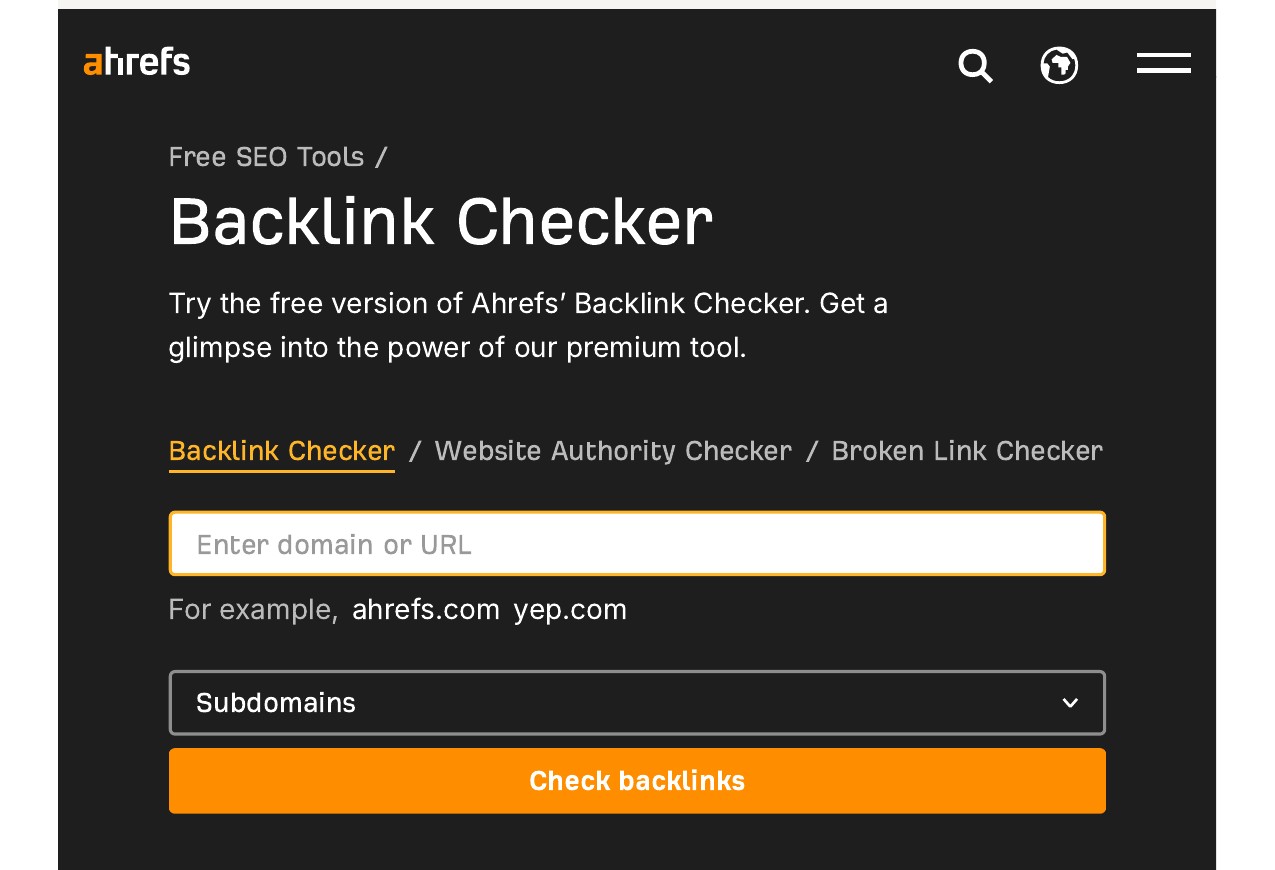
Start with the pages that matter most to your business — usually service pages and the guides that support them — and check how many referring domains the pages ranking above them have. A free backlink checker shows the count for any page in seconds, and it is the fastest way to turn a vague goal (“get more links”) into a number (“this page needs 40 more referring domains to match position three”).
Set the target in referring domains, not in links or Domain Rating. Ahrefs studied the top 20 results for one million keywords in 2025 and found referring domains had the strongest correlation with rankings of any link metric, at 0.255, ahead of total backlinks at 0.248 and Domain Rating at 0.131. One hundred links from one website are worth far less than ten links from ten different websites, so count the websites.
Then set a pace. Pages ranking first keep adding followed links from new domains at 5% to 14.5% a month, according to Ahrefs, so the bar rises while you build. A realistic target for a small site is five to ten new referring domains a month for one important page. That sounds slow, and it is — link building is a slow channel. In editorial.link’s 2026 survey of 518 SEO professionals, 57.1% said they expect results within one to three months, and another 33% within three to six months. Plan for a quarter, not a week.
Step 2: Find the gap before you build anything
Before you write a single outreach email, find out where you stand. For each target page, list the top five pages ranking above it and note three things for each: how many referring domains it has, what kind of pages link to it, and what its best-linked content is. You are looking for patterns, not copying. If every page above you has links from local news sites, that tells you digital PR matters in your niche. If they all have links from one big resource page, that page is your first outreach target.
This step also tells you what not to do. If the pages above you average 150 referring domains and you have 12, a month of guest posting will not close the gap, and your strategy should aim at the pages where the gap is smallest first. Quick wins build the habit; impossible targets kill it.
Step 3: Pick two or three tactics that fit your site
Every link building tactic works somewhere and fails somewhere else. Pick the ones that fit your niche, your team, and your budget — and drop the rest. These are the tactics with the best evidence behind them.
Digital PR and original data. Original numbers are the most linkable thing on the internet. You do not need a survey of thousands of people. A study of your own clients, a count of prices across twenty suppliers, or a before-and-after test on your own site all count. Journalists and bloggers need figures to quote, and when they quote yours, they link to you.
Guest posting on real sites. Guest posting still works when the site is real and the audience is real. Pick sites your customers actually read, pitch a topic that fits their readers, and write the best article on that topic you can. One guest post on a respected site in your niche beats ten posts on sites that exist only to sell links. Google’s spam policies are clear that links intended to manipulate rankings — including large-scale guest posting with keyword-rich anchor text — count as link spam.
Resource pages and broken link building. Resource pages collect the best links on a topic, and their whole purpose is to link out. Find them, check your page genuinely belongs, and send a short email. Broken link building works the same way: find a page in your niche that links to a resource that no longer exists, then offer your page as the replacement. The site owner already wanted to link to something on that topic, so this is one of the highest-converting tactics there is.
Link reclamation. Links break quietly. A site redesigns, a page moves, a link is removed during an edit, and you lose the link without ever knowing. Ahrefs found 66.5% of links to sampled sites have rotted since 2013. Check your backlink profile every month for lost links, and contact the site owner when a good one disappears. A short note brings back links far more cheaply than earning new ones.
Do not try all four at once. Pick two, run them for a month, and judge them on links earned per hour of work — then keep the winner and swap the loser.
Step 4: Build pages worth linking to
No outreach tactic can save a page nobody wants to cite. Before you ask anyone for a link, check the page gives a reader a reason to link: original data, a clear step-by-step process, a worked example, a free template, or a better answer than anything else on the results page. If the page is a sales page, do not expect links to it. Link to it from a useful guide instead, and share the guide. The guide earns the link, and the link passes value through your site.
This is also where most strategies go wrong: they promote the wrong page. Blog posts and guides earn links; service pages rarely do. In editorial.link’s 2026 survey of 518 SEO professionals, 52.7% said service and product pages matter most for links, ahead of blog posts at 38.4% — but that is about which pages matter to the business, not which pages earn links most easily. Earn the link with the guide, then link from the guide to the service page with clear anchor text.
Step 5: Run outreach that gets replies
Outreach is where most strategies die, because the reply rate is low and the work feels thankless. Backlinko and Pitchbox analysed 12 million outreach emails and found only 8.5% received a reply. A reply is not a link, so the share of emails that turn into a placement is lower still. That is normal. A campaign that sends 100 emails and gets eight or nine replies is doing fine — the problem is not the reply rate, it is sending 100 emails and stopping.
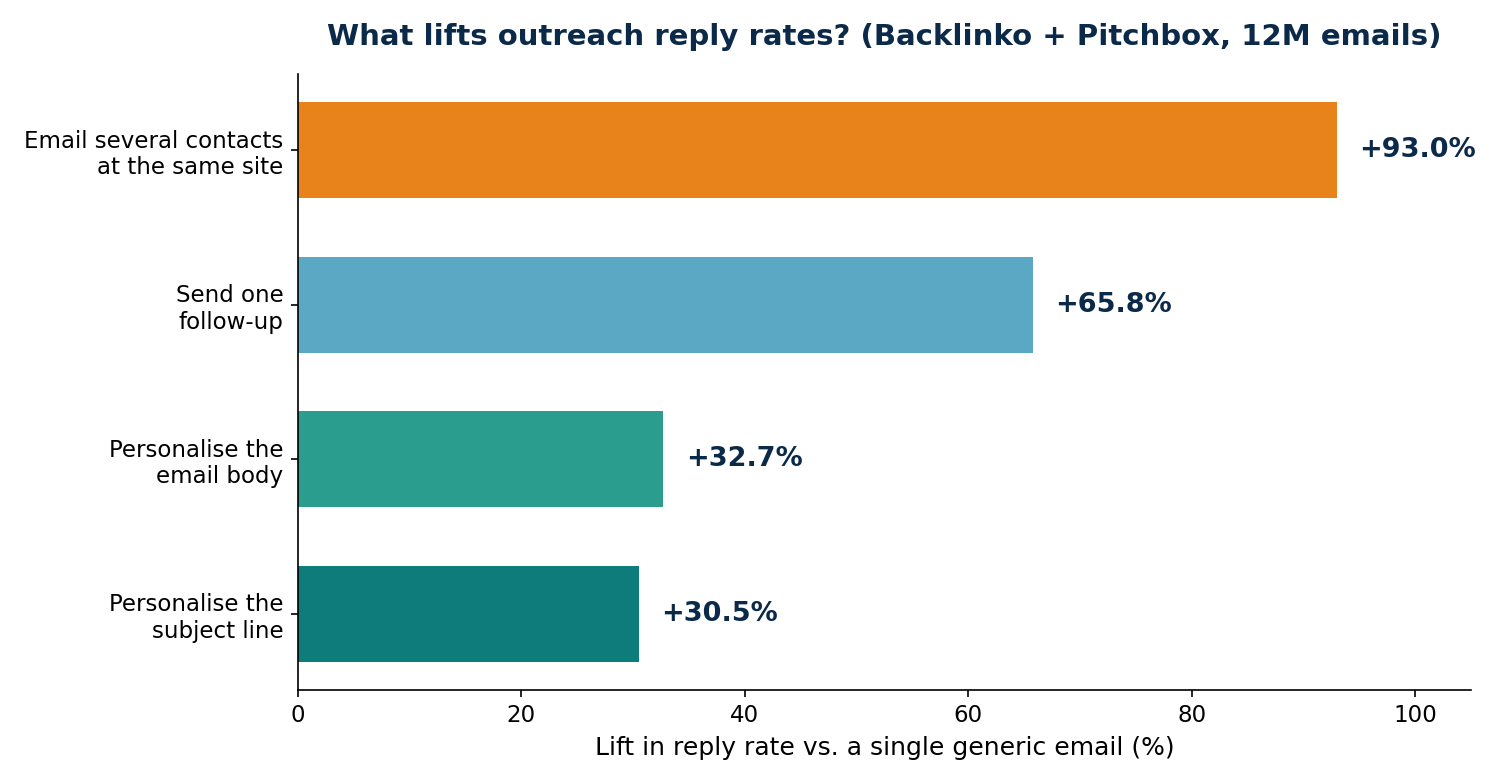
Four things lift replies, and all four are in the same study. Sending one follow-up lifts replies by 65.8%. Personalising the subject line lifts them by 30.5%, and personalising the body by 32.7%. Sending to several contacts at the same organisation lifts the response rate by 93%. So the outreach step of your strategy should be: short email, one real personal detail, one follow-up a week later, and two contacts per site instead of one. Keep it to three or four sentences. Say who you are, say exactly which page you mean, and say why linking to it helps their readers.
Step 6: Check your links in Google Search Console
Google Search Console has a free Links report that shows which sites link to you, which of your pages get the most links, and what anchor text they use. It is the simplest way to check whether your strategy is working, because it shows what Google actually sees — not what a paid tool estimates.
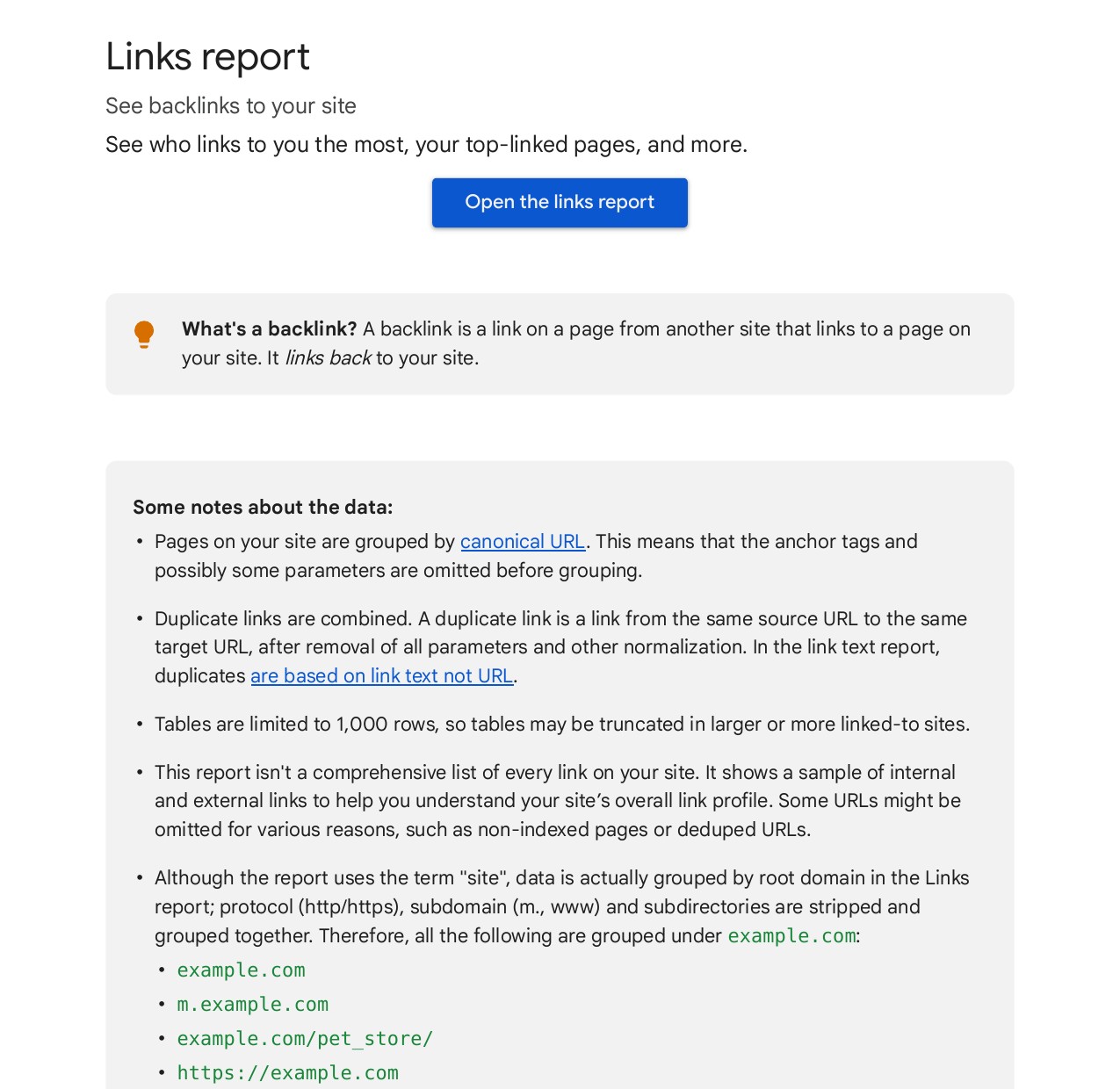
Check the report once a month. Look for three things: new referring domains since last month, links you have lost, and anchor text that looks unnatural. If a good link has disappeared, that is a reclamation email. If anchor text is stuffed with exact-match keywords from sites you do not recognise, that is a problem to look into — and a sign to review which tactics produced those links. The Links report is also the place to find your most-linked pages, which tells you what kind of content earns links in your niche. Make more of that.
How much time and money to plan for
Link building is not free, even when you do it yourself. In editorial.link’s 2026 survey, the average price SEO professionals said they consider acceptable for one high-quality backlink was $508.95. That is a useful yardstick even if you never pay for a link: it tells you what an hour of your own outreach is worth. If your outreach earns one good link per ten hours of work, that link cost you ten hours — compare that honestly with what else those hours could have done.
Budgets are still rising. Reporter Outreach’s State of Link Building 2026 survey of 500 SEO professionals found 58% increased their link building budget in 2026 compared with 2025, and only 14% cut back. And most practitioners are not giving up on links: in uSERP’s State of Backlinks survey from September 2026, 62.1% of 116 SEO professionals still called backlinks a top-three ranking factor, and 87.1% said they would keep building links even if Google removed them as a ranking signal. Links bring referral traffic and trust as well as rankings, and that is why they survive every update.
If you outsource, choose an agency that does manual outreach and can show you the sites it earned links from. That is how our link building services work at RankWithLinks: manual outreach, real sites, no private blog networks. Ask any agency the same three questions before you hire them: which sites did you earn links from last month, how do you pick them, and what happens to my links if I stop paying?
What to measure each month
A strategy without measurement is a hope. Once a month, write down five numbers for each target page: referring domains, total backlinks, lost links, organic traffic, and ranking position for its main keyword. Five numbers, five minutes, once a month. If referring domains rise and rankings do not move after three months, the links may be low quality, or the page itself may need work. If rankings rise but referring domains are flat, something else — content, site speed, or a competitor losing links — is doing the work, and you should find out what before you spend more on outreach.
Keep the report simple enough that you will actually do it. A strategy that needs an hour of reporting every week will be abandoned by week three. Five numbers, once a month, in a plain sheet, is enough to know whether the plan works.
Mistakes that waste a link building strategy
Chasing link counts instead of domains. Ten links from one site are not ten links. Count referring domains, always.
Promoting the wrong page. Sales pages do not earn links. Guides and data do. Earn the link with the guide, then link inward.
One email, no follow-up. At an 8.5% reply rate, a single email round is mostly silence. One follow-up lifts replies by 65.8%. Build follow-ups into the plan from the start.
Ignoring lost links. Two in three links rot over time. A monthly lost-link check is the cheapest link building you will ever do.
Paying for links and calling it strategy. Google’s spam policies treat links intended to manipulate rankings as link spam, and that includes links bought for ranking purposes. A penalty can undo months of honest work. If a tactic cannot be explained to a client in plain words, it does not belong in your strategy.
FAQ
What is a link building strategy?
A link building strategy is a written plan for earning links from other websites: a target in referring domains, a gap analysis against the pages outranking you, two or three tactics that fit your niche, and a monthly check of what changed. Without the target and the measurement, outreach is just sending emails and hoping. With them, you can tell in a month whether the plan works and change it if it does not.
How long does a link building strategy take to work?
Expect one to three months before you see movement, and three to six months for a clear result. In editorial.link’s 2026 survey of 518 SEO professionals, 57.1% expected results within one to three months and another 33% within three to six months. Links take time to earn, time for Google to find, and time to affect rankings. A strategy that promises results in a week is selling something else.
How many backlinks do I need to rank?
There is no fixed number, because it depends on the pages above you. Check how many referring domains the top five results for your keyword have, and aim to match the lowest of them first. As a rough guide, Ahrefs found the top result for a keyword typically holds far more referring domains than the pages below it, and pages keep gaining 5% to 14.5% more followed links from new domains each month. Your target is a moving one, so measure it monthly.
Which link building tactic works best?
It depends on your niche, but the evidence points to original data and digital PR for earning links at scale, guest posting on real sites for steady links, and broken link building for the highest reply rates. The honest answer is to run two tactics for a month and judge them on links earned per hour of work. A tactic that earns one link per twenty hours is worse than a tactic that earns one per five, whatever the guides say.
Should I buy backlinks to speed up my strategy?
No. Google’s spam policies are clear that links bought to manipulate rankings count as link spam, and a manual action can remove a page — or a whole site — from search results. The short-term gain is not worth the risk to the rankings you already have. Spend the same money on original data or manual outreach instead: the links take longer, but they stay, and they never put your site at risk.
How do I know if my link building strategy is working?
Watch referring domains, not total links. Once a month, check Google Search Console’s Links report and your backlink checker: are new domains linking to you, are you losing fewer links than you gain, and are your target pages moving up? If referring domains rise for three months and rankings do not move, check the quality of the links and the quality of the page. If both rise together, keep doing what you are doing.

Abdullah Zulfiqar is Co-founder and Client Success Manager at RankWithLinks, an SEO agency helping businesses grow online. He specializes in client relations and SEO strategy, driving measurable results and maximizing ROI through effective link-building and digital marketing solutions.