
Good copy does two jobs at once: it answers the reader’s question and it gives Google a clear reason to rank the page. Most pages fail at one of the two. They either read well but say nothing Google can match to a search, or they are stuffed with keywords and no human would finish them.
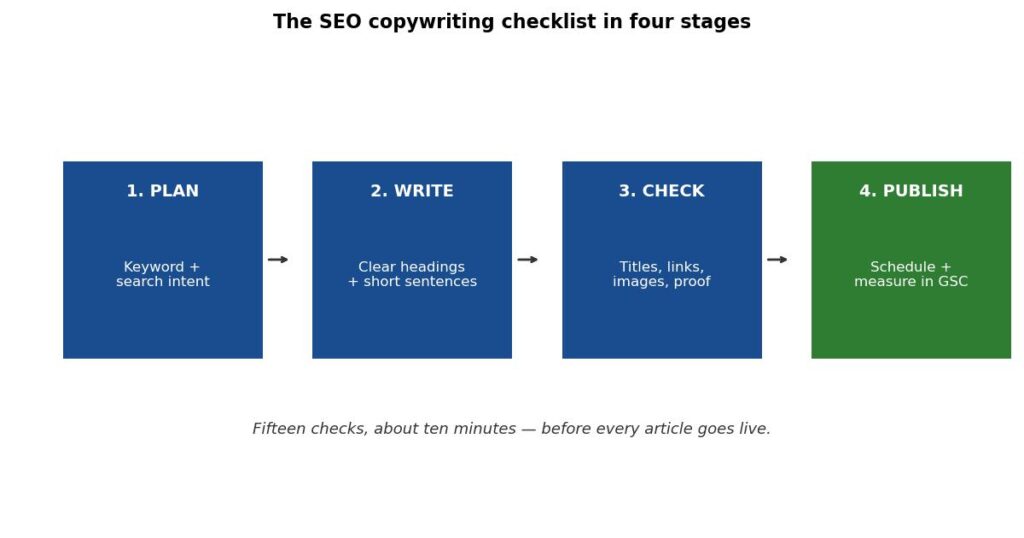
This SEO copywriting checklist fixes that. Work through the 15 checks below before you hit publish, and you will catch the common mistakes while they are still cheap to fix.
What SEO copywriting actually is
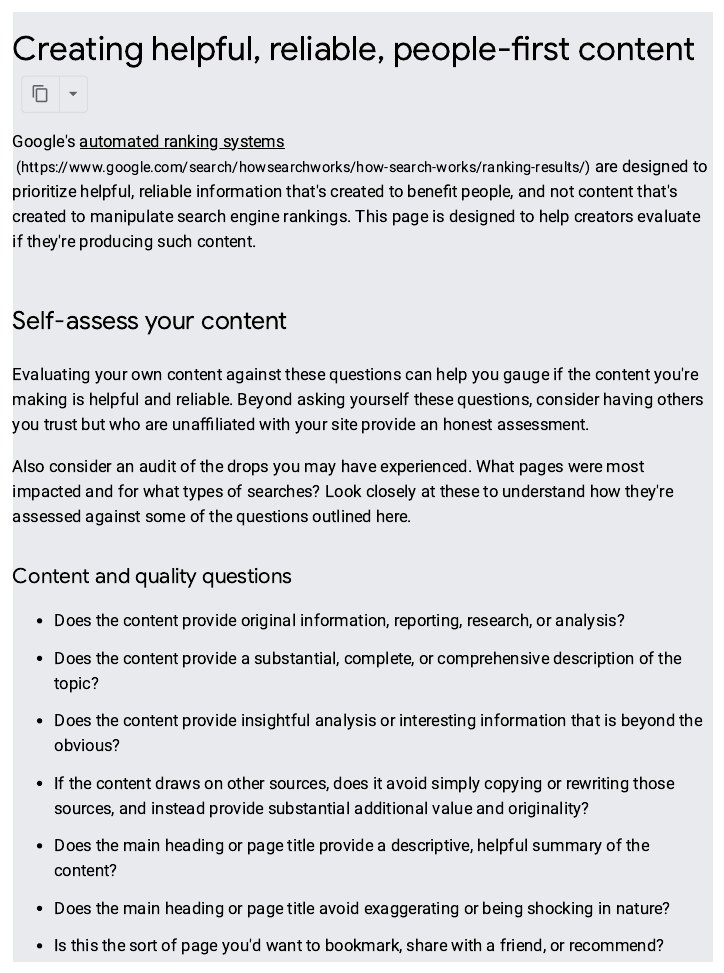
SEO copywriting is writing that serves the reader first and search engines second. The keyword matters, but only inside copy that is accurate, clear and complete. Google’s own guidance on creating helpful, reliable, people-first content says the same thing: its ranking systems reward pages made to help people, not pages made to chase rankings. That page also sets out the E-E-A-T test — experience, expertise, authoritativeness and trust — and trust sits at the centre of it.
A checklist is not a trick. It is a way to check, line by line, that the page is genuinely useful, easy to read and technically sound.
The numbers behind this checklist
A few real figures explain why each check below exists. They come from published studies, not from guesswork.
| What was measured | Finding | Source |
|---|---|---|
| Average first-page Google result | 1,447 words long, across 11.8 million results | Backlinko and Ahrefs, 2020 ranking study |
| Word count and rankings | No direct relationship between word count and ranking position | Backlinko and Ahrefs, 2020 |
| Long articles vs short articles | Articles over 3,000 words get 138% more page views than articles under 500 words | Semrush, State of Content Marketing research |
| Long articles and backlinks | Articles over 3,000 words earn about 3.5 times more backlinks than average-length posts | Semrush |
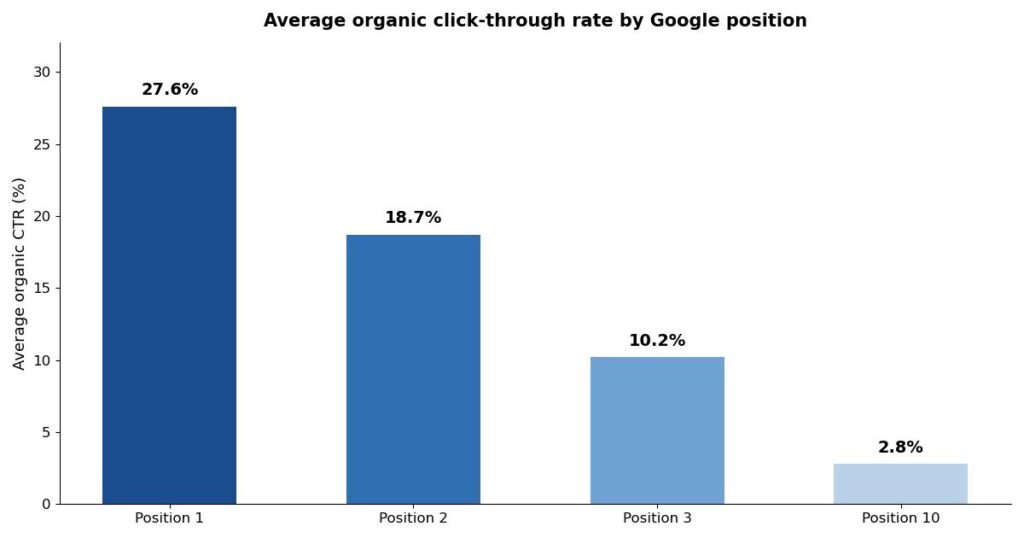
| Clicks by position | The top organic result takes 27.6% of clicks; the tenth takes 2.8% | Backlinko, CTR study of 4 million results |
| Average blog post length | 1,333 words in 2025, down from 1,427 in 2023 | Orbit Media, annual blogging survey |
Two lessons run through the table. First, length on its own does not rank a page — Google says so directly in its SEO Starter Guide — but thorough pages tend to earn the links and clicks that do. Second, the top of page one takes most of the traffic, so the title, the meta description and the first paragraph carry real weight.
Before you write: intent and keyword checks
Check 1 — Match the search intent, not just the keyword
Type the keyword into Google and look at the top ten results. Are they guides, product pages, lists or definitions? Your page should be the same type of page. A checklist article will not rank if the top results are step-by-step guides and yours is a sales page.
Check 2 — Put the keyword in the title, naturally
The main keyword should appear in the H1 title in a way a person would actually say. “SEO Copywriting Checklist: 15 Checks Before You Hit Publish” works. “SEO Copywriting Checklist SEO Copywriting Tips” does not. One natural use beats three forced ones.
Check 3 — Answer the question in the first 100 words
The reader arrived with a question. Answer it early, in plain words, then go into detail. This also helps Google lift a short answer into a featured snippet or an AI summary. If the first paragraph is throat-clearing, cut it.
Check 4 — Plan one keyword per page
One page, one main keyword, one job. If two pages chase the same keyword, they compete and neither ranks well. Check your site first: if a page already targets the keyword, improve it instead of writing a second one.
While you write: structure and readability
Check 5 — One idea per section, with a clear heading
Break the page into H2 sections that each cover one idea, and use H3s inside them where a section needs smaller steps. A reader should be able to scan the headings alone and understand what the page covers. If a heading could sit on any page on the internet, rewrite it.
Check 6 — Keep sentences and paragraphs short
Short sentences are easier to read on a phone, and most search traffic now comes from phones. Aim for sentences under 25 words and paragraphs of two to four lines. A wall of text is the fastest way to lose a reader who arrived from Google.
Check 7 — Test readability with a real tool
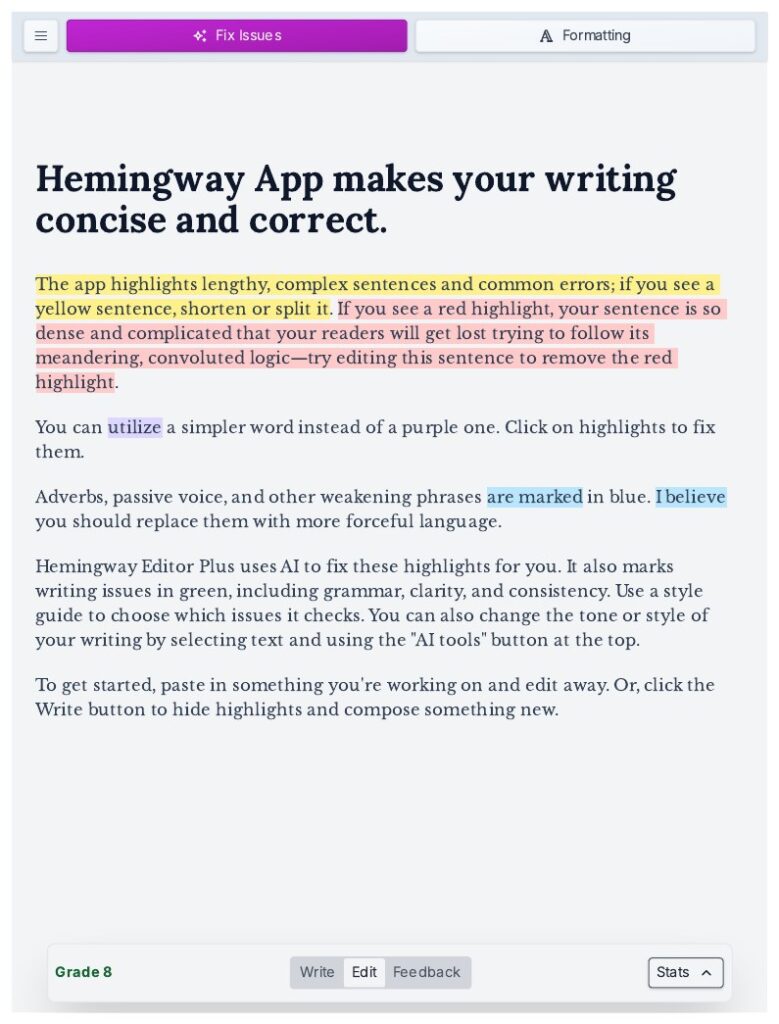
Paste the draft into a readability checker such as the Hemingway Editor and look at the grade level and the highlighted sentences. Fix the ones it flags as very hard to read. You do not need a perfect score — but if it says the page reads like a university paper and your readers are busy small business owners, rewrite it.
Check 8 — Use examples, not empty claims
“Great content ranks well” is an empty claim. “Articles over 3,000 words earn about 3.5 times more backlinks than average-length posts, according to Semrush” is a claim a reader can check. Every important point should have an example, a number with a named source, or a step the reader can follow. Never invent a statistic — one verified number beats five made-up ones.
Check 9 — Write the way your reader talks
Use the words your readers use, not industry jargon. A plumber searching for local SEO help does not search for “citation velocity”. Match their language in headings and body copy, and the page will match more real searches.
On-page SEO checks
Check 10 — Title tag under 60 characters, meta description under 155
The title tag is what shows in the search results, and titles between roughly 40 and 60 characters get about a third more clicks than titles outside that range, according to Backlinko’s CTR data — mostly because longer titles get cut off. Write the title for the results page, not for the page itself, and write a meta description that tells the searcher what they will get.
Check 11 — Add internal links to related pages
Link to two or three relevant pages on your own site, using anchor text that describes what the linked page is about. Internal links help readers find more of your content and help Google understand how your pages relate. For example, if copywriting is only part of your content plan, point readers to our SEO content writing services for help with the full job.
Check 12 — Link out to real sources
When you quote a study or a figure, link to the source. It shows the reader — and Google — that the numbers are real.
Check 13 — Give every image alt text and a real file name
Alt text describes the image for readers who cannot see it and for search engines. Write a short, honest description of what the image shows, and work the keyword in only where it fits naturally. Save the file with a plain name such as seo-copywriting-checklist-chart.jpg, not IMG_4821.jpg.
Before you publish: links, images and proof
Check 14 — Click every link and open every image
Broken links and missing images are easy to miss and quick to fix before publishing — and embarrassing after. Click each link in the draft, open each image, and check the page on a phone as well as a desktop. A page that looks fine on a wide screen can fall apart on mobile.
Check 15 — Read the whole page out loud
Read it from top to bottom, out loud, before you schedule it. You will hear repeated words, clumsy sentences and missing steps that your eyes skipped over. If a sentence is hard to say, it is hard to read. Fix it now, not after the page is live.
After you publish: measure and improve
Publishing is not the end of the job. After two to four weeks, open Google Search Console and check three things: which queries the page appears for, its average position, and its click-through rate. If the page ranks on page two, the copy is probably fine and the page needs stronger internal links or a few good backlinks. If it gets impressions but few clicks, rewrite the title and meta description first — that is the cheapest fix in SEO.
FAQ
What is SEO copywriting?
SEO copywriting is writing web copy that answers a real search query and is built so search engines can understand and rank it. It covers the keyword, the headings, the structure, the internal links and the readability of the page. Good SEO copy reads naturally to a person first; the search optimisation is built into clear writing, not added on top afterwards.
How long should SEO copy be?
There is no fixed word count that ranks a page. Backlinko and Ahrefs found the average first-page Google result runs 1,447 words, but the same study found no direct link between word count and position. Google says word count alone does not matter for ranking. Write enough to answer the question fully — for most guides that means 1,200 to 2,500 words — and stop when the job is done.
Do I need to use the keyword many times?
No. Use the main keyword once in the title, once early in the first paragraph, and a few times naturally in headings and body copy where it fits. Repeating it in every paragraph is keyword stuffing, and it makes the copy worse for readers without helping rankings. Use related words and synonyms instead of forcing the same phrase.
What is the difference between SEO copywriting and content writing?
The two overlap, but SEO copywriting is written with a specific search query in mind and is measured by rankings and search traffic. Content writing is broader: it includes brand stories, social posts and email, where search rankings are not the goal. A blog post can be both, but only if the keyword, the intent and the on-page checks were planned before writing started.
Should I hire an SEO copywriter or write it myself?
Write it yourself if you know the topic well and have time to follow a checklist like this one. Hire a writer when the topic needs research you cannot do, when you need many pages at once, or when your own pages keep ranking on page two. Either way, the person writing should show real experience with the topic — Google’s guidance rewards first-hand knowledge.
Can AI write SEO copy?
AI can draft, outline and summarise, but it cannot check facts, add first-hand experience or take responsibility for accuracy. Use it to speed up the first draft, then edit every claim, add real sources and real examples, and read the result out loud. A page published without that human check is the kind of thin content Google’s guidance warns against.

Abdullah Zulfiqar is Co-founder and Client Success Manager at RankWithLinks, an SEO agency helping businesses grow online. He specializes in client relations and SEO strategy, driving measurable results and maximizing ROI through effective link-building and digital marketing solutions.