If you want to learn link building, start with one plain fact: a backlink is a link from another website to yours, and Google still treats links as votes of confidence. A page that nobody links to has no outside proof that it is worth reading. That is why learning to earn links is one of the most useful skills in SEO, and why this guide walks through it step by step, from the basic ideas to your first links.
What link building actually is
Link building means getting other websites to link to your pages. You do not build the links yourself on your own site. You earn them, or you ask for them, by giving other site owners a good reason to point their readers at your content.
A single link has three parts worth knowing. The linking page is the page that holds the link. The anchor text is the clickable words. The target page is your page that receives the link. When you learn link building, you learn to think about all three: who links, what words they use, and which of your pages they point to.
There is one number that matters more than the raw count of links. A referring domain is a unique website that links to you. Ten links from ten different websites count for far more than ten links from one website. Ahrefs puts it plainly in its own metrics guide: the backlinks metric counts every link, while referring domains counts the unique websites behind them. When you size up your own site, count referring domains first.
Why links still matter in 2026
Links are not the whole of SEO, and Google has said so itself. Google’s Gary Illyes stated in 2023 that links are not among the top three ranking factors. But “not top three” is not the same as “does not matter”. Google Search Central still lists link analysis as part of how search works, and the large studies keep showing the same pattern: pages that rank well tend to have more links than pages that do not.
The numbers below come from two of the biggest studies ever published on the subject.
| What was measured | Finding | Source |
|---|---|---|
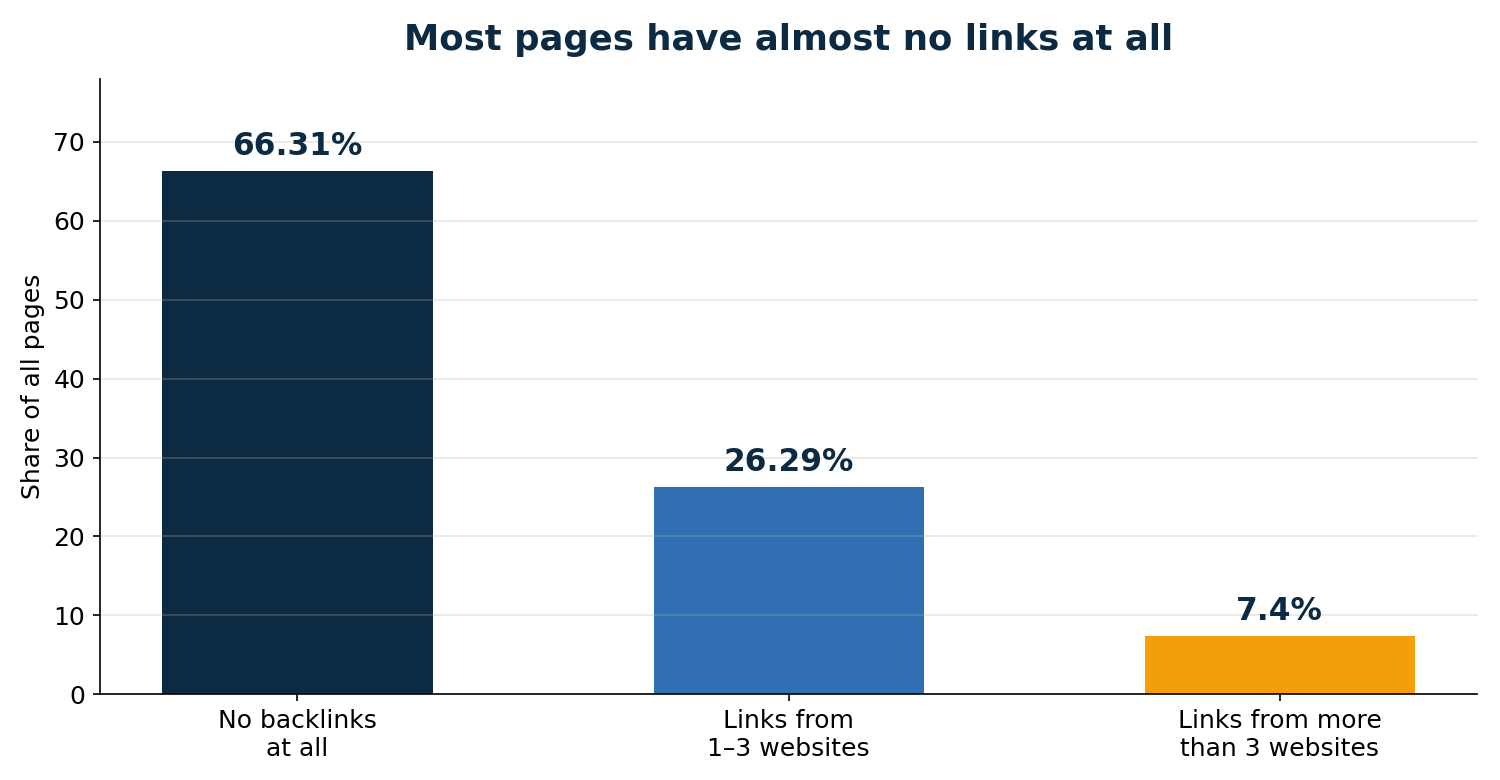
| Pages with no backlinks at all | 66.31% of pages in Ahrefs’ index | Ahrefs search traffic study, Dec 2023 (~14 billion pages) |
| Pages getting zero traffic from Google | 96.55% of pages in Ahrefs’ index | Ahrefs search traffic study, Dec 2023 |
| Pages with no links that still earn 1,000+ visits a month | Only 1 in 6,671 | Ahrefs search traffic study, Dec 2023 |
| Backlinks of the #1 Google result vs positions 2–10 | 3.8 times more on average | Backlinko study of 11.8 million search results |
| Referring domains of the #1 result vs positions 2–10 | About 3 times more on average | Backlinko study of 11.8 million search results |
Read the first two rows together and the lesson is clear. Most pages on the web have no links, and most pages get no traffic. The two facts travel together. Only 1 page in 6,671 with no referring domains at all earns more than 1,000 search visits a month, and Ahrefs notes that the few that do usually sit on strong domains and target easy topics.
One more number keeps expectations honest. In Zyppy’s 2026 survey of 131 SEO experts, 54.8% still put backlinks in Google’s top three ranking factors, second only to relevance at 57.1%. So links are a real factor, but relevance comes first. A link to a thin page will not save it.
The 5 building blocks to learn first
Before you send a single outreach email, learn these five ideas. Every tactic in link building is built on them.
1. Relevance beats raw authority
A link from a small site in your own niche is worth more than a link from a big site about something unrelated. Google reads the topic of the linking page. A plumbing blog linking to a plumber makes sense. A plumbing blog linking to a crypto exchange does not. When you judge a link opportunity, ask first: does this site write about my subject?
2. Followed and nofollowed links
Most links pass ranking credit. Some carry a rel=”nofollow” tag, which tells Google not to pass that credit. Nofollow links can still bring visitors and they still make your link profile look natural, so do not ignore them. But when you count the links that move rankings, followed links from relevant sites are the ones that count.
3. Anchor text should sound natural
Anchor text is the clickable wording of a link. If every link to your page says the exact same keyword, that looks planned, and Google notices patterns like that. A healthy mix includes your brand name, plain web addresses, generic words like “this guide”, and the occasional keyword phrase. Write for readers first and the mix takes care of itself.
4. Editorial links are the gold standard
An editorial link is one a site owner adds because your content is genuinely useful to their readers. Nobody paid for it and nobody swapped it. These are the hardest links to earn and the safest links to have. Most of this guide is about earning them.
5. Your link profile should grow slowly
A new site that gains 500 links in a week looks odd. A site that gains a few good links each month looks like a real business earning attention. Speed is not the goal. A steady, believable pattern of new referring domains is.
A 7-step plan to learn link building
Here is the plan in order. Work through it one step at a time and do not skip ahead to outreach before your own pages are ready.
Step 1: Check the links you already have
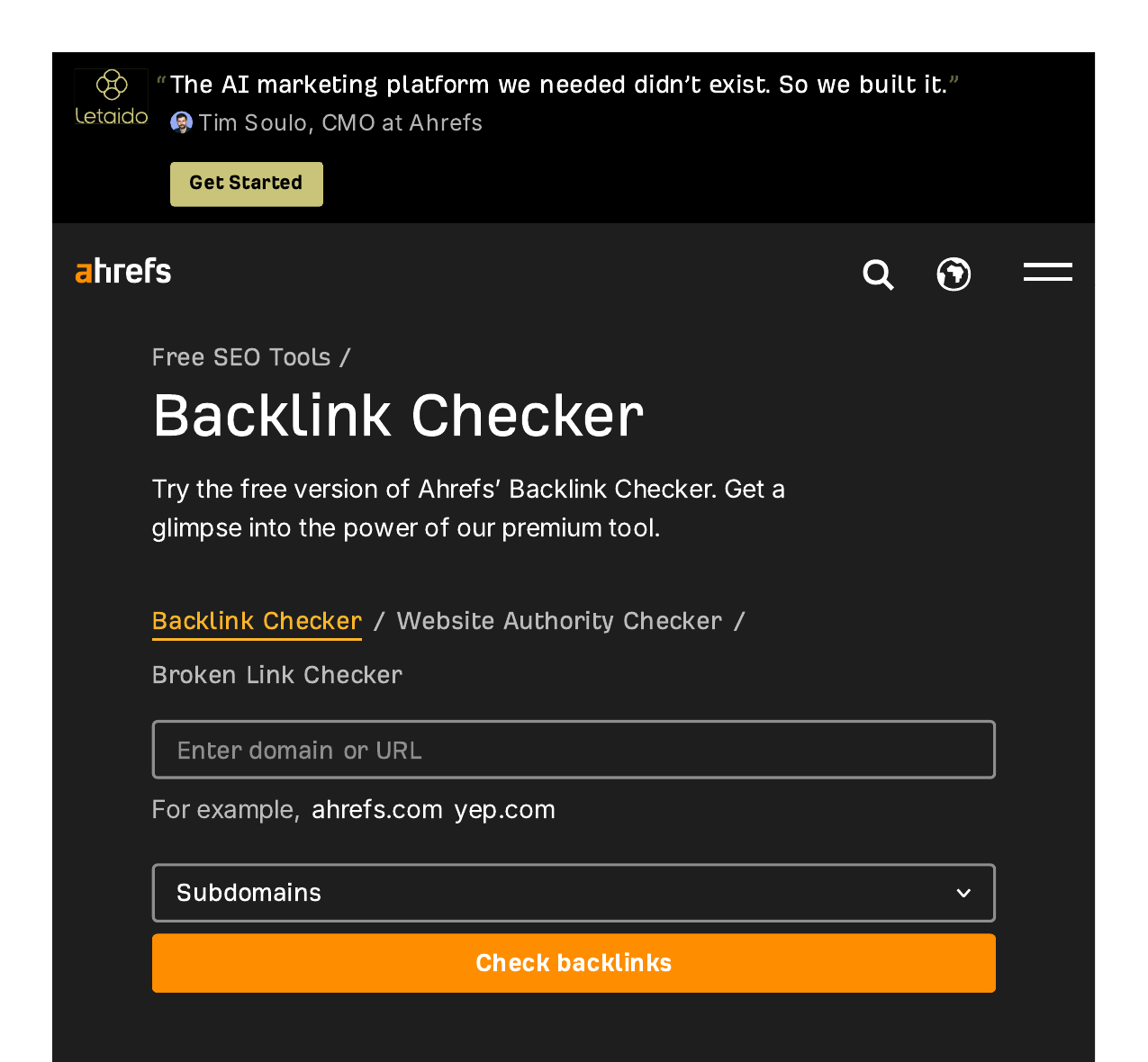
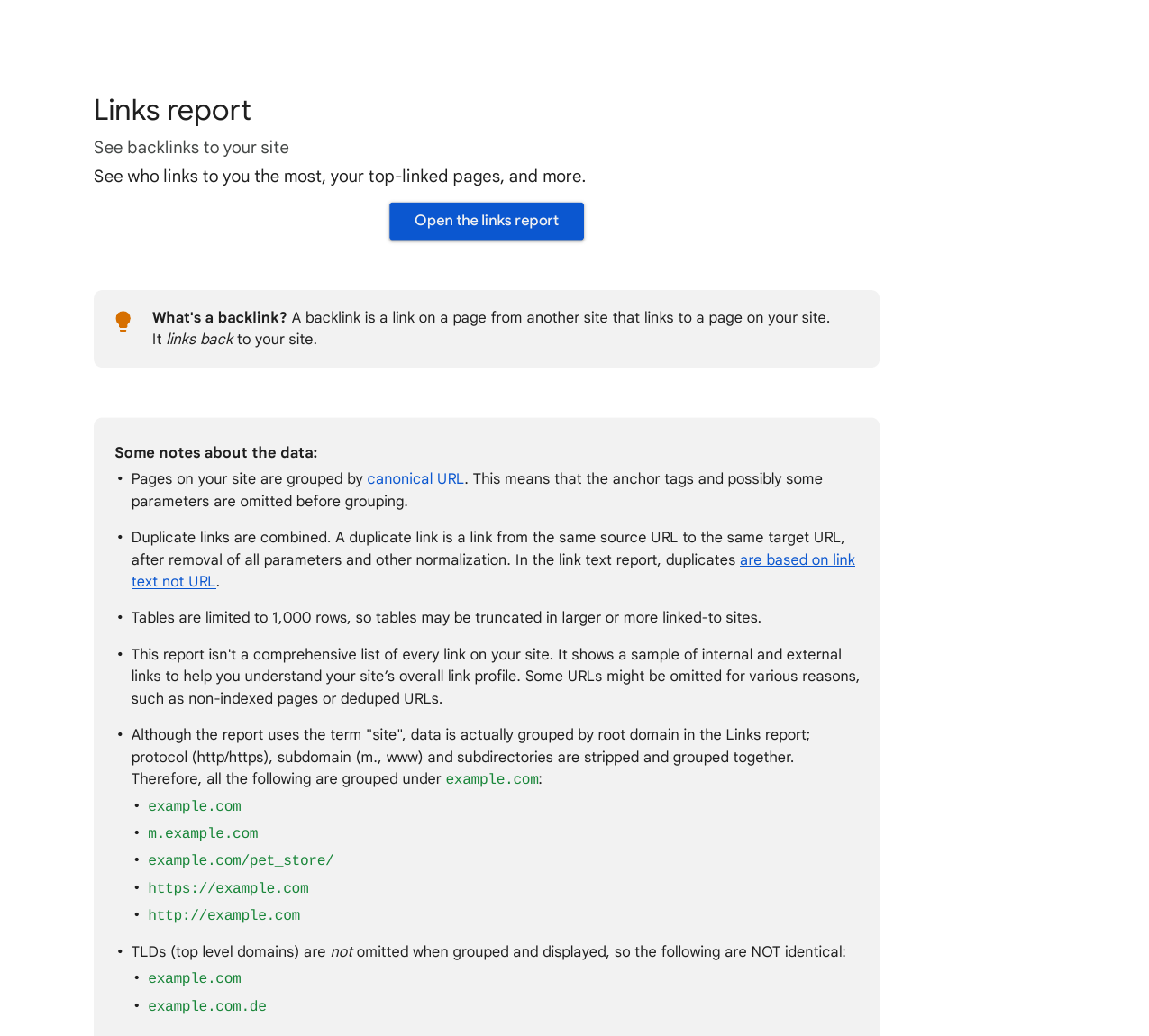
Open a free backlink checker and type in your own domain. Ahrefs runs a free backlink checker that shows your top 100 backlinks, and Google Search Console has a free Links report that lists the sites linking to you and your most-linked pages. Write down three numbers: total backlinks, total referring domains, and your most-linked page. These are your starting figures, and you will measure progress against them.
Step 2: Find your best linkable page
Look at your site and pick the one page that a stranger would most want to link to. It is usually a guide, a set of original data, a free tool, or a clear answer to a hard question. If no page on your site is worth linking to yet, that is your first job. Build one good page before you ask anyone for a link.
Step 3: See who links to your competitors
Type a competing page into the same backlink checker and look at who links to it. These sites already link to content like yours, which makes them the warmest prospects you will find. Make a short list of 20 sites, and note what each one linked to and why.
Step 4: Study the numbers before you write
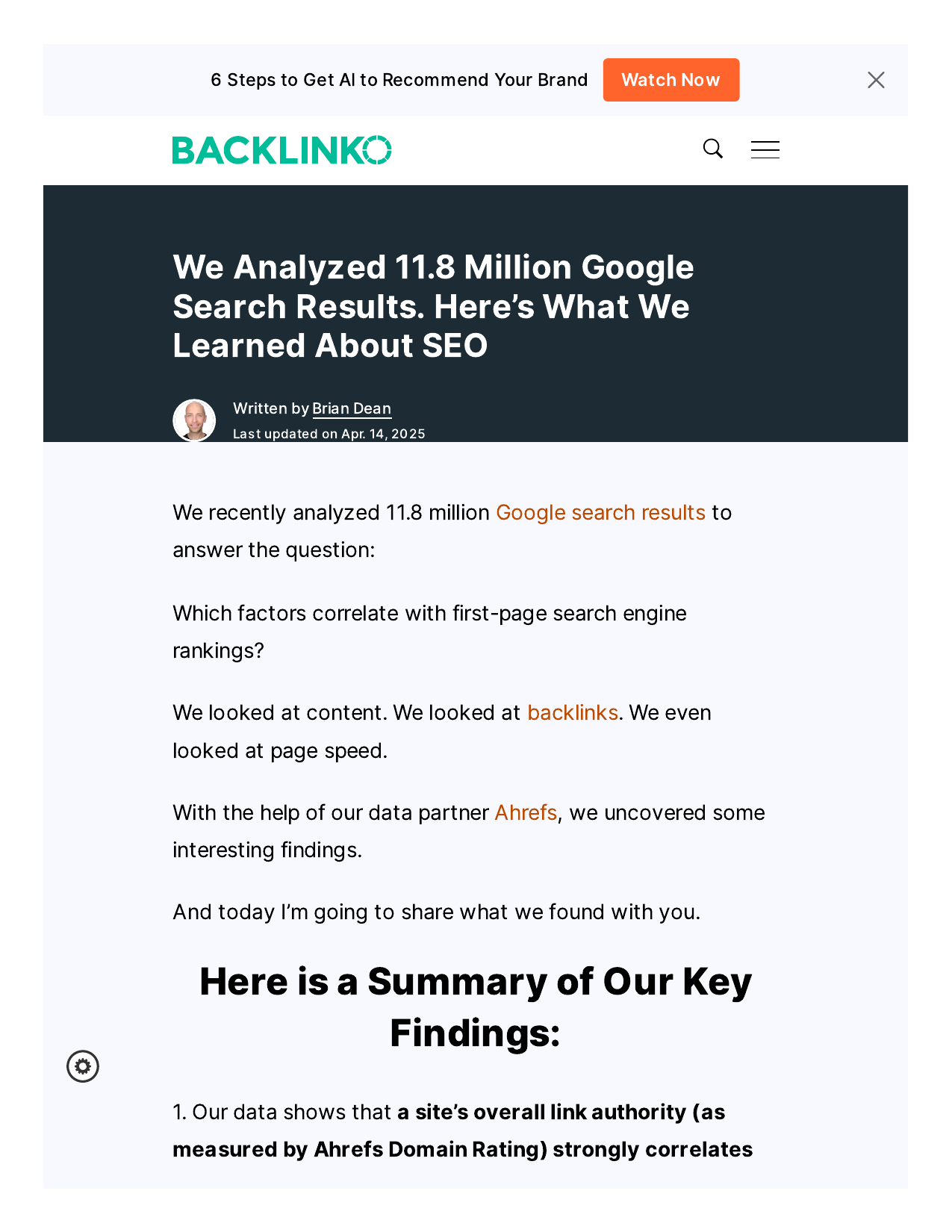
Backlinko’s analysis of 11.8 million Google search results found that the top result has, on average, 3.8 times more backlinks than the results in positions two to ten, and about three times more referring domains. That is a correlation, not a promise: strong pages tend to earn links and rank well together. Use it to set a realistic target. If the pages ranking for your keyword have 20 referring domains each, your goal is to close that gap, not to collect 500 links.
Step 5: Write a short, honest outreach email
Keep it under 120 words. Say who you are, name the page of theirs you read, explain in one sentence why your page helps their readers, and ask plainly if they would consider linking to it. Do not offer payment, do not offer a link swap, and do not send the same email to 200 people. Ten careful emails beat a hundred copied ones.
Step 6: Learn the rules that keep you safe
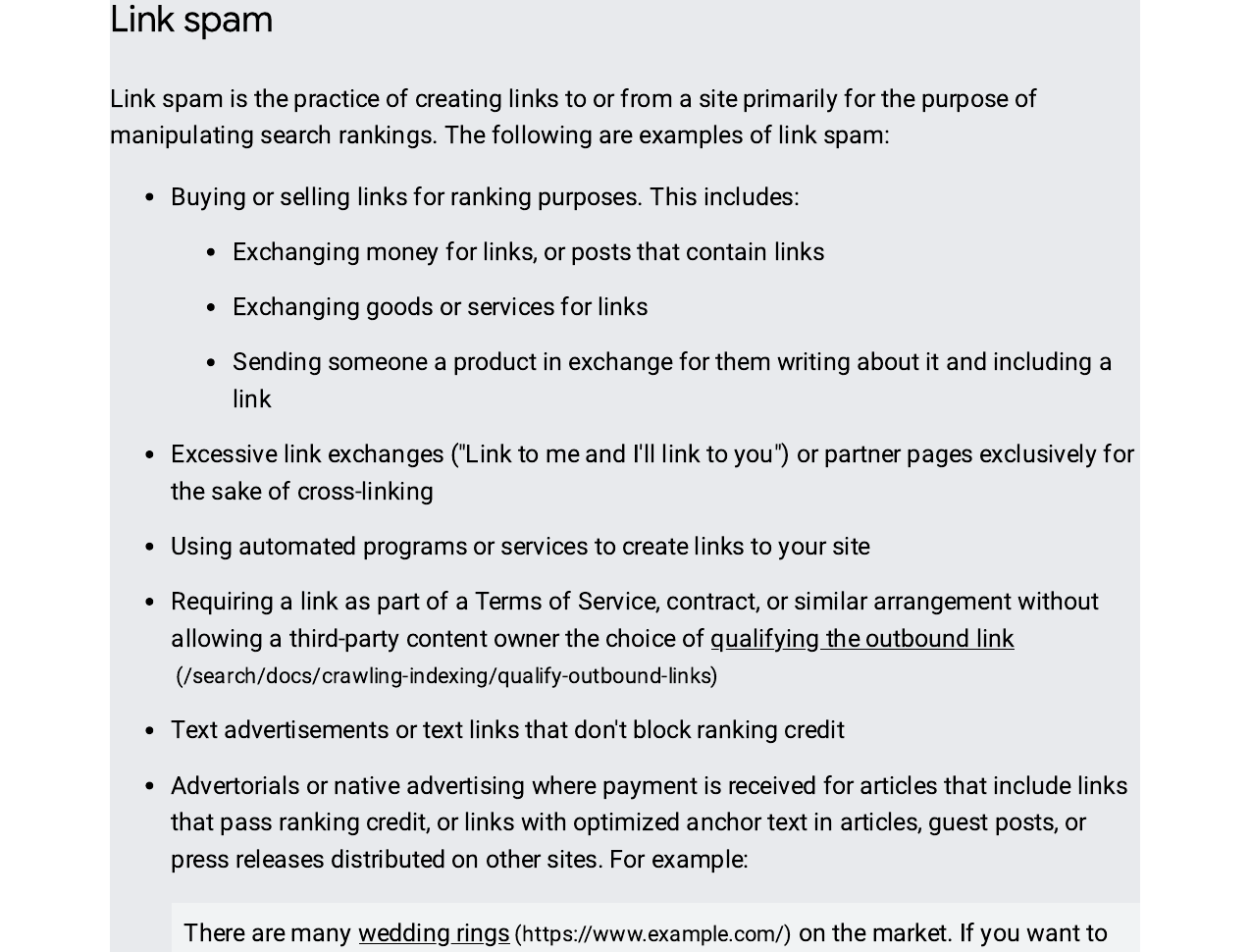
Google’s spam policies are clear about link spam: links meant to manipulate rankings, including paid links and large-scale link exchanges, can lead to a penalty. Read the link spam section of Google’s spam policies before you start outreach, so you know where the line is. The safe side of that line is simple: earn links with useful content and honest asks, and never pay for a link that passes ranking credit.
Step 7: Measure, then repeat
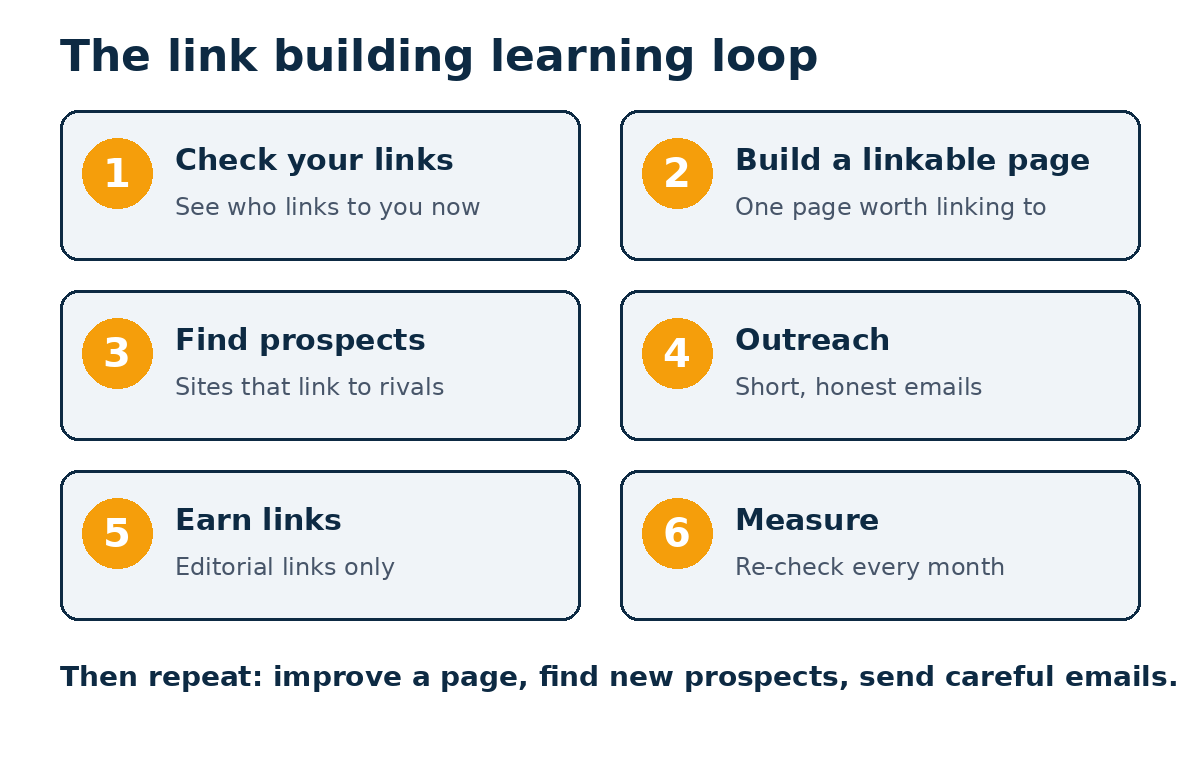
Once a month, re-check your referring domains and your rankings for the pages you worked on. Note which outreach emails got replies and which pages earned links without any ask at all. Then repeat the cycle: improve a page, find new prospects, send careful emails. Link building is a routine, not a one-off project.
Common mistakes beginners make
Chasing link counts instead of referring domains. A hundred links from one directory are worth less than five links from five real sites in your niche.
Starting outreach before the page is ready. If the page you link to is thin, nobody will link to it, and the replies you do get will be no.
Using the same anchor text everywhere. A natural link profile has brand names, plain URLs, and generic phrases mixed in with keyword phrases.
Ignoring the links you already have. Old links break. Pages get deleted and links rot. Checking your existing links each month and asking for a fix where a good link broke is the easiest link building there is.
Expecting fast results. Links take weeks to show up in tools and longer to move rankings. A beginner who quits after two weeks never sees the payoff of the first month’s work.
How long does it take to learn link building?
The basics take about two weeks of steady reading and one real attempt at the 7-step plan above. You will understand referring domains, anchor text, and outreach after your first 20 emails. Getting good takes longer: three to six months of regular practice, because judgement about which sites are worth approaching only comes from doing it and watching what happens. That is normal. The people who are good at link building are the ones who kept going past the first silent month.
If you would rather hand the work to specialists, our professional link building services use manual outreach only, with no private blog networks and no paid links.
Frequently asked questions
What is link building in simple words?
Link building is the work of getting other websites to link to your pages. Each link acts as a vote of confidence: it tells Google that another site found your content useful enough to recommend. You earn links by publishing content worth linking to and by asking relevant site owners to consider it.
Is link building still worth learning in 2026?
Yes. Google has said links are not among its top three ranking factors, but they remain part of how search works, and large studies still show that top-ranking pages have far more links than the pages below them. The skill has changed, though: relevance and honest outreach matter far more than volume now.
How many backlinks do I need to rank?
There is no fixed number. It depends on the pages already ranking for your keyword. Count the referring domains pointing at the top ten results for your keyword and aim to close the gap. For an easy keyword that may be five referring domains; for a competitive one it may be fifty or more. Start by matching the weakest page on page one.
Can a new website learn link building with no budget?
Yes. The free tools are enough to start: Google Search Console shows who links to you, and free backlink checkers show who links to your competitors. Your cost is time, not money. The main expense is the hours spent writing a page worth linking to and sending careful outreach emails.
Should I buy backlinks to learn faster?
No. Buying links that pass ranking credit breaks Google’s spam policies and can lead to a manual penalty that removes your pages from search results. Paid links also teach you nothing about outreach or content. Learn the honest way: build a useful page, find sites that already link to similar content, and ask them plainly.
What is the difference between a backlink and a referring domain?
A backlink is one single link from another page to yours. A referring domain is one unique website that links to you, however many times. Ten links from ten different websites mean ten referring domains. Ten links from one website mean one referring domain. Referring domains are the number to watch, because they show how widely your site is trusted.
Sources:
- Ahrefs, “96.55% of Content Gets No Traffic From Google” (search traffic study, Dec 2023) — https://ahrefs.com/blog/search-traffic-study/
- Backlinko, “We Analyzed 11.8 Million Google Search Results” — https://backlinko.com/search-engine-ranking
- Zyppy, Google ranking factors expert survey 2026 (131 SEOs), reported at https://www.rank.ai/statistics/backlink-statistics?via=growtha
- Google Search Central, “How Search works” — https://developers.google.com/search/docs/fundamentals/how-search-works

Abdullah Zulfiqar is Co-founder and Client Success Manager at RankWithLinks, an SEO agency helping businesses grow online. He specializes in client relations and SEO strategy, driving measurable results and maximizing ROI through effective link-building and digital marketing solutions.