
Natural link building is the process of earning backlinks because other websites choose to link to your content, without payment, swaps or pressure. Nobody asked them to do it. An editor, a blogger or a journalist found a page useful and linked to it because it helped their own readers. That simple fact is what makes a natural link the strongest kind of backlink a site can earn, and the kind Google is most willing to reward.
This guide explains what natural link building is, why it matters, how it differs from other ways of getting links, and seven practical ways to earn natural links for your own site.
What is natural link building?
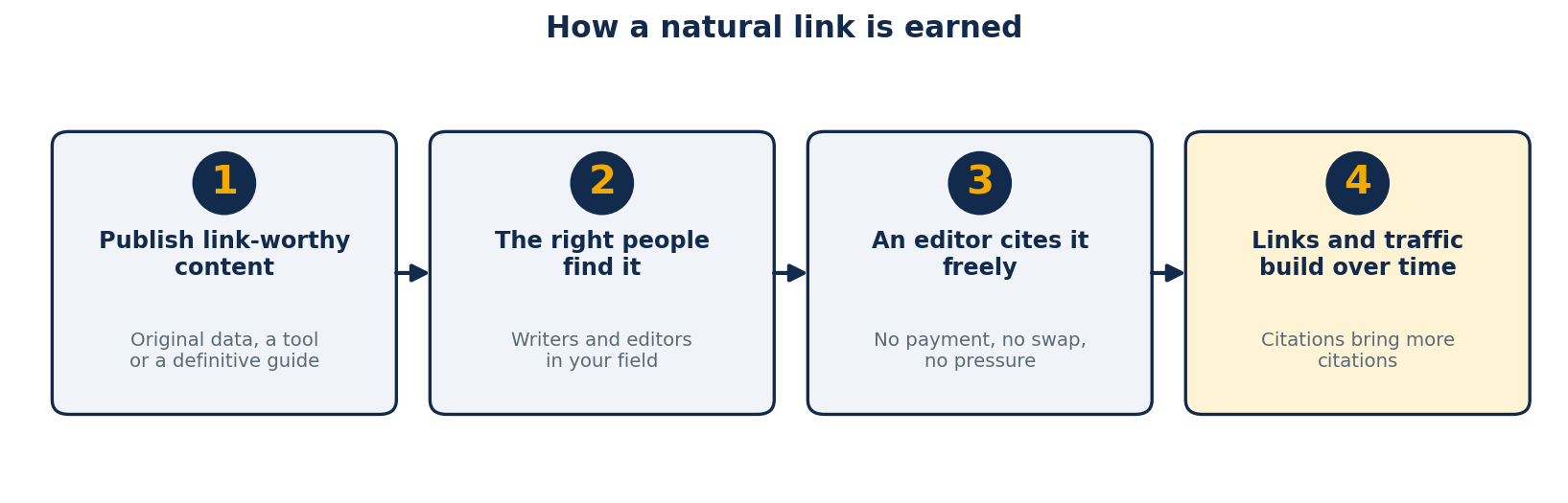
A natural link is a backlink that appears on another website through a free editorial choice. The site owner found your page, judged it worth citing, and added the link on their own. No money changed hands, no link was traded in return, and nobody sent a cold email asking for it.
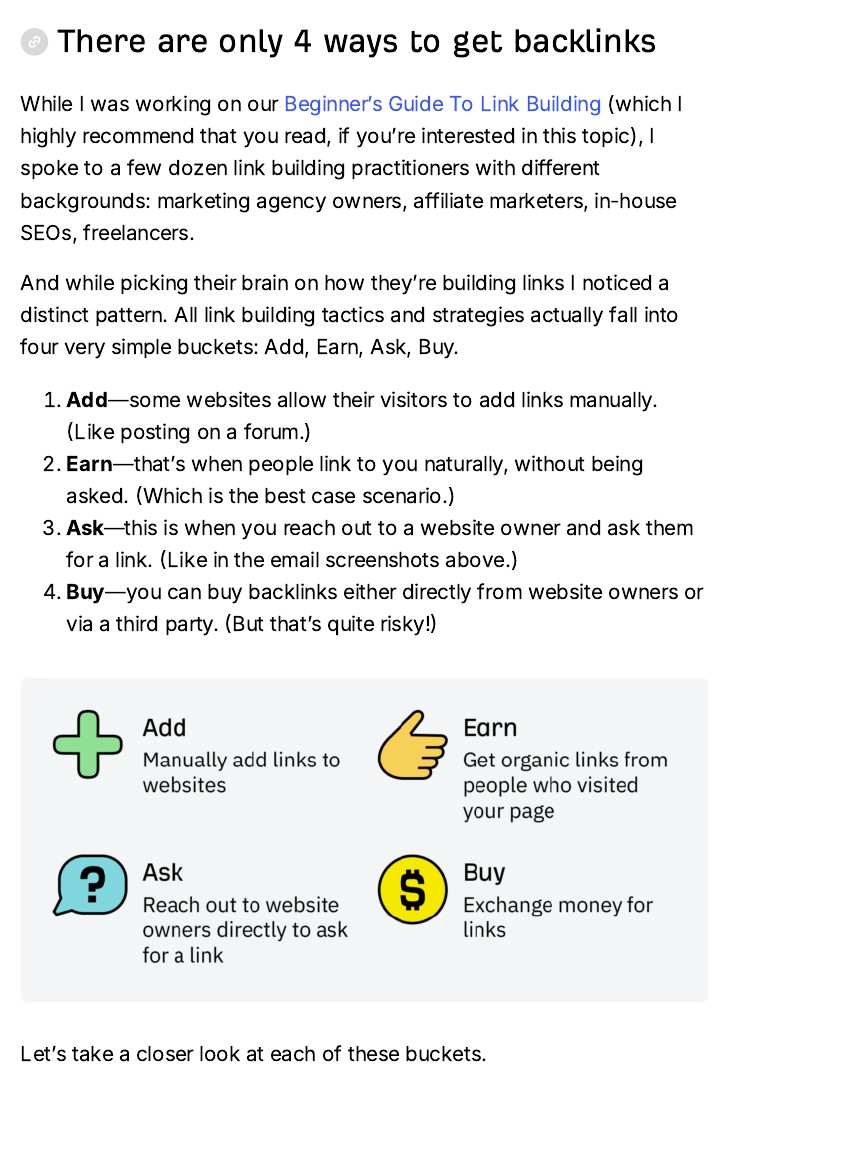
Ahrefs puts it in plain terms: earned links are the ones people give without being asked, and they only happen when a site has something truly worth linking to. In its guide to getting backlinks, Ahrefs sorts every way of gaining a link into four groups — add, earn, ask and buy — and earning is the group where the linking site acts on its own, because the content deserves it. Read the full explanation in Ahrefs’ guide to getting backlinks.
Natural link building is the work that makes those earned links happen. It is not a tactic you switch on. It is the result of publishing pages that are useful enough to cite, then making sure the right people see them. The link itself is the last step, not the first.
Why natural links matter
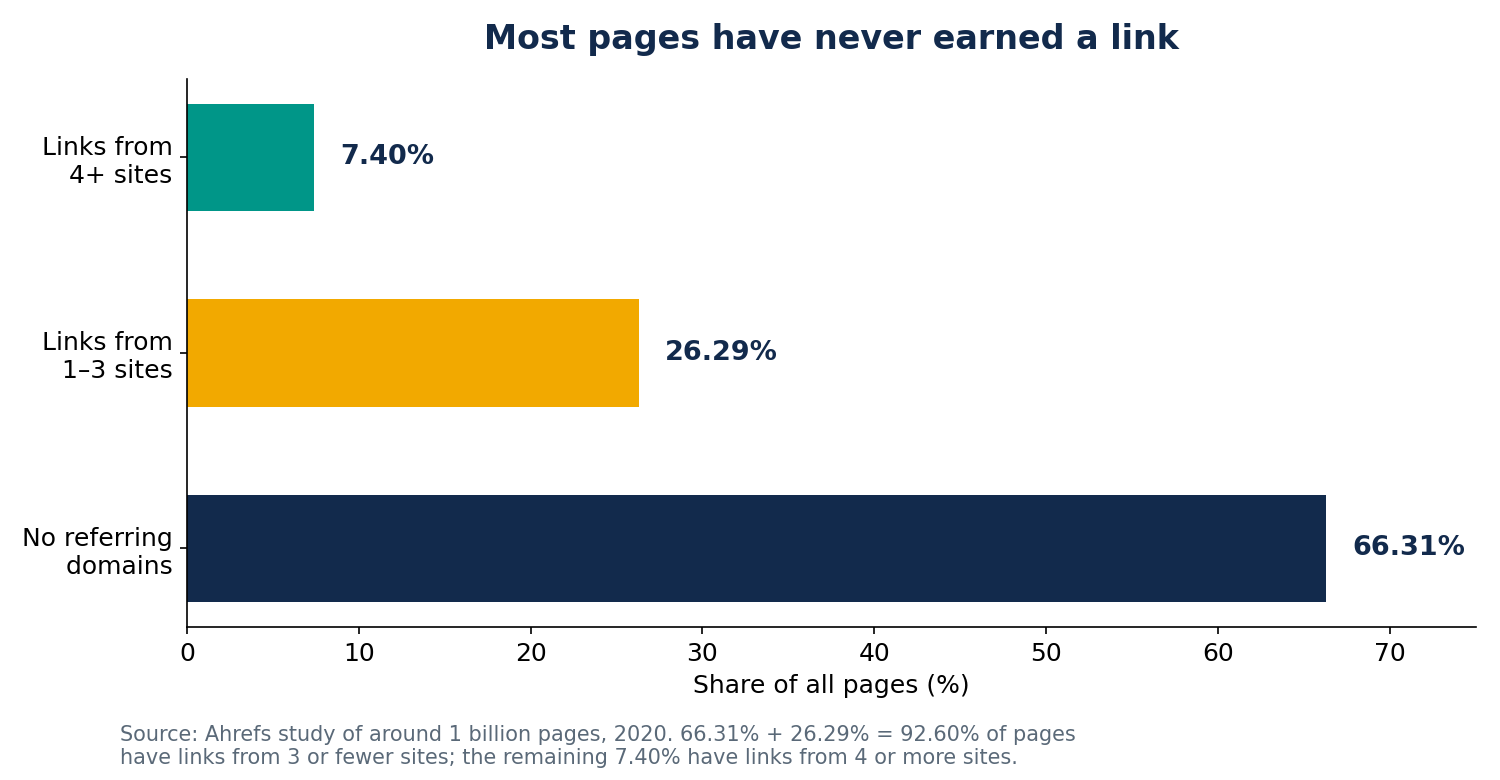
Links still track closely with rankings, but the numbers show how rare a link actually is. Most pages on the web have never earned one at all.
| Finding | Source | What it means for you |
|---|---|---|
| 66.31% of pages have no referring domains at all | Ahrefs, study of around 1 billion pages, 2020 | Two in three pages have never earned a single link from another site |
| 26.29% of pages have links from 3 or fewer sites | Ahrefs, same 2020 study | Over 92% of all pages have links from 3 or fewer sites |
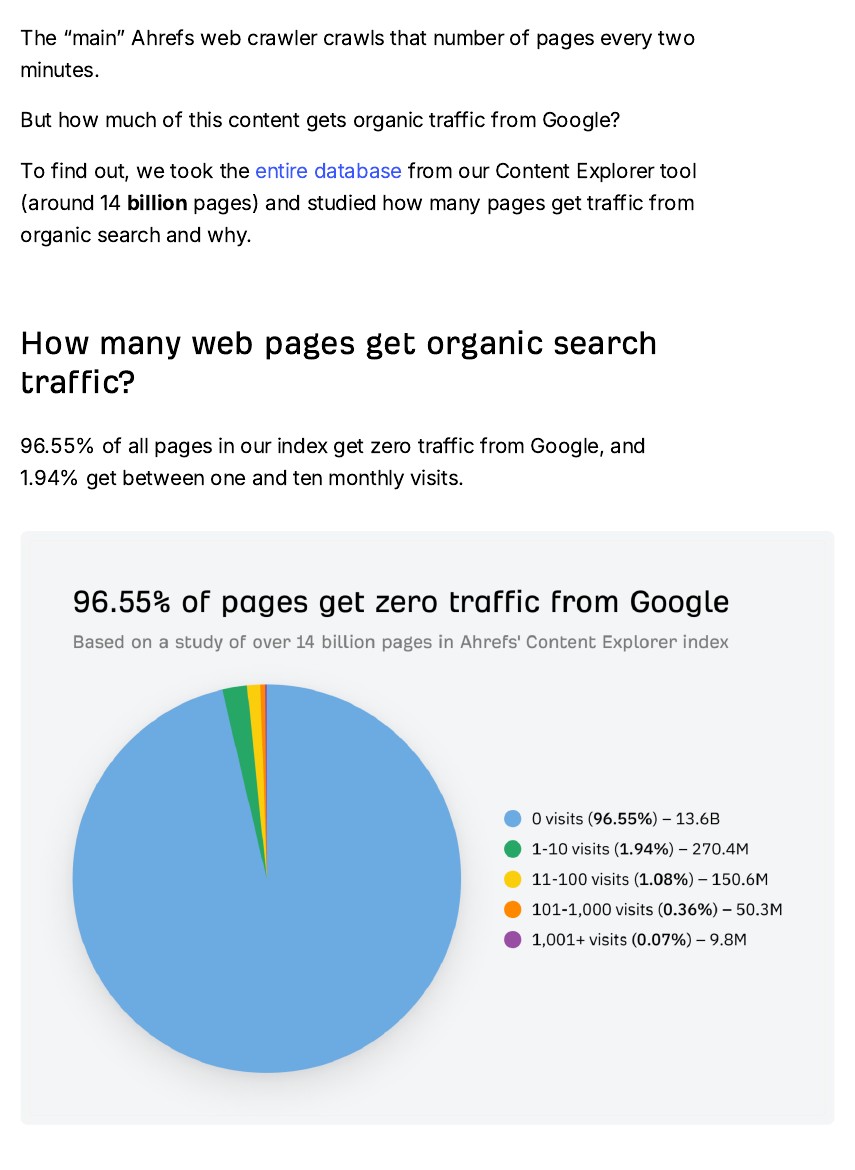
| 96.55% of pages get zero traffic from Google | Ahrefs, study of around 14 billion pages, 2023 | Most pages earn no search visits at all, and a missing link profile is one of the three reasons Ahrefs names |
| Only 1 in 6,671 pages with no backlinks earns over 1,000 monthly visits | Ahrefs, 2023 study | Of around 20 million pages with no referring domains, just 2,997 pass 1,000 monthly visits |
| The number-one result in Google averages 3.8 times the backlinks of positions two to ten | Backlinko, study of 11.8 million Google search results, updated April 2025 | Top pages hold far more links than the pages below them, but this is a correlation, not a promise |
| Referring domains have a 0.255 correlation with rankings | Ahrefs, January 2025 analysis of one million US keywords | Of all link measures, the number of different sites linking is the strongest signal |
The full data sits in Ahrefs’ search traffic study. The message is blunt: a page with no links behind it almost never earns real search traffic. Natural links are the hardest links to get, and the ones most worth having, because they are the links Google’s own guidance points to. Google lists link analysis and PageRank among its ranking systems, and its spam policies treat links made mainly to control rankings as spam. A link given freely by an editor sits on the right side of that line by definition.
Natural links vs other kinds of links
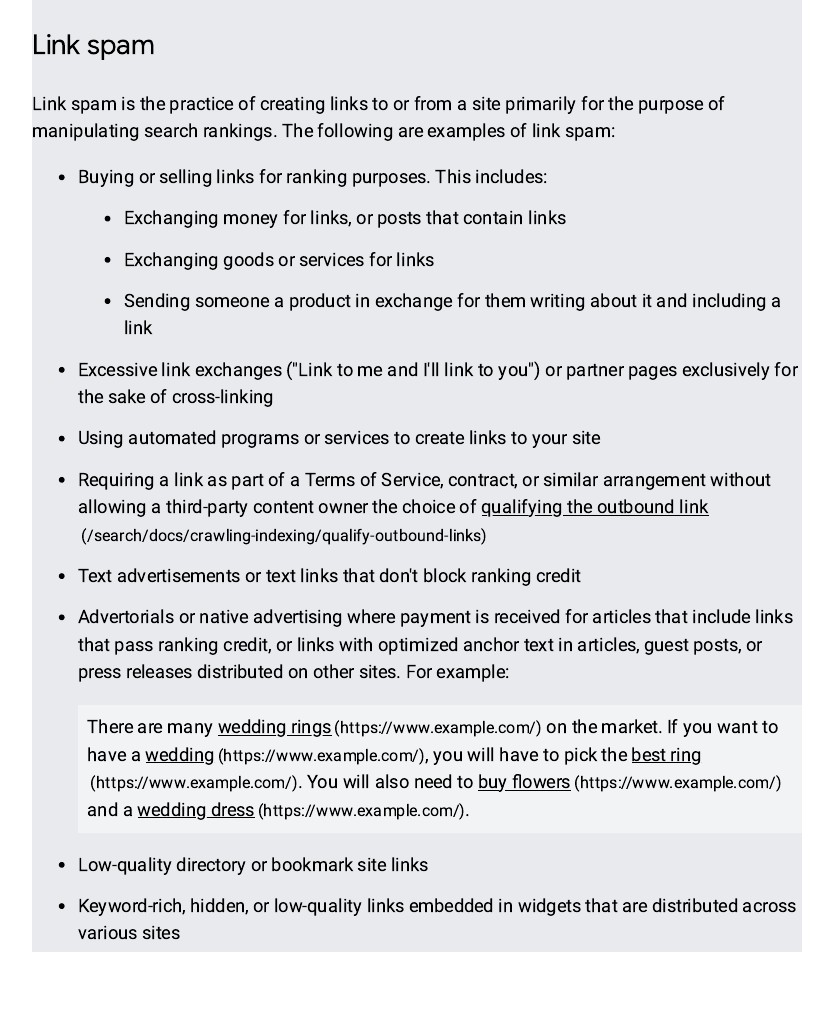
Not every backlink is natural, and Google treats the types very differently. The table below uses Google’s own spam policies as the test.
| Link type | How it appears | How Google sees it |
|---|---|---|
| Natural (earned) link | An editor links because the content is useful | The safest and strongest kind of link |
| Outreach link | You pitch a page and an editor chooses to link | Fine when the editor decides on merit and the page genuinely fits |
| Guest post link | You write for another site and link back to your own | Allowed when the post is real content for a real audience, not a link vehicle |
| Paid link that passes ranking credit | Money, goods or a free product in exchange for a followed link | Link spam under Google’s spam policies |
| Automated or mass-built link | Software or a service creates links at scale | Link spam, and the kind Google’s SpamBrain system is built to discount |
| Link swap | Two sites agree to link to each other | Excessive link exchanges are listed as link spam |
The dividing line is intent and choice. If the linking site chose freely, on merit, the link is natural. If the link exists mainly to move a ranking, it is not — however it was obtained.
7 ways to earn natural links
Natural links cannot be ordered. They can be made far more likely. Each method below gives other sites a genuine reason to link.
1. Publish original data nobody else has
Original research is the most reliable link magnet on the web. A survey of your own customers, an analysis of your own sales data, or a study built from public records gives other writers a number they cannot get anywhere else — and they have to link to you to cite it. Ahrefs’ own earned-link example is a marketing agency survey that earned links from more than 570 websites, including a link from Ahrefs’ homepage. The cost is real work: a survey needs a fair sample and honest reporting. The payoff is links that arrive without a single pitch email.
2. Build a free tool or calculator
A small tool that solves one clear problem earns links for years. A mortgage calculator, a word counter, a file converter, a price estimator — anything people use while they work. Tools get linked from round-up posts, resource pages and “best free tools” lists, because the writer linking to them is helping their own readers. Keep the tool free, fast and free of sign-up walls, or the links stop coming.
3. Write the definitive guide for your topic
A guide that covers a topic properly, with worked examples, real screenshots and honest limits, becomes the page other writers link to instead of writing their own version. The bar is high: a thin rewrite of the top ten results earns nothing. A guide that answers the follow-up questions, shows the steps and names its sources is the one that gets cited. Update it every year so it stays the current version worth linking to.
4. Create a chart or diagram worth reusing
Writers need visuals. A clear chart built from real numbers, or a diagram that explains a process at a glance, gets reused in other people’s articles — and honest writers link back to the source. This works best when the numbers come from a named study and the chart says so on the image itself. Never invent the numbers: a chart built on made-up data is a reputation problem waiting to happen.
5. Answer journalists and expert requests
Journalists need expert quotes every day, and they link to the people they quote. Services that match reporters with sources, and the #journorequest tag on social media, are the fastest routes to editorial links from news sites. Answer quickly, answer the exact question asked, and give a quote a reporter can actually use — one clear opinion, not a sales pitch. One useful quote can earn a link from a publication you could never have pitched cold.
6. Fix and reclaim what is already yours
Broken link building is the quietest way to earn natural links. Find resource pages in your niche that link to pages which no longer exist, then tell the site owner you have a live page that covers the same ground. The editor decides on merit, and the link replaces a dead one, which helps their readers too. The same idea applies to your own site: pages that moved without a redirect lose the links they had already earned. A redirect puts that value back.
7. Be quotable: strong views, clearly stated
Most content hedges. Pages that state a clear view, backed by evidence, get quoted. If your testing shows a popular tactic does not work, say so and show the numbers. If you disagree with common advice, explain why in plain words. Writers link to pages that take a position because a quote needs a source. Keep the claim honest and the evidence visible, or the links will not last.
What makes a page worth linking to?
Strip away the tactics and the test is simple: would a writer in your field link to this page while writing for their own readers? Pages that pass that test share five traits.
- It is the best answer available. Not the longest page, the clearest one, with the steps, the examples and the limits all in one place.
- It says something new. Fresh data, a test you ran yourself, or a view backed by evidence. A rewrite of what ten other pages already say earns nothing.
- It is easy to cite. Named sources, dates on the statistics, and quotes that survive being lifted into another article.
- It looks cared for. Real screenshots, working links, current numbers. A page that looks abandoned does not get linked.
- It is easy to find. A page nobody sees earns no links, however good it is. Share it where the people who write about your topic already spend time.
How long does natural link building take?
Longer than most people want to hear. A new page rarely earns links in its first weeks, because it has no audience yet and no history for writers to trust. The usual pattern is slow: a few links in the first months, then more as the page starts to rank and gets found by people writing about the same topic. Links beget links — a page that already has citations gets found and cited more often.
That slow start is normal, not a sign the method has failed. Outreach can speed up the first links, by putting a good page in front of editors who would cite it if they saw it. What outreach cannot do is make a weak page earn links. If a page has had fair exposure and still earns nothing after six months, the page is usually the problem, not the promotion. Improve the content first.
For most small sites, a realistic plan is one link-worthy page a month, promoted properly, rather than ten thin posts. Our own approach is the same: manual outreach to real editors, built around pages worth linking to. If you want help with that, see our manual link building services.
Natural links die too: look after what you earn
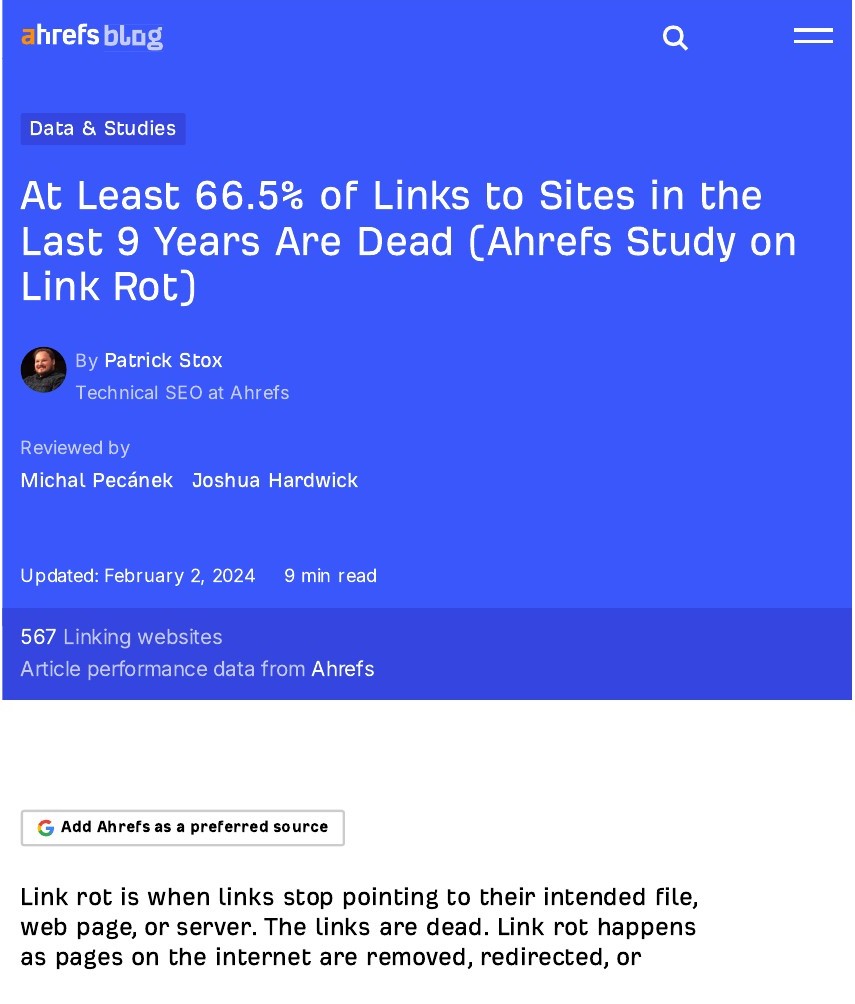
Earning a link is only half the job. Links disappear, and the rate is higher than most site owners expect. Ahrefs studied links to 2,062,173 websites from January 2013 and found that at least 66.5% had rotted — the linking page was removed, redirected or changed so the link no longer counted. Counting temporary errors and other issues, 74.5% of the links in the study were considered lost for SEO purposes. The two biggest causes were pages being dropped from the index (47.7% of lost links) and the link simply being removed during a content refresh (34.2%). Read the full study in Ahrefs’ link rot research.
Three habits protect what you earn:
- Check your links every quarter. A backlink tool shows lost links; a quick check finds the ones worth chasing.
- Keep old URLs alive. When a page moves, redirect it. A page that returns a 404 hands its earned links to nobody.
- Reclaim politely. If a site removed your link during a refresh, a short note pointing out the broken reference often gets it restored — you are helping their page, not begging for a favour.
Mistakes that stop natural links
- Publishing for search engines instead of readers. Pages written to hit a keyword count earn no citations, because nobody writing for real readers wants to cite them.
- Hiding the good part behind a form. A study that needs an email address before it can be read will not be linked. Writers link to pages their readers can open.
- Chasing link volume. Fifty links from one low-quality network count for less than five links from five real sites in your field, and the network links carry the risk.
- Ignoring the pages that already rank. If the top ten pages for your keyword average dozens of referring domains, one good page with no promotion plan will not catch them. Match the gap first, then write.
- Letting earned links rot. A link earned and then lost to a deleted page or a missing redirect is work thrown away.
FAQ
What is natural link building in simple terms?
Natural link building means earning backlinks because other websites choose to link to your content on their own. Nobody paid for the link, nobody swapped a link in return, and nobody sent a begging email. The linking site found the page useful and cited it because it helped their readers. It is the opposite of manufacturing links, and it is the kind of link Google’s own guidance treats as a genuine vote of confidence.
How is natural link building different from normal link building?
Normal link building covers every way of gaining a backlink, including outreach, guest posts and directory listings. Natural link building is the part where the link is earned rather than requested: the other site links without being asked. Outreach is still legitimate when an editor decides on merit, but the link is only truly natural when the choice was the editor’s own. The two overlap, and a good campaign uses both.
Do natural links help SEO more than other links?
Usually, yes. A natural link tends to come from a relevant page, sit inside real content, and use varied anchor text — the exact pattern Google associates with editorial choice. Outreach links can match that when the editor chooses freely. Paid and automated links cannot, and Google’s spam policies list them as link spam. Quality and relevance matter far more than the count: one earned link from a trusted site in your field beats dozens of manufactured ones.
How many natural links do I need to rank?
There is no fixed number. It depends on the keyword and the pages already ranking for it. Check the top ten results for your keyword in a backlink tool and look at their referring domains — the middle of that range is your realistic target. Low-competition topics can rank with a handful of links or none at all, while competitive terms often need dozens from different sites. Ahrefs’ data shows referring domains, not raw link counts, are the number that tracks most closely with rankings.
Is it safe to buy backlinks?
No — not if the links are meant to pass ranking credit. Google’s spam policies list buying or selling links for ranking purposes as link spam, and its SpamBrain system is built to discount them. Sites that take part can lose ranking credit or receive a manual action. Paid links are only acceptable when they are marked with rel="sponsored" or rel="nofollow" so they pass no ranking credit. Earning links through useful content is slower, but it carries none of that risk.
Can a new website earn natural links?
Yes, but it takes longer. A new site has no audience and no track record, so the first links are the hardest. Start with one genuinely useful page — original data, a free tool, or a guide better than what already ranks — and put it in front of the people who write about your topic. Journalist requests and broken link building are good first routes, because the editor judges the page itself rather than your site’s reputation.
Natural link building is slow, honest work — and that is exactly why it works. Publish pages worth citing, make sure the right people see them, and look after the links you earn. The sites that do that steadily are the ones still ranking after every update.

Abdullah Zulfiqar is Co-founder and Client Success Manager at RankWithLinks, an SEO agency helping businesses grow online. He specializes in client relations and SEO strategy, driving measurable results and maximizing ROI through effective link-building and digital marketing solutions.