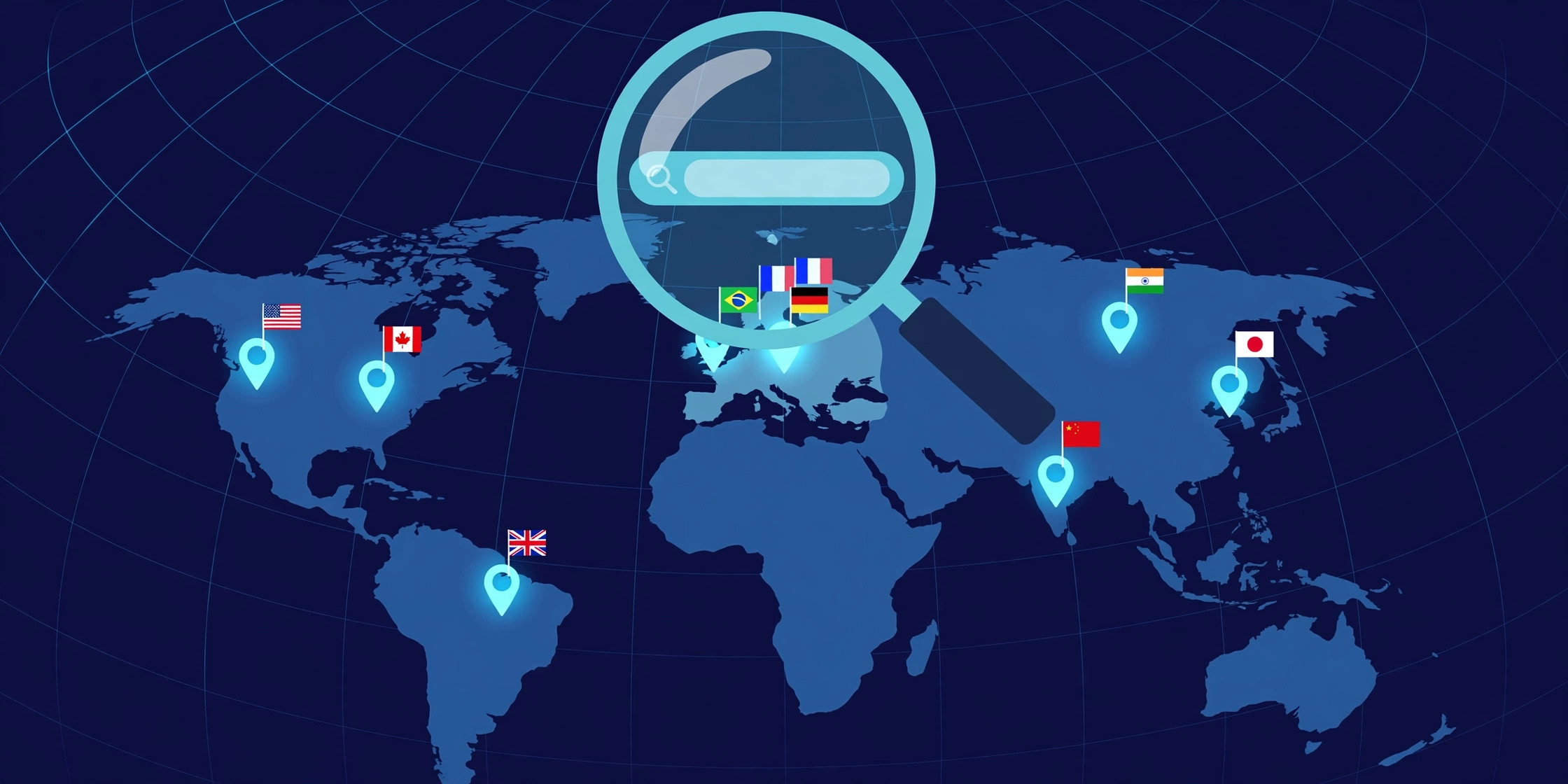
An international SEO strategy is a plan for getting your website found by people who search in other countries and in other languages. It covers which markets to target, how to structure your site, how to translate and localise your pages, and how to tell Google which version belongs to which audience. Get it right, and a site that ranks in one country can rank in ten. Get it wrong, and your pages compete with each other, your translations read like machine output, and your best content never reaches the people it was written for.
What is an international SEO strategy?
International SEO is the work of making the right version of your site show up for the right searcher, in the right country and language. A visitor in France searching in French should land on your French page. A visitor in Germany should see prices in euros, not pounds. A visitor in the United States should find your American English page, not the British one.
A strategy is the set of decisions behind that: which countries and languages are worth targeting, how the site is organised, how pages are translated, how search engines are told which version serves which audience, and how results are measured country by country. Without those decisions made up front, international sites tend to grow in a mess — duplicate pages, mixed languages, and versions that fight each other in the search results.
It is different from simply translating a website. Translation changes the words. International SEO changes the words, the keywords, the structure, the links and the technical signals, so each version can rank on its own in its own market.
Why international SEO pays: the numbers in one place
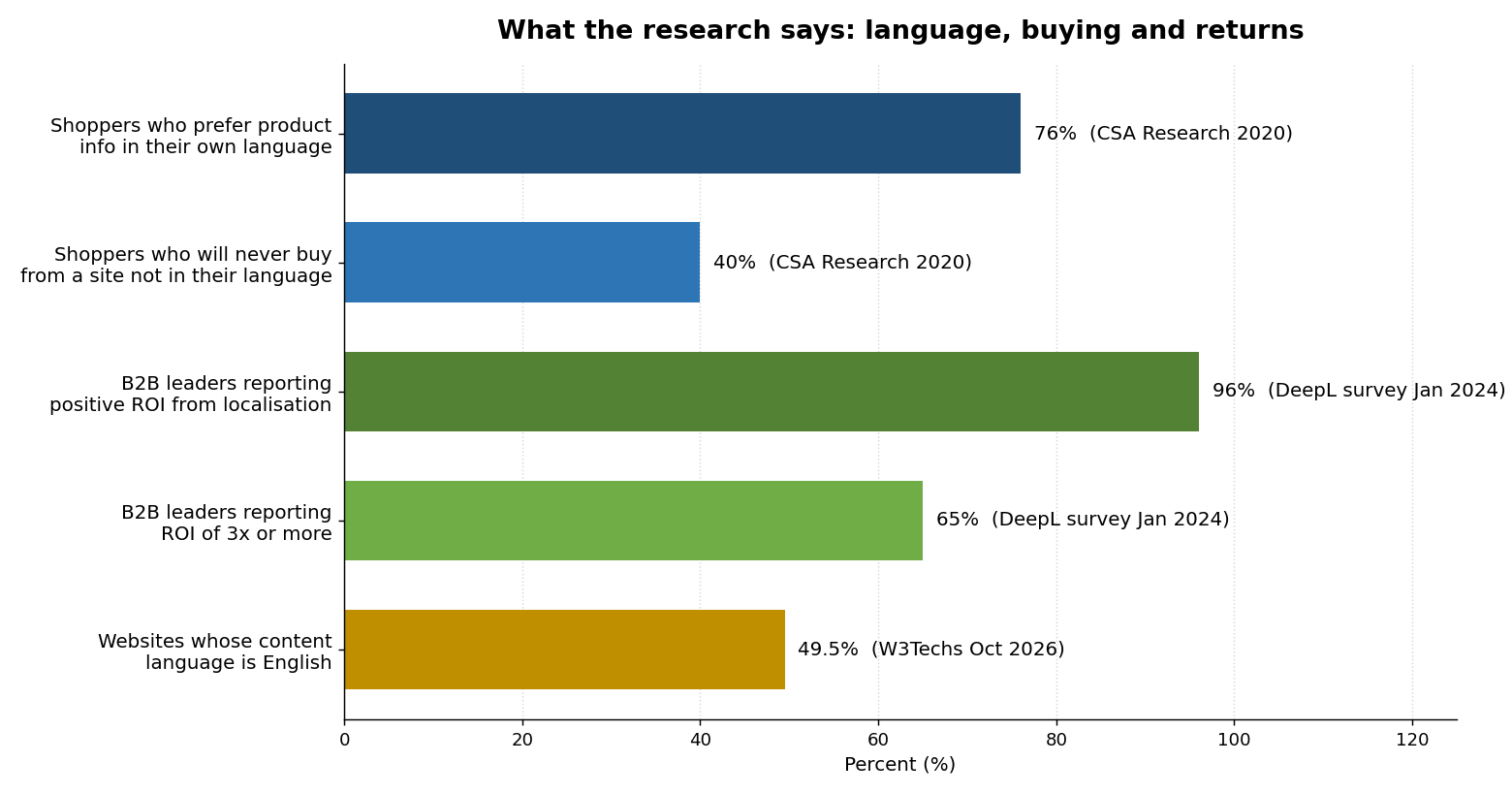
The case for going multilingual is backed by large surveys of real shoppers and by return-on-investment figures from companies that have done it.
| Finding | Number | Source |
|---|---|---|
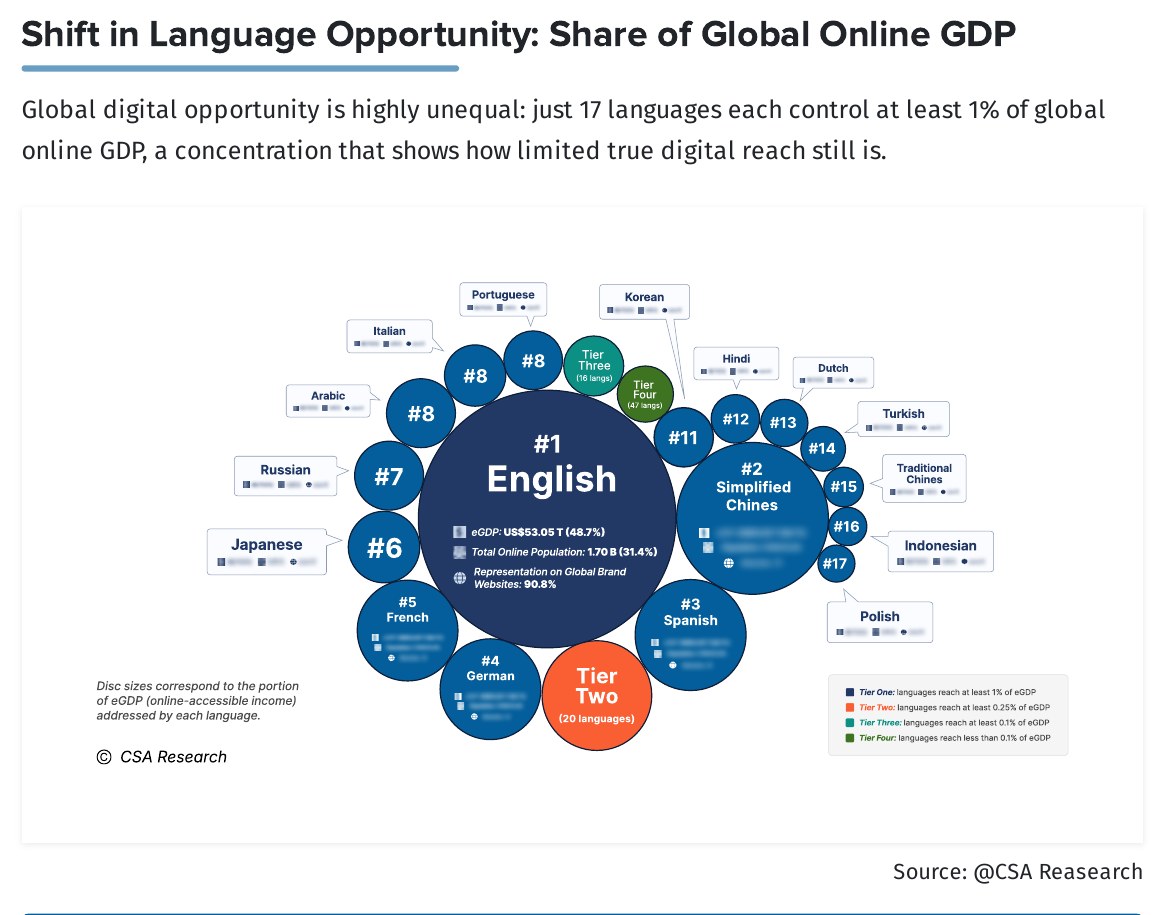
| Online shoppers who prefer product information in their own language | 76% | CSA Research, 2020 survey of 8,709 consumers in 29 countries |
| Shoppers who will never buy from a website not in their language | 40% | CSA Research, 2020 |
| B2B leaders who reported a positive return from localisation | 96% | DeepL survey, January 2024 |
| B2B leaders who reported a return of 3 times or more from localisation | 65% | DeepL survey, January 2024 |
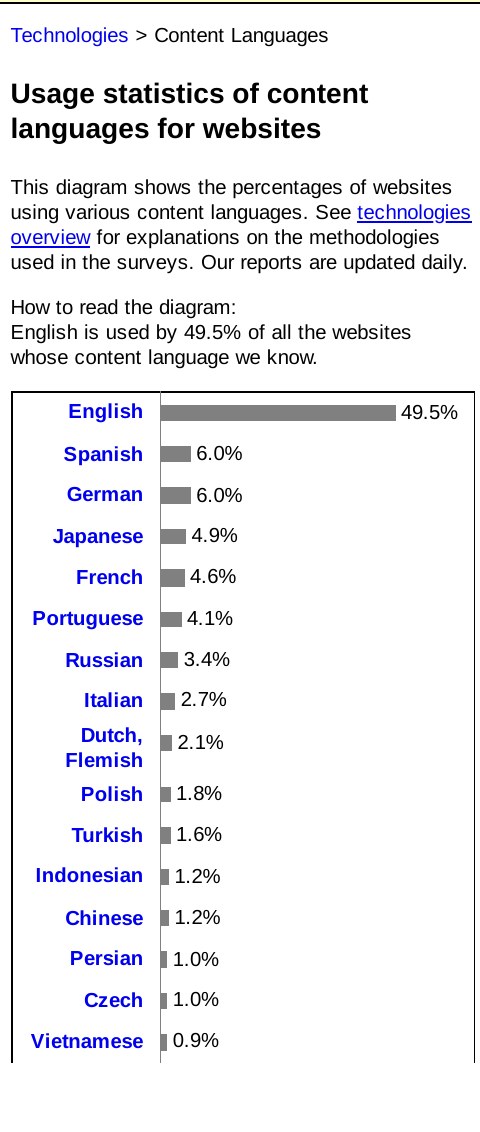
| Websites whose content language is English | 49.5% | W3Techs, October 2026 |
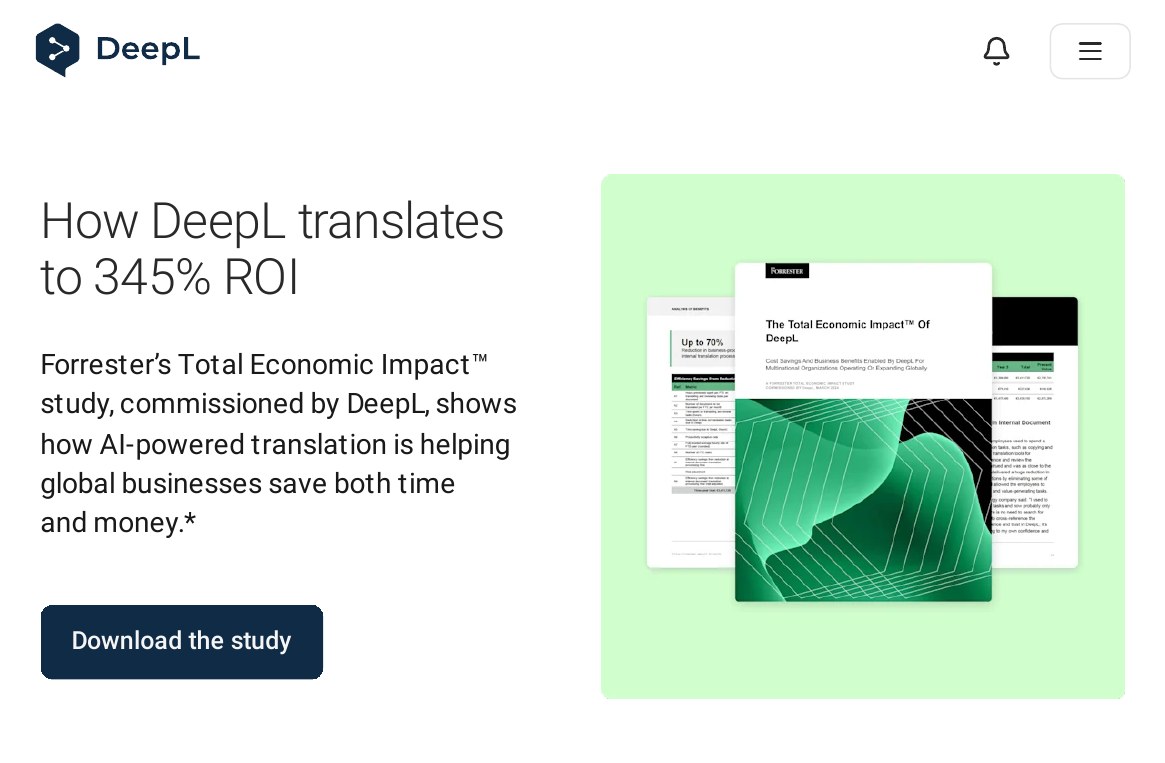
| Return on investment from AI-powered translation over three years (composite organisation) | 345% | Forrester Total Economic Impact of DeepL |
The W3Techs figure is the one that should make a site owner stop and think. About half of all websites are in English, yet most of the world’s internet users do not speak English as a first language. That gap is the opening: in many languages, competition for a search term is far weaker than in English, because few sites have bothered to serve those readers properly. A Gallup survey found that 90% of internet users choose to browse in their native language when given the choice.
Step 1: Choose your markets with data, not guesses
Do not pick countries because they look large on a map. Pick them because the evidence points there.
Start with your own analytics. Google Search Console shows which countries already send you clicks, and Google Analytics shows where your enquiries and sales already come from. If a country already brings traffic without any effort, it is usually the cheapest market to win first.
Then check demand: search volume for your main keywords in each language, and who already ranks for them. A market with strong demand and weak local competition is worth more than a huge market where ten strong local sites already own the first page. Also check you can actually serve the market — shipping, payment methods, support in the local language, and any legal rules. Pick one or two markets, prove the model, then add the next.
Step 2: Pick one URL structure and stick to it
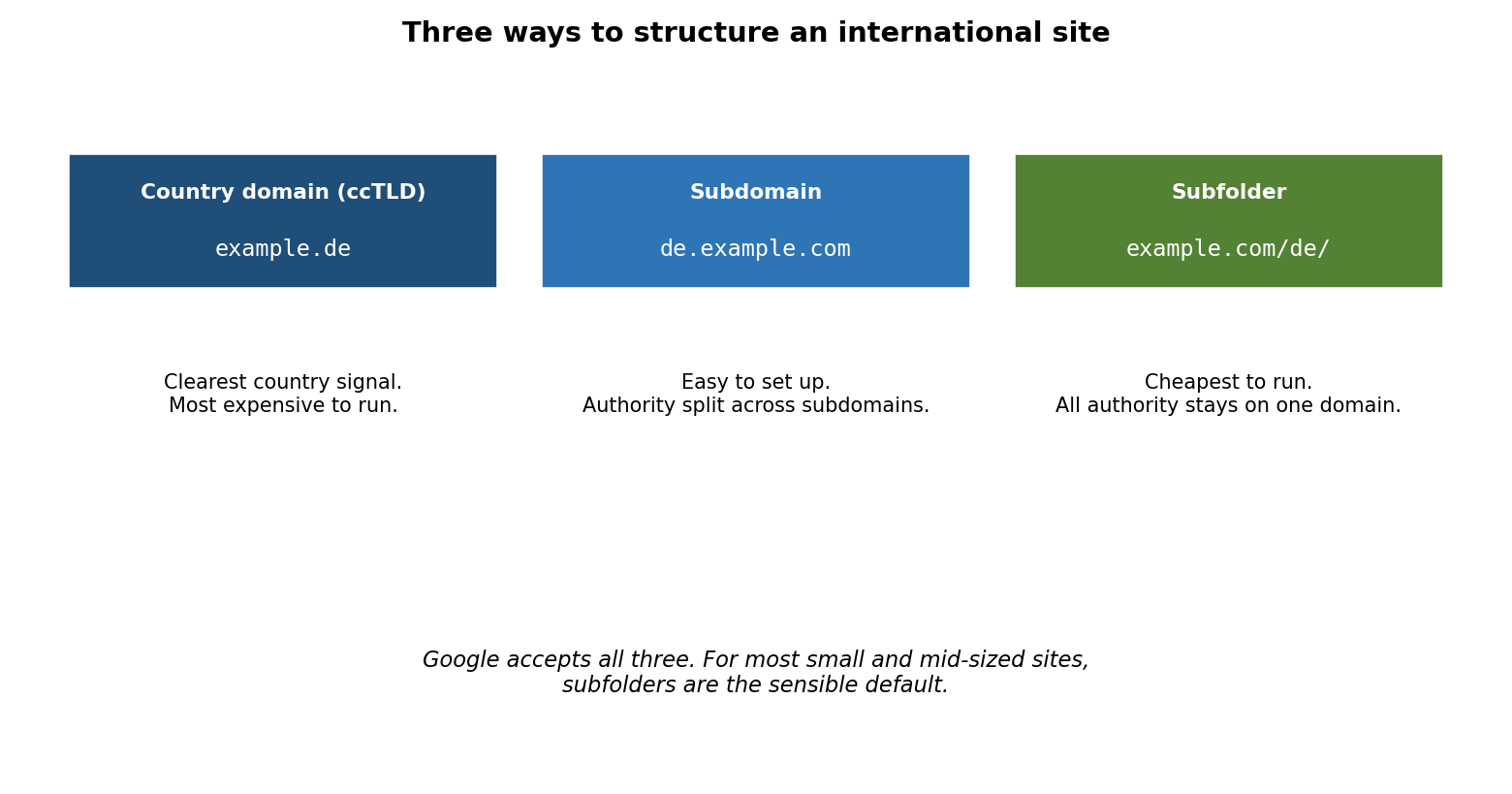
Every language or country version of your site needs its own address, and there are three common ways to do it. Google accepts all three, so the choice is about cost and control.
| Structure | Example | Strengths | Drawbacks |
|---|---|---|---|
| Country domain (ccTLD) | example.de | Clearest country signal; users trust a local domain | Most expensive; each domain builds authority from scratch |
| Subdomain | de.example.com | Easy to set up; can host on local servers | Authority is split across subdomains |
| Subfolder | example.com/de/ | Cheapest to run; all authority stays on one domain | Weakest country signal of the three |
For most small and mid-sized businesses, subfolders are the sensible default. They keep everything on one domain, so the links and authority you have already built help the new versions too. Large companies with a team and budget in each country may prefer country domains. What matters most is consistency: pick one structure and use it for every market.
Step 3: Localise, don’t just translate
Word-for-word translation is where most international SEO fails. People do not search by translating English keywords in their heads. They search in the words their own market uses, and those words are often different from a dictionary translation.
Do keyword research in each language from scratch, using a local keyword tool and, ideally, a native speaker. A term that gets thousands of searches a month in English may have a completely different local equivalent — or no local equivalent at all, because the market talks about the problem differently.
Localisation goes beyond keywords. Prices should be in the local currency. Dates, units and address formats should match local habits. Payment methods should be the ones local buyers trust. And every translated page should be read by a native speaker before it goes live. Machine translation has improved, but an unchecked machine translation still produces awkward pages that readers distrust and that rarely rank well.
Step 4: Get hreflang right
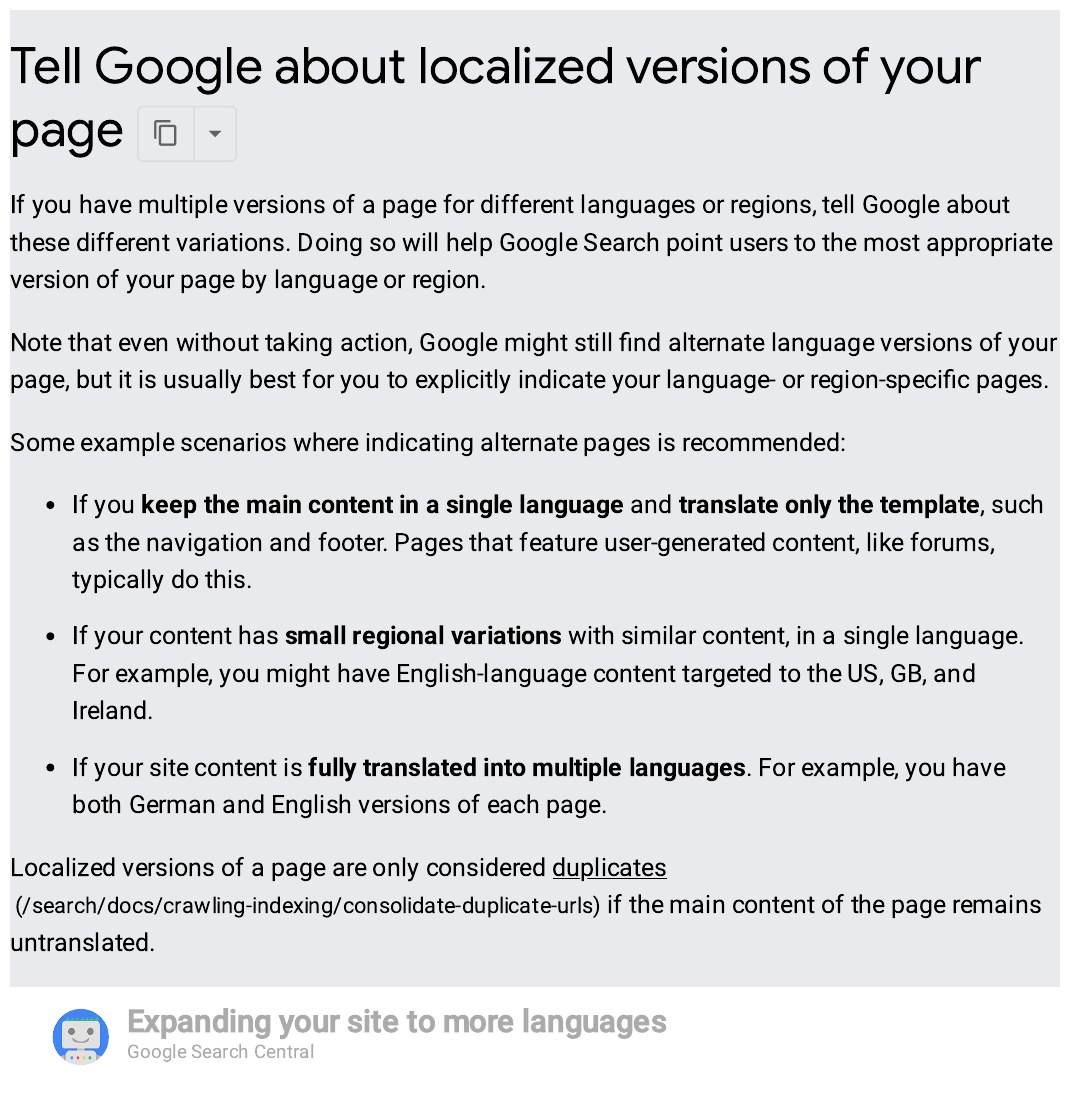
Hreflang is the code that tells Google which language and country each version of a page is for. Without it, Google has to guess — and it often guesses wrong, showing your German page to searchers in France, or your British page to searchers in the United States.
A few rules cover most of the mistakes. Every version of a page must list every other version, including itself: if the French page points to the German page, the German page must point back. Use the right language and country codes — en-GB for British English, en-US for American English, de-DE for German in Germany. Add an x-default version for visitors who match no listed language or country, usually your global homepage. And only use hreflang between pages that are genuine equivalents; pointing it at a homepage when the matching page is a product page confuses Google rather than helping it.
Google’s own documentation on localised versions is the reference to follow before you write a single hreflang tag. Errors here are common and silent: nothing breaks visibly, but the wrong version keeps showing up in the wrong country.
Step 5: Build local links and local trust signals
A translated page with no local links is a page Google has little reason to trust in that market. Links from sites in the country you are targeting — local directories, local press, local industry sites, local partners — tell Google your site belongs in that market’s results.
Start with the easy wins: list the business in the main local directories for that country, get listed by local trade bodies, and ask existing suppliers, customers and partners in that country for a link. Then earn the harder ones: local press coverage, guest articles on local industry sites, and content local sites genuinely want to link to, such as local data or a local guide.
Trust signals matter on the page too. Show a local phone number, local address, local currency and local delivery information where they apply. A visitor who cannot tell whether you serve their country will leave, and a search engine notices that. International SEO is a market-entry job, not a translation job, and our multilingual SEO services cover the full process, from market research to local links.
Step 6: Measure every market on its own
International SEO cannot be judged from one global traffic number. A site can grow in Germany and fall in France at the same time, and a single total hides both.
In Google Search Console, filter performance by country and by page, so you can see which language versions are gaining clicks and which are not. Track rankings separately for each country, because a page can sit on page one in the UK and page five in Australia for the same search. Watch the hreflang report for errors, and check that each version is indexed — a translated page Google never indexed cannot rank anywhere.
Measure conversions per market too, not just traffic. A market that brings many visitors but no enquiries is a sign that the translation, the offer or the trust signals are wrong, not that the SEO has failed. Review each market monthly at first, fix what the numbers show, and only then spend more on the next country.
Mistakes that waste international SEO budgets
- One English site plus a translate widget. A widget does not create indexable pages in other languages, so there is nothing for Google to rank.
- Translating keywords word for word. Local keyword research is a separate job, and skipping it means targeting terms nobody searches for.
- Hreflang that points to the wrong pages. Wrong codes and missing return links are the most common technical error in international SEO.
- The same content on every country version. If only the currency changes, Google may treat the versions as duplicates and rank only one of them.
- Launching five markets at once. Each market needs content, links and maintenance. Start with one or two, prove they work, then expand.
- No one to maintain the translations. A French page that still shows last year’s prices damages trust faster than having no French page at all.
Frequently asked questions
What is the difference between international SEO and local SEO?
Local SEO helps a business show up for searches in one place, such as a city or region — think “plumber in Manchester”. International SEO helps a website show up in whole countries and languages. Local SEO is about Google Business Profile, local citations and reviews in one area. International SEO is about language versions, hreflang, country targeting and local links across many markets. A business can need both, but they are different jobs with different tools.
Do I need a separate domain for each country?
No. A separate country domain is one option, but subfolders such as example.com/de/ work well for most businesses and are cheaper to run. Country domains send the clearest signal to Google and to users, but each one has to build its own authority from nothing. Subfolders keep all of your site’s authority on one domain, which usually matters more for a small or mid-sized site. Pick one structure and use it everywhere.
Does Google penalise translated content?
No, Google does not penalise translated content. It does penalise low-quality content, and that includes poor machine translations that read badly or add nothing. A well-translated page, localised for its market and aimed at a real local search term, is treated like any other good page. The risk is not translation itself; it is publishing translations nobody has checked, in bulk, with no local keyword research behind them.
How long does international SEO take to show results?
Expect the first signs in three to six months for a new language version, and six to twelve months before it brings steady traffic. New country versions start with no local authority, so they need time, local links and proof that users engage with them. Markets with weak local competition move faster. If nothing has changed after six months, the problem is usually hreflang errors, missing local links, or pages that were never indexed — not the strategy itself.
Should I use hreflang if my site is only in English but serves several countries?
Yes, if you have separate pages for different English-speaking countries. A page written for the UK and a page written for the US may both be in English, but they differ in spelling, currency and offers. Hreflang with codes like en-GB and en-US tells Google which one to show in each country. If you have only one English version for all countries, hreflang is not needed, because there is nothing to choose between.

Abdullah Zulfiqar is Co-founder and Client Success Manager at RankWithLinks, an SEO agency helping businesses grow online. He specializes in client relations and SEO strategy, driving measurable results and maximizing ROI through effective link-building and digital marketing solutions.