Intro
SEO backlinks meaning is simple: a backlink is a link from one website to another. When a blog, a news site or a business directory links to your page, that link is a backlink for you. Search engines treat these links as votes of confidence. A page with links from trusted, relevant websites is more likely to rank well than a similar page with no links at all. This guide explains the meaning of backlinks in SEO in plain words, shows what the research says about how much they matter, and explains how to check and earn them without breaking Google’s rules.
SEO Backlinks Meaning in Plain Words
A backlink is also called an inbound link or an incoming link. It is any hyperlink on someone else’s website that points to a page on your website. If a food blogger links to your restaurant’s menu page, your menu page has gained a backlink. If you link from your own blog to your own services page, that is an internal link, not a backlink. The word “backlink” only applies when the link comes from a different website.
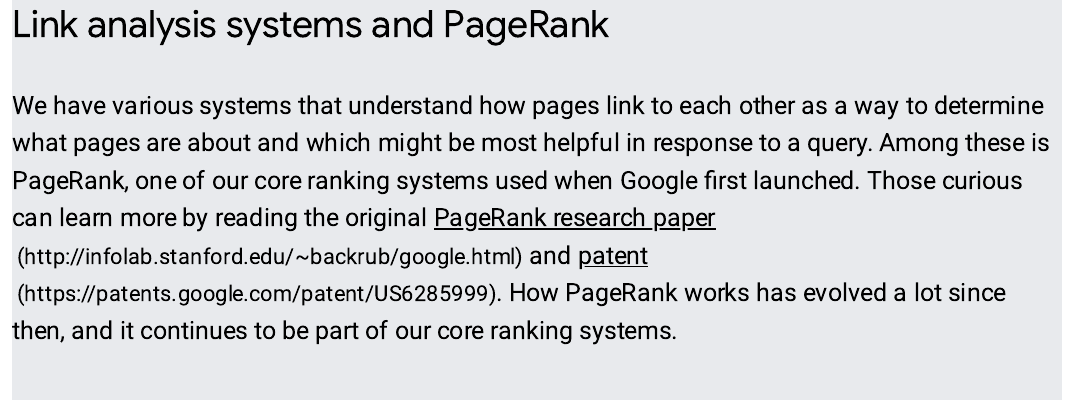
The idea behind backlinks is older than Google. The web was built on links, and a link is a recommendation. When a real website links to your page, it is telling its readers — and Google — that your page is worth a visit. Google’s founders built their search engine around this idea. Their PageRank system treated links as a way to judge which pages were trusted and useful. Google’s own guide to its ranking systems still lists link analysis systems and PageRank among its core ranking systems today. The method has changed a lot since 1998, but the basic idea has not: links from other sites help Google decide what a page is about and how much it can be trusted.
That is why people search for “SEO backlinks meaning” in the first place. They have heard that backlinks matter for ranking, and they want to know what they are before they spend time or money on them. The short answer is that a backlink is a vote from another website, and the quality of the voter matters far more than the number of votes.
How Backlinks Work
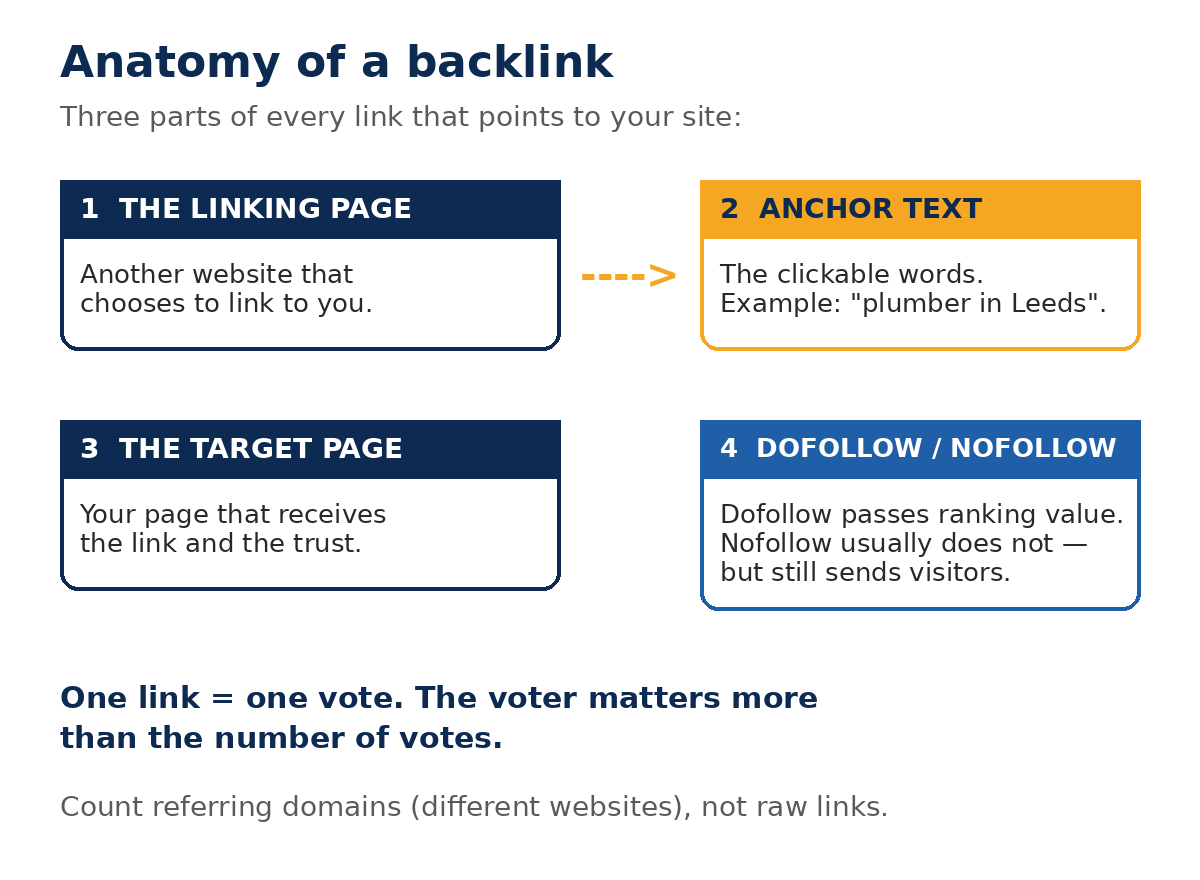
When Google finds a link to your page, it reads three things: the page that links to you, the words used in the link, and the page the link points to.
The linking page is the source. A link from a respected site in your field carries more weight than a link from a new, unknown site. A link from a page about your exact topic carries more weight than a link from an unrelated page. Google looks at the topic, the trust and the history of the site doing the linking.
The words in the link are called anchor text. If ten sites link to your page with the words “plumber in Leeds”, Google learns that your page is probably about plumbing in Leeds. Natural anchor text varies. Real sites link with your brand name, your page title, a plain web address, or a phrase like “this guide”. If every link uses the exact same sales phrase, that looks planned, and Google treats it with suspicion.
The page the link points to is the target. Links to a specific, useful page — a guide, a tool, a product page — are worth more than links that all point to your homepage. They show that a particular page earned the mention.
Google also counts referring domains, which is the number of different websites linking to you, not the total number of links. Ten links from ten different sites are worth far more than ten links from one site. When you check your backlinks, look at referring domains first. It is the number that tells you how widely your site is trusted.
What the Numbers Say About Backlinks
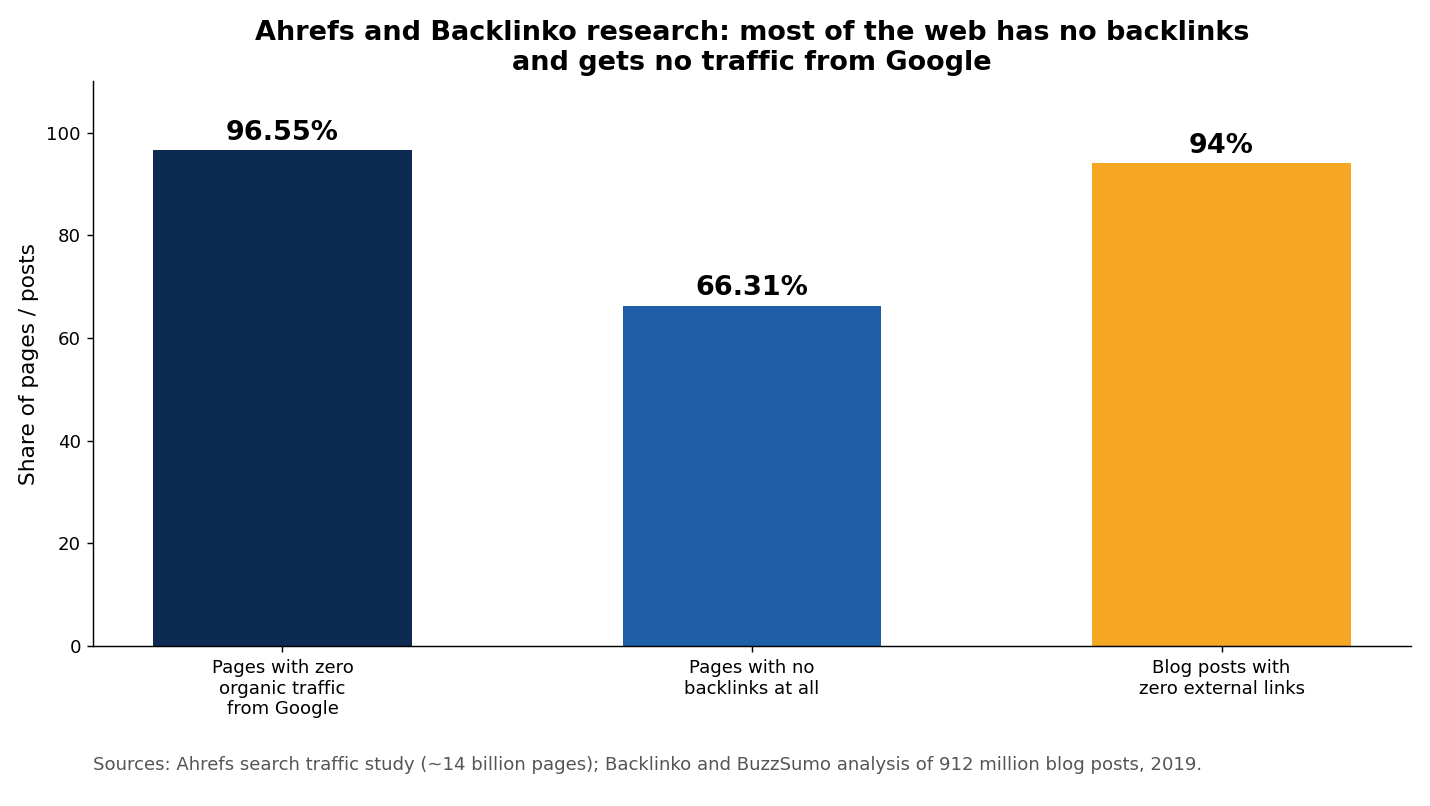
It is easy to talk about backlinks in general terms. The research makes the picture much clearer, and it is stark: most pages on the web have no backlinks and get no traffic from Google.
| Finding | Figure | Source |
|---|---|---|
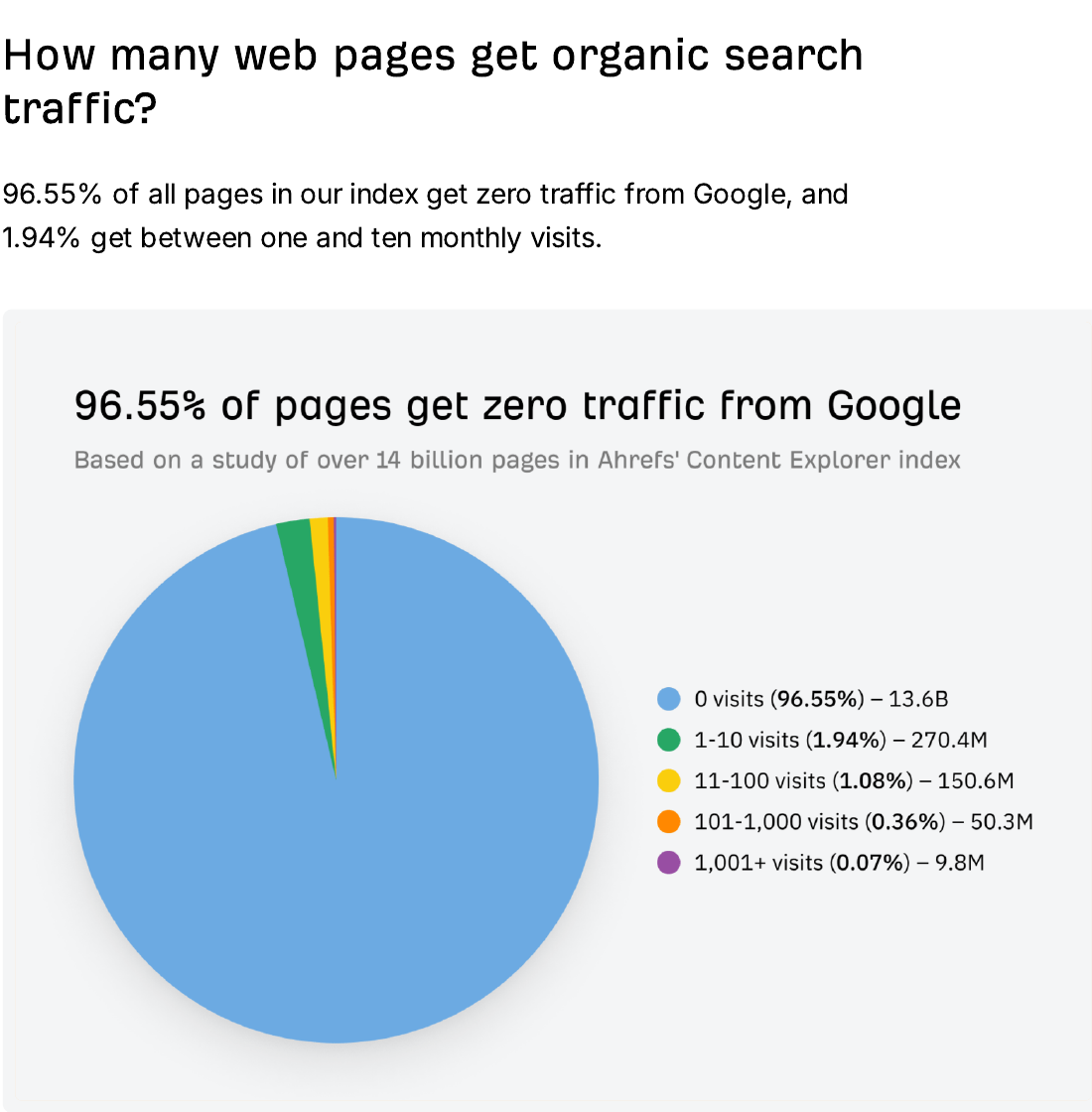
| Pages that get zero organic traffic from Google | 96.55% of about 14 billion pages | Ahrefs search traffic study |
| Pages with no backlinks at all | 66.31% | Ahrefs, same study |
| Blog posts that earn zero external links | 94% of 912 million posts | Backlinko and BuzzSumo, 2019 |
| Pages with no referring domains that get over 1,000 monthly search visits | 1 in 6,671 | Ahrefs, same study |
| Backlinks of the number one Google result, compared with positions 2 to 10 | 3.8 times more on average | Backlinko, analysis of 11.8 million Google results |
Source: Ahrefs, “96.55% of Content Gets No Traffic From Google” (study of about 14 billion pages); Backlinko ranking factors study of 11.8 million Google search results; Backlinko and BuzzSumo analysis of 912 million blog posts, 2019.
The Ahrefs figures deserve a closer look. Of about 20 million pages in its index with no referring domains at all, only 2,997 received more than 1,000 search visits a month. That is roughly 1 in every 6,671 pages. The two sites that managed it without links both had very strong domain authority, which shows that a powerful site can sometimes rank without links to a particular page — but for ordinary sites, it is close to impossible.
None of this proves that a link causes a ranking. Pages that rank first also tend to be older, better known and more useful, which earns them links. Cause and effect run both ways. But the pattern is consistent across every large study: pages that rank well almost always have backlinks, and pages with no backlinks almost never get traffic. For a new or small site, earning links is one of the few levers that moves rankings.
The Main Types of Backlinks
Not all backlinks are the same. Knowing the types helps you judge which ones are worth earning.
Dofollow links. These are ordinary links. They pass ranking value from the linking page to your page. Most editorial links — links a site owner places because your content is useful — are dofollow. These are the links that move rankings.
Nofollow links. These carry a small piece of code, rel=”nofollow”, that tells Google not to pass ranking value. Google has treated nofollow as a hint rather than a strict rule since 2019, so nofollow links may still help a little, and they still send visitors. Links from blog comments, forums and many social sites are nofollow by default. They are normal, and a natural link profile includes plenty of them.
Editorial links. A journalist, blogger or site owner links to your page because they chose to. Nobody paid for the placement and nobody asked for it as a favour. Editorial links are the hardest to earn and the most valuable, because they are the closest thing to a genuine recommendation.
Guest post links. You write an article for another website and it includes a link back to your site. These can be useful when the host site is real, relevant and has a genuine audience. They turn into a problem when the host site exists only to sell guest posts.
Directory and citation links. Links from business directories, trade bodies and local listings. On their own they carry little ranking power, but they confirm your business details and help local search. They are a starting point, not a strategy.
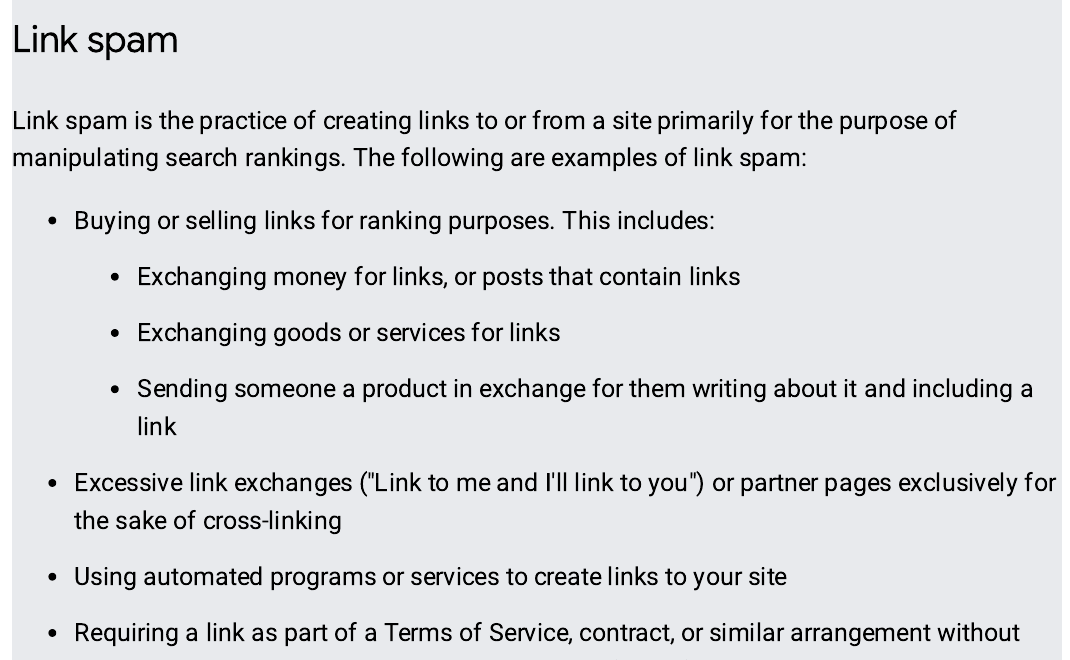
Sponsored and paid links. Links you paid for. Google’s spam policies are clear: links intended to manipulate rankings must carry rel=”sponsored” or rel=”nofollow”. A paid link that passes ranking value breaks those rules and can lead to a penalty.
What Makes a Backlink Good or Bad
Four things decide the value of a backlink.
Relevance. A link from a site in your field is worth more than a link from an unrelated site. A link to a law firm from a legal directory means something. A link to the same firm from a recipe blog means very little, however big the blog is.
Authority. A link from a site Google already trusts — a university, a national newspaper, a government site, a long-running trade publication — carries more weight than a link from a new site nobody has heard of. You can check a site’s standing with tools such as Ahrefs, Moz or Semrush, but the simplest test is whether you would be proud to show the link to a customer.
Placement. A link inside the main text of an article, where readers can see it, is worth far more than a link buried in a footer, a sidebar or a comments section. Editorial links in the body of a page are hard to fake, and Google knows it.
Natural anchor text. Real links use varied words: your brand name, a plain web address, the title of your page, or a phrase that fits the sentence. When hundreds of links all use the same keyword-rich phrase, that pattern looks bought, and Google’s spam systems are built to spot it.
A bad backlink fails most of these tests. It comes from a site with no real audience, no clear topic, or a history of selling links. It sits in a footer or a sidebar. Its anchor text is an exact sales phrase. One bad link will not hurt you. Hundreds of them, gained quickly, can. Google’s Penguin system, now part of its core ranking systems, was built to catch exactly this kind of manipulation.
How to Check Your Backlinks
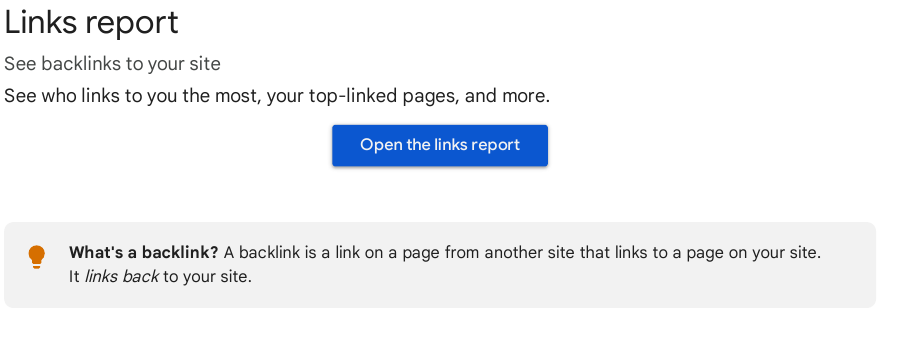
You do not need a paid tool to see who links to your site. Google Search Console is free, and its Links report shows the sites that link to you most, the pages on your site that attract the most links, and the anchor text other sites use.
- Open Google Search Console and select your website.
- In the left-hand menu, open Links.
- Look at “Top linking sites” first. This is your referring domain list. A healthy profile grows slowly and includes sites you recognise.
- Check “Top linked pages” to see which of your pages earn links. If only your homepage has links, your deeper pages need better content or more promotion.
- Check “Top linking text” to see your anchor text. If one sales phrase dominates, that is a warning sign.
Check the report once a month. Look for sudden jumps in links, links from sites you have never heard of, and anchor text that looks bought. If you find links you did not ask for and do not want, note them down. Most can be ignored — Google is good at ignoring spam links on its own — but a large batch of clearly manipulative links is worth recording in case you ever need to disavow them.
How to Earn Backlinks the Right Way
There is no shortcut that lasts. The methods that work are slow, but they are the same methods Google rewards.
Publish something worth linking to. Original research, a clear guide, a useful tool or a strong opinion piece earns links because other writers need something to cite. A page that says nothing new earns nothing.
Help journalists and writers. Services that connect experts with journalists let you answer questions in your field. When your quote is used, you usually get a link from a news site. These links are editorial, relevant and hard to copy.
Guest post on real sites. Write for websites your customers actually read. One guest post on a respected site in your field is worth more than ten posts on sites that exist only to host guest posts.
Fix broken links. Find pages in your field that link to pages which no longer exist, then tell the site owner and suggest your page as a replacement. It works because you are solving their problem first.
Build relationships, not link lists. The sites that link to you more than once are usually sites whose owners you know. Comment on their work, share it, and help them before you ask for anything.
If the work is more than you can do in-house, our manual link building services handle outreach by hand, with no private blog networks and no bought links. Whatever route you take, the rule is the same: earn links from real sites, and let the rankings follow.
Frequently Asked Questions
What is the meaning of backlinks in SEO?
In SEO, a backlink is a link from one website to another. When site A links to site B, site B has gained a backlink. Search engines treat backlinks as votes of confidence: a page linked to by trusted, relevant sites is more likely to rank well. The number of different websites linking to you, called referring domains, matters more than the raw number of links.
Are backlinks still important in 2026?
Yes. Google’s own guide to its ranking systems still lists link analysis and PageRank among its core systems. Large studies agree: Ahrefs found that 96.55% of pages get no organic traffic from Google, and pages without backlinks almost never rank. Links are not the only factor — content quality, relevance and site performance all matter — but for competitive keywords, ranking without backlinks is very hard.
How many backlinks do I need to rank?
There is no fixed number. It depends on the keyword and on the sites already ranking for it. A low-competition query might need only a few links from relevant sites, while a competitive term may need dozens from strong domains. Compare your page with the top ten results for your keyword, count their referring domains, and aim to match or pass them with better links, not just more of them.
What is the difference between a backlink and a referring domain?
A backlink is a single link. A referring domain is a website that links to you. If one website links to your page five times, that is five backlinks from one referring domain. Google counts referring domains separately because ten links from ten different sites show wider trust than ten links from one site. When people talk about growing a link profile, they usually mean growing referring domains.
Do nofollow backlinks help SEO?
Nofollow links do not pass ranking value in the old sense, but they are still useful. Google has treated nofollow as a hint since 2019, so some value may pass. More importantly, nofollow links send real visitors, build brand awareness and make your link profile look natural. A site with only dofollow links looks bought. A healthy profile has a mix of both.
Should I buy backlinks?
No. Buying links to manipulate rankings breaks Google’s spam policies, which say paid links must carry rel=”sponsored” or rel=”nofollow”. Bought links usually come from low-quality sites, and Google’s spam systems are built to find them. The risk is a manual action or a sudden loss of rankings that takes months to recover from. Earn links instead, or hire an agency that does manual outreach.

Abdullah Zulfiqar is Co-founder and Client Success Manager at RankWithLinks, an SEO agency helping businesses grow online. He specializes in client relations and SEO strategy, driving measurable results and maximizing ROI through effective link-building and digital marketing solutions.