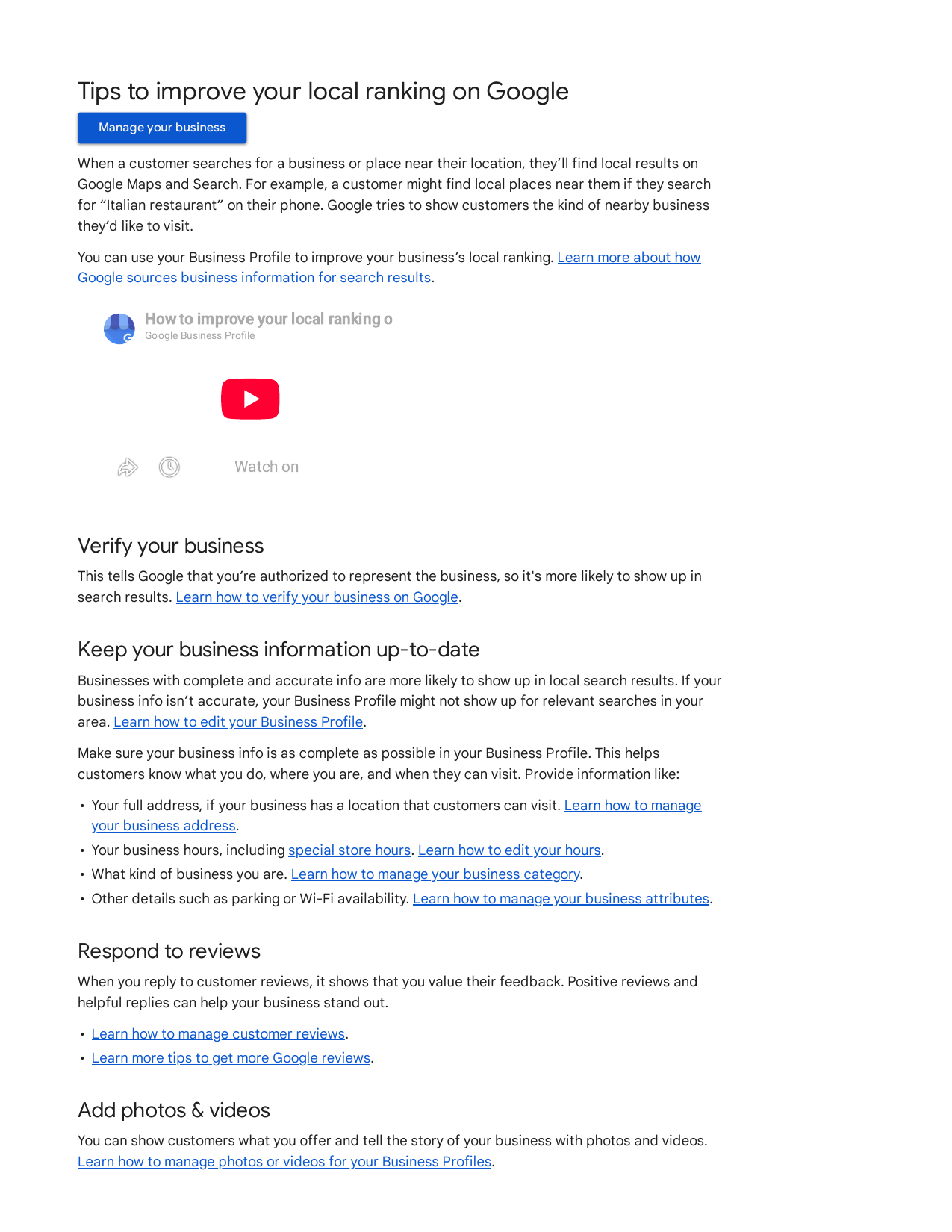
Local SEO backlinks are links from websites in your town or city to your business website. They tell Google that real organisations near you know your business exists, and that is exactly what local search rewards. Google’s own help page (https://support.google.com/business/answer/7091/improve-your-local-ranking-on-google?hl=en) says local results rest on relevance, distance and prominence, and that prominence is based on information such as “how many websites link to your business” and how many reviews you have. A plumber in Leeds does not need links from national newspapers. A handful of links from the local chamber of commerce, a neighbourhood news site and a supplier’s directory will do more for the map pack than fifty links from unrelated blogs. This guide explains which local links carry weight, seven practical ways to earn them, and the mistakes that waste time or put your rankings at risk.
What Are Local SEO Backlinks?
A local SEO backlink is any link to your website from a site with a clear connection to your area. The connection can be geographic, like a city council page, or community-based, like a local charity, school, sports club or business group. What sets these links apart from ordinary backlinks is the local signal they carry. Google reads the linking site’s location, its topic and its audience, and uses that to judge whether your business is a genuine part of the community it serves.
That matters because local search is a different contest from national search. You are not competing with every website on the internet. You are competing with the other businesses in your town that offer the same service. A link from a respected local source can tip that contest in your favour, even if the linking site is small. Relevance beats raw size in local SEO, and a local link is relevant by definition.
Local links also bring real visitors. A link in a local newspaper article, a “best of” list or a community events page sends people who live nearby and are ready to buy. That traffic is a second benefit on top of the ranking effect, and it is one reason local links are worth earning even when their ranking impact is hard to measure on its own.
Do Local Backlinks Still Matter in 2026?
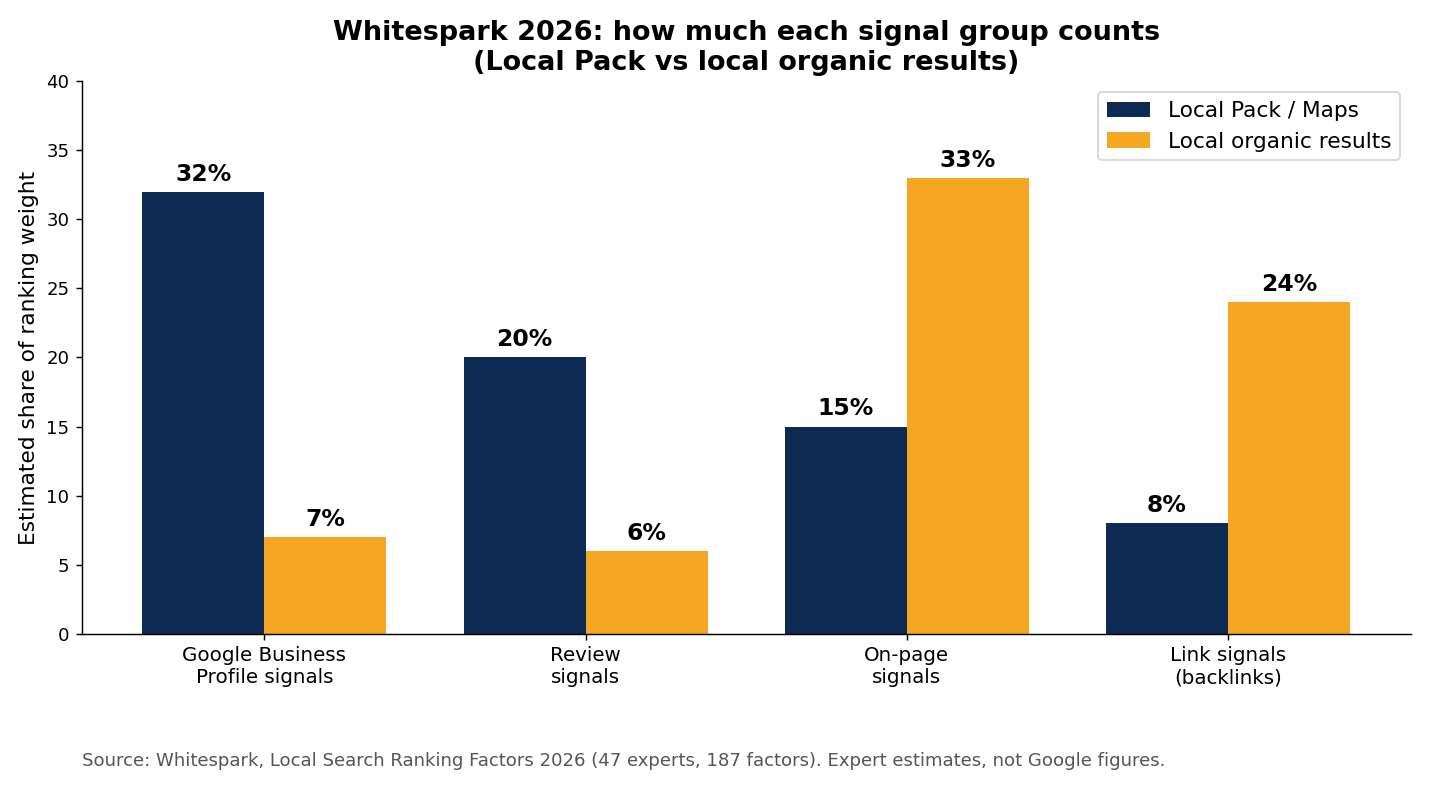
Yes, but their role has shifted. The clearest public evidence is the Whitespark Local Search Ranking Factors survey, 2026 edition, published on 6 November 2025. In it, 47 local search experts scored 187 ranking factors. Their estimates put link signals at about 8% of the weight behind the Local Pack (the map results) and about 24% of the weight behind local organic results (the blue links below the map). Google Business Profile signals lead the Local Pack at about 32%, with review signals next at about 20%.
| Signal group | Local Pack / Maps weight | Local organic weight |
|---|---|---|
| Google Business Profile signals | 32% | 7% |
| Review signals | 20% | 6% |
| On-page signals | 15% | 33% |
| Link signals (backlinks) | 8% | 24% |
| Citation signals | 6% | — |
Source: Whitespark, Local Search Ranking Factors 2026 (https://whitespark.ca/local-search-ranking-factors/) — survey of 47 local search experts scoring 187 factors. These are expert estimates, not figures published by Google.
Two things follow from the table. First, backlinks are not the biggest factor in the map pack, so they should never be your only local SEO work. Your profile, your reviews and your location pages come first. Second, backlinks become much more important in the organic results below the map, where they are the second-heaviest signal group. A local business that ignores links will struggle to rank its own pages for searches like “emergency plumber Leeds” or “family solicitor Manchester”.
The case for local links is also getting stronger in AI search. BrightLocal’s Local AI Visibility Study, published in September 2026, analysed 200,085 local prompts across ChatGPT, Google AI Mode and Google AI Overviews, and recorded nearly 2 million citations. Business websites supplied 42% of those citations, and Google Business Profile supplied 28.6%. Being mentioned and linked by trusted local sources is one of the ways a business gets picked up when an AI tool answers a “near me” question. BrightLocal’s Local Consumer Review Survey 2026, based on 1,002 US adults, found 45% of consumers had used an AI tool for a local business recommendation, up from 6% a year earlier.
None of this means you should chase links at any cost. It means local links are one part of a balanced local SEO plan, and they pay off most when they come from real local sources.
What Makes a Local Backlink Valuable?
Not every local link is equal. Four things decide how much a local backlink is worth.
Local relevance. A link from a website that serves your town, your county or your trade in your area counts more than a link from a generic site with no local connection. A dentist in Bristol gains more from a Bristol health directory than from a general health blog.
Real authority. The linking site should be one Google already trusts: a council site, a chamber of commerce, a local newspaper, a university, a trade body or a long-running community site. These are the sites local people actually use, and Google treats them as anchors for a place.
Editorial placement. A link placed by the site’s owner because your business is genuinely useful — in an article, a guide or a member list — is worth far more than a link in a footer, a sidebar or a comments section. Editorial links are hard to fake, and Google knows it.
Real visitors. If the linking page gets traffic from local people, the link sends customers as well as ranking value. A link nobody ever clicks is still a signal, but a link that brings calls and bookings is proof the placement works.
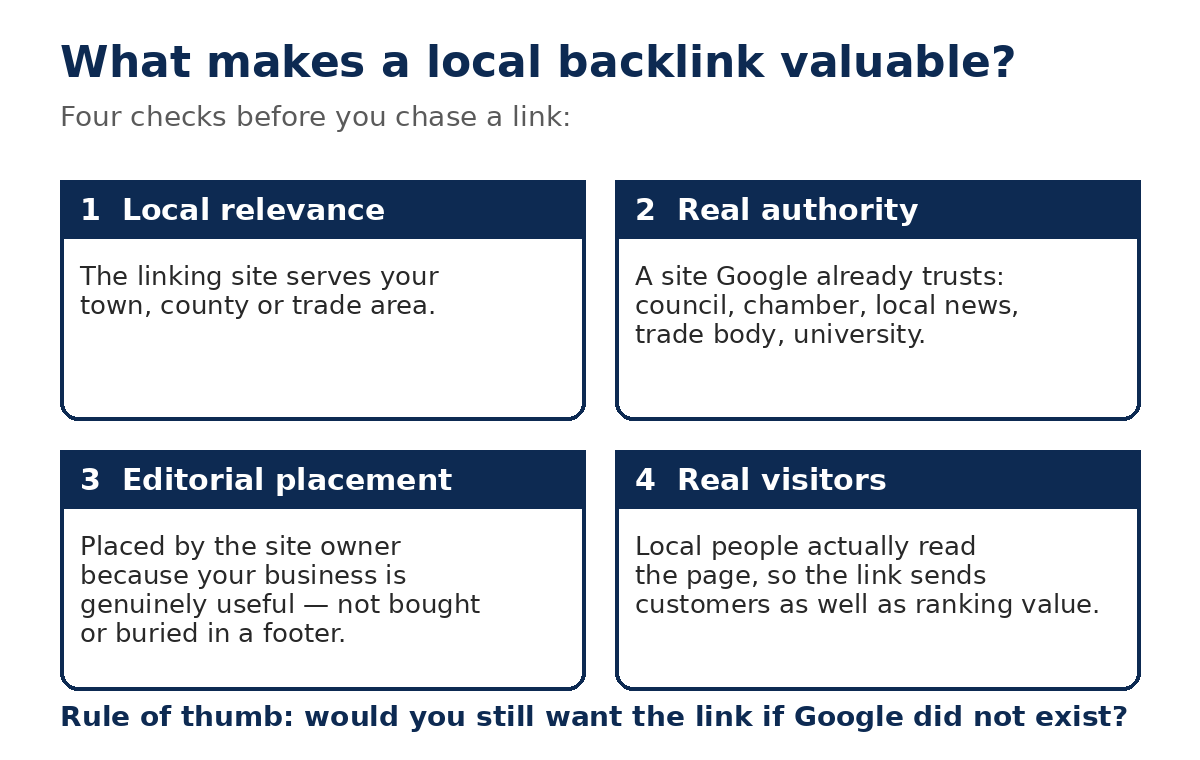
A simple test applies to every opportunity: would you still want this link if Google did not exist? If the answer is yes because local customers would see it and trust it, it is a good link. If the only reason you want it is the ranking effect, think twice.
7 Ways to Earn Local SEO Backlinks
1. Join your chamber of commerce and local business groups
Chambers of commerce, trade associations and business improvement districts almost always publish a member directory with a link to each member’s website. These are some of the strongest local links a small business can get, because the linking sites are established, trusted and clearly tied to a place. Join, keep your listing complete, and take part in events so the membership is real rather than a paid directory entry.
2. Get covered by local news
Local newspapers and community news sites link to the businesses they write about. You do not need a big story. Opening a new branch, hiring local staff, winning an award, supporting a charity event or publishing useful local research are all reasons a local journalist might cover you. In the United States, the Medill State of Local News Report 2025 counted 213 counties with no local news outlet at all, so where a local paper still exists, its links are scarce and valuable. Send a short, plain email to the news desk with the facts, a quote and a photo. Make the journalist’s job easy.
3. Sponsor a local team, event or charity
Sponsoring a youth football team, a school fair, a charity run or a community festival usually earns a link from the organiser’s website, often on a sponsors page that stays live for years. Pick sponsorships your customers will see and respect, and make sure the link goes to a relevant page on your site rather than always to the homepage. One genuine sponsorship beats ten directory submissions.
4. Earn links from suppliers, partners and customers
Businesses you already work with are your easiest source of local links. Ask suppliers to list you as a stockist or approved installer. Ask happy customers, especially other local businesses, to mention you on their site or in a case study. Offer a short testimonial in return. These links are natural, because they describe a real working relationship, and they are the kind of link Google’s link spam policies expect to see.
5. Create a genuinely useful local resource
A page that helps local people will attract local links on its own. Examples include a guide to parking near your clinic, a list of local suppliers for your trade, a calendar of community events, or a plain-English guide to a local rule or permit. Local blogs, community Facebook groups and council pages link to resources like these because they help their own readers. This is slower than asking for a link, but the links it earns are editorial and lasting.
6. List your business in the right local directories
Directories are citations first and backlinks second. The main value is consistent name, address and phone number details across the web, which support your local rankings. Still, a link from a respected local directory or a trade directory adds a small ranking signal. Focus on the directories your customers actually use — Google Business Profile, Yelp, Bing Places, Apple Maps and your trade body — and skip the hundreds of low-quality general directories that exist only to sell links.
7. Build relationships with local bloggers and community sites
Local bloggers, neighbourhood guides and community websites often need content and local knowledge. Offer an expert quote for their article, a guest post on a topic you know well, or data from your own experience. A guest post on a real local site with a real audience is a legitimate way to earn a link. The test is the same as always: the site should have readers who live in your area, and the article should be useful to them.
Local Backlinks vs Local Citations
Newcomers often confuse backlinks with citations. A citation is a mention of your business name, address and phone number on another website, with or without a link. A backlink is a clickable link to your website. Both help local SEO, but they do different jobs.
| Local backlink | Local citation | |
|---|---|---|
| What it is | A clickable link to your site | A mention of your name, address and phone number |
| Main job | Builds prominence and authority | Confirms your business details are real and consistent |
| Ranking weight (Local Pack, Whitespark 2026) | Link signals about 8% | Citation signals about 6% |
| Example | Chamber of commerce member page | Yelp or Thomson Local listing |
You need both. Citations prove your business exists at a real address. Backlinks prove other local organisations vouch for you. Fix your citations first, because inconsistent details confuse Google, then build backlinks on top of a clean foundation.
Mistakes That Waste Time or Risk a Penalty
Chasing volume over relevance. Fifty links from unrelated directories will not beat five links from respected local sites. Google’s link spam policies treat large-scale link schemes as a violation, and a sudden flood of irrelevant links looks like a scheme even when nobody paid for it.
Paying for links. An Ahrefs outreach study across 450 sites found the average price for a paid link placement was $361.44, and only 12.6% of sites would sell a link at all. Paid links that pass ranking credit break Google’s spam policies, and Google can ignore them or penalise the site that bought them. Earn links instead, or hire an agency that does manual outreach. Our own approach is manual outreach with no private blog networks — see our manual link building services.
Using the same anchor text everywhere. If every local link says “best plumber Leeds”, that pattern looks manufactured. Natural links use your business name, your web address or plain descriptive words. Vary the anchor text and let linking sites choose their own words.
Ignoring your profile and reviews. Links cannot rescue a thin Google Business Profile with no reviews. BrightLocal’s 2026 consumer research found 52% of people started their latest local search on Google Search and 9% on Google Maps, and 73% searched on a phone. Those searchers judge your profile and your star rating before they ever click a link. Fix the basics first.
Forgetting to check what you already have. Before you build new links, find out which local sites already link to you and which link to your competitors. That gap list is your outreach list, and it is usually shorter and more useful than any generic tactic.
How to Check Your Local Backlinks
Google Search Console has a free Links report (https://support.google.com/webmasters/answer/9049606?hl=en) that shows who links to your site. Open Search Console, choose your property, then go to Links in the left-hand menu. The “Top linking sites” table shows the domains that link to you most, and “Top linked pages” shows which of your pages attract the most links. Click a domain to see the exact pages linking to you. The report is a sample rather than a complete list, and it does not say whether a link is marked nofollow, but it is the best free view of your link profile and it comes from Google itself.
Check the report once a month. Look for new local links, and look for links you did not ask for from irrelevant or spammy sites. If a competitor gains a local link you do not have, that is your next outreach target. Keep a simple list of your best local links and the date each one appeared, so you can see which of your efforts actually work.
Why Local Links Deserve a Place in Your Plan
Local search moves fast. BrightLocal’s 2026 consumer research (https://www.brightlocal.com/research/smb-marketing-report/) found 75% of people decided which local business to use in under 30 minutes, and 72% looked at three or fewer businesses before deciding. Google’s own research found that 76% of people who search for something nearby on a smartphone visit a related business within 24 hours, and 28% of those searches end in a purchase. The businesses that win those quick decisions are the ones Google already trusts in that town — and local backlinks are one of the clearest signs of that trust.
Frequently Asked Questions
How many local backlinks do I need to rank in the map pack?
There is no fixed number, because the map pack weighs your profile, reviews, distance and links together. In most towns, a small set of strong local links — from the chamber, local news, suppliers and community sites — is enough to compete, provided your profile is complete and your reviews are steady. Compare your links with the three businesses already in the map pack for your main search, and closing that gap is a clear target.
Are local directory links still worth getting?
Yes, for the right directories. A listing on Google Business Profile, Yelp, Bing Places, Apple Maps and your trade body’s directory supports your rankings and sends customers. The link itself is a small part of the value; the consistent name, address and phone number matter more. Avoid bulk submissions to hundreds of general directories, which add little and can look like a link scheme.
How long do local backlinks take to affect rankings?
Expect weeks rather than days. Google has to find the linking page, crawl it and factor the link into its view of your site. A link from a well-known local site is usually picked up faster than one from a small blog. Track your map pack position for your main search each week, and judge a link-building effort over two to three months rather than after a single link.
Do I need backlinks from websites in my exact town?
Links from your town carry the strongest local signal, but links from your county, region or trade are still useful. A solicitor in Manchester benefits from a link on a North West legal site or a national trade body page. What matters is a real connection to your area or your trade, not a random link from a site with no connection to either.
Should I buy backlinks for local SEO?
No. Paid links that pass ranking credit break Google’s spam policies, and Google states there is no way to request or pay for a better local ranking. A paid link can be ignored by Google, or it can lead to a manual action that harms your rankings. The safer path is to earn links through memberships, sponsorships, local press and useful content, or to hire an agency that does manual outreach.
What is the difference between a local backlink and a citation?
A backlink is a clickable link from another website to yours. A citation is a mention of your business name, address and phone number, with or without a link. Backlinks build prominence and authority, while citations confirm your details are consistent across the web. You need both, and citations should be fixed first because inconsistent details confuse Google.

Abdullah Zulfiqar is Co-founder and Client Success Manager at RankWithLinks, an SEO agency helping businesses grow online. He specializes in client relations and SEO strategy, driving measurable results and maximizing ROI through effective link-building and digital marketing solutions.