
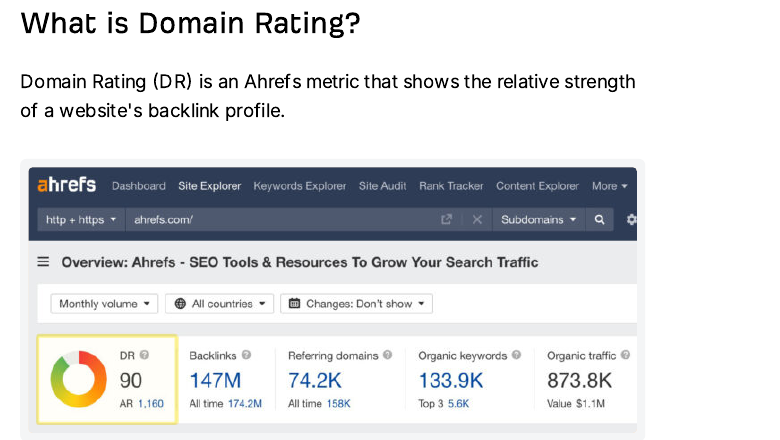
If you want to improve Domain Rating with white hat links only, start with a clear fact: Domain Rating (DR) is not a Google score. It is Ahrefs’ own score for the strength of a website’s backlink profile, on a scale from 0 to 100. Google does not use it to rank pages. It is still useful, because it gives you one simple way to track whether your link profile is getting stronger, and it is built only from links — not from traffic, domain age, or brand size.
This guide works through the process in order: measure where you are, fix the site first, create pages worth linking to, earn links by honest outreach, and track progress without cutting corners. Every step below uses white hat methods only: editorial links earned because a page is useful, relevant, and placed by a real person who chose to link to it.
What Domain Rating actually measures
Ahrefs explains DR in three parts. First, it finds every domain with at least one followed link to your site. Second, it looks at how many other domains each linking domain links to. Third, it passes some value from each linking domain to yours, roughly its own DR divided by the number of unique domains it links to. The result is plotted on a logarithmic scale from 0 to 100, so the jump from DR 20 to DR 21 is much easier than the jump from DR 70 to DR 71.
Three points in that definition shape the whole plan:
- Unique domains matter more than total links. Ten links from one site do not count ten times. One followed link from ten different, relevant sites is stronger for DR.
- Followed links only count. Nofollow links can still bring visitors and brand mentions, but Ahrefs says DR ignores them.
- A link is shared. A high-DR site that links to thousands of other domains passes less value per link than a smaller site that links to only a few. Relevance and a clean linking page matter as much as the headline score.
Ahrefs is also clear that DR is purely link-based and does not account for backlink spam. That means a pile of low-quality links can push the number up while doing nothing for your rankings, and while putting you at risk under Google’s spam policies. A rising DR on its own is not proof of good SEO. A rising DR built from relevant, editorial links, alongside better rankings and traffic, is.
The numbers behind this guide
Use these figures to set honest expectations, not to promise a result by a date.
| Data point | What it means for your plan |
|---|---|
| DR is measured on a logarithmic 0–100 scale (Ahrefs) | Early gains come faster; gains at DR 60+ need far more, and far better, links |
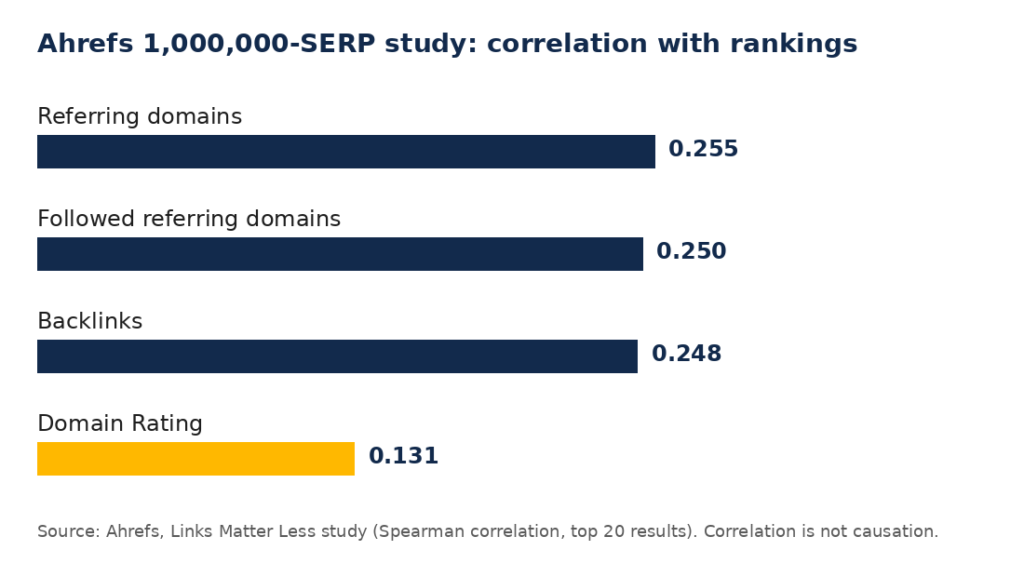
| Referring domains correlate with rankings at 0.255, backlinks at 0.248, DR at 0.131 in Ahrefs’ study of 1,000,000 SERPs | Breadth of linking domains matters most; DR alone is the weakest of the three signals |
| The vast majority of pages with no referring domains get no traffic from Google, in Ahrefs’ analysis of about 1 billion pages | A page with no links at all is unlikely to be found, however good the writing is |
| DR counts followed links from unique domains only, split by how many domains each linking site links to (Ahrefs) | Chase new, relevant domains, not repeat links from the same site |
| Paid links must be qualified with rel=”nofollow” or rel=”sponsored” (Google Search Central) | A paid link that passes ranking credit breaks Google’s link spam policy |
Ahrefs adds the warning that correlation is not causation. These numbers show that stronger link profiles tend to rank better. They do not prove that any single link will move a page, and they do not replace checking your own rankings, traffic, and conversions.
Step 1: Take an honest baseline
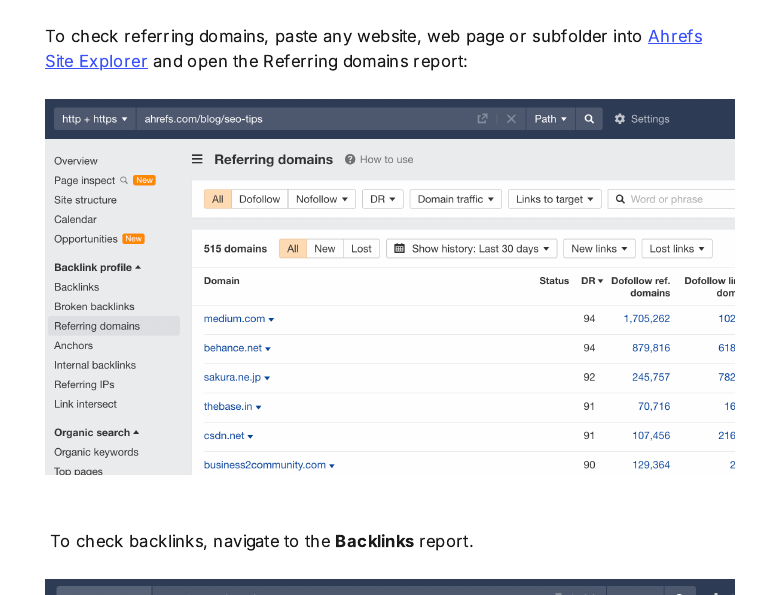
Before you build anything, record four numbers for your site: Domain Rating, number of referring domains, number of followed referring domains, and your top linked pages. Write them down with the date. Without a baseline, you cannot tell whether a later change helped, and you will be tempted to judge the work after a week, when nothing has had time to move.
Then look at the shape of the profile, not just the total. Ask:
- Are most links from a handful of sites, or spread across many domains?
- Do the linking sites cover your topic, or are they unrelated directories and forums?
- Which pages attract links already? Those pages tell you what your audience already finds worth sharing.
- Have you lost links recently? A lost link from a real page is often easier to recover with a polite note than a brand-new link is to earn.
Also check for obvious problems: links from hacked pages, copied content, or sites with no real topic. Note them, but do not rush to disavow everything unfamiliar. Google’s guidance is to disavow only links you believe are spammy and that you cannot get removed, after you have tried. Most small sites do not need a disavow file at all.
Step 2: Fix the site before you ask for links
Outreach fails when the page it points to is weak. Before you pitch anyone, make sure the page you want linked to answers its question fully, loads well on a phone, and is easy to quote. A journalist or blogger will not link to a thin page, and a link to a page that visitors bounce from will not help your business anyway.
Work through this short fix list for each page you plan to promote:
- One clear purpose per page. If the page tries to cover five topics, split it or sharpen it. The linking site needs a reason to point to this page, not your homepage.
- Evidence, not claims. Add real figures with named sources, worked examples, and clear steps. Pages with original data earn links far more often than pages that repeat general advice.
- Internal links that make sense. Link from the promoted page to your service pages and related guides, so a visitor who arrives by a new link can find what you sell. Internal links do not raise DR — only external links do — but they turn link traffic into enquiries.
- Technical basics. Check that the page is indexed, that it has no broken links, and that images have useful alt text. A page Google cannot crawl properly will not benefit fully from new links.
This step is unglamorous, but it protects the rest of the plan. Every hour spent here makes every outreach email more likely to succeed.
Step 3: Create one page worth linking to
White hat link building starts with the asset, not the email. Pick one of these formats and build it properly:
- Original data. A small survey, a count from public sources, or a clear summary of a study, with the method stated plainly. Data pages are the most linked-to format on many sites, because writers need a source to cite.
- A complete beginner guide. A step-by-step guide that answers every follow-up question a beginner would ask, with screenshots, a checklist, and a table. Long, well-structured guides earn resource-page links.
- A free template, checklist, or calculator. A tool people can use at once is easier to link to than another opinion article, and it keeps bringing links long after publication.
- An expert round-up with real quotes. Ask three or four named experts one short question and publish their answers with permission. Each expert may share the page, and other writers may cite it.
Do not publish five thin assets. Publish one strong asset, promote it well, and learn what worked before you build the next. One asset with twenty relevant links beats five assets with none.
Step 4: Earn links with honest outreach
Now pitch the asset to sites that already link to similar pages. This is manual work, and that is the point: a personal, relevant email to twenty right sites beats a templated blast to two thousand wrong ones.
Digital PR and expert comment. Watch for journalist requests in your field and answer quickly with a short, quotable comment and your name, role, and site. News and industry sites link when the quote adds something real. Do not send a generic paragraph that could have come from anyone.
Guest posting on relevant sites. Offer a genuinely useful article to a site your customers actually read, on a topic that fits that site. The link should sit naturally in the article or author bio, and the article must be written for that site’s readers, not as a vehicle for a link. Avoid sites that exist mainly to sell guest posts, that publish on every topic, or that promise a dofollow link for a fee. Those links look bought, because they are.
Resource pages. Find pages that list useful resources on your topic, check that your asset fits the list, and send a short note explaining where it would fit and why it helps their readers. Resource-page owners add links when the suggestion saves them work, not when the email flatters them.
Broken link building. Find a page in your niche that links to a page that no longer exists, and offer your working page as a replacement. This works because you are fixing their page, not just asking for a favour. Check the broken link yourself first, and only suggest a page that truly replaces the old one.
Unlinked mentions. Search for your brand name, product name, or a distinctive phrase from your research. Where a site mentions you without linking, send a polite thank-you and ask whether they would add a link so readers can find you. These are often the easiest links to win, because the site already chose to mention you.
For every pitch, keep a simple record: site, contact, date sent, page pitched, and reply. Follow up once, after a week or two, and then move on. Chasing the same editor five times does not turn a no into a yes, and it damages your name in a small niche.
Step 5: Keep every link white hat
White hat is not a label you add at the end. It is a set of checks you run before a link goes live:
- Would this link exist if search engines did not exist? If the answer is no, do not build it.
- Is the linking site real, with real readers and a real topic that fits yours?
- Is the link editorial — placed because the editor found the page useful — rather than paid, swapped in bulk, or hidden?
- If money, a free product, or a service changed hands, is the link qualified with rel=”sponsored” or rel=”nofollow”, as Google requires?
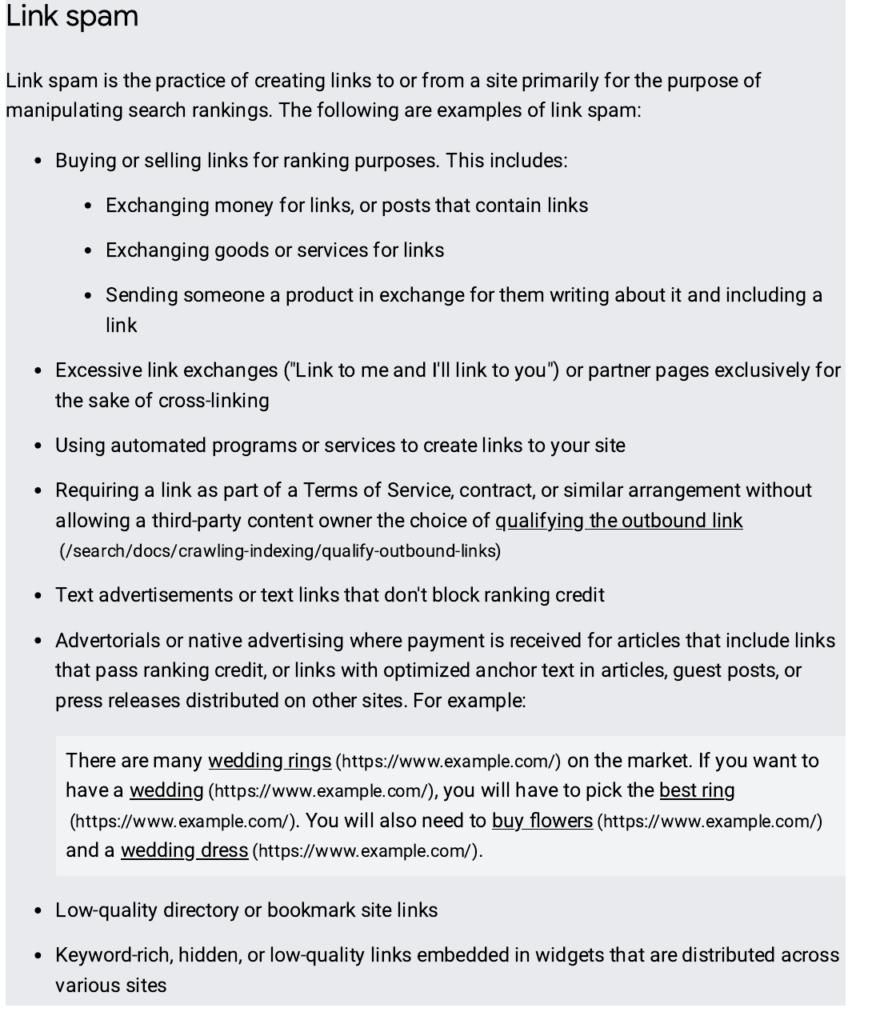
Google’s spam policies page states the rule plainly: link spam is creating links mainly to manipulate rankings, and buying or selling links for ranking purposes is listed as an example. Sites that break the policies may rank lower or not appear at all. Google also says it understands that buying and selling links is a normal part of the web for advertising, provided those links are qualified so they do not pass ranking credit.
That rule settles two common arguments. First, a private blog network — a group of sites built mainly to link to each other — is not white hat, however the seller describes it. Second, a paid placement with a sponsored tag is honest advertising, but it will not raise DR, because DR counts followed links only. If a seller promises DR gains from paid placements, ask how those links are tagged. If they are tagged correctly, they cannot move DR. If they are not tagged, they break Google’s policy.
Step 6: Track monthly, and judge the right numbers
Check your profile once a month, on the same day, and record the same four baseline numbers from Step 1. Also note new referring domains, lost referring domains, and the pages that gained links. DR moves slowly, and Ahrefs must crawl new links before they count, so judge the work over a quarter, not a week.
Judge success in this order:
- New referring domains from relevant sites. This is the input you control.
- Rankings and organic traffic for the promoted pages. This is the outcome that matters.
- Enquiries, sales, or sign-ups from those pages. This is the business result.
- Domain Rating. This is a useful summary, not the goal itself.
If DR rises but rankings and enquiries do not, look again at relevance. Links from unrelated sites can lift a link-only score without helping real searchers. If rankings rise but DR barely moves, do not panic: a few strong, relevant links can matter more than a number suggests, especially on a logarithmic scale.
When you lose a good link, check why. If the linking page was updated, offer an updated version of your asset. If the site closed, move on. When you find a genuinely spammy link you cannot remove, use the disavow tool only for that link, with a short note explaining why, and keep a copy of the file. Disavowing good links by mistake can hurt you, so never disavow in bulk on a guess.
A realistic 90-day plan
| Phase | What to do | What to expect |
|---|---|---|
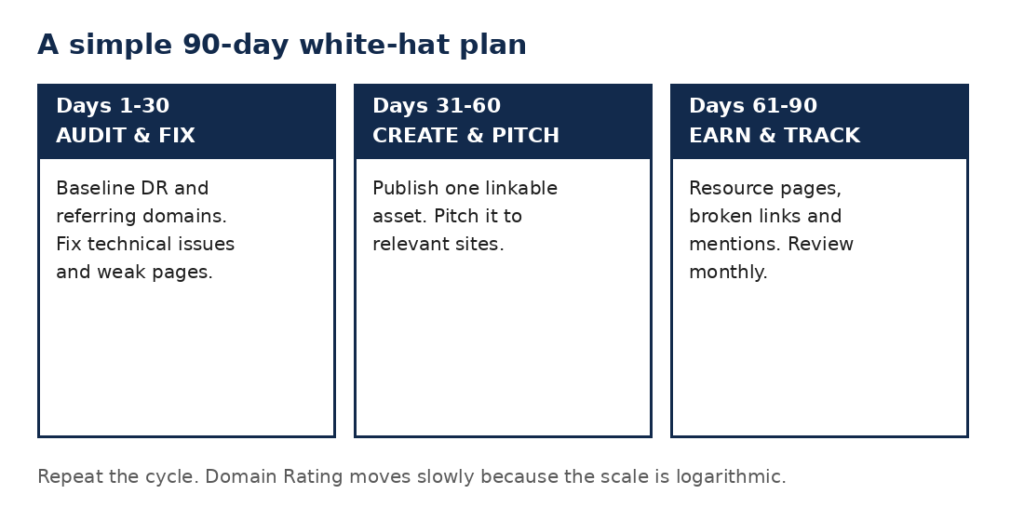
| Days 1–30: Audit and fix | Baseline DR and referring domains; fix technical issues; choose one asset | No DR change yet; a cleaner site and a clear target |
| Days 31–60: Create and pitch | Publish the asset; pitch 20–40 relevant sites; fix broken-link and mention opportunities | First replies and first new referring domains |
| Days 61–90: Earn and track | Follow up once; publish a second asset if the first worked; review monthly numbers | A small, real rise in referring domains; DR may move by a few points, or not yet |
That pace is honest. A new site may move from DR 0 to DR 15–20 with a handful of decent links, because the low end of a logarithmic scale is easier. A site already at DR 50 will need many more, and much stronger, links to reach DR 55. Anyone who promises a fixed DR gain by a fixed date, for a fixed fee, is selling a number, not a link profile.
If you want help with this kind of work, our manual link building services are built around editorial outreach to real sites, with no private blog networks and no paid placements passed off as earned links.
Frequently asked questions
How long does it take to improve Domain Rating with white hat links?
Allow at least three months of steady work before judging the result. Ahrefs must first crawl new links, and DR moves slowly because the scale is logarithmic. Early gains on a new site can come faster, but a site already at a higher DR needs more and stronger links for each extra point. Judge the first quarter by new referring domains and rankings, not by DR alone, and review monthly rather than daily.
Is Domain Rating a Google ranking factor?
No. Domain Rating is Ahrefs’ own metric, built only from backlinks. Google does not use DR, and Google has its own systems for judging links and pages. DR is still useful as a simple summary of your link profile and as a way to compare sites in the same niche, but it should never be treated as a target that Google rewards directly. Rankings, traffic, and enquiries matter more than the score itself.
Can I improve Domain Rating without any new links?
No, not in any real sense. Ahrefs calculates DR only from followed links from unique domains, so internal links, new content alone, and social shares do not move it. Good content and a sound site help you earn links, and they help pages rank once links arrive, but the score itself only moves when new domains link to you with followed links. That is why the plan starts with a linkable asset, not with a promise.
Should I buy backlinks to raise Domain Rating faster?
No. Google’s link spam policy lists buying or selling links for ranking purposes as link spam, and sites that break the policy may rank lower or not appear at all. Paid links are only acceptable when they are qualified with rel=”sponsored” or rel=”nofollow”, and those qualified links do not count towards DR. A seller who promises fast DR gains from paid links is either selling untagged links that break the policy, or selling tagged links that cannot move DR.
Do nofollow links help Domain Rating at all?
No, not directly. Ahrefs says DR ignores links with the nofollow attribute, so a nofollow link will not raise the score. Nofollow links can still be valuable: they bring visitors, build brand awareness, and sometimes lead to a followed link later when another writer finds your page through them. Do not refuse a relevant nofollow link from a good site, but do not count it in your DR plan either.
What is the safest way to remove a bad link?
First, contact the site owner and ask for the link to be removed or qualified. Keep a short record of the request. Only if that fails, and you believe the link is spammy, should you use Google’s disavow tool for that specific link or domain. Never disavow links in bulk on a guess, and never disavow a good link from a relevant site just because its DR looks low. For most small sites, a disavow file is rarely needed at all.
Sources: Ahrefs, Domain Rating, https://ahrefs.com/blog/domain-rating/ ; Ahrefs, Links Matter Less study, https://ahrefs.com/blog/links-matter-less-but-still-matter/ ; Ahrefs Help, Referring Domains vs Backlinks, https://help.ahrefs.com/en/articles/2791107-what-s-the-difference-between-referring-domains-and-backlinks ; Google Search Central, Spam Policies for Google Web Search, https://support.google.com/webmasters/answer/66356?hl=en

Abdullah Zulfiqar is Co-founder and Client Success Manager at RankWithLinks, an SEO agency helping businesses grow online. He specializes in client relations and SEO strategy, driving measurable results and maximizing ROI through effective link-building and digital marketing solutions.