
A local SEO strategy is a plan for showing up when people near you search for what you sell. It is not the same as ordinary SEO. A strong national ranking does not help a plumber in Leeds if the customer searching is in Leeds and Google shows three businesses on a map before any website result. Nearly half of all Google searches carry local intent, according to a figure shared by Google in 2018 that the industry still uses as its baseline. And local searches act fast: 76% of people who run a “near me” search visit a business within a day, according to Google. This guide works through the six steps that matter, in order, with the numbers behind each one.
Why local search deserves its own strategy
Local search is where small businesses win or lose, because the customer is ready to act. Four in five US consumers search for a local business online at least once a week, and about one in three does it every day, according to SOCi’s 2024 Consumer Behavior Index. On a phone, the intent is sharper still: 88% of people who run a local search on their smartphone visit a related store or call the business within a week, according to Google.
The search box itself keeps moving towards local. Queries with “near me” or “close by” grew 900% over two years, according to Google data reported by Think with Google. And the prize for ranking well is the map pack, the three businesses Google shows under the map. First Page Sage’s 2025 click-through study found that 42% of people who run a local search click a result inside the map pack. If your business is not in those three, most of that demand passes you by.
How Google decides local rankings
Google’s own help page states the position plainly: local results rest mainly on relevance, distance and prominence. Relevance is how well your Business Profile matches what someone searched for. Distance is how far your business is from the searcher. Prominence is how well known your business is, built from reviews, links and mentions across the web. Google also states, on the same page, that there is no way to request or pay for a better local ranking.
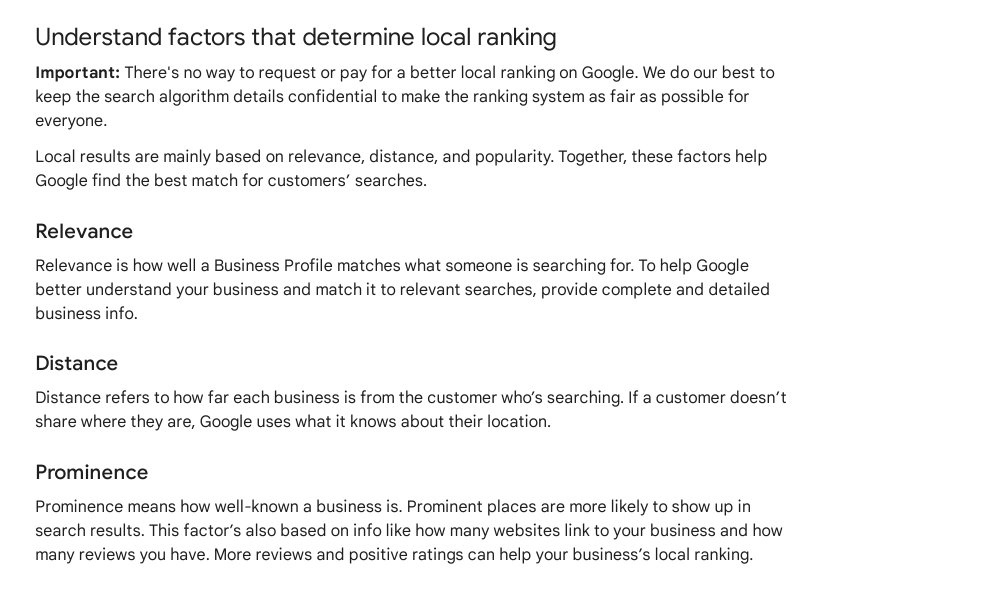
That gives you the shape of a local SEO strategy. You cannot move your shop closer to every searcher, so distance is mostly fixed. Relevance and prominence are the parts you can work on, and they are the parts this plan covers.
The 6-step local SEO strategy
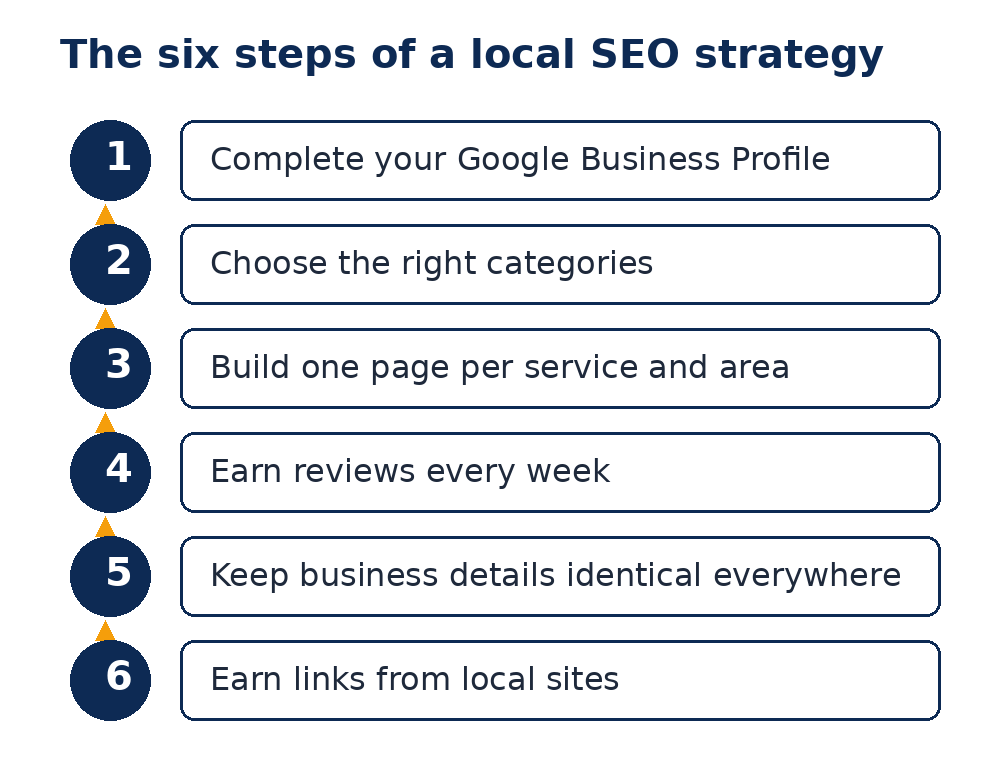
Work through these steps in order. Each one builds on the last, and skipping ahead to links before your profile is complete wastes the effort.
Step 1: Claim and complete your Google Business Profile
Start with your Google Business Profile, because it is the single biggest group of ranking signals. In Whitespark’s 2026 Local Search Ranking Factors survey, 47 local search experts scored 187 factors, and Google Business Profile signals carried about 32% of local pack ranking weight, more than any other group.
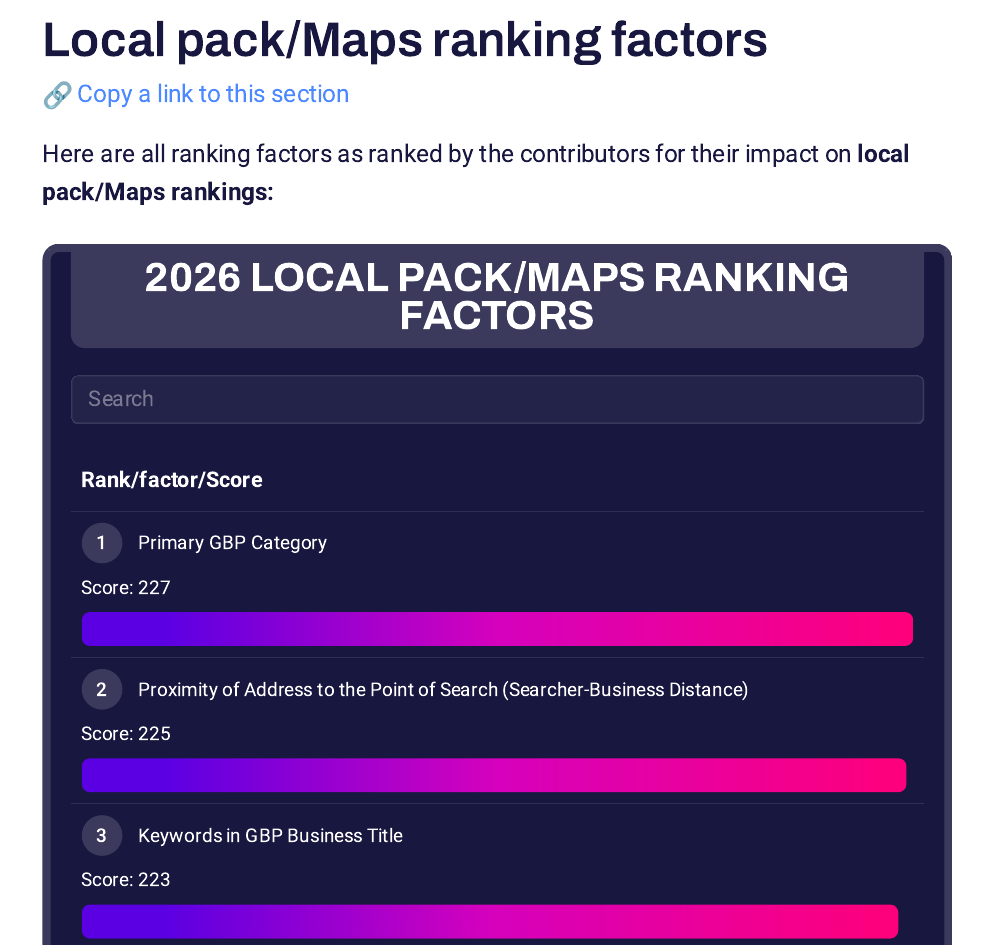
Claim the profile and verify the business, then fill in every field: the exact business name, address, phone number, website, opening hours, services and a business description. Add photos of the premises, the team and real work. Google’s help page says businesses with complete and accurate information are more likely to show up in local search results. Set your primary category to the most specific category that fits your main service, such as “Personal injury attorney” rather than “Law firm”. In the Whitespark 2026 survey, the primary category was the single highest-scoring local pack factor, with 227 points out of a possible 235.
Step 2: Choose your categories with care
Your primary category is the strongest single signal you control, so pick it carefully and do not change it without a reason. Add secondary categories only for services you genuinely offer. One common mistake is stuffing keywords into the business name, for example “Smith Plumbers — Best Emergency Plumber Leeds”. Keywords in the business title scored third in the Whitespark survey, but Google’s guidelines say the name must be your real business name. A stuffed name risks suspension, and a suspension costs far more than any ranking gain.
Step 3: Build one strong page per service and area
Your website still matters for local search. On-page signals carried about 15% of local pack weight in the Whitespark 2026 survey, and about 33% of weight in the ordinary local organic results below the map. The single highest-scoring local organic factor was a dedicated page for each service.
So build one page per service, and one per area you genuinely serve, with the service and the place in the page title and the first heading. Put your business name, address and phone number on every page, exactly as they appear on your profile. Write the page for a customer in that place: what you do there, how to reach you, and what happens next. Do not copy one page and swap the town name. Thin location pages that differ only by a place name are exactly the kind of content Google’s quality guidance warns against.
Step 4: Earn reviews every week
Reviews are the second-biggest group of local pack signals, at about 20% of ranking weight in the Whitespark 2026 survey, up from 16% in 2023. They are also the part customers read before they call. BrightLocal’s Local Consumer Review Survey 2025 found that 98% of consumers read online reviews for local businesses, and 71% read them always or regularly. More than half, 55%, would only consider a business with a rating of at least four stars, and 83% use Google to check reviews.
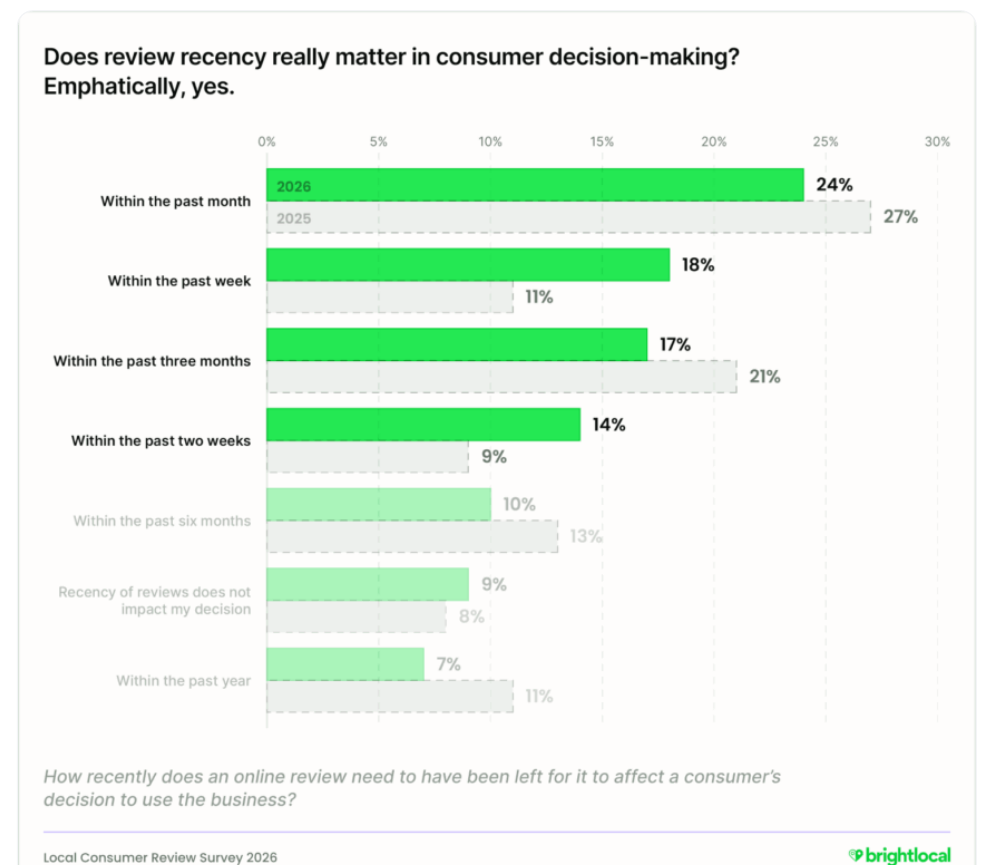
Freshness matters as much as the star rating. BrightLocal’s 2026 survey found that 74% of consumers only pay attention to reviews written in the last three months. That means a review programme is a weekly habit, not a one-off push. Ask every happy customer, at the moment the job is done, and send them a direct link to your Google review page. Reply to every review, good and bad, within a few days. Never buy reviews and never offer a reward for a positive one: both break Google’s rules, and trust in reviews is already falling. BrightLocal found that 42% of consumers trusted online reviews as much as a personal recommendation in 2025, down from 79% in 2020.
Step 5: Keep your business details identical everywhere
Citations are mentions of your business name, address and phone number on other sites: directories, review sites, trade bodies, local news and data aggregators. They carried about 6% of local pack weight in the Whitespark 2026 survey, and consistent citations were the 28th-ranked individual factor. The rule is simple and strict: the details must match your Google Business Profile exactly, down to the same spelling of “Street” and the same phone format. A changed phone number on one directory, or an old address on another, sends Google mixed signals about which details to trust. Work through the main directories first, then the trade and local sites that matter in your industry, and fix the old address anywhere it still appears.
Step 6: Earn links from local sites
Links carried about 8% of local pack weight in the Whitespark 2026 survey, but about 24% of the weight in local organic results, so they matter more the further down the page you look. The links that help a local business most are the ones a real local business would naturally earn: a mention in the local newspaper, a supplier or trade body listing, a sponsorship of a local club or event, a chamber of commerce page, or a case study a customer links to. These are the same links that bring real visitors, which is a useful test: if a link would bring no one, it probably carries little weight either. If you want help with this part, our local SEO services cover local link building alongside the profile and citation work, so the whole strategy moves together.
What the ranking weights say to prioritise
If your time is limited, the weights tell you where it goes first. The table below uses Whitespark’s 2026 Local Search Ranking Factors survey, in which 47 experts scored 187 factors. These are expert estimates, not a formula published by Google, so read them as a guide to priorities, not a promise of rankings.
| Ranking factor group | Share of local pack weight (Whitespark 2026) |
|---|---|
| Google Business Profile signals | 32% |
| Review signals | 20% |
| On-page signals | 15% |
| Behavioural signals | 9% |
| Link signals | 8% |
| Citation signals | 6% |
| Personalisation | 6% |
| Social signals | 4% |
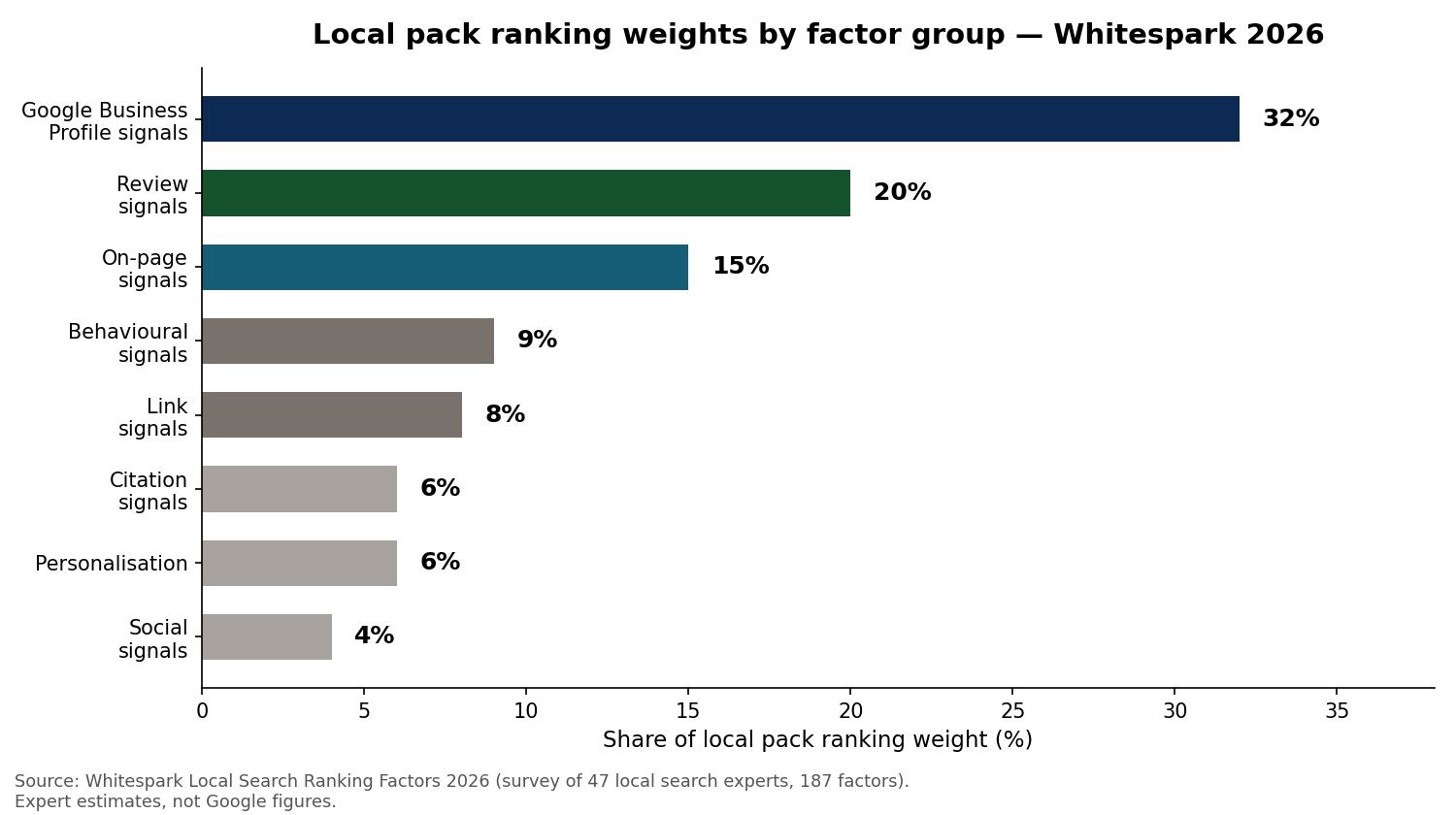
The first three rows add up to 67% of the weight. That is the whole strategy in one line: a complete profile, a steady flow of honest reviews, and strong pages for each service and area. Everything else is support for those three.
How to measure a local SEO strategy
Measure what a customer does, not just where you rank. In your Google Business Profile, check the monthly views, calls, direction requests and website clicks. Direction requests are the clearest sign of local intent: someone who asks for directions is on their way. Track calls and direction requests month by month, and keep a simple record of where new enquiries heard about you. For rankings, track a small set of “service plus place” searches, such as “emergency plumber Leeds”, in the map pack and the organic results. Check them weekly at the same time of day, because local results change with the searcher’s location. Give the plan at least three months before judging it. Local rankings move slower than paid ads, but the traffic they bring costs nothing per click once it is earned.
Mistakes that waste a local SEO budget
The most common waste is paying for work that breaks the rules. Keyword-stuffed business names and bought reviews both risk suspension, and a suspended profile vanishes from the map entirely. A second waste is building dozens of thin location pages that say the same thing with a different town name; they rarely rank and they weaken the site. A third is treating reviews as a one-off campaign and then going quiet for six months, when customers only trust recent reviews. A fourth is ignoring the profile once it is set up: hours go out of date, holiday closures are missed, and customers turn up to a closed shop. The strategy above avoids all four, because it is built on the profile, the reviews and the pages that Google itself says matter.
Frequently asked questions
How long does a local SEO strategy take to work?
Most small businesses see movement in the map pack within six to twelve weeks, and steadier results after three to six months. The profile and review changes show first, because Google re-reads them quickly. New service and location pages take longer, because they must earn their place in the organic results. If nothing has moved after three months, check the basics again: is the profile verified, is the primary category right, and are reviews still coming in?
What is the most important part of local SEO?
Your Google Business Profile. In the Whitespark 2026 survey of 47 local search experts, profile signals carried about 32% of local pack ranking weight, more than any other group, and the primary category was the single highest-scoring factor. A complete, accurate, verified profile with the right category is the foundation. Reviews and your website pages build on it, but neither one makes up for a profile that is unclaimed or half empty.
Do I need a website for local SEO?
You can appear in the map pack with only a Google Business Profile, but a website makes the strategy far stronger. On-page signals carried about 33% of the weight in local organic results in the Whitespark 2026 survey, and a dedicated page for each service was the top single organic factor. A website also gives customers somewhere to land, a place to read about your services, and a way to contact you that you fully control.
How many reviews do I need?
There is no fixed number, but two findings from BrightLocal’s 2026 survey set a useful bar. Almost half of consumers, 47%, will not consider a business with fewer than 20 reviews, and 74% only pay attention to reviews from the last three months. Aim for at least 20 reviews, then keep a steady flow coming in every month. A profile with 50 recent reviews beats one with 200 reviews from three years ago.
Can I do local SEO myself, or should I hire an agency?
A small business owner can do the core of it: claim and complete the profile, ask customers for reviews, and keep business details consistent. That covers most of the ranking weight. An agency helps when the work needs more time than you have, when several locations are involved, or when you need local links and content at scale. Either way, the work is the same. If someone promises a guaranteed top-three map ranking, be wary, because Google says no one can pay or ask for a better local ranking.

Abdullah Zulfiqar is Co-founder and Client Success Manager at RankWithLinks, an SEO agency helping businesses grow online. He specializes in client relations and SEO strategy, driving measurable results and maximizing ROI through effective link-building and digital marketing solutions.