
Quick Answer: Is HighSoftware99.com a Legitimate SEO Service?
No. Based on available evidence and the keyword data visible in SEMrush analytics screenshots, HighSoftware99.com operates as a click farm and bot traffic service — not a legitimate SEO provider.
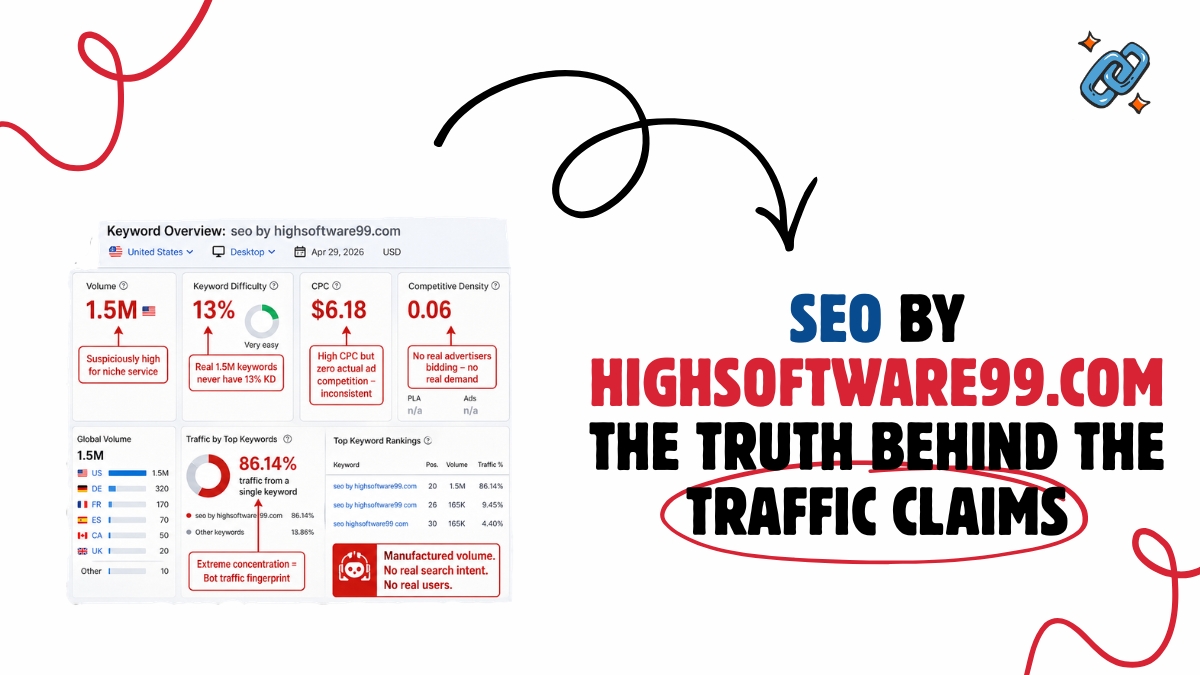
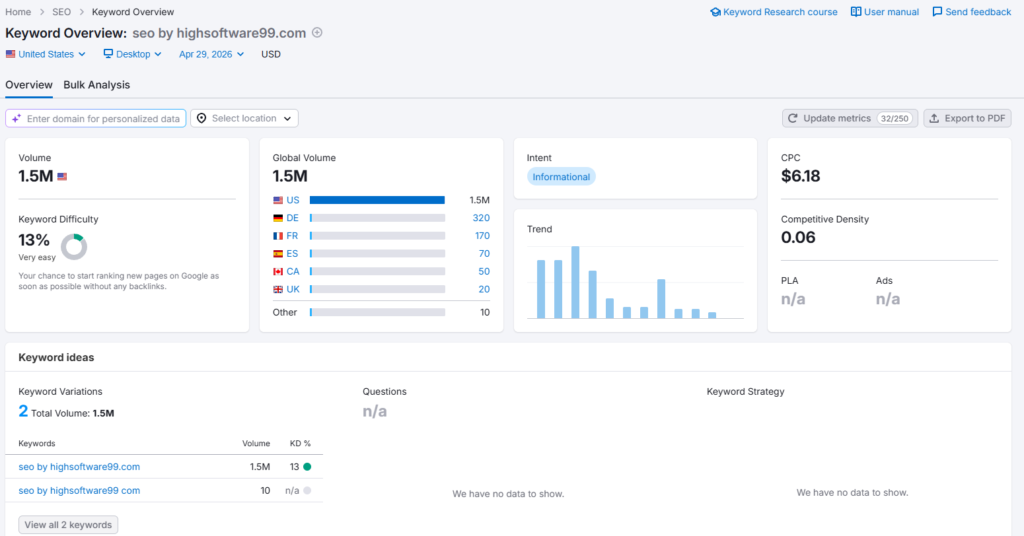
The keyword “seo by highsoftware99.com” carries 1.5 million monthly search volume in the US alone, yet shows only 13% keyword difficulty and a CPC of $6.18 with near-zero competitive density. This combination is a textbook fingerprint of artificially inflated search volume driven by automated bot queries — not genuine organic human interest in an SEO service.
If you are researching this service before spending money on it, this article will save you significant time, budget, and potential Google penalties.
What Is HighSoftware99.com and What Does It Claim to Offer?
HighSoftware99.com presents itself as an SEO service provider — positioning its offering under the branded phrase “SEO by HighSoftware99.com” as though it represents a distinct methodology or recognized approach to search engine optimization.
The actual service operates by driving artificial traffic to client websites through click farms and automated bot systems. Users pay to have their websites receive what appears to be significant traffic — inflated visitor counts, keyword click signals, and engagement metrics that look impressive in a dashboard but represent zero real human visitors.
This is not a gray area approach to SEO. It is textbook black-hat manipulation.
Understanding the Data: What the SEMrush Screenshots Actually Reveal
The keyword data visible in the screenshots tells a very specific and revealing story that anyone familiar with SEO analytics can read clearly.
The Volume-to-Difficulty Contradiction
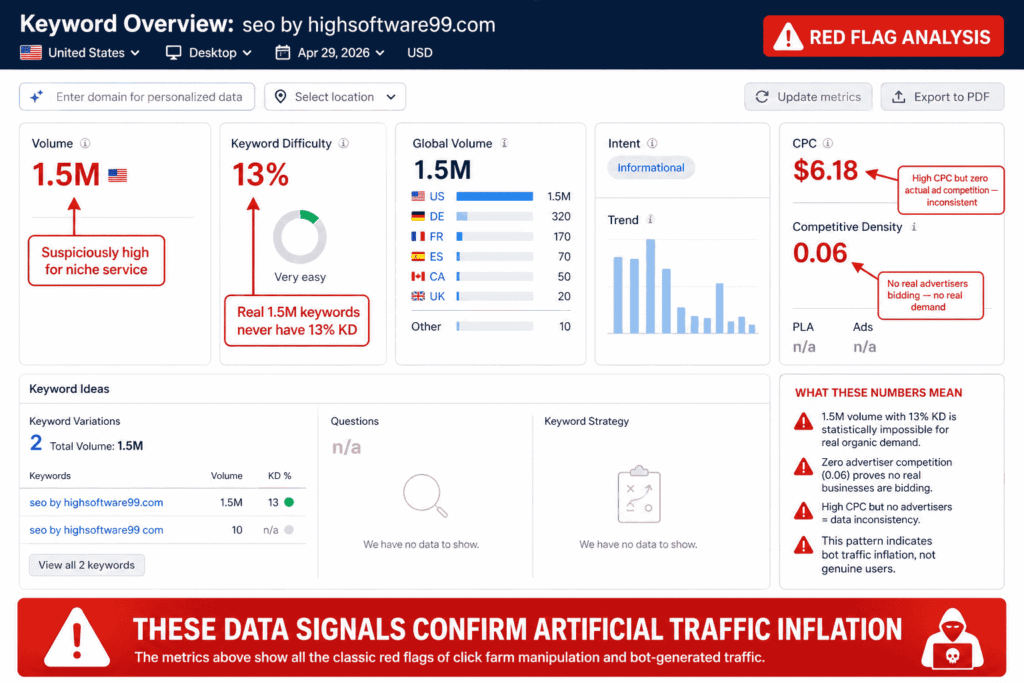
The keyword “seo by highsoftware99.com” shows 1.5 million monthly searches in the United States with only 13% keyword difficulty — classified as “very easy.”
In legitimate search behavior, a keyword generating 1.5 million monthly searches in a competitive category like SEO services would carry substantially higher keyword difficulty. High-volume competitive keywords in the SEO industry typically carry difficulty scores of 60%, 70%, or higher. A keyword with 1.5 million monthly searches and only 13% difficulty is not a real organic demand signal — it is an artificially pumped search volume generated by automated systems repeatedly querying the same phrase.
The Traffic Percentage Anomaly
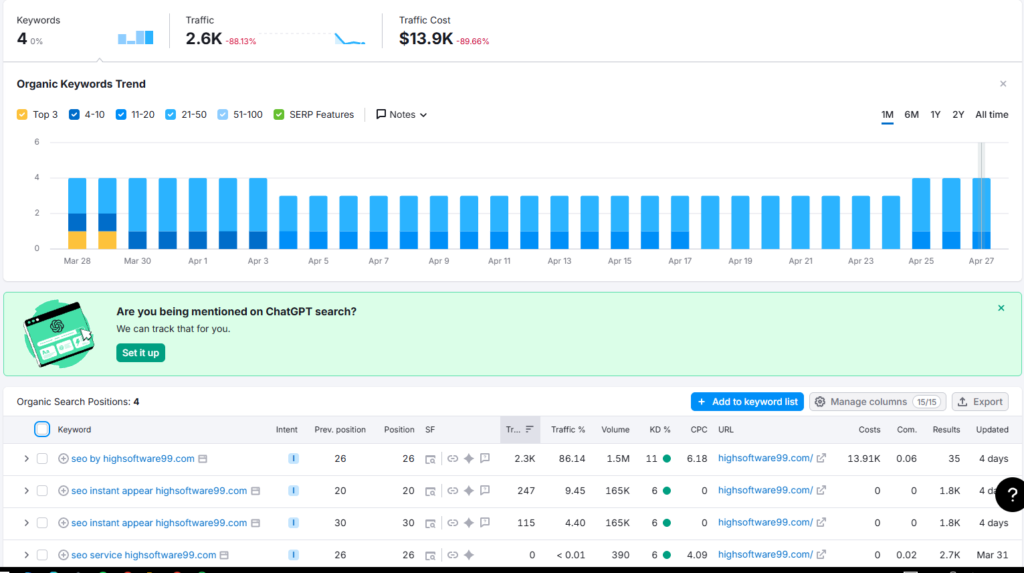
The data shows 86.14% traffic concentration on a single keyword — “seo by highsoftware99.com” — pointing to highsoftware99.com/. Genuine organic SEO traffic for a legitimate service provider distributes across dozens or hundreds of keyword variations reflecting natural user search behavior. Extreme concentration on a single branded query is characteristic of bot traffic systems programmed to repeatedly query one specific phrase.
Zero Competition Signals
A CPC of $6.18 with 0.06 competitive density and n/a for both PLA and Ads means no legitimate advertiser is bidding on this keyword. Real SEO service providers with genuine demand attract advertiser competition. The complete absence of advertising competition on a supposedly high-volume keyword confirms that no real market demand exists behind the inflated search numbers.
The Position Data
The keyword ranking data shows positions of 20, 26, and 30 for related queries — with traffic percentages of 9.45% and 4.40% on 165K volume keywords. These numbers describe a site that has manufactured search volume around its own brand name rather than earning organic visibility for genuinely competitive search terms.
What Are Click Farms and Bot Traffic Services?
Understanding what HighSoftware99.com actually sells requires understanding the mechanics of the industry it operates in.
Click Farms
A click farm is an operation — sometimes a physical facility with rows of devices, sometimes a distributed network of compromised computers — that generates artificial engagement signals at scale. Workers or automated scripts perform repetitive actions: searching specific keywords, clicking specific results, spending time on target pages, clicking ads, and leaving behavioral signals that mimic human user activity.
Click farms exist because search engines and advertising platforms use behavioral signals — click-through rates, dwell time, bounce rates, return visits — as inputs into their ranking and quality assessment algorithms. The theory behind selling click farm traffic is that artificially feeding positive behavioral signals into these systems will cause rankings or ad quality scores to improve.
Bot Traffic
Bot traffic refers to automated software programs — bots or scripts — that visit websites, execute searches, click links, and generate analytics data without any human involvement. Bot traffic can be sophisticated enough to mimic human browsing patterns — varying session durations, scrolling behavior, and navigation paths — to avoid detection by analytics systems.
How These Services Are Sold
Services like HighSoftware99.com typically market themselves using language that sounds like legitimate SEO — “instant visibility,” “rapid traffic growth,” “keyword ranking acceleration,” “SEO signals.” The pitch appeals to businesses that want faster results than legitimate SEO provides and do not fully understand how search engine algorithms actually work.
The pricing is usually low enough to seem like a bargain compared to legitimate SEO services — which is the first indication that what is being sold is not real.
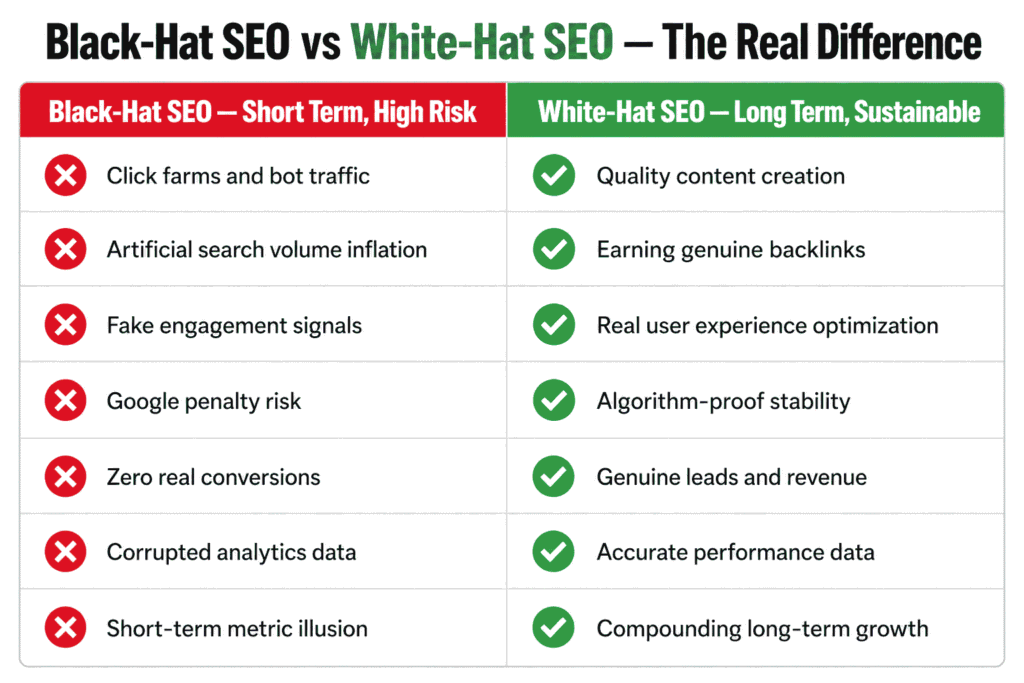
Why Click Farm and Bot Traffic Is Black-Hat SEO
The SEO industry distinguishes between white-hat practices — those that comply with search engine guidelines and build sustainable rankings — and black-hat practices — those that attempt to manipulate algorithms through deception.
Click farm and bot traffic services fall firmly and unambiguously into the black-hat category for several interconnected reasons.
Violating Search Engine Webmaster Guidelines
Google’s Search Essentials documentation explicitly prohibits attempts to manipulate search signals through artificial means. Generating fake click signals to influence search rankings violates these guidelines directly. Google’s spam policies specifically address “cloaking, sneaky redirects, and other deceptive techniques” designed to manipulate how sites appear to search engines versus how they appear to users — and click farm traffic is fundamentally a deception of this type.
Manipulating Algorithm Signals Dishonestly
Search algorithms are designed to interpret behavioral signals as genuine indicators of content quality and user satisfaction. Click farms corrupt this signal system by feeding fake behavioral data into algorithms that are designed to reflect real user preferences. This is not just a terms of service violation — it is a fundamental corruption of the mechanism by which search engines attempt to serve genuine users.
Creating Misleading Representations
When a business uses bot traffic to inflate its traffic metrics, it is misrepresenting its performance to stakeholders, investors, clients, and partners who rely on those metrics to make real decisions. This extends beyond SEO into potential legal and financial misrepresentation territory for businesses that report inflated traffic as evidence of market traction.
How Bot Traffic Harms Your Website: The Real Consequences
The marketing pitch for click farm services focuses entirely on the apparent upside — more traffic, better metrics, higher apparent rankings. What it never mentions is the damage these services cause — damage that is often more lasting and more expensive than any short-term metric improvement.
Google Penalty Risk
Google’s systems are specifically designed to detect and penalize artificial traffic manipulation. The Penguin and Panda updates established the precedent for algorithm-level penalties, and Google’s manual review team issues manual actions against sites identified as engaging in manipulative practices.
A Google manual action is among the most damaging events that can happen to a website’s search visibility. Recovering from a manual penalty requires identifying and removing all manipulative practices, submitting a reconsideration request, and waiting through a review process that can take months — all while the site operates with severely suppressed search visibility.
Algorithm-level detection is even less forgiving. Sites that trigger algorithmic spam detection can experience ranking drops that persist indefinitely without a clear manual review process to appeal through.
Analytics Corruption That Destroys Decision-Making
Bot traffic does not just inflate vanity metrics — it actively corrupts the analytics data that businesses use to make real decisions.
When bot traffic inflates session counts, it distorts bounce rate calculations, average session duration metrics, conversion rate measurements, traffic source attribution, and geographic user distribution. Every marketing decision informed by this corrupted data — which channels to invest in, which content is working, which audience segments are engaging — is now based on fundamentally misleading information.
Businesses that run paid advertising campaigns alongside bot traffic services face a particularly severe version of this problem. When inflated organic traffic metrics obscure the actual performance of paid channels, advertising budget allocation decisions are systematically distorted.
Zero Conversion Value
Bot traffic generates zero commercial value. Bots do not purchase products, sign up for services, submit inquiry forms, call telephone numbers, or take any action that represents real business value.
For any business that measures marketing success in terms of leads, sales, or revenue — which is every business — traffic that does not convert is worthless regardless of what the session count looks like. Worse than worthless, because the cost of the bot traffic service is real money spent on a guaranteed zero return.
Server Load and Cost Without Benefit
Significant bot traffic volumes consume real server resources — bandwidth, processing capacity, and hosting allowances that businesses pay for. A service generating thousands of artificial visits per day is effectively charging clients twice — once for the bot traffic service itself, and once through the increased hosting costs required to serve that artificial traffic volume.
The Misleading Reviews Ecosystem Around Services Like HighSoftware99.com
The search results visible in the screenshots reveal something important beyond the HighSoftware99.com service itself — they expose a pattern in how deceptive SEO services sustain themselves through an ecosystem of misleading promotional content.
Why So Many Reviews Are Biased
Looking at the search results for “seo by highsoftware99.com,” sites like Coruzant, Brand ClickX, Backlinkshatch, and TechUniverses appear — all publishing content about this service. Understanding why these publications promote services like HighSoftware99.com requires understanding their business model.
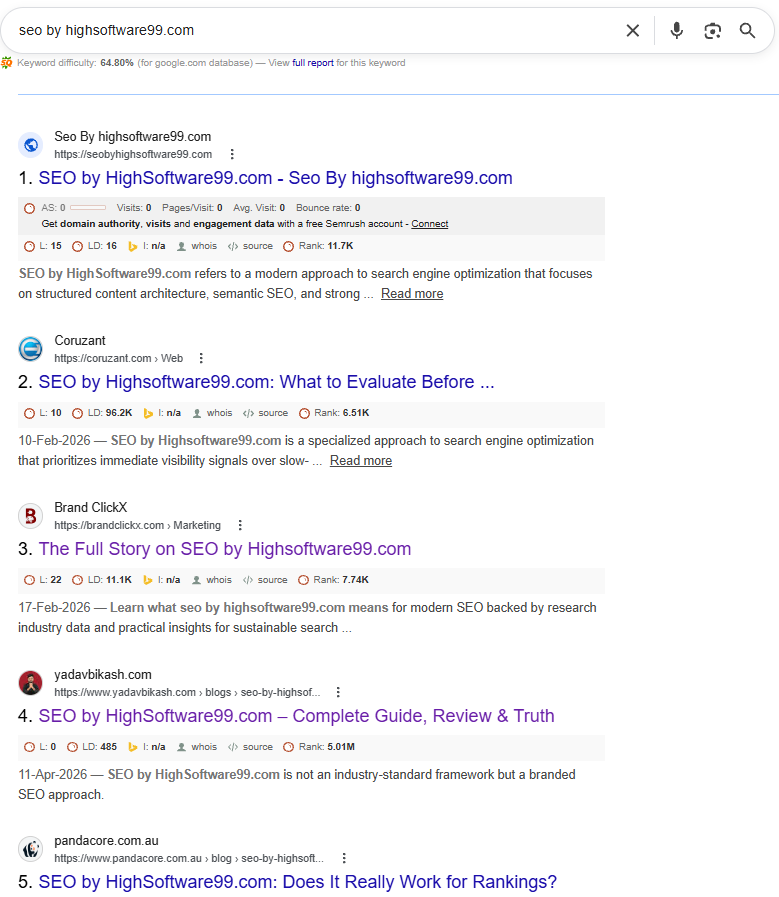
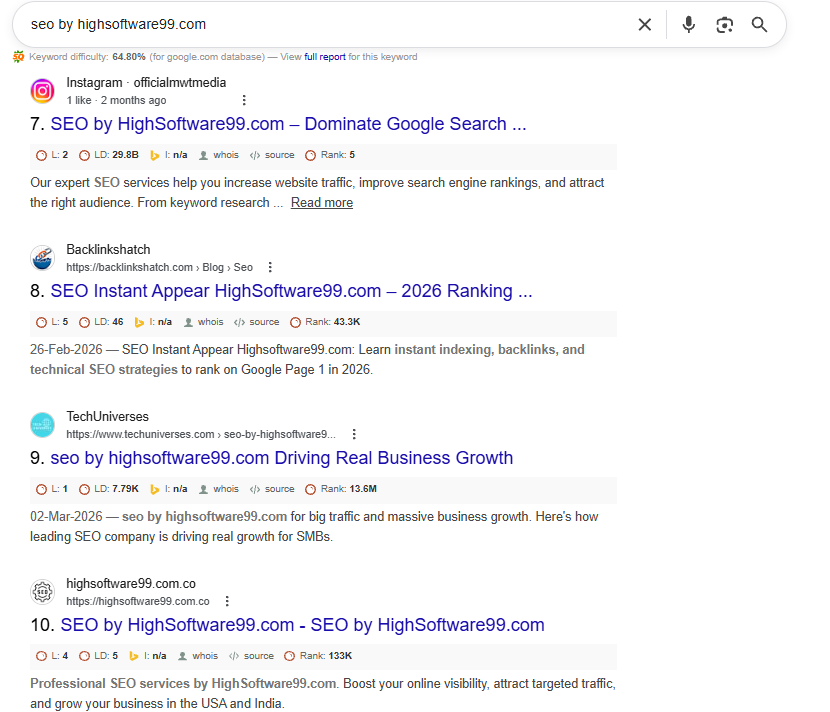
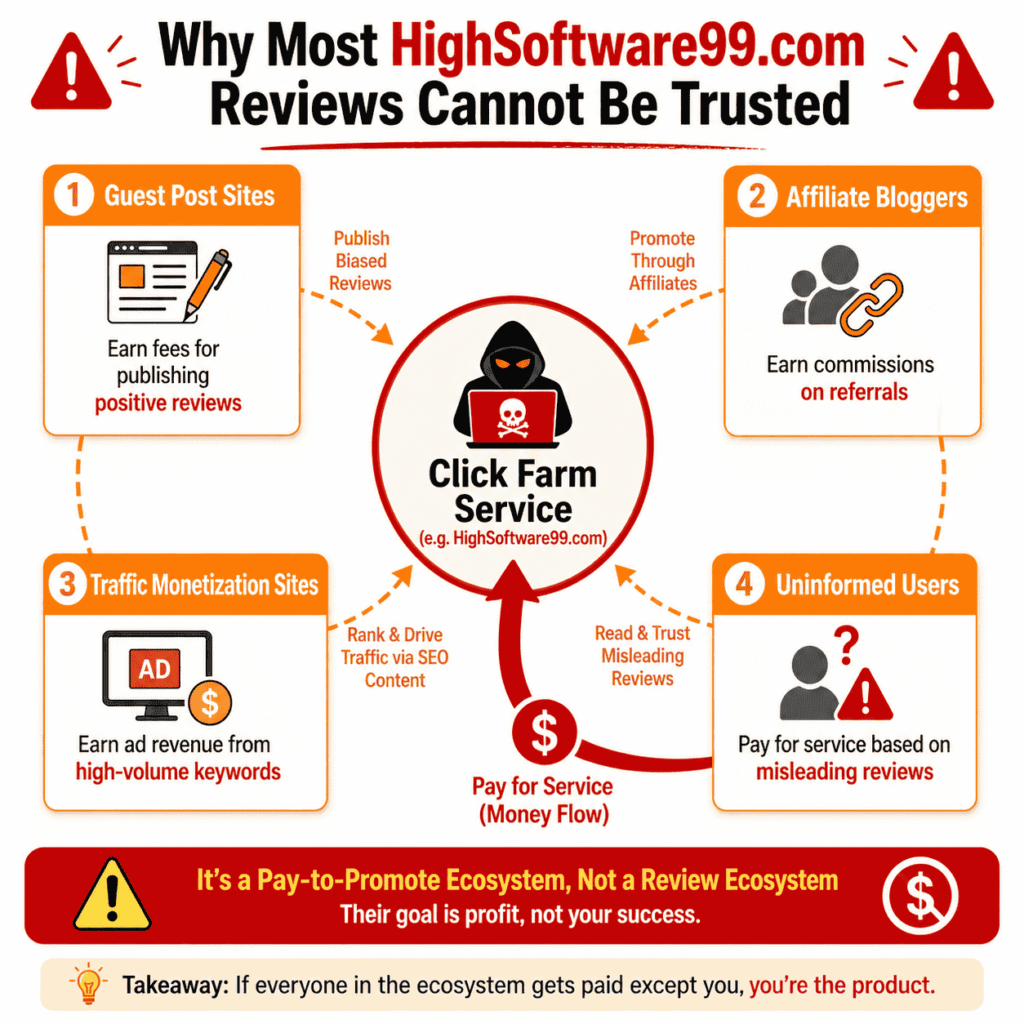
Many of these sites operate as guest post platforms or monetized content hubs. They earn revenue by publishing articles — either through direct guest post fees paid by the service being reviewed, affiliate commissions on referrals, or advertising revenue from the traffic that controversial topics generate.
A platform that publishes an honest critical review of a click farm service earns nothing from that service. A platform that publishes a positive review — or even a nominally “objective” review that stops short of clearly identifying harmful practices — may receive guest post fees, affiliate commissions, or traffic benefits from association with a high-volume keyword.
The Monetization Incentive for Misinformation
The 1.5 million monthly search volume around “seo by highsoftware99.com” is itself a monetization opportunity for content publishers. Writing about a high-volume keyword — even if the subject is a harmful service — generates organic traffic that can be monetized through advertising. The financial incentive to publish content optimized for high-volume keywords exists regardless of whether that content honestly serves the people searching for it.
This is why you will find articles that describe HighSoftware99.com using language like “specialized approach to search engine optimization” and “driving real business growth” — descriptions that are either deliberately misleading or reflect writers who have not investigated what the service actually does.
How to Identify Biased Reviews
Several reliable signals identify promotional rather than honest review content.
Content that describes a click farm service using legitimate SEO terminology — “structured content architecture,” “semantic SEO,” “immediate visibility signals” — without explaining what the service actually does is almost certainly promotional rather than analytical. Legitimate SEO analysis of a click farm service leads directly to the conclusion that it is harmful — any content that fails to reach this conclusion while appearing to review the service is not serving the reader honestly.
Reviews that lack specific data, technical analysis, or firsthand evidence of results are likely template content produced for SEO purposes rather than genuine independent assessment. The absence of negative findings about a service with clear red flags in its data profile is itself a red flag about the reviewer’s independence.
The Real Cost of Using HighSoftware99.com
For businesses that have used or are considering using this service, a clear-eyed cost-benefit analysis leaves no ambiguity.
What You Pay
The direct financial cost of the service itself — whatever fee HighSoftware99.com charges for its traffic packages. The indirect hosting cost of serving artificial traffic. The opportunity cost of budget that could have been invested in legitimate SEO, content creation, or paid advertising with real conversion potential.
What You Get
Inflated traffic metrics that look impressive in a dashboard but represent zero real users. Corrupted analytics data that actively undermines every marketing decision going forward. Penalty risk that could suppress your site’s organic visibility for months or permanently. Zero leads, zero sales, zero revenue attributable to the artificial traffic.
The Long-Term Damage Calculation
For a business that experiences a Google manual action as a result of artificial traffic manipulation, the recovery cost — in time, professional SEO fees, and lost organic revenue during the recovery period — almost invariably exceeds the original investment in the harmful service by a significant multiple.
Small businesses operating on tight marketing budgets are disproportionately harmed by this outcome because they typically lack the SEO resources to navigate penalty recovery efficiently and cannot absorb extended periods of suppressed organic visibility.
What Legitimate SEO Actually Looks Like
Understanding why click farm services are harmful is most useful when paired with a clear picture of what genuine SEO investment looks like and why it produces sustainable results that artificial traffic never can.
Content Quality and Topical Authority
Google’s ranking systems are increasingly sophisticated at evaluating genuine expertise and content quality. The Helpful Content system, introduced and expanded through successive updates, specifically targets content created primarily for search engine manipulation rather than genuine user value.
Building topical authority — deep, genuine expertise expressed through high-quality content that actually helps real users — is the foundation of sustainable organic visibility. This takes time and genuine investment, but it produces ranking signals that are stable, defensible, and not subject to penalty risk.
Earning Real Backlinks
Link building remains one of the most powerful ranking signals in Google’s algorithm, but the quality and authenticity of those links matters enormously. Links earned through genuine content value — other sites linking to your content because it is genuinely useful — produce lasting ranking improvements. Links manufactured through manipulation are devalued or penalized.
Technical SEO Excellence
Site speed, mobile responsiveness, Core Web Vitals performance, crawlability, and structured data implementation are technical factors that genuinely influence ranking performance and can be improved through legitimate investment without any penalty risk.
Real User Experience Signals
The behavioral signals that click farms try to fake — positive click-through rates, low bounce rates, strong dwell time — can be earned legitimately by creating content that genuinely satisfies user search intent. When real users find what they are looking for, spend time with it, and return to the source, those signals register authentically in ranking systems and produce sustainable ranking improvements.
How to Protect Yourself From Similar Services
The SEO industry has always attracted services that promise shortcuts to results that legitimate practice requires time to achieve. Protecting yourself from these services requires a combination of healthy skepticism and baseline knowledge.
Verify traffic claims independently. Any SEO service that claims to deliver significant traffic increases should be able to provide verifiable analytics access — not just screenshots or dashboard images that can be manipulated. Independent analytics verification through Google Analytics or Google Search Console is the minimum evidence standard for any traffic-related claim.
Understand realistic SEO timelines. Legitimate SEO improvements typically show measurable results over three to six months and compound over longer periods. Any service promising dramatic traffic increases in days or weeks is either selling artificial signals or misrepresenting what its service delivers.
Check the keyword data behind traffic claims. The kind of SEMrush analysis visible in the screenshots at the top of this article is exactly the right approach to evaluating SEO services. High volume on branded or unusual keyword phrases with very low keyword difficulty and zero advertiser competition is a reliable indicator of artificially inflated search volume.
Research any SEO service through independent channels. Look for evidence of the service’s effectiveness beyond content published on sites with obvious monetization incentives. Client case studies with independently verifiable results, Google Search Console data showing organic growth, and transparent methodology documentation are the standards legitimate services can meet and fraudulent services cannot.
Consult established SEO resources. Google’s Search Central documentation, Moz, Ahrefs, and SEMrush’s own educational resources provide authoritative guidance on what legitimate SEO practice looks like. Any service whose methodology contradicts the guidance in these established resources should be treated with serious skepticism.
Conclusion: The Verdict on SEO by HighSoftware99.com
The evidence is clear and the conclusion is direct.
SEO by HighSoftware99.com is not an SEO service in any legitimate sense of that term. It is a click farm and bot traffic operation that artificially inflates keyword search volume and website traffic metrics — selling an illusion of performance that delivers no real business value and carries significant penalty risk for the businesses that use it.
The 1.5 million monthly search volume around its branded keyword is itself a manufactured signal — evidence of the service’s own bot infrastructure rather than genuine market demand for its offering. The ecosystem of positive reviews surrounding the service reflects the financial incentives of content publishers rather than genuine user value.
For any business investing in digital marketing and SEO, the only path to sustainable online visibility is legitimate — quality content, genuine link earning, technical excellence, and real user value. These approaches take longer than a click farm service promises, cost more than a bot traffic package charges, and require ongoing investment.
They also actually work. And more importantly, they do not put your domain at risk of penalties, corrupt your analytics data, or drain your budget on traffic that will never, under any circumstances, generate a single real customer.
The truth about SEO by HighSoftware99.com is simple — it is a service designed to take your money in exchange for metrics that look like results without being results. Now that you know that, you can make a better decision with your marketing investment.

Abdullah Zulfiqar is Co-founder and Client Success Manager at RankWithLinks, an SEO agency helping businesses grow online. He specializes in client relations and SEO strategy, driving measurable results and maximizing ROI through effective link-building and digital marketing solutions.