
You have probably scrolled past one today without noticing. A sponsored post is any article, video, or social media post that a brand has paid for in some way — and it is meant to promote that brand’s product or service.
The money can change hands in different ways: a flat fee for the placement, a free product sent for review, or a commission on every sale. What makes it a “sponsored post” is not where it appears, but the fact that there is a commercial deal behind it. When money, gifts, or freebies are involved in creating content that recommends something, it counts as sponsored.
Sponsored posts sit between classic advertising and normal content. They look and read like regular blog posts or videos, which is exactly why the law says they must be labelled honestly.
What a sponsored post actually looks like
Here are a few everyday examples:
- A beauty blogger publishes a review of a skincare serum after the brand paid her £500 for the post.
- A tech website runs a 1,500-word article about “the best project management tools” and one of the featured tools paid for a mention with a link.
- An Instagram creator posts a photo of a watch with “#ad” at the top of the caption.
- A business pays a news site to publish a “sponsored article” about its new service, with a small “Sponsored” label above the headline.
In each case, the brand gets in front of an audience that already trusts the publisher. The publisher gets paid for the placement. The reader gets content that — at least in theory — is still useful. That triangle only works when the reader knows about the deal.
Sponsored posts vs guest posts: what is the difference?
This is the point most people mix up, so here is a clear comparison:
| Sponsored post | Guest post | |
|---|---|---|
| Payment | Always paid (money, products, or commission) | Usually unpaid, written for exposure |
| Main goal | Promote a product or service | Share knowledge and build authority |
| Tone | Promotional, brand-led | Educational, reader-led |
| Link treatment | Should use rel=”sponsored” or rel=”nofollow” | Usually a natural editorial link |
| Disclosure | Required by law in many countries | Not required (no payment involved) |
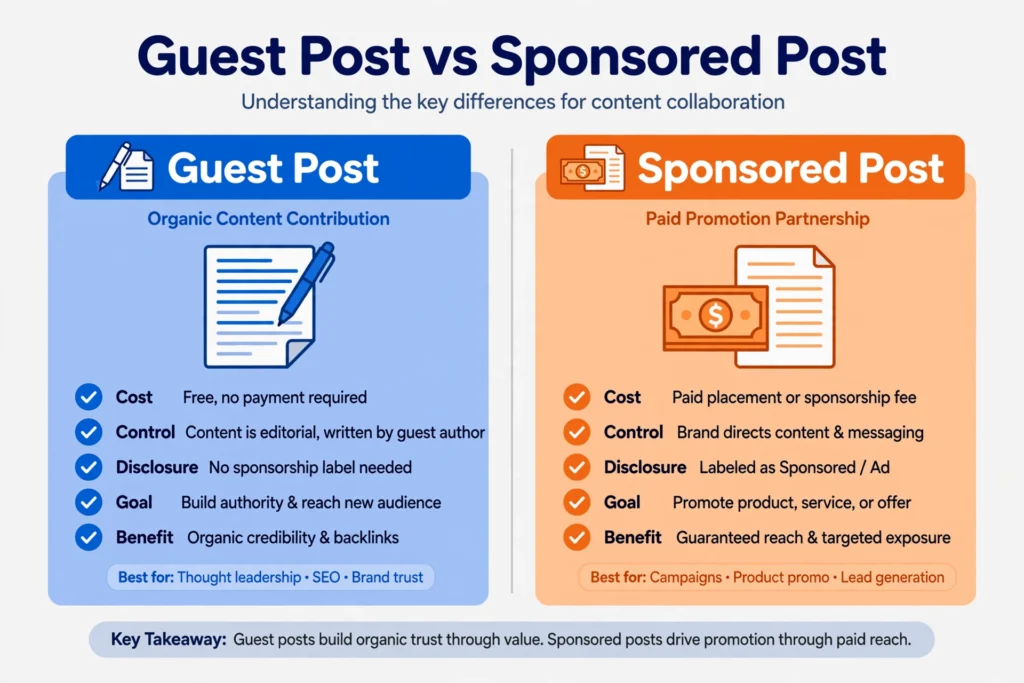
A guest post earns its link because the content is genuinely useful. A sponsored post is advertising space inside content — closer to an ad slot than an editorial favour. Search engines treat them differently because of this.
The short version: if someone paid for it, it is a sponsored post. If someone wrote it for free to share expertise, it is a guest post.
Why brands pay for sponsored posts
Sponsored posts are a big business now. The global influencer marketing industry was valued at an estimated $32.55 billion in 2025, up from $24 billion in 2024 — a 35% jump in a single year, according to Influencer Marketing Hub and Statista 1. In the US alone, spending on sponsored content reached $10.52 billion in 2025, growing 15% year over year, per eMarketer 1.
The reason brands keep spending is control and reach. A sponsored post lets a company:

- Reach a specific audience it could not reach on its own
- Tell its story in more depth than a banner ad allows
- Borrow the trust the publisher has already built with readers
- Get measurable traffic and sales through tracked links
That trust is the real product being bought. Around 86% of US marketers at companies with 100 or more employees used influencer marketing in 2025, according to eMarketer 1. When almost nine in ten big-company marketers are doing it, sponsored posts are no longer an experiment — they are a standard channel.
The rules: FTC disclosure requirements
Here is the part many brands get wrong. If a creator is paid, given free products, or has any financial tie to the brand, the US Federal Trade Commission (FTC) requires a clear and obvious disclosure. The EU, UK (via the ASA), and other regulators have similar rules.
What “clear and obvious” means in practice:
- Use plain words. “Ad”, “Sponsored”, “Paid partnership with [brand]” all work. Abbreviations like “#sp” do not — the FTC has said the average reader would not understand them 2.
- Put it where people will see it. On Instagram, the disclosure should come before the “…more” cut-off in the caption, not buried in a pile of hashtags 2.
- Say it in videos too. A disclosure in the description is not enough for a video — it should be spoken or shown on screen early 3.
- One platform rule does not fit all. Each social network has its own branded-content tools (like Instagram’s “Paid partnership” label). Use them, but add your own clear text as well.
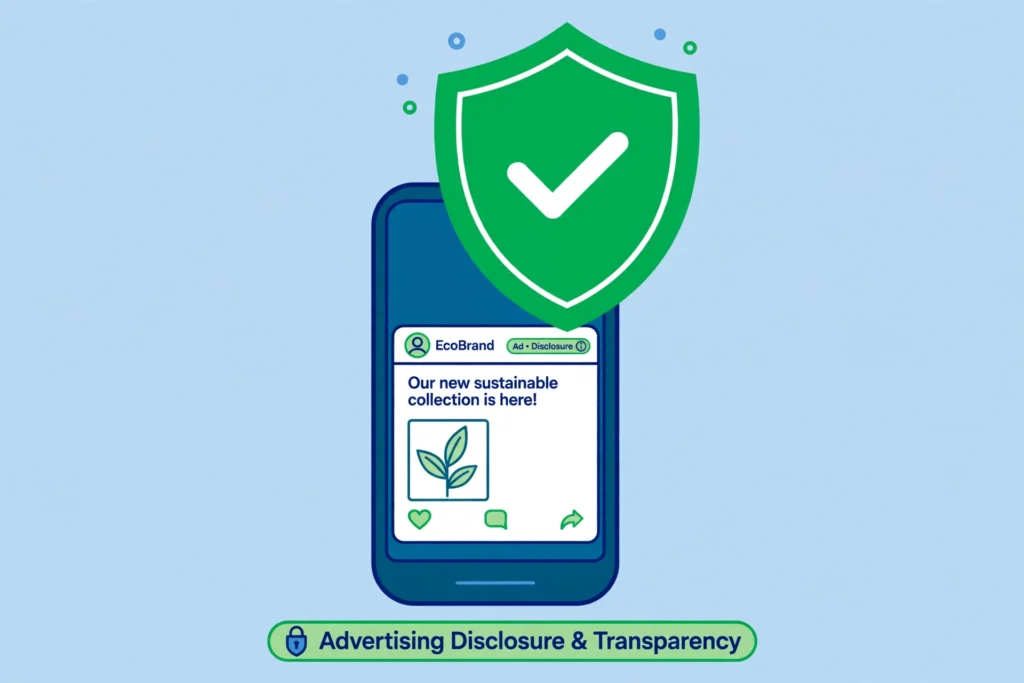
Breaking these rules is expensive. The FTC can impose fines of up to $43,280 per violation for non-compliant sponsored content 3. On top of that, hiding a sponsorship damages the trust the brand paid to borrow in the first place.
Sponsored posts and SEO: what you need to know
This matters a lot if you are building links. Google treats paid links as a different category from editorial links. Its rule is simple: any link you paid for must carry the rel=”sponsored” or rel=”nofollow” attribute, which tells Google not to count it as a ranking vote 4.
What this means in practice:
- Sponsored posts do not pass ranking power. Because the link is marked as paid, Google will not treat it as an endorsement. That is by design.
- They still send real traffic. A well-placed sponsored post on a busy site can send hundreds of interested visitors to your page. Traffic and brand exposure are genuine benefits.
- Marking links protects both sides. The publisher follows Google’s rules and the advertiser avoids a penalty for a link scheme.
This is why serious link building separates the two strategies. Editorial guest posts build rankings because the links are earned. Sponsored posts build awareness and traffic because the placement is bought. A healthy marketing plan can use both — but you should never confuse one with the other. If you want links that actually move your rankings, work with a team that specialises in manual, editorial link building — like our professional link building services, which are built on real outreach, not paid placements.
When a sponsored post makes sense for your business
Sponsored posts are the right tool when you need reach and control fast:
- Launching a product. A coordinated round of sponsored posts can put a new product in front of thousands of targeted readers in a week.
- Entering a new market. Partnering with publishers who already serve that market is faster than building an audience from zero.
- Supporting a campaign. Sponsored posts work well alongside email, paid ads, and PR to repeat the same message across channels.
- Building brand familiarity. Repeated exposure on trusted sites makes your brand feel established, even if you are new.
They are the wrong tool when your only goal is higher Google rankings. For that, you need earned links from genuinely useful content — which is a slower, steadier game.
FAQs about sponsored posts
What is a sponsored post in simple terms?
A sponsored post is content — an article, video, or social media post — that a brand has paid for in some way to promote its product or service. The payment can be money, free products, or a commission. Because there is a commercial deal behind it, the content must be clearly labelled so readers know it is advertising.
Do sponsored posts have to say they are sponsored?
Yes. In the US, the FTC requires clear disclosure of any paid relationship between a creator and a brand 2. The UK’s Advertising Standards Authority has similar rules, and most other countries do too. Labels like “#ad”, “Sponsored”, or “Paid partnership” are accepted; vague tags like “#sp” or hiding the label in hashtags are not.
What is the difference between a sponsored post and an ad?
There is very little difference — a sponsored post is a form of advertising. The distinction is mostly about format: a sponsored post is styled to look like normal content (an article or a creator’s video) rather than a display banner. Legally, both are ads and both need clear disclosure.
Can a sponsored post help my SEO?
Only indirectly. The link in a sponsored post should carry rel=”sponsored” or rel=”nofollow”, which means Google will not count it as a ranking vote 4. However, a good sponsored post can send real referral traffic, grow brand searches, and earn natural links if readers share it — and those things do help SEO over time.
Is it safe to buy backlinks through sponsored posts?
You should be careful here. Google’s guidelines say that paid links meant to manipulate rankings are a link scheme and can lead to a penalty — even if they are dressed up as sponsored posts. If you pay for a placement, the link must be marked rel=”sponsored” or rel=”nofollow”. Our advice: use sponsored posts for traffic and visibility, and earn your ranking links through genuine outreach and content.
How much does a sponsored post cost?
It varies widely. A small blog might charge $50–$200 per post, while a large publication or a top creator can charge thousands. Prices usually depend on the site’s traffic, audience size, and how much work the content requires. Always agree on the fee, the link terms, and the disclosure wording before the post goes live.
The bottom line
A sponsored post is paid-for content that promotes a brand, and the payment is what defines it — not the format. Used honestly, with clear disclosure and correctly marked links, sponsored posts are a legitimate way to reach new audiences. Used secretly, or bought purely to game search rankings, they become a liability.
The rule of thumb is simple: if money changed hands, say so, mark the link, and let the post earn its value through real readers — not through tricks.

Abdullah Zulfiqar is Co-founder and Client Success Manager at RankWithLinks, an SEO agency helping businesses grow online. He specializes in client relations and SEO strategy, driving measurable results and maximizing ROI through effective link-building and digital marketing solutions.