

Running a successful ecommerce operation depends on one thing most store owners underestimate — clean, consistent, and complete product data. Whether you sell across your own website, Amazon, Google Shopping, or dozens of retail marketplaces simultaneously, the quality of your product information directly determines your conversion rates, return rates, and search visibility.
That is exactly what Product Information Management software solves. If you are evaluating the best PIM software for ecommerce sites, this guide covers the top platforms, what features actually matter, and how to choose the right solution for your catalog size, team, and sales channels.
What Is PIM Software and Why Does Every Ecommerce Site Need It?
Product Information Management software is a centralized system for storing, managing, enriching, and distributing all product-related data across every sales channel your business operates. It serves as the single source of truth for product titles, descriptions, attributes, images, pricing rules, technical specifications, and channel-specific content variations.
Without a PIM, ecommerce teams typically manage product data across spreadsheets, ERP systems, individual platform backends, and shared drives — a fragmented approach that leads to inconsistent listings, duplicate work, and costly errors at scale.
The best PIM software for ecommerce sites solves these problems by centralizing everything in one place and pushing accurate, channel-ready content wherever it needs to go automatically.
Who Needs PIM Software?
PIM software becomes essential when:
- Your catalog exceeds several hundred SKUs and manual updates are becoming unmanageable
- You sell across multiple channels including your own store, marketplaces, and wholesale portals
- Product data inconsistencies are causing customer complaints, high return rates, or poor search rankings
- Your team wastes significant time reformatting product content for different platforms
- You are expanding internationally and need multilingual product content management
- You are scaling your catalog rapidly through new product lines or supplier onboarding
Key Features to Look for in the Best PIM Software for Ecommerce
Not every PIM platform is built the same way. Before evaluating specific tools, understand which capabilities are genuinely critical for ecommerce success.
Centralized Product Data Repository
The core of any PIM is a unified database that holds every attribute, media file, and content variant associated with your products. Look for platforms that support custom attribute modeling so the data structure fits your specific product taxonomy — not the other way around. To ensure this data remains accurate and well-structured over time, a data governance specialist can help define standards, maintain consistency, and improve data quality across the entire system.
Channel-Specific Content Management
Different sales channels have different content requirements. Amazon requires different attribute structures than Shopify. Google Shopping has specific image and title rules. A strong PIM allows you to maintain one master product record while producing channel-optimized versions automatically.
Digital Asset Management Integration
Product images, videos, technical documents, and 3D files are part of the product story. Before assets are uploaded into a PIM, teams often need to clean up visuals for instance, to remove object from photo backgrounds or distracting elements to ensure images meet marketplace quality standards.
The best PIM tools for ecommerce either include native digital asset management or integrate tightly with dedicated DAM platforms to keep media linked to the correct products at all times.
Workflow and Collaboration Tools
Large catalogs require team-based enrichment workflows. Look for role-based access controls, task assignment, content completion tracking, and approval workflows that keep product data moving through enrichment stages without bottlenecks.
Ecommerce Platform and Marketplace Integrations
Your PIM is only as useful as its ability to push data where it needs to go. Evaluate native connectors for Shopify, WooCommerce, Magento, BigCommerce, Amazon, eBay, Walmart, and any other channels relevant to your business.
Data Quality and Validation Rules
Built-in validation rules ensure products meet completeness standards before they are published. This prevents incomplete listings, missing required attributes, or content that fails marketplace requirements from going live.
Multilingual and Multiregional Support
If international expansion is part of your roadmap, choose a PIM that handles translation management, locale-specific content variants, and regional pricing or compliance requirements natively.
Best PIM Software for Ecommerce Sites in 2026
1. Akeneo PIM
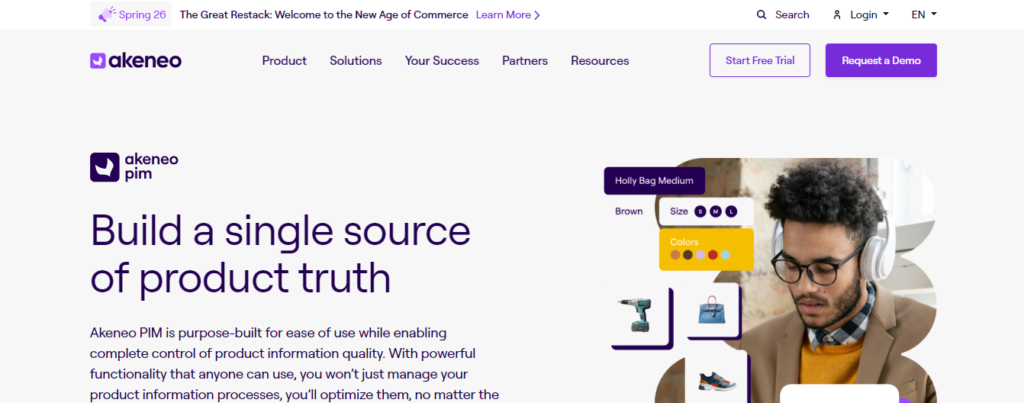
Akeneo is consistently ranked among the best PIM software for ecommerce sites globally, and for good reason. It was purpose-built for product experience management and serves brands ranging from mid-market retailers to global enterprise operations.
Its open-source Community Edition makes it accessible for growing businesses, while the Growth and Enterprise editions add AI-powered enrichment, advanced workflow automation, and enterprise-grade scalability.
Standout features for ecommerce:
- Product Experience Management (PXM) framework built around customer-facing content quality
- Akeneo Activation for direct channel syndication to marketplaces and retailers
- AI-powered product data enrichment and translation suggestions
- Flexible attribute modeling that adapts to complex, multi-category catalogs
- Strong Shopify, Magento, and BigCommerce connector ecosystem
- Excellent data quality scoring and completeness tracking dashboards
Akeneo’s emphasis on product experience — not just data storage — makes it particularly strong for brands where content quality directly drives conversion rates and brand perception.
Best for: Mid-market to enterprise ecommerce brands managing large, complex catalogs across multiple channels and regions.
2. Salsify

Salsify markets itself as a Product Experience Management platform rather than a pure PIM — and that distinction reflects its strength. It combines product content management with direct retailer and marketplace syndication in a single platform, making it especially powerful for brands that sell through third-party retail channels in addition to their own stores.
Standout features for ecommerce:
- Direct syndication network connecting to over 1,000 retail partners and marketplaces
- Retailer-specific content requirements built into the platform’s workflow engine
- Page performance insights that connect product content quality to actual conversion data
- Collaborative supplier and brand onboarding tools
- Strong content readiness scoring aligned to specific channel requirements
- Integration with major ecommerce platforms and ERP systems
Salsify’s combination of PIM and syndication in one platform reduces the need for separate middleware tools, making it particularly efficient for brands managing many retail partnerships simultaneously.
Best for: Consumer brands and manufacturers selling through retail partners, distributors, and multiple digital marketplaces.
3. Plytix

Plytix is one of the best PIM software options specifically designed for small to mid-sized ecommerce businesses. While enterprise platforms can be expensive and complex to implement, Plytix offers a focused, accessible PIM experience without sacrificing the core capabilities growing ecommerce teams actually need.
Standout features for ecommerce:
- Purpose-built for SMB ecommerce with an intuitive, low-learning-curve interface
- Built-in product feed management for Google Shopping, Facebook, and marketplace channels
- Product sheets and digital catalog creation tools built directly into the platform
- Attribute-based filtering and bulk editing tools for fast catalog management
- Transparent, catalog-size-based pricing that scales predictably
- Strong import and export capabilities for common ecommerce data formats
Plytix fills a genuine gap in the market for ecommerce businesses that need real PIM functionality without the implementation complexity and cost of enterprise platforms.
Best for: Small to mid-sized ecommerce businesses managing catalogs of a few hundred to several thousand SKUs across multiple channels.
4. Syndigo

Syndigo is a content experience platform that combines PIM, digital asset management, and content syndication into a unified system. It has a particularly strong footprint in the grocery, health, beauty, and consumer packaged goods sectors — industries where retailer content requirements are highly structured and compliance-driven.
Standout features for ecommerce:
- One of the largest retail syndication networks available, covering major grocery chains, drug stores, and mass market retailers
- Built-in digital asset management tightly linked to product records
- Content verification and compliance checking against retailer-specific rules
- Enhanced content capabilities for A+ content and rich media product pages
- Strong supplier onboarding tools for brands managing large product portfolios
- Analytics connecting content quality to retail sales performance
Syndigo’s syndication network reach makes it uniquely valuable for brands where getting content right to major retail partners quickly is a primary operational priority.
Best for: CPG brands, health and beauty companies, and food and beverage manufacturers selling through major retail chains and grocery platforms.
5. inRiver PIM

inRiver is a cloud-native PIM platform with a strong focus on the complete product information lifecycle — from initial supplier data ingestion through enrichment, approval, and multichannel distribution. Its visual pipeline concept gives teams a clear, configurable view of how product data flows through the organization.
Standout features for ecommerce:
- Visual data pipeline modeling that maps exactly how product data moves from source to channel
- Strong B2B and B2C ecommerce support with channel-specific publishing rules
- Native integration with Episerver, Salesforce Commerce Cloud, and other enterprise platforms
- Supplier portal for automating inbound product data collection from manufacturers
- Multi-market and multilingual content management built for international ecommerce
- Flexible API-first architecture for custom integration requirements
inRiver’s pipeline-based approach to data management gives operations teams unusual clarity and control over complex, multi-step product enrichment processes.
Best for: Mid-market and enterprise brands with complex product data workflows and strong international commerce requirements.
6. Catsy
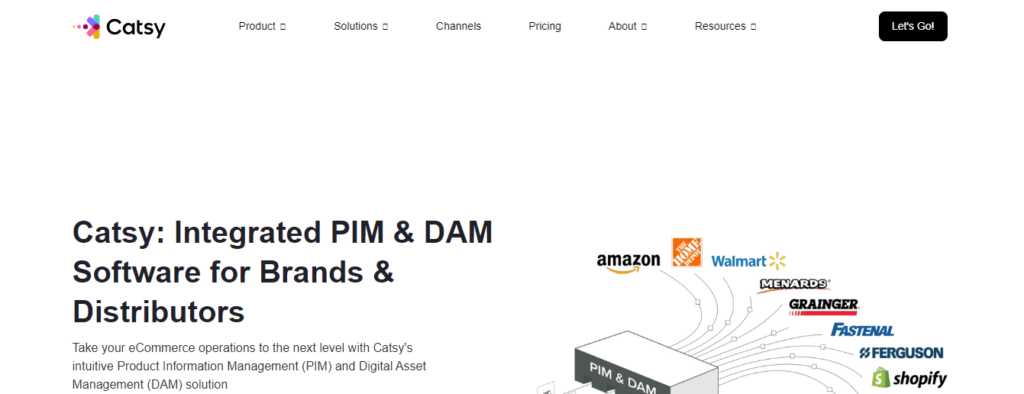
Catsy combines PIM and DAM capabilities in a single platform designed specifically for ecommerce teams. Its strength lies in the tight connection between product data and digital assets — ensuring that images, documents, and media are always linked correctly and distributed alongside product information.
Standout features for ecommerce:
- Unified PIM and DAM in a single interface, eliminating the need for separate systems
- Channel-ready content syndication for Amazon, Shopify, WooCommerce, and other platforms
- Bulk content editing tools for fast updates across large catalogs
- Product data completeness scoring and quality management dashboards
- Strong import tools for migrating data from spreadsheets and legacy systems
- Competitive pricing compared to larger enterprise PIM platforms
Catsy is a practical, efficient choice for ecommerce teams that need both product data and digital asset management solved without investing in two separate platforms.
Best for: Growing ecommerce brands that need combined PIM and DAM functionality in a single, affordable platform.
PIM Software Comparison: Key Factors at a Glance
When comparing platforms side by side, evaluate these dimensions for your specific situation:
Catalog size and complexity: Plytix and Catsy serve smaller, simpler catalogs well. Akeneo, Salsify, inRiver, and Contentserv handle large, complex, multi-category catalogs with technical attribute requirements.
Channel coverage: Salsify and Syndigo lead in retail syndication network reach. Akeneo and inRiver lead in ecommerce platform connector depth.
Budget: Plytix and Catsy offer the most accessible pricing for SMBs. Enterprise platforms like Akeneo Enterprise, Salsify, and Contentserv require significant investment but deliver commensurate capabilities.
Implementation complexity: Plytix and Catsy can be deployed relatively quickly by small teams. Enterprise platforms typically require implementation partners and multi-month deployment timelines.
DAM needs: If combined PIM and DAM is a priority, Catsy, Contentserv, Syndigo, and Bynder are the strongest options.
How to Choose the Best PIM Software for Your Ecommerce Site
Selecting the right PIM is one of the most consequential technology decisions an ecommerce operation makes. A poorly chosen platform creates more operational burden than it solves. Follow this evaluation framework to choose confidently.
Step 1: Audit Your Current Product Data Situation
Before evaluating platforms, document your current state honestly. How many SKUs do you manage today and how many will you manage in three years? How many channels do you publish to? What are your biggest data quality problems? What does your current product data workflow actually look like?
Step 2: Define Your Channel Requirements
List every sales channel you operate today and every channel you plan to add. Map the specific data requirements for each — Amazon’s listing requirements differ significantly from Google Shopping and from your own Shopify store. Your PIM needs to support all of them without requiring manual reformatting.
Step 3: Evaluate Integration Depth, Not Just Connector Counts
Every PIM platform advertises hundreds of integrations. What matters is how those integrations actually work in practice. During your evaluation, test the specific connectors you need. A native Shopify connector that syncs in real time is fundamentally different from a CSV export you schedule manually.
Step 4: Assess Team Adoption Requirements
The best PIM software is the one your team will actually use consistently. A feature-rich enterprise platform that requires months of training and a dedicated administrator creates adoption risk. Match platform complexity to your team’s technical capacity and operational maturity.
Step 5: Run a Proof of Concept With Your Real Data
Most PIM vendors offer trials or proof-of-concept periods. Use them with a real subset of your actual product catalog — not demo data. This surfaces integration challenges, data modeling decisions, and workflow friction that only become visible when real product data is loaded into the system.
Common PIM Implementation Mistakes to Avoid
Even with the right platform, poor implementation undermines the investment:
- Importing dirty data: Migrating inconsistent, incomplete data from your existing systems into a new PIM simply moves the problem. Cleanse and standardize data before migration, not after.
- Skipping data modeling: Rushing into data entry without designing your attribute structure first creates a disorganized catalog that becomes increasingly difficult to manage as it grows.
- Not involving channel managers early: The people responsible for each sales channel need to define their content requirements before the PIM is configured, not after launch.
- Underestimating change management: PIM adoption requires changing how your team thinks about and handles product data. Training, process documentation, and internal champions matter as much as the technology itself.
- Over-customizing at launch: Start with standard configuration and add customization incrementally as you understand your real usage patterns. Over-engineering the initial setup delays launch and creates technical debt.
The Business Impact of Choosing the Right PIM for Ecommerce
The ROI of the best PIM software for ecommerce sites is measurable across multiple dimensions that directly affect revenue and operational cost:
Higher conversion rates: Complete, accurate, and rich product content on every channel reduces purchase hesitation and drives higher conversion rates across all touchpoints.
Lower return rates: Detailed, accurate product descriptions and specifications reduce expectation mismatches that cause returns — one of the largest cost drains in ecommerce.
Faster time to market: Centralized product enrichment workflows mean new products reach all channels simultaneously rather than rolling out channel by channel over weeks.
Reduced operational overhead: Eliminating manual data re-entry and reformatting for each channel frees team time for higher-value work.
Better search visibility: Consistent, optimized product content across channels improves organic and marketplace search rankings, directly increasing discoverability.
Scalable catalog growth: A well-implemented PIM makes adding new products, new categories, and new channels operationally straightforward rather than exponentially complex.
Final Thoughts
The best PIM software for ecommerce sites is not the one with the longest feature list — it is the one that fits your catalog complexity, channel requirements, team capabilities, and growth trajectory. Akeneo leads for brands that prioritize product experience quality at scale. Salsify leads for brands managing extensive retail partnerships. Plytix leads for growing SMBs that need real PIM functionality without enterprise complexity. Syndigo leads for CPG brands in high-compliance retail environments.
What every ecommerce business shares, regardless of size or sector, is the same fundamental need: a single, authoritative source of product truth that ensures every customer, on every channel, sees accurate and compelling product information every time. That is what the right PIM delivers — and in a competitive ecommerce landscape, it is an operational advantage that compounds with every product you add and every channel you expand into.

Fazilat zulfiqar is an SEO specialist at RankWithLinks, focused on improving search rankings through smart link building and optimization.He helps businesses grow organic traffic and build strong online authority.