
Typography has always been one of the most powerful tools in a designer’s arsenal. But in 2026, artificial intelligence has fundamentally transformed what is possible with text effects — turning what once required hours of manual work in Photoshop into results achievable in seconds with the right AI-powered platform.
Whether you are a graphic designer creating social media visuals, a marketer building promotional materials, a content creator designing YouTube thumbnails, or a brand strategist developing visual identity systems, the best AI text effects software can dramatically accelerate your workflow and elevate the quality of your output.
This guide covers the top AI text effects software available today, what makes each platform stand out, and how to choose the right tool for your creative needs.

What Is AI Text Effects Software?
AI text effects software uses artificial intelligence and machine learning to automatically generate, stylize, and enhance typographic elements in ways that would traditionally require advanced design skills and significant manual effort.
These tools can apply complex textures, materials, lighting effects, 3D transformations, gradient overlays, glitch effects, neon styling, metallic finishes, fire and smoke simulations, and dozens of other visual treatments to text — often from a single text prompt or a few clicks.
The best AI text effects platforms combine generative AI with traditional design controls, giving creators the speed of automation with the precision of manual adjustment. The result is professional-grade typography that non-designers can produce and experienced designers can create at a fraction of the traditional time investment.
Why AI Text Effects Are Transforming Graphic Design in 2026
The traditional workflow for creating advanced text effects was genuinely complex. A metallic 3D text treatment in Photoshop required layer management, blending modes, lighting adjustments, texture sourcing, and hours of refinement. Even experienced designers could spend a full working day on a single headline treatment.
AI text effects software has compressed that workflow dramatically. What took hours now takes minutes. What required expert-level software knowledge now requires only a creative direction and a willingness to iterate.
This shift has democratized high-quality typography for creators at every skill level. It has also freed experienced designers from repetitive technical execution, allowing them to spend more time on creative strategy and less on mechanical production.
For businesses, the practical impact is significant — faster content production cycles, lower design costs, and consistent visual quality across high-volume output channels like social media, digital advertising, and content marketing.
Key Features to Look for in AI Text Effects Software
Before reviewing specific platforms, understanding what separates a great AI text effects tool from a mediocre one helps you evaluate options against your actual creative needs.
Generative text styling — The ability to describe a text effect in natural language and receive a high-quality result that matches the creative direction. The best tools understand prompts like “chrome metallic with blue reflections” or “vintage distressed letterpress on aged paper” and deliver accurate, usable results.
Style variety and depth — A wide library of effect styles covering 3D, metallic, neon, grunge, watercolor, fire, ice, glass, emboss, and beyond. Depth matters too — each style should offer enough variation to feel unique rather than templated.
Editability and customization — AI-generated effects that cannot be adjusted are limiting. The best platforms allow fine-tuning of colors, textures, lighting, shadows, and dimensional properties after the initial generation.
Resolution and export quality — Professional use requires high-resolution output. Platforms that generate low-resolution previews without clean high-resolution export options are not viable for print or large-format digital use.
Integration with design workflows — Compatibility with industry-standard tools like Adobe Photoshop, Illustrator, Figma, and Canva determines how smoothly AI text effects fit into existing professional workflows.
Font flexibility — The ability to apply effects to your own custom fonts and typefaces rather than being locked into a limited built-in font library is essential for brand-consistent work.
Speed and iteration — Fast generation times and the ability to quickly produce multiple variations allow for effective creative exploration rather than committing to a single result.
The Best AI Text Effects Software in 2026
1. RankWithLinks Font Generator
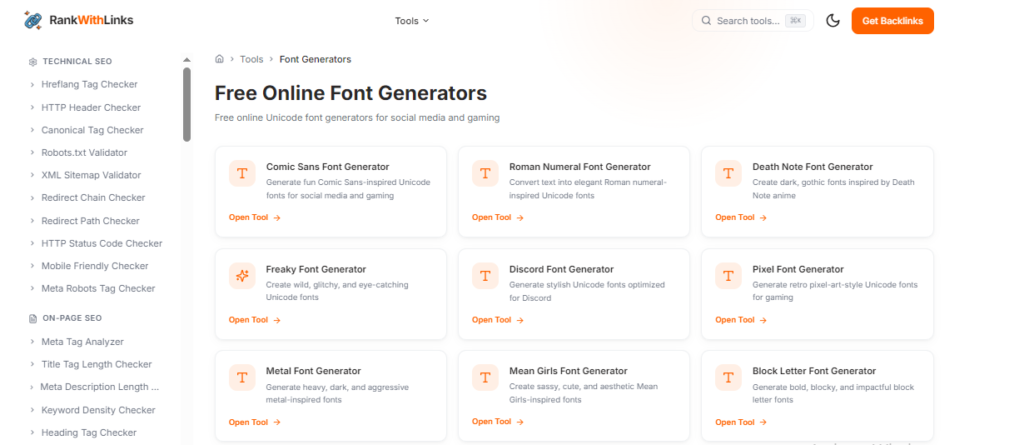
The RankWithLinks Font Generator at tools.rankwithlinks.com/tools/font-generators/ is a fast and accessible online text effects tool designed for creators who need stylized typography without the complexity of full design software. It generates a wide range of decorative font styles and text treatments instantly from any input text, making it particularly useful for social media captions, bio styling, heading treatments, and quick content creation needs.
Its zero-installation browser-based approach means there is no software to download or account to create — simply type your text and instantly browse through dozens of styled font variations ready to copy and use across any platform.
Best for: Social media creators, bloggers, and anyone needing quick decorative text styles without design software
Strengths: Instant results, browser based, no account required, wide style variety, completely free to use
Considerations: Better suited for quick styling needs than complex professional design projects requiring high resolution export or layered customization
2. Adobe Firefly
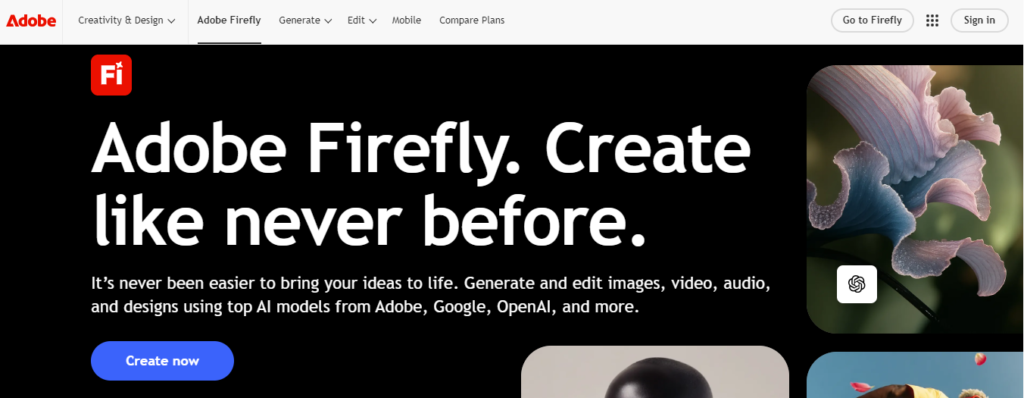
Adobe Firefly has established itself as the most professionally relevant AI text effects platform available in 2026, primarily because of its deep integration with the Adobe Creative Cloud ecosystem that most professional designers already use daily.
Its Text Effects feature allows designers to type any text and apply a detailed generative prompt to fill the letterforms with AI-generated imagery and textures. Type “ancient stone carved with moss and ivy” or “liquid chrome with iridescent reflections” and Firefly generates a photorealistic text treatment that fills the characters with remarkable precision and detail.
The results are exceptionally high quality and, critically, are trained on licensed Adobe Stock content — making them commercially safe to use without copyright concerns that plague some competing AI platforms.
Firefly integrates directly into Photoshop through the Generative Fill feature and into Illustrator through its vector recoloring and text styling tools, making it the most workflow-integrated AI text effects solution for professional designers.
Best for: Professional graphic designers, brand designers, and creative agencies already working within the Adobe ecosystem
Strengths: Exceptional output quality, commercial licensing safety, deep Creative Cloud integration, precise prompt following, high-resolution export
Considerations: Requires an Adobe Creative Cloud subscription; standalone access has generation credit limits that can be restrictive for high-volume users
3. Canva AI Text Effects
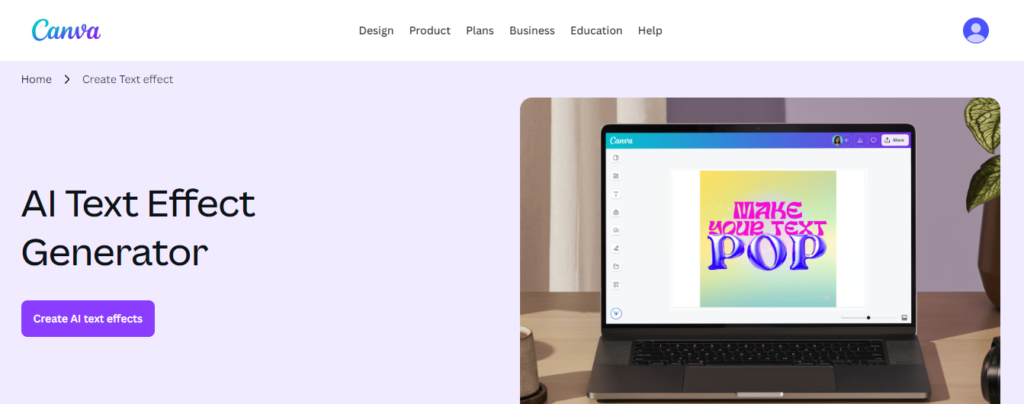
Canva’s AI text effects suite has made professional-quality typography accessible to a massive audience of non-designers — and in 2026, its capabilities have expanded significantly beyond the basic shadow and glow effects it originally offered.
Canva’s Magic Studio now includes AI-powered text styling that can apply textured fills, gradient animations, glitch treatments, neon effects, and material-based finishes to any text element within the Canva design environment. Its prompt-based text generation allows users to describe the effect they want in plain language and receive instant results.
For social media creators, small business owners, and marketing teams without dedicated design resources, Canva AI text effects deliver results that would have required professional design software just a few years ago. The platform’s template library provides starting points that can be customized with AI effects in minutes.
Best for: Non-designers, social media managers, small business owners, marketers, and content creators who need professional-quality text effects without advanced design skills
Strengths: Extremely accessible, large template library, fast iteration, strong social media format support, affordable pricing
Considerations: Less control over fine-grained technical adjustments compared to professional platforms; export resolution limits on lower pricing tiers
4. Stylar AI
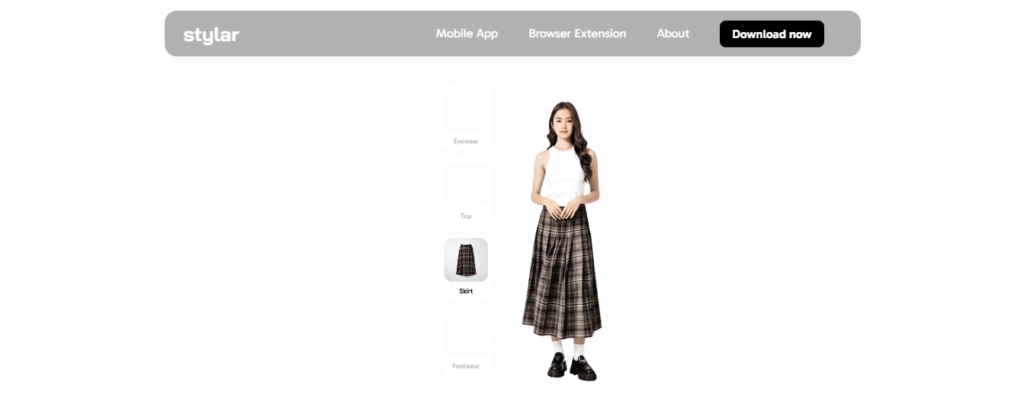
Stylar AI has emerged as one of the most capable dedicated AI text effects platforms, offering a level of stylistic depth and creative control that positions it between consumer tools like Canva and professional tools like Adobe Firefly.
Its text effects engine is particularly strong for decorative and illustrative styles — producing elaborate hand-lettering aesthetics, ornate vintage treatments, graffiti-inspired styling, and complex textural fills with impressive accuracy. Users can combine multiple style influences in a single prompt, creating hybrid effects that would be genuinely difficult to produce manually.
Stylar also offers a strong layer-based editing system that allows designers to adjust individual elements of AI-generated text effects after generation — a level of post-generation control that many competing tools lack.
Best for: Illustrators, lettering artists, content creators, and designers looking for decorative and expressive text effect styles
Strengths: Rich decorative style library, post-generation editing, strong prompt understanding, good value for the feature set
Considerations: Less known than Adobe or Canva — smaller community and fewer third-party tutorials available
5. Picsart AI Text Effects
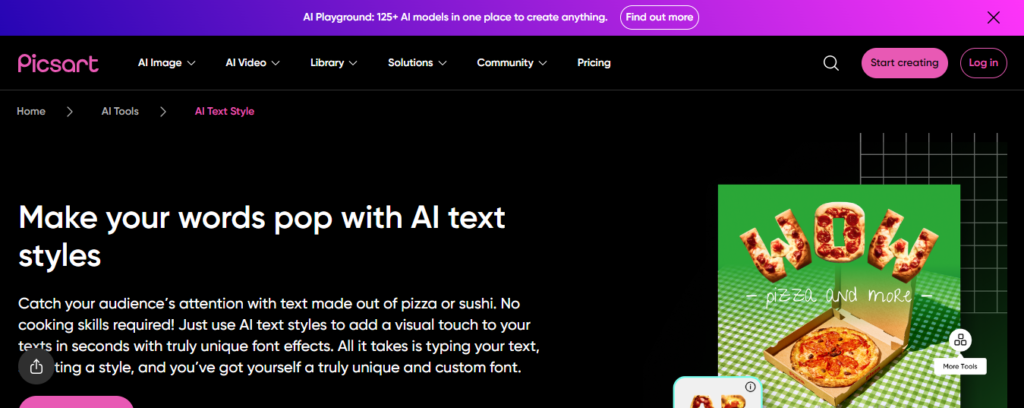
Picsart has grown from a mobile photo editing app into a genuinely capable AI-powered design platform, and its text effects features reflect that evolution. Its AI text styling tools cover a broad range of popular visual treatments — neon glow, holographic, metallic, retro, and 3D extrusion — with a user experience optimized for speed and simplicity.
Picsart’s strength lies in its cross-platform accessibility. The same AI text effect capabilities are available on desktop, iOS, and Android, making it particularly valuable for creators who work across devices and need consistent results regardless of platform.
Its content creation templates are well-designed for social media formats, and the AI effects integrate naturally into multi-element compositions rather than being limited to isolated text treatments.
Best for: Mobile-first creators, social media influencers, content creators who work across devices, and designers needing quick professional results
Strengths: Strong mobile experience, cross-platform consistency, fast generation, good social media template library, accessible pricing
Considerations: Professional-grade fine-tuning options are more limited than desktop-first platforms
6. Visme AI Text Effects
Visme is primarily known as a presentation and infographic design platform, but its AI text effects capabilities deserve recognition in their own right — particularly for business communicators and marketing professionals who need visually compelling text treatments within data visualization and presentation contexts.
Its AI styling tools produce clean, professional text effects that work particularly well in branded environments — maintaining typographic legibility while adding visual interest through gradient fills, subtle texture overlays, and dimensional treatments that enhance rather than overwhelm the underlying message.
Visme’s brand kit integration means AI text effects can be applied within defined brand color palettes and typography systems, ensuring consistency across all output — a significant advantage for marketing teams managing visual brand standards at scale.
Best for: Marketing teams, business communicators, presentation designers, and organizations managing visual brand consistency across high-volume content output
Strengths: Brand kit integration, professional and clean aesthetic output, strong presentation and infographic context, team collaboration features
Considerations: Text effect variety is narrower than platforms focused specifically on decorative or expressive typography
How to Choose the Best AI Text Effects Software for Your Needs
With ten strong platforms to consider, the selection process comes down to matching tool capabilities to your specific creative context.
Match the Tool to Your Skill Level
If you are a non-designer or beginner, Canva, Fotor, and Picsart offer the most accessible entry points with the shortest learning curves. If you are an experienced designer or art director, Adobe Firefly, Krea AI, and Stylar offer the depth and control that professional work demands.
Consider Your Primary Output Format
Static graphics for social media, print, and digital advertising are best served by platforms with strong high-resolution export and precise typographic control. Animated and video content calls for Runway ML’s motion typography capabilities. Presentations and business communications align best with Visme or Microsoft Designer.
Evaluate Workflow Integration
If your existing design workflow is built around Adobe Creative Cloud, Firefly’s native integration makes it the default choice. If you work primarily in browser-based tools, Canva and Visme fit more naturally. If mobile is your primary working environment, Picsart and Photoleap are the strongest options.
Think About Commercial Use Requirements
AI-generated content licensing varies significantly between platforms. Adobe Firefly’s commercially safe training data makes it the most straightforward choice for professional commercial work. Always verify the licensing terms of any platform before using AI-generated text effects in commercial projects, client work, or published brand materials.
Tips for Getting the Best Results From AI Text Effects Software
Getting exceptional results from AI text effects tools requires more than pressing a button. These practices will consistently improve the quality and usability of your output.
Write descriptive, specific prompts — Vague prompts produce generic results. “Gold metallic with deep shadows and subtle scratches on a dark background” will always outperform simply typing “gold.” The more specific your material, lighting, and environmental description, the closer the output will match your creative vision.
Iterate quickly rather than perfecting slowly — AI tools reward rapid iteration. Generate five to ten variations of a prompt before committing to refinement. The best result is rarely the first one.
Consider legibility throughout — Elaborate text effects are visually impressive only when the underlying text remains readable. Complex textures and busy fills can obscure letterforms at smaller sizes. Always check your text effect at the actual display size before finalizing.
Combine AI effects with manual refinement — The best professional results typically combine AI-generated effects with manual adjustments in Photoshop, Illustrator, or your preferred design tool. Use AI for the heavy lifting and manual tools for precision finishing.
Build a prompt library — When you find a prompt combination that consistently produces excellent results for a specific style or use case, save it. A personal library of proven prompts dramatically accelerates future projects.
AI Text Effects vs. Traditional Text Effects: What Is the Difference?
Traditional text effects in software like Photoshop rely on manual layer techniques — blending modes, layer styles, gradient maps, displacement maps, and texture overlays applied through technical knowledge and iterative manual adjustment.
AI text effects use trained models to interpret a stylistic description and generate the visual treatment algorithmically, bypassing the need for technical knowledge of how the effect is constructed.
The practical difference is speed, accessibility, and creative range. AI can generate effects that would take an experienced designer hours to build manually — in seconds. It can produce results that would require specialized skills most designers do not possess. And it can explore creative territory that manual techniques make impractical within normal production timelines.
The limitation is control. Manual techniques offer precise, predictable control over every element of the effect. AI generation is probabilistic — close to the creative direction but not always exactly what was intended, requiring iteration and occasional manual refinement to achieve the precise result needed.
For most creators in 2026, the optimal approach combines both — using AI for speed, creative exploration, and complex effect generation, then applying manual refinement for precision and brand consistency.
The Future of AI Text Effects Software
The trajectory of AI text effects technology points toward even greater capability, speed, and integration in the coming years.
Real-time generation — already demonstrated by Krea AI — will become standard across most platforms, eliminating the generate-and-wait cycle entirely. Animated and interactive text effects will become as accessible as static treatments are today. Voice-to-effect interfaces will allow designers to describe creative direction verbally and see results materialize in real time.
Integration between AI text effects and brand management systems will allow large organizations to generate unlimited variations of on-brand typographic treatments automatically — maintaining visual consistency at a scale that would be impossible with manual design production.
For designers and creators, this trajectory means that the competitive advantage will shift further from technical execution skill toward creative direction, taste, and the ability to use AI tools effectively to realize a clear creative vision quickly and consistently.
Final Thoughts
The best AI text effects software in 2026 has genuinely transformed what is possible with typography across every level of design experience. Adobe Firefly leads for professional commercial work within the Adobe ecosystem. Canva AI text effects remains the most accessible choice for non-designers and marketing teams. Krea AI pushes the creative frontier for experimental and artistic work. Picsart and Photoleap deliver strong mobile-first experiences. And Stylar, Fotor, Visme, Microsoft Designer, and Runway each serve specific creative contexts with genuine capability.
The right choice depends on your skill level, workflow, output format, and creative ambitions. But across all of these platforms, the common truth is the same: AI has made exceptional text effects faster, more accessible, and more creatively expansive than at any point in the history of graphic design.
Start with the platform that fits your current workflow, invest time in learning how to write effective prompts, and iterate quickly. The results will consistently exceed what manual techniques alone could produce in the same time — and that creative advantage compounds with every project you complete.

Fazilat zulfiqar is an SEO specialist at RankWithLinks, focused on improving search rankings through smart link building and optimization.He helps businesses grow organic traffic and build strong online authority.