
A link building case study can teach you a lot about what works. It can also mislead you badly. A headline that promises traffic multiplied by ten rarely shows the starting point, the other work done at the same time, or how much of the result came from links at all. This guide explains what a link building case study is, what real published examples actually show, and how to judge one before you trust its numbers.
What a link building case study actually is
A link building case study is a report on a real campaign: where a site started, what links were built, and what changed afterwards. The useful ones read like a lab report. They give a start date, a baseline for traffic and rankings, the number and type of links earned, and the result measured in the same way at the end. The weak ones give only the result. “Traffic up 400%” means nothing without knowing whether traffic rose from 100 visits a month or from 100,000.
There is a second reason to read carefully. Most case studies are published by the agency that ran the campaign. That does not make them false, but it does mean the author chose which numbers to show. A good reader looks for what is missing: no mention of a site redesign, new content, or a Google update during the same period is a warning sign, because any of those can move traffic on their own.
What the research says before any single case study
Single campaigns are stories. Large studies show the pattern behind them, and they are more honest about limits. Ahrefs studied around 14 billion pages and found that 96.55% of them get no traffic from Google at all, and that pages with no referring domains almost never get traffic. Its help pages on referring domains repeat the point plainly: there is a clear correlation between the number of unique sites linking to a page and the search traffic that page receives, while warning that correlation is not causation.
A second Ahrefs study looked at 44,589 keywords and the top ten pages ranking for each. It found that links from pages with traffic did not predict rankings as strongly as expected, and that the total authority of the linking pages mattered more than a simple count of links. The lesson for reading case studies is direct: a campaign that reports “200 links built” has told you almost nothing. A campaign that reports links from relevant sites with real traffic of their own has told you something worth checking.
| Finding | Source | What it means for you |
|---|---|---|
| 96.55% of pages get no Google traffic; pages with no referring domains almost never rank | Ahrefs study of around 14 billion pages | Links are close to a precondition for competitive rankings, not a bonus |
| Referring domains correlate with traffic, but correlation is not causation | Ahrefs help pages on referring domains | More unique linking sites tend to go with more traffic, but links alone do not prove the cause |
| Links from pages with real traffic carry more weight than raw link counts | Ahrefs study of 44,589 keywords | Judge a case study by the quality of its linking sites, not the number of links |
Three published case studies, and what they really show
The examples below are published by other agencies, with their numbers as reported. None of them is a Rank With Links client, and none of their results is promised to any other site. They are useful because they show the range of honest outcomes, and the different timeframes involved.
A US florist: slow, steady authority building over 24 months
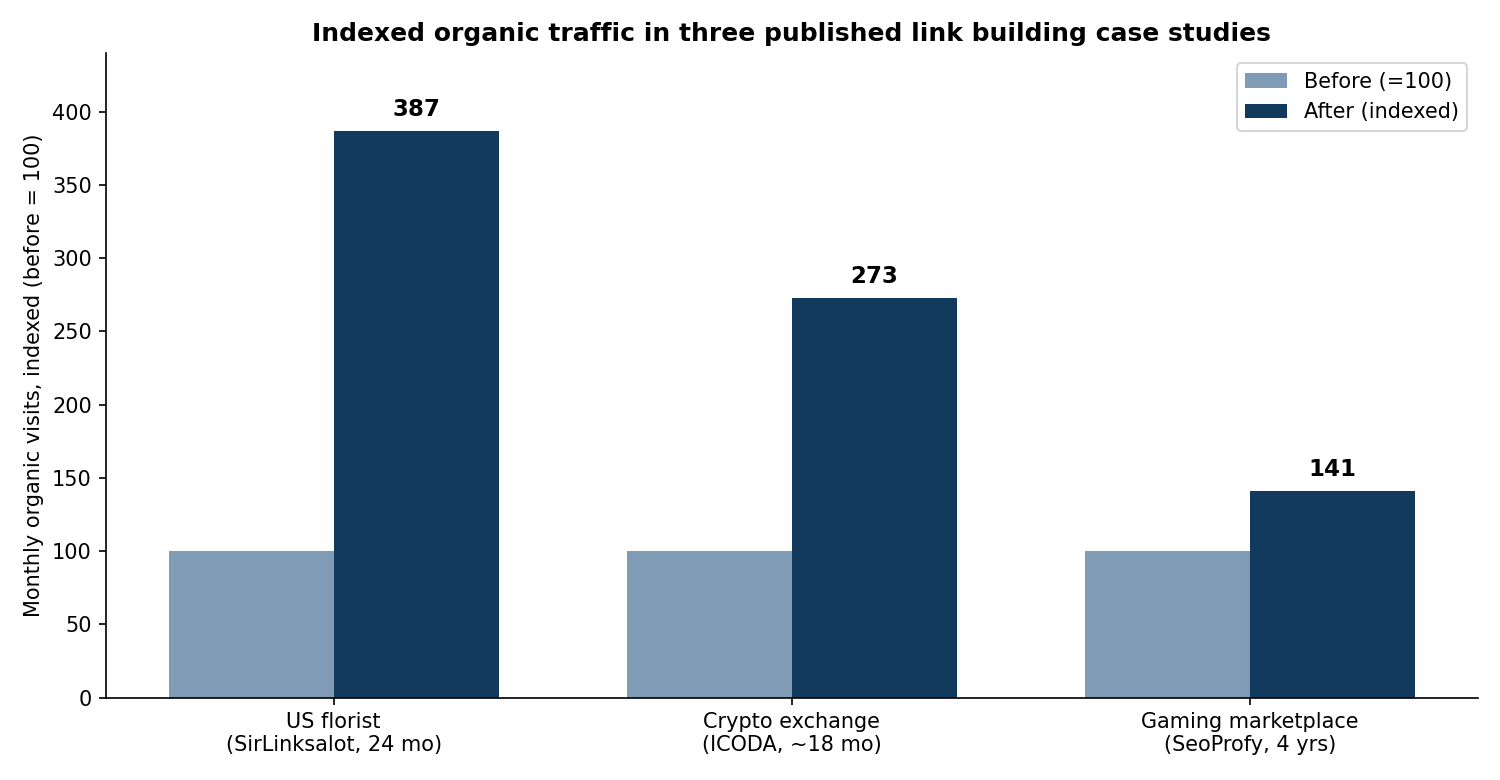
SirLinksalot published a 24-month case study for an established US e-commerce florist. The site started in May 2024 with a Domain Rating of 19, 180 referring domains, 577 keywords in the top three results, and about 37,500 monthly organic visits. Roughly 46% of its existing backlinks came from automated image-scraper sites, which added bulk but little authority. By April 2026, Domain Rating had risen to 34, referring domains to more than 2,100, top-three keywords to 2,900, and monthly organic traffic to about 145,000.
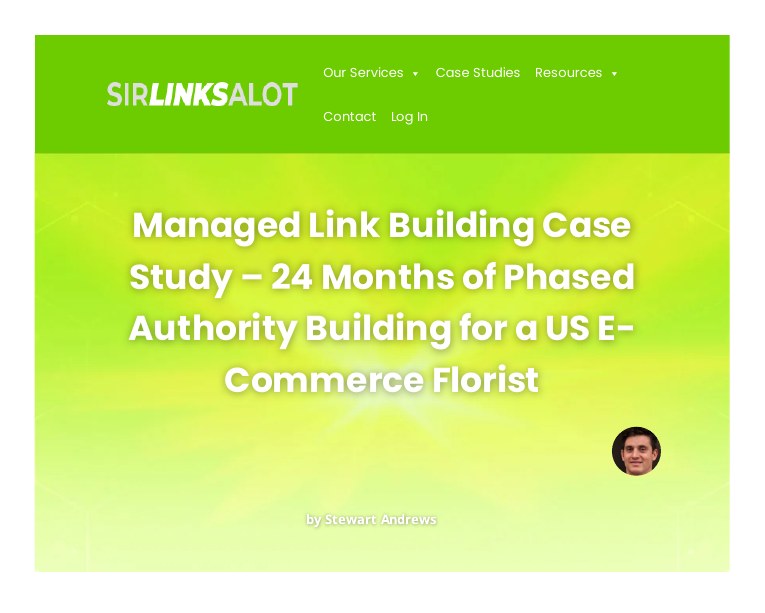
The honest detail is the timeframe. This was two years of continuous work, not a quick win, and the early audit mattered as much as the links: cleaning up a profile padded with scraper links came before new links could do their best work. It also shows why a single metric misleads. Domain Rating rose by only 15 points while traffic nearly quadrupled, because Domain Rating measures the strength of a link profile on a logarithmic scale, not traffic itself.
A crypto exchange: growth with a setback in the middle
ICODA’s case study for Godex.io, a no-KYC crypto exchange, covers roughly a year and a half of link building, content expansion, and demand generation. Monthly organic traffic rose from 7,551 visits to 20,634, a 2.7-fold increase, while referring domains grew 66%, from 2,510 to 4,177, and conversions rose 24% year on year. Mid-campaign, the site’s Domain Rating dipped from 65 to 60 before recovering to 65.
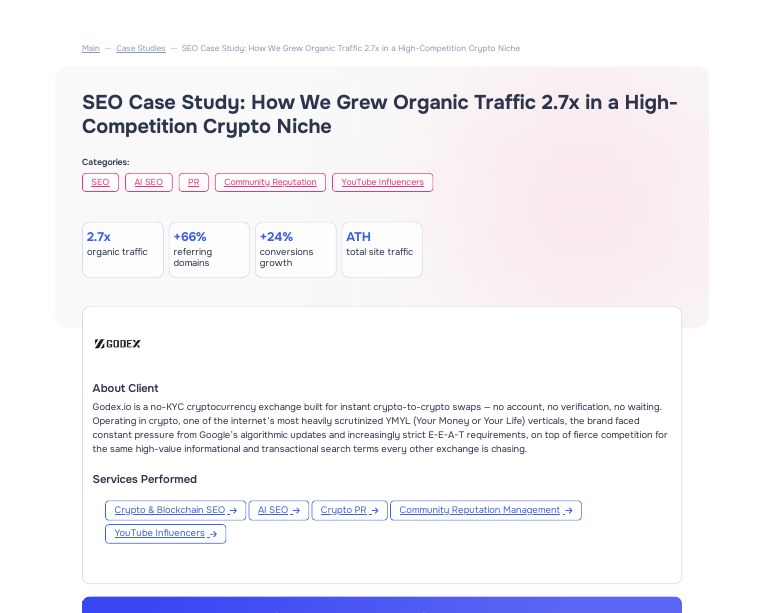
That dip is the most believable part of the report. Real campaigns wobble. A case study with no setback, no flat month, and no change of plan deserves more doubt, not less. This example also shows that link building was only one part of the work: content and multilingual expansion ran alongside it, so the traffic gain cannot be credited to links alone.
A gaming marketplace: 40% growth over four years
SeoProfy’s case study for a gaming marketplace reports organic traffic growth of 40% in the first year, from 380,000 to 535,919 monthly visits over four years, with 331 high-quality links built and referring domains rising from 60 to 391. Top-three keyword rankings rose from 3,600 to 14,200.
The timeframe is the point again. A 40% gain spread over four years is a very different claim from the same gain in four months, and it is far more plausible. When a case study gives no dates, treat its percentages as decoration. When it gives dates, a baseline, and the link count together, you can start to judge whether the pace of work matches the size of the result.
How to judge a link building case study in five checks
Use these checks on any case study an agency sends you, including ours. A strong report passes all five. A weak one fails at the first question you ask.
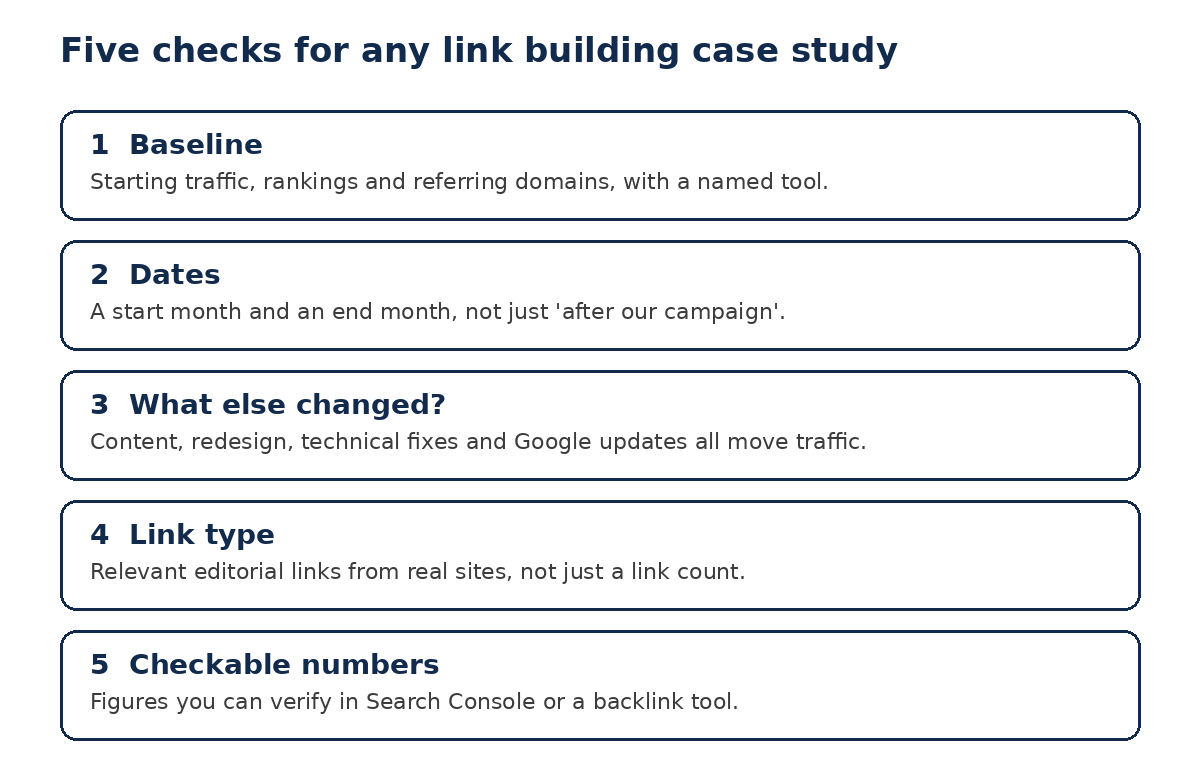
First, is there a baseline? You need the starting traffic, rankings, and referring domains, measured with a named tool. Without a baseline, no percentage can be checked.
Second, are the dates clear? A result over two years and the same result over two months are different achievements. Look for a start month and an end month, not just “after our campaign”.
Third, what else changed? Content publishing, a redesign, technical fixes, and Google updates all move traffic. A report that never mentions them is hiding the most likely alternative explanation.
Fourth, what kind of links were built? Relevant editorial links from real sites with their own traffic are worth far more than directory submissions or links from unrelated blogs. Ask for the type of sites, not just the count.
Fifth, can the numbers be checked? Traffic figures from Ahrefs or a similar tool are estimates, and honest reports say so. Rankings, referring domains, and indexed pages can all be checked in Search Console or a backlink tool. If every number comes only from the agency’s own spreadsheet, ask why.
Red flags that should stop you
Some claims are not just weak, they are warnings. A promise of a specific ranking position, such as “number one in 30 days”, is not a case study at all, it is a sales claim no honest agency can guarantee, because rankings depend on competitors, updates, and the site itself. A report that shows only traffic, with no link or ranking data, may be showing the effect of a seasonal peak or a viral page rather than link building. And a report that never names a single linking site, publication, or method is asking you to trust a result you cannot inspect.
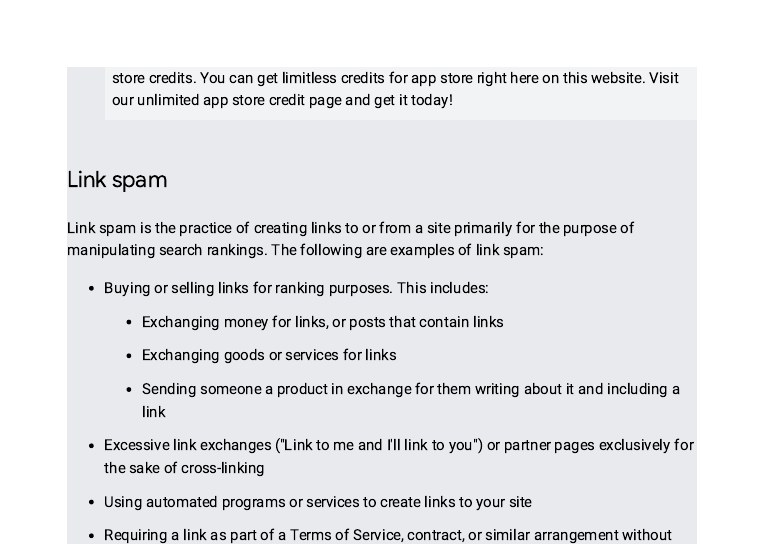
Google’s own rules set the boundary here. Its spam policies define link spam as creating links mainly to manipulate rankings, and list buying or selling links for ranking purposes, excessive link exchanges, and automated link creation as examples. Paid links must be qualified with rel=”sponsored” or rel=”nofollow” so they do not pass ranking credit. Any case study built on links that break those rules is a liability, not an asset: Google may simply ignore the links, or in serious cases take manual action against the site.
What a good case study means for your own site
A case study is not a promise, it is a pattern to learn from. The pattern across the examples above is consistent: steady work over months or years, links from relevant real sites, a clean starting profile, and content and technical work running alongside. The florist gained the most in percentage terms after two years. The exchange grew through a mid-campaign dip. The marketplace grew 40% over four years. None of them suggests that a handful of links will transform a site in a month.
If you are comparing agencies, ask each one for a case study that passes the five checks above, in your niche if possible, with dates and a baseline. Then check one claim yourself: open the linking sites, read the pages, and see whether a real reader would find them useful. That ten-minute check tells you more than any headline percentage.
For a closer look at how manual, editorial link building works in practice, see our manual link building services, built on outreach to real sites, with no private blog networks and no automated link schemes.
Frequently asked questions
What is a link building case study?
A link building case study is a report on a real campaign that shows a site’s starting position, the links earned, and the change in traffic, rankings, and referring domains over a stated period. The best ones name their measurement tool, give dates, and admit what else changed at the same time. Reports without a baseline or dates cannot be checked and should not guide a buying decision.
How long does a link building case study usually cover?
Honest examples usually cover many months or years. The published cases in this guide span roughly eighteen months to four years, and their gains arrived gradually rather than in a single jump. A report claiming a dramatic result in a few weeks, with no explanation of a seasonal peak or a site change, deserves careful questioning before you believe it.
What numbers matter most in a link building case study?
Referring domains from relevant sites matter more than total backlinks, because one site linking a hundred times is one endorsement, not a hundred. Traffic and top-three keyword rankings matter more than Domain Rating alone, since authority scores move on a different scale from traffic. Always look for the baseline next to the result, so a percentage can be turned back into real visits.
Can a case study prove that links caused the rankings to rise?
No, not on its own. Rankings move for many reasons, including new content, technical fixes, competitor changes, and Google updates, and most case studies do not isolate links from those factors. Large studies show a correlation between referring domains and traffic, but correlation is not causation. Treat a case study as supporting evidence for a method, not proof that the same result will repeat for you.
Should I trust a case study that does not name its client?
An unnamed client is common, since many businesses do not want competitors to see their strategy, and it is not a reason to dismiss a report on its own. It does raise the bar for everything else: dates, baselines, link types, and checkable numbers must be stronger when the client cannot be verified. If a report hides both the client and the method, there is nothing left to check.
Is it risky to buy backlinks to copy a case study’s results?
Yes. Google’s spam policies treat links bought mainly to manipulate rankings as link spam, and paid links must be qualified with rel=”sponsored” or rel=”nofollow” so they pass no ranking credit. Copying a case study by paying for unqualified links risks those links being ignored, or manual action against your site. The safe route is earning editorial links from relevant sites, which is slower but does not put the site at risk.

Abdullah Zulfiqar is Co-founder and Client Success Manager at RankWithLinks, an SEO agency helping businesses grow online. He specializes in client relations and SEO strategy, driving measurable results and maximizing ROI through effective link-building and digital marketing solutions.