
1. Introduction: The Death of Guesswork in Link Building
The traditional link-building market is broken. For years, search engine optimization (SEO) agencies, software-as-a-service (SaaS) founders, and affiliate marketers have relied on a flawed currency: Domain Authority (DA) and Domain Rating (DR). These proprietary third-party metrics were originally built as crude proxies for Google’s PageRank. Today, they have morphed into highly manipulated numbers.
In any low-cost link marketplace, it is trivial to buy a backlink on a domain with a DR of 70+. Yet, a quick look at its organic search profile reveals a harsh reality: the site has zero organic traffic, ranks for no meaningful keywords, and has been systematically decimated by recent Google core updates.
This metric manipulation has led to a major crisis in off-page SEO. Buying links from public guest post sheets or static link databases does not build authority; it creates a massive footprint. Google’s algorithms, powered by advanced AI-driven systems like SpamBrain, have become highly sophisticated at detecting patterns of unnatural link placement. When a domain exists solely to sell outbound links—exhibiting an artificially inflated outbound link velocity and no real editorial standards—any backlink acquired from it acts as a negative ranking signal.
If you want to rank for highly competitive search terms in 2026, you must eliminate the guesswork. You cannot afford to build links on dead pages and hope for the best.
This is where the concept of serp insight link insertion comes in. Instead of placing links on brand-new, unindexed guest posts or arbitrary pages within low-quality networks, this strategy focuses on inserting contextual backlinks into existing, high-ranking, topically relevant articles that Google already crawls, trusts, and indexes.
By analyzing real-time search engine results page (SERP) data, you can identify pages that already rank in the top 10 or top 20 for your target keywords or closely related terms. Acquiring a link on a page that already drives search impressions and matches your desired search intent alignment allows you to leverage historical trust and immediate authority.
At RankWithLinks, we have spent years engineering a manual, relationship-driven outreach process designed specifically to secure these high-value contextual placements. This guide provides the complete, technical blueprint for executing a SERP-driven link insertion strategy that satisfies Google’s Helpful Content standards, minimizes algorithmic risk, and drives scalable organic search rankings.
2. What is SERP Insight Link Insertion?
At its core, a serp insight link insertion is a data-first approach to contextual link building. While traditional link insertion (often referred to as a “niche edit” or “curated link”) involves placing a backlink within the body of an existing article, a SERP-driven insertion elevates this process by using live search engine data to guide the placement.
Instead of targeting a website based on its homepage domain metrics, a SERP-driven strategy targets the specific URL that is already ranking for a relevant search term.
How a “SERP-Driven” Placement Differs from a Standard Niche Edit
Standard niche edits are typically commoditized. A broker maintains a database of websites that accept paid links. When an agency orders a link, the broker searches their database for a matching category, finds an old post on a partner site, and inserts the anchor text. The primary problem is that the selected page is often deeply buried in the site architecture, has zero internal link support, receives no organic impressions, and possesses no page-level authority.
In contrast, a SERP-driven link insertion is entirely dynamic. The process begins with the search query itself. By analyzing the top 100 search results for a target term, we identify high-performing URLs owned by independent bloggers, industry publications, or non-competing businesses. Because these pages already rank, they have proven their topical authority directly to Google’s ranking systems.
| Feature / Metric | Standard Niche Edit (Database-Driven) | SERP-Driven Link Insertion (RankWithLinks) |
|---|---|---|
| Vetting Level | Domain-level metrics only (DA/DR) | URL-level performance (Live rankings & traffic) |
| Indexation State | Often cached but rarely crawled frequently | Highly active, crawled weekly or daily by Googlebot |
| Topical Proximity | Broad category match (e.g., Business) | Exact semantic alignment with target keyword |
| Outbound Link Profile | High density of outgoing commercial links | Clean, editorial profile with selective outbound links |
| Acquisition Footprint | High (Sites are part of public link broker networks) | Virtually zero (Custom-negotiated manual outreach) |
| Referral Traffic Potential | Extremely low to non-existent | High (Placed on pages with active user visits) |
The Core Mechanics: How Search Engines Value Existing Content
To understand why search engines place a premium on link insertions within already-ranking content, we must look at the underlying mechanics of modern indexing.
When a new page is published (such as a standard guest post), it must go through Google’s entire crawl and evaluation pipeline:
[New Guest Post Published] │ ▼[Added to Crawl Queue] │ ▼[Initial Rendering & Extraction] │ ▼[Quality & Originality Filtering] │ ▼[Indexing / Sandbox Evaluation] │ ▼[PageRank Accumulation (Requires external backlinks to that page)]
This pipeline can take weeks, or even months, to process. Furthermore, a newly indexed page starts with an initial PageRank of zero. Until that specific guest post page acquires its own backlinks, the amount of authority it can pass through its outbound links to your target page is minimal.
A serp insight link insertion completely bypasses this friction by leveraging already-indexed pages. When you insert a link into a page that already ranks:
- Immediate PageRank Flow: The host page has already accumulated internal and external authority. The moment Google recrawls the page and detects the new outbound link, PageRank distribution occurs instantly.
- Topical Proximity Verification: Google has already categorized the host page and deemed it highly relevant for specific search terms. The link insertion inherits this established topical authority immediately, passing highly contextual relevance to your site.
- Crawl Frequency Advantage: Pages that rank well and receive organic traffic are crawled far more frequently than deep-level archive pages. This ensures your backlink is discovered and indexed rapidly, often within 48 to 72 hours of placement.
Imagine you are trying to rank a page for the keyword “best enterprise CRM software”.
- Scenario A: You publish a guest post on a DR 50 general tech blog. The page is new, gets 0 traffic, and is buried 4 clicks deep from the homepage.
- Scenario B: You secure a link insertion on a page that currently ranks position #4 on Google for the search term “how to scale enterprise sales tools”. The page has been live for three years, gets 1,200 organic visits monthly, and already has 12 external domains linking to it.
Scenario B passes significantly more powerful ranking signals because search engines have already validated the trust, relevance, and value of that specific host URL.
3. The Technical SEO Benefits of Link Insertions vs. Guest Posts
While guest posting remains a viable strategy for top-of-funnel brand visibility, relying solely on it for ranking high-competition commercial keywords is inefficient and expensive. Let’s break down the technical SEO reasons why targeted link insertions offer a far superior return on investment.
1. Zero Crawl Latency (Immediate Indexation)
Crawl latency is the time delay between when a link is published and when Google actually crawls, indexes, and applies that link to its ranking algorithms.
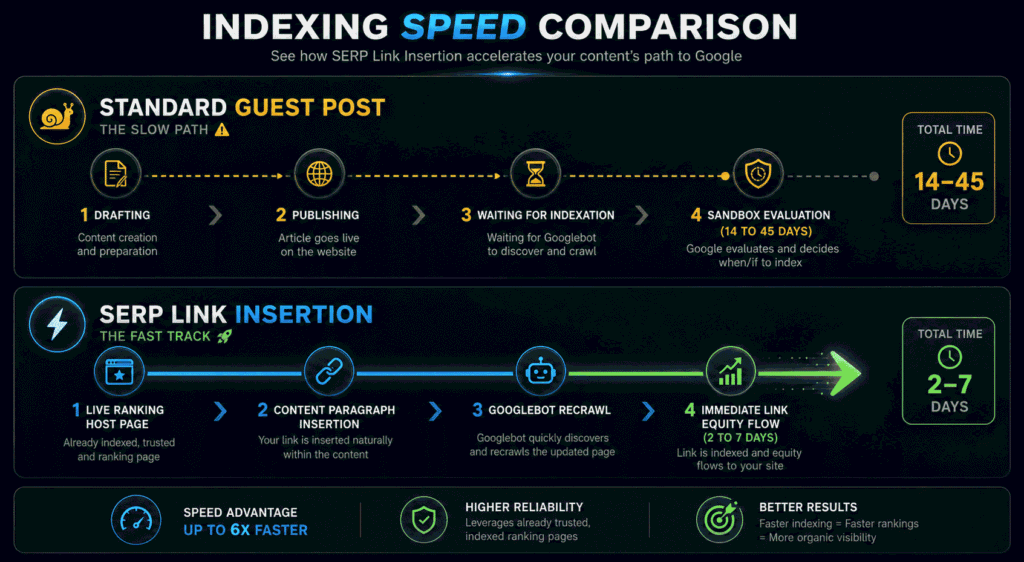
For new guest posts, crawl latency is at an all-time high. Because of the sheer volume of AI-generated content flooding the web, Google has tightened its crawl budget allocation. Search engines are highly selective about which new pages they index. It is common for guest posts to remain in a “crawled – currently not indexed” state indefinitely.
With a SERP-driven link insertion, crawl latency is practically zero. Because the host URL is already ranking and driving impressions, Googlebot prioritizes it for frequent recrawling. When we secure a placement, the site owner makes a minor update to the HTML of an active page. During the next routine crawl, Googlebot detects the content update and the new contextual anchor text, passing ranking authority to your site almost immediately.
2. Built-In Historical Trust (Page-Level Authority)
Google’s ranking systems do not just evaluate links in real-time; they evaluate the historical performance of the page hosting the link. This is known as historical trust signals.
A page that has ranked in the top 20 of search engine results for multiple years has built up a strong history of positive user interaction signals (high dwell time, low bounce-back-to-SERP rates, and consistent click-through rates). When this trusted page links to your site, Google views it as an editorial recommendation from an established authority.
A new guest post has no historical trust. It is an unproven entity. If the site hosting the guest post has a history of publishing low-quality, high-frequency promotional content, Google’s algorithms may apply a lower trust weight to the entire directory, rendering your guest post link virtually useless.
3. The Information Gain Factor
In April 2020, Google was granted a patent titled “Contextual Estimation of Link Information Gain.” This patent fundamentally changed how search engines evaluate the value of backlinks.
[Google's Information Gain Patent] │ ┌────────────────────────┴────────────────────────┐ ▼ ▼[Does the linking page add [Is the link directing theunique, non-duplicate value?] user to a deeper resource?] │ │ └────────────────────────┬────────────────────────┘ ▼ [High Information Gain Score] │ ▼ [Maximum PageRank/Trust Transfer]
The Information Gain patent describes a system that estimates the likelihood that a user will find new, non-duplicative information by clicking a link. If a guest post simply rehashes the same information already found in the top 10 search results, its Information Gain score is extremely low, and the value passed through its outbound links is mitigated.
When we execute a serp insight link insertion, we carefully optimize the copy surrounding the backlink (what we call the “micro-context”). By writing 2 to 4 sentences of highly specific, original value-add copy that expands on the host page’s existing content, we drastically increase the page’s Information Gain score. When Googlebot indexes the update, it recognizes that the article has become more comprehensive and helpful to users, rewarding both the host page and your linked page with a boost in topical authority.
4. The Reasonable Surfer Model
Under Google’s classic PageRank model, every link on a page passed an equal share of authority. If a page had a PageRank of 10 and contained 10 links, each link passed a value of 1.
This was replaced by the Reasonable Surfer Model (US Patent 7,716,216). Under this model, the amount of PageRank passed through a link is directly proportional to the probability that a human user will actually click on it.
Google uses visual and behavioral features to determine click probability, including:
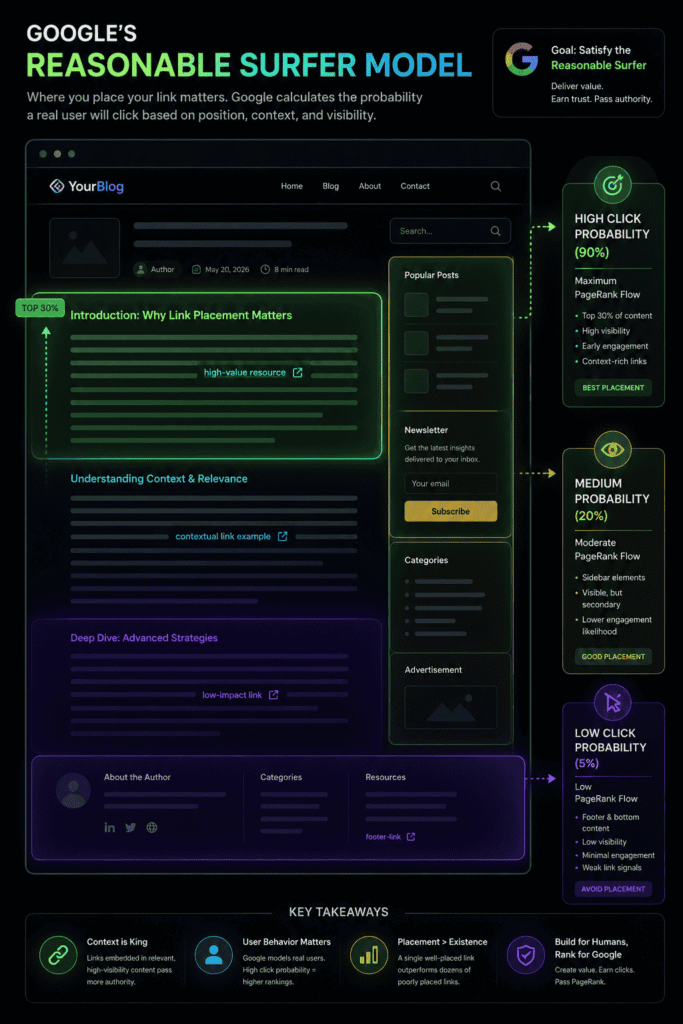
- Link Position: Links placed high up in the main body content pass significantly more value than links placed in the footer, sidebar, or author bio.
- Formatting: Font size, color, contrast, and style elements that draw the eye.
- Contextual Relevance: The semantic relationship of the surrounding text to the anchor text.
When executing a SERP-driven insertion, we ensure the link is placed naturally in the upper half of the existing article, surrounded by highly engaging, contextually relevant text. This guarantees a high probability of user interaction under the Reasonable Surfer Model, resulting in the maximum possible transfer of authority.
4. The Dangerous Pitfalls of Static Link Databases
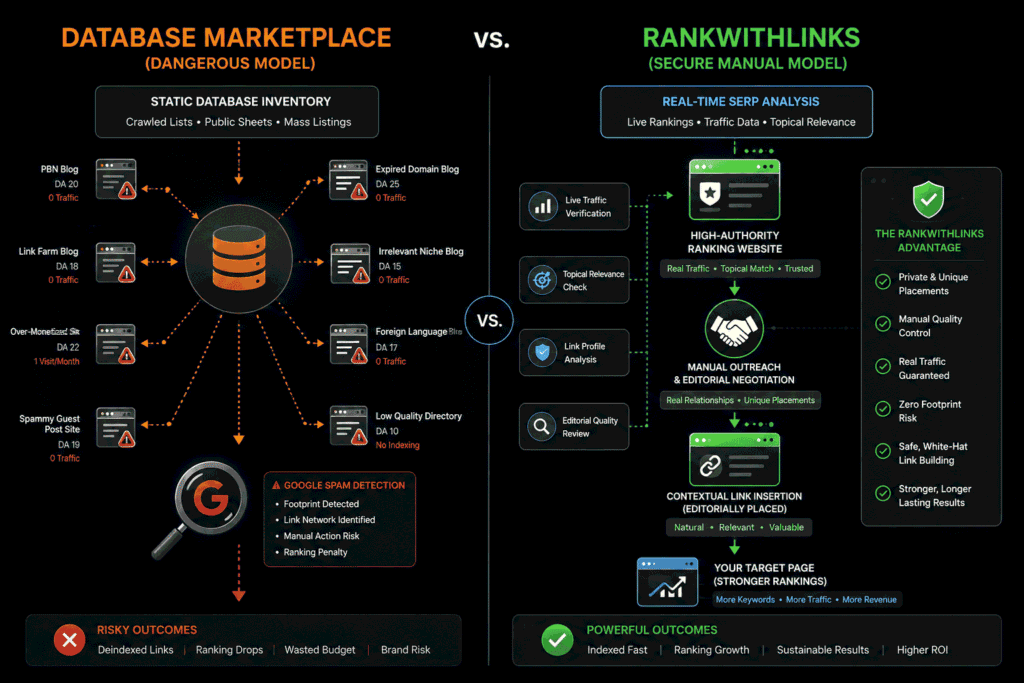
Many link-building agencies and marketplaces operate on a database model. They build a list of thousands of websites that have agreed to sell guest posts or link insertions. The agency then displays these sites in an open marketplace, allowing users to filter by DA, DR, and price.
While this model is convenient for the broker, it is incredibly risky for the buyer. Here is why static link databases are a ticking time bomb for your organic rankings.
The “Public Sheet” Penalty: How Google Flags Over-Harvested Domains
The primary issue with static link databases is that they are entirely public or easily accessible by competitors and search engines alike. Google’s webspam team actively signs up for these marketplaces, harvests the list of domains, and flags them in their internal systems.
When a domain is flagged as an over-harvested link vendor, Google does not necessarily issue a manual action in Search Console. Instead, it silently devalues all outbound links from that domain. You spend hundreds of dollars buying a “DR 70 niche edit,” only for Google’s algorithms to completely ignore the placement.
Furthermore, sites in these databases exhibit a highly unnatural outbound link velocity. Because the site owner is monetizing their platform, they publish dozens of outgoing links every week across wildly unrelated niches (e.g., linking to a personal injury lawyer, a crypto site, and a home decor blog from the same general article). This massive outbound link footprint is incredibly easy for Google’s SpamBrain AI to detect and neutralize.
Inflated Metrics (DA/DR) vs. Real Organic Search Impressions
Third-party metrics are incredibly easy to manipulate. Spammers frequently use expired domains with high legacy authority, build spammy automated redirect chains to inflate their DR/DA, and sell links based on those artificial numbers.
To protect your brand, you must look beyond these vanity metrics. Real authority is determined by active search visibility and organic impressions.
⚠️ Warning Signs Checklist for Link Farm Domains
If a domain exhibits any of the following characteristics, it is likely a link farm that should be avoided at all costs:
- The “Write for Us” Footprint: The website has a prominent page dedicated to selling guest posts or link insertions (e.g.,
/write-for-us/,/submit-an-article/,/guest-post-guidelines/). - Wild Topical Incoherency: The blog publishes articles on completely unrelated topics (e.g., writing about “b2b lead generation” one day and “how to clean a swimming pool” the next).
- The Downward Traffic Slope: Ahrefs or Semrush shows a steady, long-term decline in organic search traffic, signaling that the domain has been hit by Google quality algorithms.
- Unnatural Outbound-to-Inbound Ratio: The site has far more outbound links to commercial pages than it does high-quality inbound links from authoritative editorial sources.
- Keyword-to-Traffic Discrepancy: The site ranks for thousands of low-competition, informational keywords (often in foreign languages or irrelevant niches) but drives zero traffic to its primary commercial pages.
- Hidden Author Profiles: Articles are published by generic, non-existent authors with stock photos and no verifiable professional experience in the industry.
[STATIC DATABASE APPROACH] [RANKWITHLINKS MANUAL APPROACH]┌───────────────────────────────────────┐ ┌───────────────────────────────────────┐│ • Open marketplace / public lists │ │ • Zero public inventory / footprint ││ • Highly manipulated DR/DA metrics │ │ • Strict verification of real traffic ││ • Massively inflated outbound links │ │ • Selective, editorial placements ││ • Ignored by Google SpamBrain algorithms│ │ • Natural, contextually rich anchors │└───────────────────────────────────────┘ └───────────────────────────────────────┘
5. The RankWithLinks Vetting Standard: 6 Metrics That Matter
To solve the link quality crisis, RankWithLinks has developed a strict vetting framework. Every single URL we target for a serp insight link insertion must pass our rigorous 6-point verification process. We do not rely on third-party metrics; we look at the real-world health and authority of the host URL and domain.
[The RankWithLinks Vetting Standard] │ ┌───────┬───────┬───────────┴───────────┬───────┬───────┐ ▼ ▼ ▼ ▼ ▼ ▼Traffic OLR Topical Anchor Crawl Editorial Slope Ratio Proximity Spam Freq Integrity
Metric #1: The Organic Traffic Slope
A website’s organic traffic history is the most honest reflection of its health in Google’s eyes. We analyze the last 24 months of organic search traffic using Ahrefs or Semrush.
- The Requirement: The host domain must have a stable or upward traffic trajectory.
- The Filter: Any site showing a sudden, permanent drop of 50% or more in traffic is immediately blacklisted. This downward slope indicates that Google has identified the domain as possessing low-quality content, and any link from it could pass negative ranking signals.
Metric #2: Outbound-to-Inbound Link Ratio (OLR)
We calculate the Outbound Link Ratio to ensure the host page is not being used as a commercial link exit page.
OLR=Number of Referring Domains Linking to the PageNumber of Outgoing Links to Commercial Domains
- The Requirement: The host domain must have a healthy balance of incoming link equity compared to outgoing commercial links.
- The Filter: If a specific page contains more than 3 outgoing commercial links without a proportionate number of internal and external incoming links, we reject it. This protects the PageRank distribution of your placement.
Metric #3: Topical Proximity & Contextual Fit
Search engines use semantic vector space models to understand how closely related two pieces of content are. We evaluate topical proximity on two distinct levels:
- Domain-Level Relevance: The overall theme of the website hosting your link must be logically aligned with your industry (e.g., a software tool should be linked from a technology, business, or marketing blog).
- Page-Level Relevance: The specific host URL must cover a topic that is directly relevant to your target page. If you are linking to an “e-commerce email platform,” the host page should cover topics like e-commerce growth, marketing automation, or customer retention strategies.
Metric #4: Anchor Text Distribution & Spam History
Before securing a placement, we audit the existing anchor text profile of the host domain and the specific URL.
- The Filter: If the host page ranks for spammy, highly commercial keywords in foreign languages, or exhibits an unnatural density of exact-match commercial anchor texts (e.g., “buy cheap essay online”), it is instantly rejected. We only work with domains that maintain a clean, natural anchor profile dominated by branded and descriptive navigational links.
Metric #5: Indexation Frequency
A link is only valuable if Googlebot actively crawls it. We verify how often the target URL is indexed.
- The Verification: We check Google’s cache date for the specific page. If the page has not been cached or crawled in the last 30 days, it is a signal that the page has low search interest. We prioritize pages with a cache date of less than 7 days, indicating high crawl frequency and immediate link-equity transfer.
Metric #6: Editorial Integrity
We look at the overall design, user experience, and publishing standards of the target site.
- The Standard: Real websites have active social media channels, comprehensive “About” pages, contact details, clear privacy policies, and real editorial oversight. If a site features poorly formatted articles, lacks an editor’s bio, or has no physical business presence, it fails our editorial integrity check.
6. How We Do It: Custom Manual Outreach vs. Automated Databases
The difference between buying a link from a standard database and partnering with RankWithLinks for a serp insight link insertion is like night and day. We do not maintain a database of “partner sites” that sell links. Instead, we operate as a custom outreach agency, executing real-time digital PR campaigns for every client.
Comparison: RankWithLinks Custom Acquisition vs. Competitor Databases
| Step in the Process | Automated Link Databases | RankWithLinks Custom Manual Outreach |
|---|---|---|
| 1. Site Selection | Pick from a static, public list of sites. | Fresh SERP scraping based on your target keywords. |
| 2. Relationship Quality | Transactional, pre-negotiated paid agreements. | High-level editorial collaboration and value pitching. |
| 3. Link Placement | Context-free insertion of anchor text into old posts. | Writing custom, highly relevant paragraphs (micro-content). |
| 4. Security Standards | High footprint (Same sites sell links to everyone). | Secure, custom negotiation with zero public footprints. |
| 5. Indexation Monitoring | None (You have to manually submit URLs to indexers). | 30-day automatic indexation monitoring and verification. |
Our Quality Control & Paragraph Insertion Process
When we identify a high-ranking page that passes our 6 vetting metrics, we do not simply email the editor asking to place a commercial anchor text. That approach has a near-zero success rate on real, authoritative sites.
Instead, our editorial team analyzes the target page to find a logical content gap. We then write a custom, highly helpful paragraph of 50 to 80 words (micro-content) that perfectly fills this gap and provides a natural transition to your target URL.
Here is an example of our paragraph insertion process in action:
- Host Article Topic: “How to Scale a B2B SaaS Business” (Currently ranking #8 on Google, driving 3,000 monthly visits).
- Target Page to Link To: A comprehensive guide on “SaaS Customer Churn Reduction” on our client’s site.
- The Insertion Paragraph We Pitch:
“While acquiring new accounts is crucial for growth, long-term sustainability depends heavily on retention. In fact, even a minor reduction in customer drop-off can significantly boost your overall valuation. To manage this effectively, implementing a structured system for tracking user behavior and addressing churn early is essential. Using a specialized checklist can help you identify high-risk accounts before they cancel, protecting your monthly recurring revenue.”
(Link: specialized checklist -> pointing to client’s SaaS churn guide)
By proposing a complete, beautifully written paragraph that actively improves their article’s comprehensiveness and helpfulness, we achieve a high acceptance rate from premium editors. The link fits organically, provides immediate value to the reader, and carries a high click-through probability under the Reasonable Surfer Model.
7. Strategic Link Insertion Walkthrough: A Step-by-Step Guide
If you want to execute a SERP-driven link insertion campaign internally, follow this step-by-step technical workflow.
[THE STEP-BY-STEP WORKFLOW]┌───────────────────────────────────────┐│ Step 1: Scrape SERPs for Top 20 URLs │└───────────────────┬───────────────────┘ │ ▼┌───────────────────────────────────────┐│ Step 2: Vet Domains via Ahrefs/Semrush│└───────────────────┬───────────────────┘ │ ▼┌───────────────────────────────────────┐│ Step 3: Identify High-Traffic URLs │└───────────────────┬───────────────────┘ │ ▼┌───────────────────────────────────────┐│ Step 4: Write Custom Value Paragraph │└───────────────────┬───────────────────┘ │ ▼┌───────────────────────────────────────┐│ Step 5: Execute Value-First Outreach │└───────────────────────────────────────┘
Step 1: Identifying the Target Page Using SERP Intelligence
Start by listing your target keyword and its primary semantic variations. Use an API or manual scraping tool to extract the top 20 organic URLs ranking for these terms.
For example, if your target page is an article about “enterprise billing software”, scrape the top 20 results for:
- how to manage enterprise billing
- best corporate billing platforms
- enterprise invoicing challenges
Exclude direct competitors, major national news outlets (like Forbes or WSJ, which rarely update old articles for external links), and large forum sites (like Reddit or Quora). Focus on authoritative industry blogs, resource pages, and independent publications.
Step 2: Pitching Contextual Value to the Site Owner
When reaching out to the editor or site owner, you must lead with value. Do not send a generic email offering to pay for a link. Instead, highlight how their article can be improved.
📧 Real-World Value-First Outreach Template
Subject: Quick improvement for your "[Host Article Title]" articleHi [Editor First Name],I was reading your guide on "[Host Article Title]" while researching B2B billing trends, and I noticed it currently ranks on the first page of Google for relevant terms. It's an exceptionally detailed resource.I noticed that in section three, you discuss the challenges of managing global currency compliance. It's a huge pain point, but the section doesn't expand on how international sales tax structures (like VAT) impact this process.We recently published a highly detailed, interactive VAT compliance breakdown that explains exactly how enterprise finance teams can automate these calculations. I've drafted a brief, 2-sentence paragraph that explains this concept and integrates perfectly into your existing section:"Managing global invoicing becomes incredibly complex when accounting for international VAT and sales tax compliance. Integrating an automated tax calculation system is often necessary to avoid costly audit penalties."Would you be open to adding this quick update to your page? It would add some great practical value for your readers.Either way, thanks for putting together such a high-quality resource!Best regards,[Your Name] [Your Title & Brand]
Step 3: Engineering the Insertion
Once the editor agrees to the placement, ensure the HTML code is clean and properly formatted. Avoid adding irrelevant tracking parameters to the URL that might signal a footprint to Google’s SpamBrain algorithm.
Use standard, absolute URLs:
html<a href="https://yourbrand.com/enterprise-billing-guide">automated tax calculation system</a>
Ensure the anchor text is wrapped naturally inside the sentence. Do not make the anchor text an exact commercial keyword if it breaks the natural flow of the paragraph.
Step 4: Anchor Text Optimization
To keep your link profile completely natural and secure against algorithmic updates, you must maintain a diverse anchor text distribution.
Avoid over-optimizing with exact-match commercial anchors. If you are linking to a page about “best email software”, do not use the exact anchor “best email software” for every placement. Instead, use a mix of:
- LSI/Descriptive Anchors (60%): e.g., “streamlined email distribution platform”, “managing email outreach pipelines”
- Branded/Navigational Anchors (30%): e.g., “according to RankWithLinks”, “the RankWithLinks data-driven guide”
- Exact-Match Anchors (10%): e.g., “best email software”
Step 5: Monitoring Rankings and Indexation
After the link is placed:
- Force Crawling: Use an indexation check tool to verify if Google has crawled the host URL since the update was made.
- Track Keyword Movements: Monitor the organic ranking position of your target page for its primary keywords using tools like Ahrefs, Semrush, or AccuRanker.
- Monitor Link Status: Set up automated alerts to verify that the link remains live, does not acquire a
nofolloworsponsoredtag, and the host page is not deleted.
8. Frequently Asked Questions
Is SERP Insight link insertion safe?
Yes. Unlike automated database link buying, which creates a massive footprint, a SERP-driven link insertion acquired via manual outreach is one of the safest off-page SEO strategies available. Because the link is placed within high-quality, editorially managed content that Google already trusts, it perfectly mimics a natural editorial recommendation.
How long does it take to see ranking improvements from a link insertion?
Because the host page is already indexed and crawled frequently, search engines typically discover the link update within 48 to 72 hours. You can expect to see initial ranking movements and authority transfer within 7 to 14 days, compared to guest posts which can take 30 to 90 days.
What is the ideal word count for the copy surrounding a link insertion?
The copy surrounding the link (the micro-context) should be between 30 and 80 words. Writing a complete paragraph of 2 to 4 sentences ensures the placement fits naturally into the existing article and provides high contextual relevance, maximizing its value under Google’s Reasonable Surfer Model.
Why are link databases dangerous for SEO?
Static link databases are public inventories that are easily crawled and blacklisted by Google’s webspam team. Domains in these databases typically display a highly unnatural outbound link velocity, zero organic traffic, and a history of monetizing outbound links, which can result in algorithmic penalties or silent devaluation of all outbound links.
How does Google’s SpamBrain impact link insertions?
Google’s SpamBrain is an AI-based system designed to identify manipulative link-building patterns. It looks at factors like sudden changes in outbound link frequency, poor topical relevance between linking pages, and unnatural anchor text distribution. By focusing on manual outreach and securing links on pages with active organic traffic, you ensure your link profile remains completely natural and secure against SpamBrain updates.
What is the difference between a niche edit and a link insertion?
While the terms are often used interchangeably, a standard niche edit is typically purchased from a static database of pre-partnered sites. A serp insight link insertion is a custom-negotiated placement secured specifically on a page that currently ranks on Google’s first page for your target keywords or closely related terms, ensuring maximum topical authority and live traffic.
Do link insertions pass more PageRank than guest posts?
Frequently, yes. A new guest post begins with a page-level PageRank of zero. It must acquire its own external backlinks to pass meaningful authority. A link insertion is placed on a page that is already integrated into the site’s internal link architecture and has historical trust, allowing it to pass immediate, established PageRank.
How many link insertions do I need to rank on the first page?
This depends on the keyword difficulty of your target search term. For low-to-medium competition terms, 2 to 4 premium, SERP-vetted link insertions are often enough to drive significant ranking boosts. For highly competitive commercial terms, a sustained monthly campaign of 5 to 10 manual placements is typically recommended.
How do you guarantee link placements are permanent?
At RankWithLinks, we build genuine editorial relationships with site owners. Every placement we secure is negotiated for the lifetime of the article. In the rare event that a site owner deletes the page or modifies the link within 12 months, we provide a replacement placement on a page of equal or greater traffic and authority at no extra cost.
Should I combine link insertions with guest posting?
Yes. A balanced, natural backlink profile should include a mix of high-authority contextual link insertions for immediate ranking power, high-editorial guest posts for brand visibility, and digital PR for broad-scale authority signals.
9. Conclusion: Scalable Rankings Without Algorithmic Risk
The era of building links based on vanity metrics like DA/DR is over. To rank for high-competition commercial keywords in 2026, your off-page SEO strategy must be built on real search engine data, contextual relevance, and editorial safety.
By targeting already-indexed, high-ranking pages using serp insight link insertion, you leverage historical trust, immediate crawl priority, and established PageRank. This data-driven approach allows you to bypass the lengthy crawl delays of guest posting and secure immediate authority transfer that directly satisfies Google’s Reasonable Surfer Model and Information Gain requirements.
Stop wasting your marketing budget on public link sheets, dead PBNs, and low-traffic databases that place your brand at risk of manual penalties. Partner with RankWithLinks to build a secure, scalable, and high-ROI backlink profile through premium, manually negotiated contextual placements on real, traffic-driving websites.
🚀 Scale Your Topical Authority Today
Ready to dominate the search engine results pages with premium, manual link insertions? Our team of SEO strategists and outreach experts is ready to secure high-authority placements on pages that currently rank for your target keywords.
👉 Get in Touch with our Outreach Team to request a custom SERP analysis and begin scaling your rankings safely.

Abdullah Zulfiqar is Co-founder and Client Success Manager at RankWithLinks, an SEO agency helping businesses grow online. He specializes in client relations and SEO strategy, driving measurable results and maximizing ROI through effective link-building and digital marketing solutions.