
Introduction
The rise of artificial intelligence (AI) is transforming how people live in their homes. In India, smart homes using AI are opening up new possibilities by integrating advanced technologies into everyday living. Devices such as smart lights, voice assistants, security cameras, and automated appliances are making homes more convenient, secure, and energy-efficient.
With increasing internet penetration, affordable smart devices, and growing awareness of automation technologies, India is witnessing rapid adoption of smart home systems. AI enables these systems to learn user behavior and make intelligent decisions, creating a seamless and personalized living experience.
Understanding Smart Homes
A smart home refers to a residence equipped with interconnected devices that can be controlled remotely through smartphones, voice commands, or automated systems. These devices are typically connected through the Internet of Things (IoT), allowing them to communicate with each other.
Artificial intelligence enhances smart homes by enabling devices to learn from user habits. For example, AI systems can automatically adjust lighting, regulate room temperature, or activate security systems based on daily routines.
Common smart home devices include:
- Smart lighting systems
- Smart thermostats
- Smart speakers and voice assistants
- AI-powered security cameras
- Smart locks and doorbells
- Connected home appliances
These technologies work together to provide convenience, safety, and efficiency.
Technologies Powering Smart Homes
Several advanced technologies make AI-powered smart homes possible.
Internet of Things (IoT)
IoT connects devices such as lights, appliances, and security systems through the internet. This allows homeowners to control and monitor devices remotely.
Voice Assistants
Voice assistants like Amazon Alexa and Google Assistant allow users to control devices using voice commands. For example, users can turn off lights, play music, or adjust temperature simply by speaking.
Machine Learning
Machine learning enables devices to learn patterns from user behavior. Over time, the system becomes more efficient and personalized.
Computer Vision
AI-powered security cameras use computer vision to detect motion, recognize faces, and identify suspicious activities.
Smart Home Market Growth in India
India’s smart home market is expanding rapidly due to technological advancements and rising consumer demand.
Market Growth Data
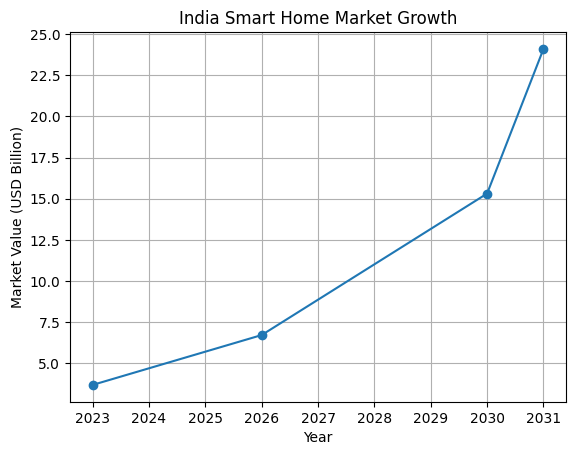
According to industry estimates, the India smart home market was valued at USD 3.68 billion in 2023 and is projected to reach USD 24.1 billion by 2031. This represents massive growth driven by IoT, AI, and increased adoption of smart devices.
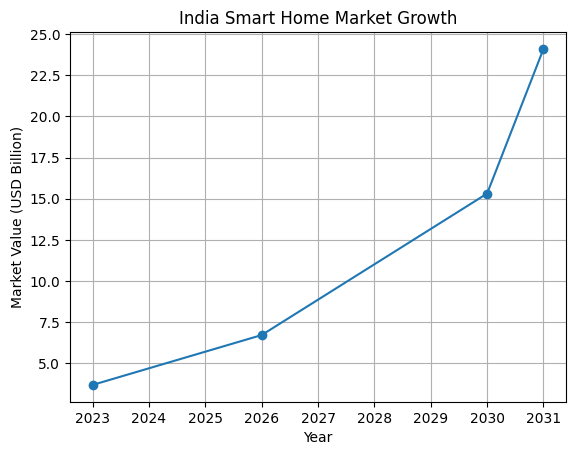
Graph 1: India Smart Home Market Growth
| Year | Market Value (USD Billion) |
|---|---|
| 2023 | 3.68 |
| 2026 | 6.71 |
| 2030 | 15.31 |
| 2031 | 24.1 |
Analysis
The graph shows a strong upward trend in market value. Between 2023 and 2031, the market is expected to grow more than six times, indicating strong demand for smart home solutions in India.
Key drivers of this growth include:
- Rising disposable income
- Increased smartphone penetration
- Smart city initiatives
- Affordable smart home devices
AI Smart Home Market Forecast
Artificial intelligence is expected to play an even larger role in the smart home ecosystem.
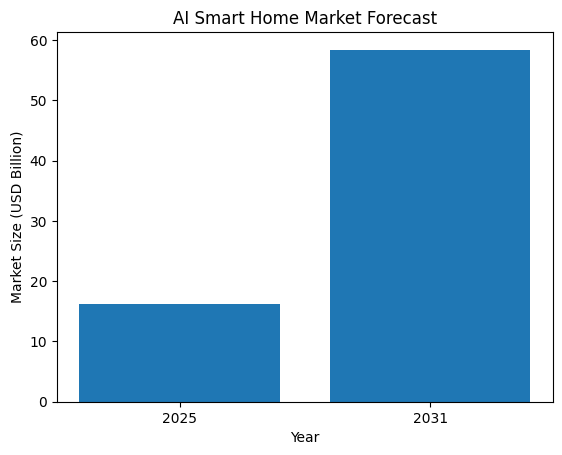
Graph 2: AI Smart Home Market Forecast
| Year | Market Size (USD Billion) |
|---|---|
| 2025 | 16.2 |
| 2031 | 58.4 |
Analysis
The forecast indicates that the AI smart home market could grow from USD 16.2 billion in 2025 to USD 58.4 billion by 2031. This rapid expansion highlights the increasing integration of AI technologies into home automation systems.
AI enables homes to:
- Automatically adjust energy usage
- Predict maintenance needs for appliances
- Enhance security through facial recognition
- Provide personalized automation experiences
Adoption of Smart Home Devices
Several types of devices are driving the adoption of smart homes across India.
Graph 3: Popular Smart Home Device Adoption
| Device | Adoption Trend |
|---|---|
| Smart TVs | 90% of TVs sold |
| Smart Speakers | Rapid growth |
| Security Cameras | Increasing adoption |
| Smart Lighting | Growing market |
Analysis
Smart TVs dominate the smart home ecosystem in India, with about 90% of televisions sold being smart TVs. These devices often serve as a gateway for users entering the smart home environment.
Other devices such as smart speakers, security cameras, and smart lighting systems are also becoming increasingly popular as consumers seek greater convenience and security.
Benefits of Smart Homes Using AI
Convenience
AI allows homeowners to control devices remotely and automate everyday tasks.
Energy Efficiency
Smart systems optimize electricity usage by adjusting lighting and temperature automatically, reducing energy costs.
Enhanced Security
AI-powered cameras and smart locks provide improved home security through motion detection, facial recognition, and real-time alerts.
Personalized Living
AI systems learn user habits and create a customized living environment, adjusting lighting, music, and temperature according to preferences.
Challenges Facing Smart Homes
Despite their benefits, smart homes face several challenges.
Privacy Concerns
Smart devices collect large amounts of data, raising concerns about personal privacy.
High Installation Costs
The initial cost of installing a complete smart home system can be expensive.
Device Compatibility
Different brands may use different systems, which can cause integration issues.
Cybersecurity Risks
Connected devices can be vulnerable to hacking if proper security measures are not implemented.
To mitigate these risks early in development, a SAST tool helps identify security vulnerabilities in the codebase, enabling developers to address issues before deployment and strengthen overall device security.
Future Possibilities of AI Smart Homes
The future of smart homes in India looks extremely promising. As technology advances and costs decrease, AI-powered homes will become more common.
Future developments may include:
- AI-based healthcare monitoring systems
- Fully automated kitchens
- Smart energy management using renewable energy
- Integration with smart city infrastructure
With continued advancements in AI, IoT, and 5G technology, smart homes will play a major role in shaping modern living environments.
Conclusion
Smart homes using AI in India are opening up new possibilities for the future of residential living. By integrating advanced technologies such as IoT, machine learning, and voice assistants, these homes offer greater convenience, security, and energy efficiency.
Market data and forecasts show that the smart home industry in India is poised for rapid growth in the coming years. As technology becomes more accessible and affordable, AI-powered tools smart homes are likely to become a standard feature in modern households across the country.

Abdullah Zulfiqar is Co-founder and Client Success Manager at RankWithLinks, an SEO agency helping businesses grow online. He specializes in client relations and SEO strategy, driving measurable results and maximizing ROI through effective link-building and digital marketing solutions.