
The landscape of online data collection has changed dramatically. In 2026, the best software for creating professional surveys goes far beyond simple question-and-answer forms. Modern survey platforms are powered by artificial intelligence, deeply integrated with business intelligence tools, and designed to deliver real-time, actionable insights at a speed and scale that was simply not possible a few years ago.
Whether you are a market researcher, a human resources professional, a university academic, a startup founder, or a customer experience manager, choosing the right survey creation software in 2026 is a strategic decision. The platform you select will determine the quality of your data, the efficiency of your workflow, and ultimately the accuracy of the decisions you make based on that data.
This comprehensive guide covers everything you need to know — the top platforms, the features that matter most, how to evaluate your options, and how to build surveys that people actually complete.
Why Professional Survey Software Has Never Been More Important
Data is the foundation of every smart business decision in 2026. Organizations that rely on guesswork are falling behind those that collect, analyze, and act on structured feedback continuously. Professional survey software has become a core part of the modern business intelligence stack, sitting alongside CRM systems, analytics platforms, and automation tools.
At the same time, respondent expectations have risen sharply. People are less willing than ever to sit through a long, poorly designed survey. Attention spans are shorter. Mobile usage is dominant. And privacy awareness has made many respondents cautious about sharing information without clear context and trust signals.
This means the best survey software in 2026 must do two things simultaneously — satisfy the sophisticated analytical needs of the organization collecting data and deliver an experience that feels respectful, fast, and worth completing for the person answering.
What Has Changed in Survey Software in 2026
Before reviewing specific platforms, it is worth understanding how the category has evolved. Several major shifts define the current generation of professional survey tools.
AI is now central, not optional. In 2026, artificial intelligence is embedded into virtually every leading survey platform. AI assists with question writing, detects bias in real time, generates entire survey drafts from a short prompt, analyzes open-ended responses through natural language processing, predicts completion rates, and surfaces insights automatically without manual analysis.
Conversational interfaces have gone mainstream. The old-fashioned, page-by-page form format is increasingly being replaced by conversational survey experiences that feel more like a natural dialogue. This shift has produced measurably higher completion rates across industries.
Voice and multimodal surveys are emerging. Several platforms now support voice-based responses, video answers, and image uploads as legitimate response formats. This opens entirely new possibilities for qualitative research.
Privacy and compliance requirements are stricter. GDPR, CCPA, and newer regional data protection laws have pushed survey software providers to build stronger consent management, data residency controls, and anonymization features directly into their core products.As compliance standards continue to evolve, data privacy software helps organizations manage sensitive information more securely, maintain regulatory compliance, and strengthen customer trust.
Real-time analytics have become standard. Waiting 24 hours to see survey results feels outdated in 2026. Leading platforms now deliver live dashboards, automated alerts, and instant cross-tabulation as responses flow in.
The Best Software for Creating Professional Surveys in 2026
1. SurveyMonkey — Best All-Around Platform for Businesses
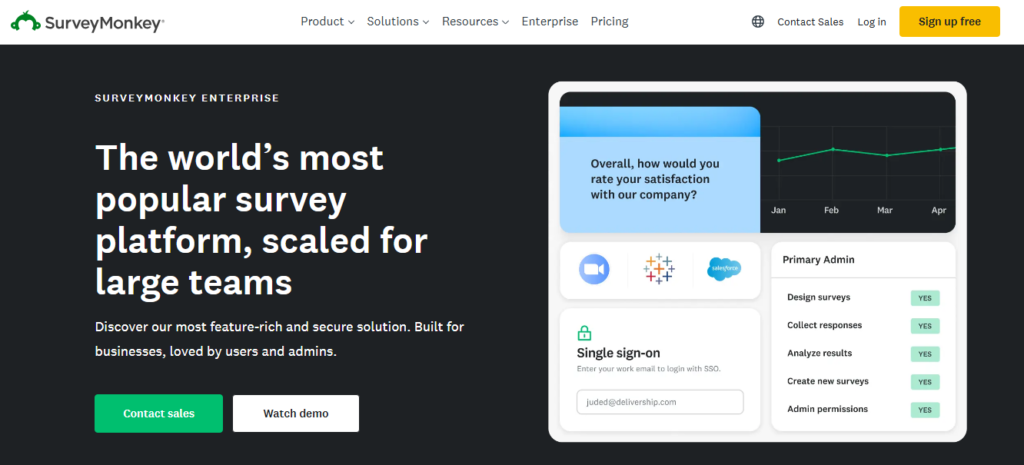
SurveyMonkey remains one of the most trusted and widely used survey platforms in the world, and its 2026 iteration is significantly more powerful than earlier versions. The platform has leaned heavily into AI-driven survey creation, offering a feature that generates a complete, optimized survey from a single sentence describing your research goal. The AI also reviews your questions in real time and flags potential bias, confusing language, or structural problems before you launch.
The platform offers an extensive library of professionally designed templates covering customer satisfaction, employee engagement, product feedback, event planning, healthcare, education, and more. Its logic and branching capabilities are robust, allowing complex survey flows that adapt dynamically to each respondent’s answers.
SurveyMonkey’s analytics dashboard has been significantly upgraded. You can now filter and segment results by any demographic variable, run sentiment analysis on open-ended responses, and generate shareable reports with a single click. The platform integrates natively with Salesforce, HubSpot, Slack, Zoom, Microsoft Teams, and hundreds of other tools through Zapier and direct API connections.
Its enterprise tier offers advanced security features including SSO, role-based permissions, audit logs, and dedicated account management. For most businesses seeking a reliable, full-featured, and well-supported survey platform, SurveyMonkey in 2026 remains the safest and smartest choice.
Best for: Customer experience research, employee feedback, market research, and mid-size to large businesses.
2. Typeform — Best for Design, Engagement, and Conversion
Typeform continues to lead the industry in survey design and respondent experience. Its signature one-question-at-a-time format has been proven to produce significantly higher completion rates compared to traditional survey layouts, particularly on mobile devices where patience for long forms is minimal.
In 2026, Typeform has expanded its AI capabilities substantially. Its AI survey builder can generate a fully designed, logically structured survey in seconds based on a brief description of your goal. The platform also supports video questions, where respondents can record and submit video answers — a feature increasingly popular in qualitative research, UX studies, and candidate screening.
Typeform’s conditional logic has become more sophisticated, supporting multi-condition rules, hidden fields, and dynamic content that personalizes the survey experience based on the respondent’s previous answers or even their referral source. Its integration ecosystem connects seamlessly with tools like Notion, Airtable, HubSpot, Mailchimp, and Google Sheets.
For brands that care deeply about how their surveys look and feel, Typeform has no equal. The platform allows full visual customization including custom fonts, background images, video backgrounds, and animated transitions. Every survey feels like a thoughtfully crafted experience rather than a data collection exercise.
Best for: Brand-conscious organizations, lead generation surveys, UX research, product feedback, and any use case where completion rate is the primary concern.
3. Qualtrics XM — Best for Enterprise and Academic Research
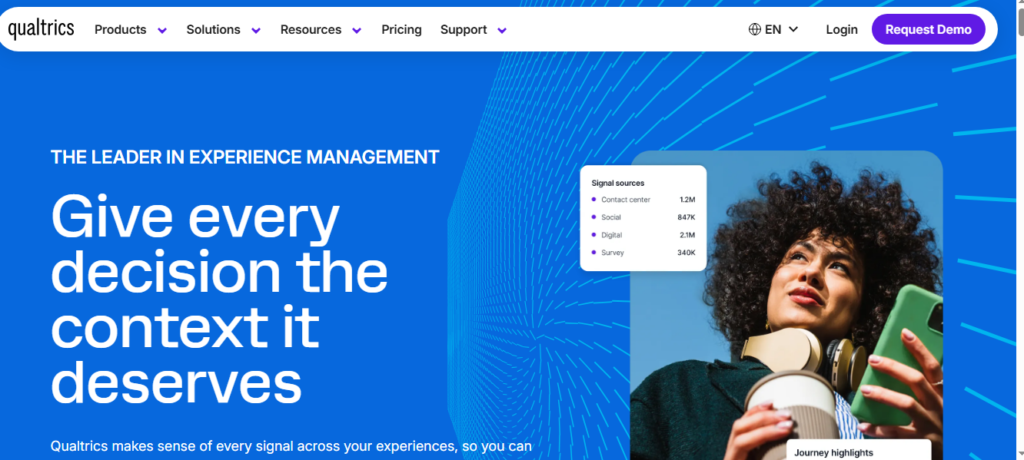
Qualtrics remains the undisputed leader for serious enterprise research and academic data collection in 2026. Its Experience Management platform integrates customer experience, employee experience, product experience, and brand research into a single, unified system that delivers insights across every dimension of an organization.
The platform’s research capabilities are extraordinary. Qualtrics supports conjoint analysis, MaxDiff studies, text analytics with advanced sentiment classification, predictive modeling, and statistical significance testing — all within the platform, without needing to export data to a separate analytics tool.
Qualtrics has invested heavily in AI through its proprietary intelligence engine, which can surface hidden patterns in large datasets, generate plain-language summaries of research findings, and recommend actions based on survey results. For executive audiences who need to understand research insights without digging into raw data, this capability is transformative.
The platform’s security and compliance infrastructure is best in class, making it the preferred choice for healthcare organizations, government agencies, financial institutions, and universities that operate under strict regulatory requirements.
Qualtrics is not the right choice for individuals or small teams who need something quick and affordable. But for organizations running serious, large-scale, or scientifically rigorous research programs, it is in a category of its own.
Best for: Enterprise organizations, academic institutions, healthcare research, government agencies, and any use case requiring advanced statistical analysis.
4. Jotform — Best for Versatility and Small Business Value
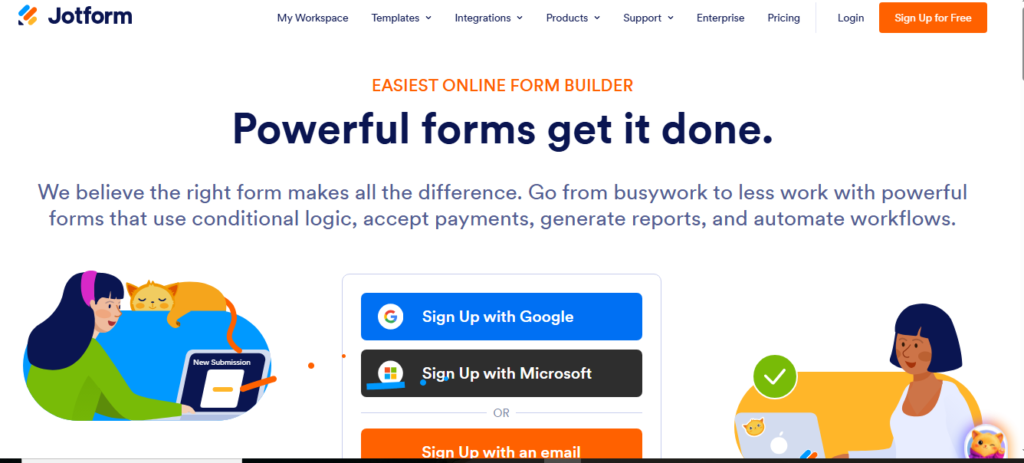
Jotform has grown into one of the most flexible and feature-rich survey and form platforms available in 2026, with a template library now exceeding 10,000 designs covering virtually every industry and use case. Its drag-and-drop builder is intuitive enough for complete beginners while offering enough depth to satisfy experienced survey designers.
What sets Jotform apart in 2026 is its extraordinary versatility. Beyond surveys, the platform handles payment collection, appointment scheduling, document signing, file uploads, and product order forms. This makes it an all-in-one data collection solution for small businesses that do not want to manage multiple tools.
Jotform AI Agents, introduced in late 2024 and significantly expanded since, allow you to create conversational AI-powered forms that guide respondents through questions dynamically, answer their queries in real time, and adapt the survey flow intelligently based on responses. This brings enterprise-grade conversational intelligence to an affordable platform.
The platform maintains its strong compliance credentials with HIPAA-compliant plans for healthcare providers, GDPR compliance tools, and robust data encryption. Its integration network spans hundreds of platforms including Salesforce, Google Drive, Dropbox, Slack, and PayPal.
Best for: Small businesses, nonprofits, healthcare providers, educators, and organizations that need versatile data collection beyond traditional surveys.
5. Microsoft Forms — Best Within the Microsoft 365 Ecosystem
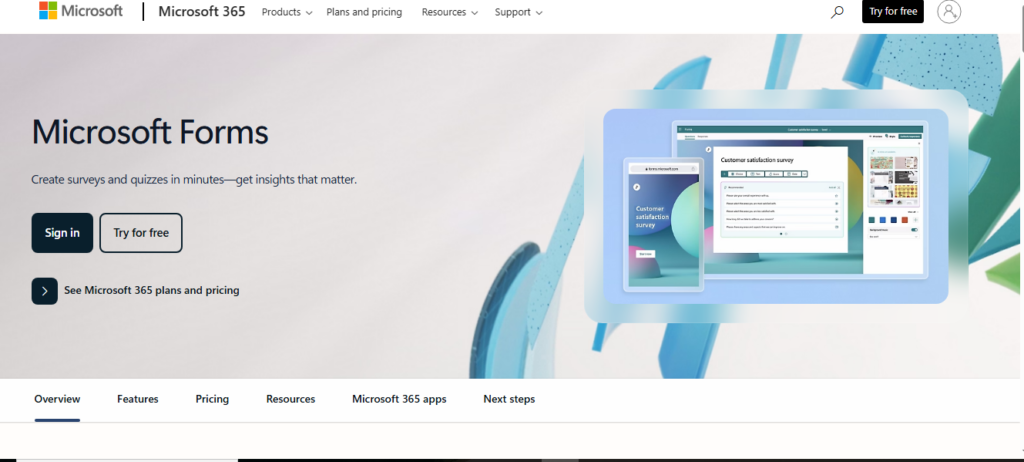
Microsoft Forms has evolved significantly and in 2026 it offers a more capable and polished experience than earlier versions. For organizations deeply embedded in the Microsoft 365 environment, it remains the most convenient and cost-effective survey tool available since it is included at no additional charge with Microsoft 365 subscriptions.
The platform now supports more advanced branching logic, improved real-time collaboration features, and tighter integration with Microsoft Copilot. Copilot can help you draft survey questions, summarize responses in natural language, and create charts from your data inside Excel with minimal manual effort.
Forms integrates natively with Microsoft Teams, SharePoint, OneDrive, and Power BI. Response data flows automatically into Excel, where it can be further analyzed with Power Query and pivot tables. For internal surveys, pulse checks, compliance assessments, and team feedback within a Microsoft-centric organization, it delivers excellent value.
Its limitations remain in customization, advanced logic, and analytical depth compared to dedicated survey platforms. But for its target use case, it is effective, reliable, and genuinely easy to use.
Best for: Organizations using Microsoft 365, internal surveys, team pulse checks, and educational institutions.
6. Google Forms — Best Free Option for Simple Surveys
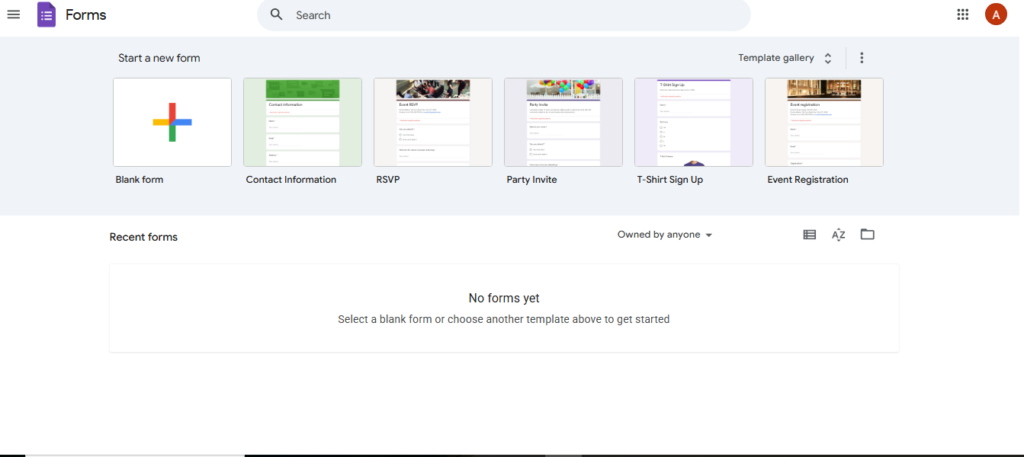
Google Forms continues to be the most accessible free survey tool available, and in 2026 it has benefited from Google’s broader investment in AI through Gemini integration. You can now use Gemini to generate survey questions, summarize open-ended responses, and create visualizations from your data in Google Sheets.
The platform remains simple by design, which is both its greatest strength and its most significant limitation. It handles basic surveys, event registrations, quizzes, and feedback forms efficiently. Its automatic connection to Google Sheets makes data management straightforward for users already working within Google Workspace.
For professional-grade research, customer-facing surveys, or anything requiring custom branding and advanced analytics, Google Forms falls short. But as a free, fast, and universally accessible starting point, it has no equal.
Best for: Individual users, students, educators, internal team polls, and anyone needing a simple survey without a budget.
7. Alchemer — Best for Complex Survey Workflows
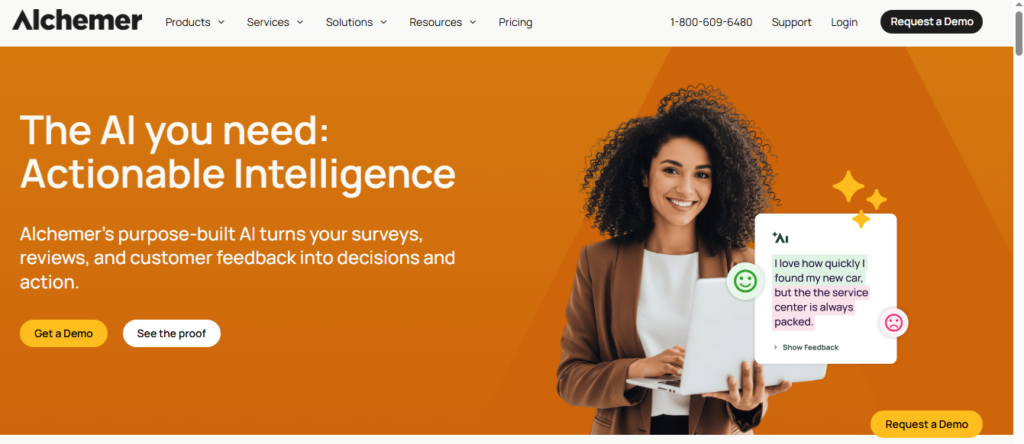
Alchemer occupies a valuable space in the market in 2026, sitting between the simplicity of consumer tools and the complexity of enterprise platforms like Qualtrics. It is the platform of choice for organizations that need sophisticated survey logic, deep customization, and powerful automation without the cost and complexity of a full enterprise solution.
Alchemer’s workflow automation capabilities are particularly impressive. You can build multi-step processes that trigger emails, update CRM records, create tasks in project management tools, and route responses to different team members based on survey answers — all without writing a line of code.
Its voice-of-customer and customer feedback management features have expanded in 2026, with better longitudinal tracking, trend analysis, and closed-loop feedback tools that help organizations follow up with respondents automatically based on their answers.
Best for: Mid-market businesses, customer feedback programs, voice-of-customer research, and organizations that need complex multi-step survey workflows.
8. Zoho Survey — Best for Zoho Ecosystem Users
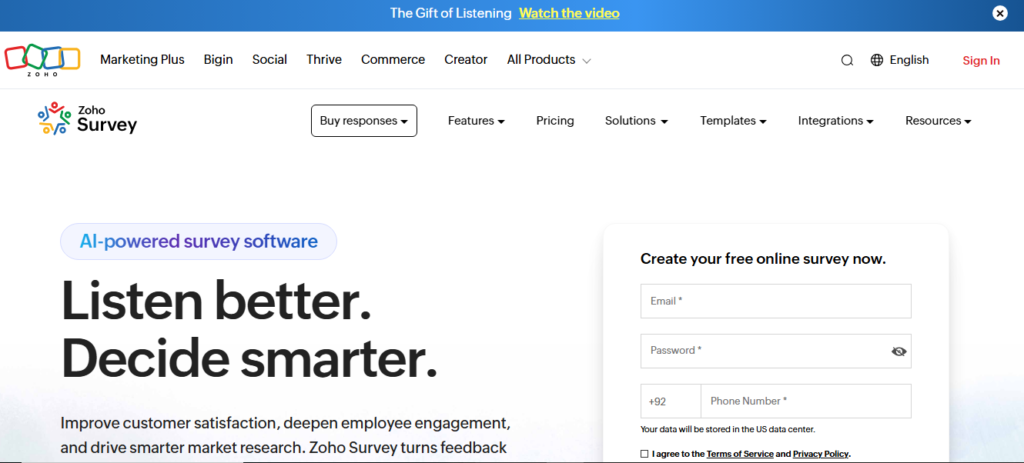
Zoho Survey remains a strong and cost-competitive choice in 2026 for organizations already using Zoho’s broader suite of business applications. Its deep integration with Zoho CRM, Zoho Analytics, Zoho Campaigns, and other Zoho products allows survey data to flow seamlessly into sales, marketing, and business intelligence workflows.
The platform supports multi-language surveys in over 75 languages, offline data collection through its mobile app, audience panel access for reaching specific demographics, and a solid set of reporting and cross-tabulation tools. It offers strong value at its price point and continues to improve its AI-assisted question writing and response analysis features.
Best for: Businesses using the Zoho suite, international research requiring multilingual support, and cost-conscious organizations seeking solid mid-range features.
How to Choose the Right Survey Platform in 2026
With so many capable platforms available, the decision should be driven by your specific context rather than brand recognition alone. Here is a practical decision framework.
Start by clarifying your primary use case. Customer feedback programs, academic research, employee engagement, market studies, and event registrations each have different requirements. The platform that is perfect for one use case may be inadequate for another.
Consider your respondent experience priorities. If completion rate is critical, prioritize platforms with conversational or mobile-optimized designs. If data depth matters more than volume, focus on platforms with sophisticated question types and analytical tools.
Evaluate the total cost of ownership, not just the subscription price. Factor in the time required to learn the platform, the cost of integrations, and the potential cost of hitting response limits on lower-tier plans.
Think carefully about your data security requirements. If you operate in healthcare, finance, education, or government, your platform must meet specific compliance standards. Not all platforms do.
Take advantage of free trials. Most leading platforms offer trial periods. Use them seriously — build a real survey, distribute it to a small test group, and evaluate the analytics before committing.
Survey Design Best Practices for 2026
Technology is only part of the equation. The quality of your survey design determines whether you get useful data or noise. These principles remain as relevant as ever.
Respect your respondents’ time above all else. The ideal professional survey takes between three and seven minutes to complete. Every question that does not directly serve your research goal should be removed.
Write questions in plain, neutral language. Avoid jargon, double negatives, and leading phrasing. If a question could be interpreted in more than one way, it needs to be rewritten.
Use the right question type for each piece of information you need. Rating scales work well for measuring satisfaction and attitudes. Multiple choice works for categorical data. Open-ended questions are valuable for capturing context but should be used sparingly since they require more effort from respondents.
Test every survey before launching it. Send it to colleagues or a small test group, ask them to flag anything confusing, and check your logic flows thoroughly. Errors in a live survey can compromise your entire dataset.
Close the loop with respondents where appropriate. In customer and employee surveys, people are more likely to participate in future surveys if they see evidence that their previous feedback led to real action. Brief follow-up communications that acknowledge responses and describe resulting changes build trust and improve long-term response rates.
The Trends Shaping Survey Software Beyond 2026
Several developments already underway will shape the next generation of professional survey tools.
Agentic AI survey assistants will become standard. Rather than simply helping you write questions, AI agents will manage the entire research process — designing the methodology, distributing the survey, monitoring response quality in real time, and delivering finished insight reports automatically.
Passive data collection will complement active surveys. Organizations will increasingly combine traditional survey responses with behavioral signals — website interactions, support ticket sentiment, purchase patterns — to build richer pictures of customer and employee experience without increasing survey fatigue.
Personalization at scale will become an expectation. Surveys will be dynamically personalized based on who each respondent is, what they have said previously, and what the organization most needs to understand about them at that specific moment in time.
Final Thoughts
The best software for creating professional surveys in 2026 is more intelligent, more versatile, and more capable than anything that came before it. The right choice for your organization depends on the complexity of your research needs, the size of your team, your budget, your existing technology stack, and how much you prioritize respondent experience versus analytical depth.
SurveyMonkey offers the best all-around value for most businesses. Qualtrics is the clear choice for enterprise and academic research. Typeform leads on design and engagement. Jotform provides exceptional versatility for small businesses. Microsoft Forms and Google Forms serve straightforward needs within their respective ecosystems.
Whatever platform you choose, the most important investment you can make is in the quality of your survey design itself. Great software with poorly written surveys will still produce poor data. But great software combined with thoughtful, well-tested, respondent-focused surveys will give you the insights you need to make genuinely better decisions in 2026 and beyond.

Usman Hakim is an SEO specialist at RankWithLinks, focusing on link building and organic growth. He helps brands improve search rankings through white-hat strategies, including guest posting and authority backlinks.