
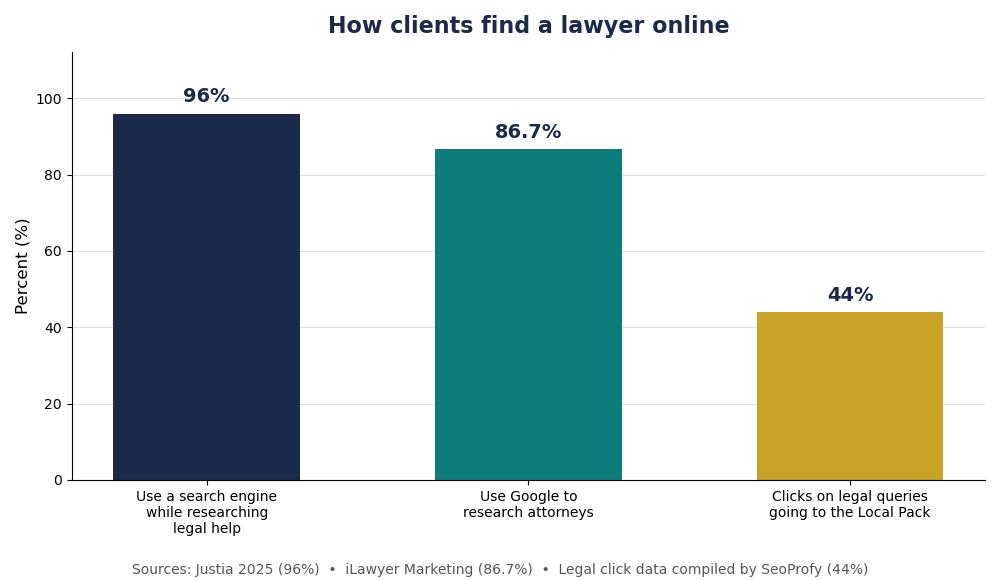
Link building for lawyers is the work of earning links from other websites to a law firm’s website, so Google trusts the firm more and shows it higher when someone searches for a lawyer. It matters because clients now start their search online. Research by Justia, reported in 2025, found that 96% of potential clients use a search engine at some point while researching legal help. If your firm is invisible in those searches, those clients call a competitor instead.
This guide explains, in plain terms, what a good link looks like for a law firm, which safe methods actually work, and which shortcuts put a firm’s rankings at risk. No jargon, no tricks, and nothing that breaks Google’s rules.
Why links matter so much for a law firm
Google still uses links as one of its core ranking signals. A link from another site acts like a vote of confidence: the linking site is telling Google that your page is worth showing. For lawyers, that trust signal carries extra weight, because legal advice is a high-trust topic and Google holds it to a higher standard than most subjects.
The numbers show why visibility pays. Backlinko’s study of millions of search results found that the top organic result captures a 27.6% click-through rate, while results on page two are almost never clicked. And FirstPageSage reports that law firm SEO converts at around 7.4% from visitor to lead on average. In other words, ranking higher does not just bring more visitors; it brings more consultations.
| Fact | What it means for a law firm | Source |
|---|---|---|
| 96% of potential clients use a search engine while researching legal help | If you are not visible in search, most clients never find you | Justia, 2025 research |
| The top Google result wins a 27.6% click-through rate | Moving from page two to the top changes everything | Backlinko click-through study |
| About 44% of clicks on legal queries go to the Local Pack (map results) | Local links and reviews matter as much as website links | Legal click data compiled by SeoProfy |
| Law firm SEO converts at around 7.4% visitor-to-lead on average | Search visitors are high-intent, not casual browsers | FirstPageSage |
| Referring-domain count is one of the strongest predictors of rankings | Links from many different sites beat many links from one site | Ahrefs analysis of 920 million pages |
One point in that table deserves emphasis. Ahrefs found that the number of different websites linking to you predicts rankings better than the raw number of links. One hundred links from one directory will not do what ten links from ten different, relevant sites can do. Variety and relevance beat volume.
What counts as a good link for a lawyer
Not every link helps. Before chasing any link, check it against four tests:
- Relevance. Does the linking site have something to do with law, your city, or your practice area? A link from a local news site or a legal directory makes sense. A link from an unrelated site in another country does not.
- Real audience. Would a real person ever visit that page? Links on pages nobody reads carry little trust.
- Editorial choice. Did the site link to you because your content or firm is genuinely useful, not because you paid for the link or swapped links?
- Local signal. For most firms, clients come from one city or region. Links from local organisations, news outlets and directories strengthen that local signal.
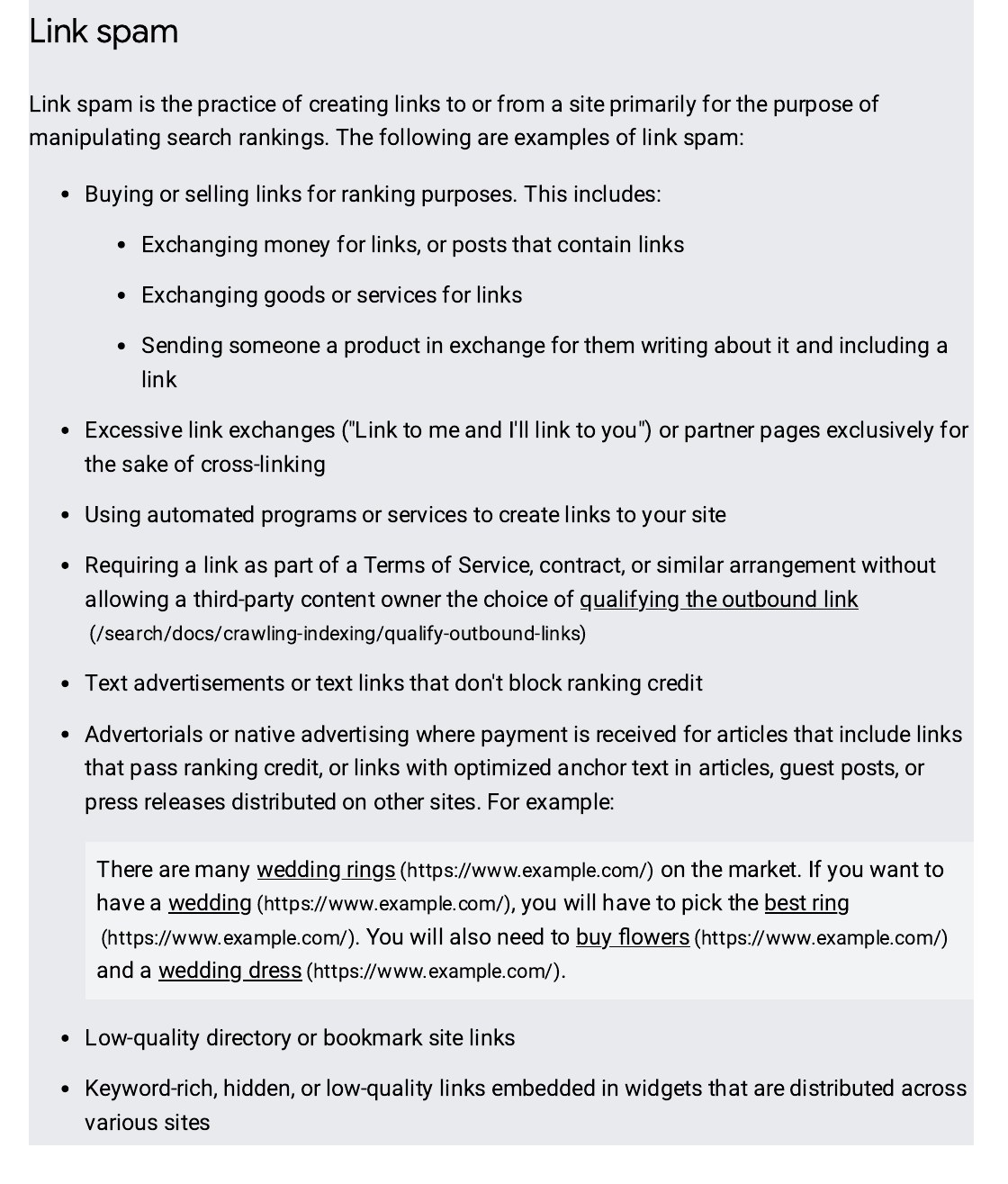
A link that fails these tests is at best wasted effort. At worst, it is the kind of link Google’s spam policies warn about. Google states plainly that sites violating its policies may rank lower or not appear in results at all, and it defines link spam as creating links mainly to manipulate rankings.
Safe ways for a law firm to earn links
1. Claim and complete the legal directories
Start with the directories clients actually use: Justia, Avvo, FindLaw, Nolo and your state bar’s lawyer directory. Claim the firm’s profile, fill it in fully, and make sure the firm’s name, address and phone number match the website exactly. These profiles are legitimate citations, and they often rank well themselves, so a client may find the firm through the directory even before the firm’s own site ranks.
2. Publish genuinely useful local content
The content that earns links for lawyers is rarely a sales page. It is the page that answers a question people actually ask: what happens at a first divorce consultation, how long a personal injury claim takes in your state, or what documents to bring to an estate planning meeting. Local guides, checklists and plain-English explainers get linked by community sites, journalists and other professionals because they are useful, not because someone was asked to link.
3. Earn local news and community links
Local newspapers, radio stations and community organisations link to firms that take part in real life: sponsoring a legal aid clinic, speaking at a community event, or commenting on a local legal story. If money changes hands for a sponsorship, the link should be qualified with rel=”sponsored” or rel=”nofollow” so it does not pass ranking credit. The value of the mention remains; the risk disappears.
4. Build relationships with other professionals
Accountants, financial advisers, therapists and medical practices often keep a “resources” page for clients. A firm that refers work both ways and is known locally can earn a place on those pages honestly. This is slow, relationship-based outreach, and that is exactly why Google trusts it.
5. Fix the basics before chasing new links
A firm with broken pages, no Google Business Profile or inconsistent directory details will waste good links. Claim the Business Profile, ask clients for reviews through Google’s own review link (never pay for reviews or only ask happy clients), and keep opening hours and contact details current. Local Pack clicks make up a large share of legal search clicks, so this groundwork supports every link earned later.
What to avoid
Some shortcuts look tempting and are dangerous for a law firm:
- Links from private blog networks (PBNs) built only to sell links. These exist to manipulate rankings, and Google’s systems are built to neutralise them.
- Large packages of low-quality directory or forum links bought in bulk. They fail the relevance and real-audience tests above.
- Link exchanges at scale, where firms link to each other only to raise rankings.
- Guest posts written only for an optimised anchor-text link, rather than to inform readers.
A law firm also has professional rules to respect. Advertising claims must be honest, and anything that looks like a misleading endorsement can cause trouble beyond SEO. When in doubt, ask one question: would you be comfortable explaining this link to a client, or to your bar association? If not, do not build it.
A simple monthly routine
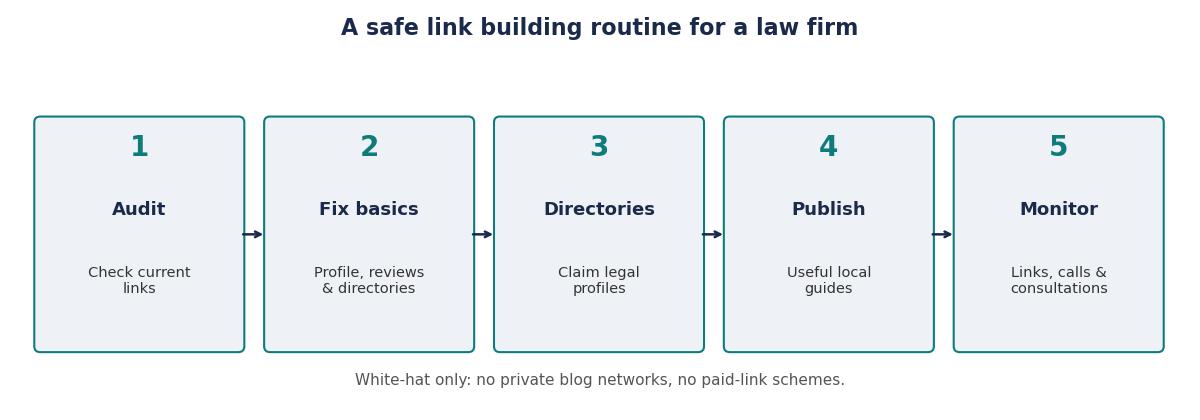
Link building works best as a routine, not a one-off campaign. A small firm can manage it in a few hours a month:
- Check Google Search Console’s Links report to see which new sites linked to you and which pages they linked to.
- Check a free link tool, such as Ahrefs’ free backlink checker, for a second view of new and lost links.
- Publish one useful local page or guide each month, and tell one local contact about it.
- Review directory profiles once a quarter for accuracy and consistency.
- Track consultations and calls from search, not just link counts. A single link that brings a client beats fifty links nobody clicks.
How RankWithLinks can help
Link building takes steady outreach and careful judgement about which links are safe. That is the work our team does every day, by hand, for firms that want rankings without risking their reputation. If you would like that work handled for you, take a look at our link building services and tell us about your practice area and city. We will be honest about what is realistic, and we will never use private blog networks or paid-link schemes on your firm’s behalf.
Frequently asked questions
How long does link building take to work for a law firm?
Expect months, not days. Law is competitive, and Google needs time to find, value and trust new links. Most firms see early movement in local results first, then steadier gains in organic rankings over six to twelve months. Anyone promising page one in a week is selling something you should avoid.
Do lawyers need backlinks if they already get referrals?
Referrals remain valuable, but they reach only people who already know someone who knows you. Search reaches the 96% of potential clients who research online, including people new to your city or dealing with a legal problem for the first time. Links help search find you; referrals alone cannot do that.
Are directory links enough on their own?
No. Directories are a solid foundation, but every competing firm can claim the same profiles. To stand out, a firm also needs links that competitors cannot copy by filling in a form: local news mentions, professional relationships and useful content that other sites choose to link to. Those harder links also tend to point at the firm’s most valuable pages.
Is it safe to buy backlinks for a law firm website?
No, and we advise against it. Google’s spam policies class buying or selling links for ranking purposes as link spam, and sites that break those policies may rank lower or disappear from results. A law firm has more to lose than most businesses, because a penalty damages the reputation clients trust. Earn links instead, or hire an agency that earns them by hand.
Do nofollow links help a law firm at all?
Yes, in a limited but real way. A nofollow link does not pass ranking credit directly, but it can still send visitors, build the firm’s name, and lead to followed links later when someone discovers the firm through it. Directory profiles, sponsored mentions and press coverage often use nofollow, and they are still worth having.
What anchor text should law firm links use?
Keep it natural. Most links should use the firm’s name, its website address, or a plain phrase such as “family law firm in Austin”. Exact-match phrases stuffed into every link look manipulated and invite a closer look from Google. A natural mix of branded and plain anchors is both safer and more believable.

Abdullah Zulfiqar is Co-founder and Client Success Manager at RankWithLinks, an SEO agency helping businesses grow online. He specializes in client relations and SEO strategy, driving measurable results and maximizing ROI through effective link-building and digital marketing solutions.