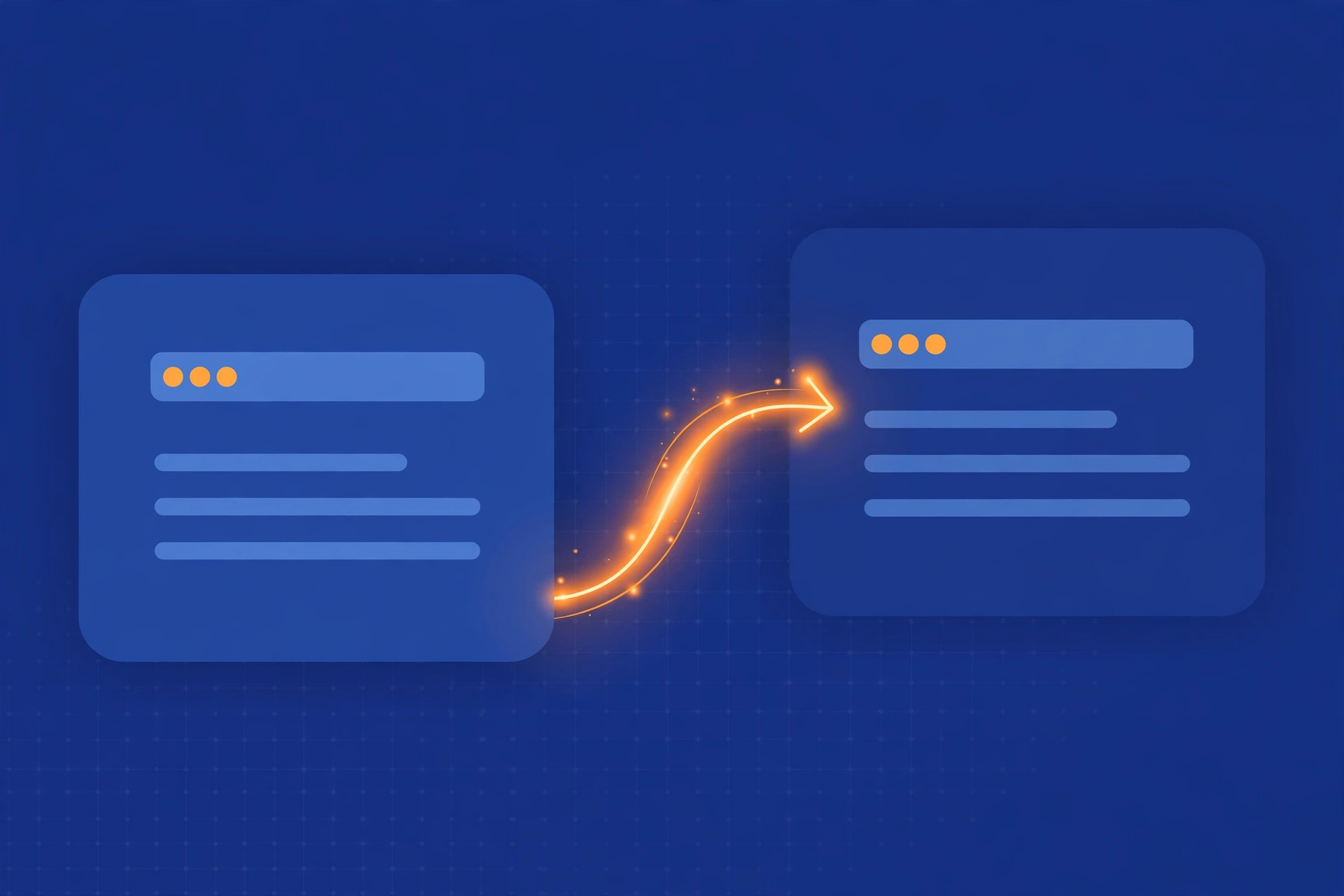
If you are asking what a backlink in SEO is, you are really asking how Google decides which pages deserve to rank. A backlink is a link from one website to another: when site A links to a page on site B, site B earns a backlink. It works like a public vote of confidence — the linking site tells its readers (and Google) that your page is worth visiting. These votes carry real weight: Backlinko’s analysis of 11.8 million Google search results found that the #1 result has, on average, 3.8x more backlinks than the pages in positions #2–#10 (serpreach.com).
This guide explains backlinks in plain English: what they are, how Google uses them, the types that exist, what makes one valuable, and how to earn them without getting into trouble.
A backlink, defined simply
Every link on the web has a direction. A link from your page to someone else’s is an “outbound link”. A link from someone else’s page to yours is a “backlink” (also called an inbound link). The word “backlink” is always written from the point of view of the site receiving the link — you can only have a backlink when someone else links to you.
A simple example: you publish a guide on making sourdough, and a food blogger links to it from her recipe roundup. Your guide now has one backlink. If ten more sites link to it, it has eleven. Google notices, because each of those links is a signal that real people found your page useful enough to reference.
How Google uses backlinks
Backlinks were at the heart of Google’s original ranking system, PageRank, which treated each link as a vote. Twenty-five years on, the system is far more sophisticated, but links still play a central role:
- Authority. A page with many quality backlinks is treated as more trustworthy than a similar page with none. Links pass “authority” from the linking page to the linked page.
- Discovery. Google’s crawlers follow links to find new pages. A brand-new page with no links pointing to it is harder for Google to discover and index.
- Relevance. The topic of the linking page and the text of the link (the “anchor text”) help Google understand what your page is about.
No single factor decides a ranking on its own — content quality, search intent, and page experience all matter. But links remain one of the few off-page signals Google has, and they are the main way sites build authority outside their own pages.
Why backlinks matter: the numbers
The studies on backlinks are some of the most repeated in SEO, because the pattern shows up again and again:
- The #1 Google result has 3.8x more backlinks on average than results #2–#10, across 11.8 million search results analysed (Backlinko).
- 92.3% of domains that ranked in Google’s top 100 for 13 straight months had at least one backlink — while 55.1% of new domains that never reached the top 10 had no backlinks at all (Semrush study, cited at userp.io).
- Roughly 95% of all pages on the web have no backlinks at all (Ahrefs), and pages without links are far less likely to earn organic traffic.
The message is consistent: pages that rank almost always have links, and pages without links almost never do. That makes link building one of the highest-leverage activities in SEO — and one of the hardest. A Backlinko analysis of 12 million outreach emails found that only 8.5% receive a reply, which is why most sites either build links badly or never build them at all (cited at linkbuildingstats.com).
The main types of backlinks
Not all backlinks are the same. Google classifies links with attributes, and the attribute changes how (and whether) a link passes ranking value:
| Type | Attribute | What it means |
|---|---|---|
| Dofollow | None (default) | A normal link. It can pass ranking value and is the kind that helps SEO most. |
| Nofollow | rel=”nofollow” | Tells Google not to pass ranking credit. Still useful for traffic and can lead to followed links. |
| Sponsored | rel=”sponsored” | Marks a paid or sponsored link. Required for advertising; passes no ranking credit. |
| UGC | rel=”ugc” | Marks user-generated content links (blog comments, forum posts). |
A natural backlink profile contains a mix of these. Do not panic if some of your links are nofollow — a profile that is 100% dofollow looks manufactured, not healthy.
What makes a backlink valuable
One link from a respected site in your industry can outweigh a hundred links from random blogs. Four factors decide a backlink’s worth:
1. Relevance. A link from a site covering the same topic as yours is far more powerful than a link from an unrelated site. A plumbing blog linking to your plumbing business makes sense; a plumbing blog linking to a casino site does not, and Google treats it accordingly.
2. Authority. Links from established, well-linked sites carry more weight. A mention on a major news outlet or a respected industry publication is worth more than a link from a site nobody visits.
3. Placement. A link inside the main body of an article — where an editor placed it because it genuinely helped the reader — carries more weight than a footer link, sidebar link, or author-bio link.
4. Anchor text. The clickable words of the link should read naturally: brand names, plain URLs, and descriptive phrases. A profile stuffed with exact-match keyword anchors (“cheap SEO services”) is a classic sign of manipulation.

How to earn backlinks the safe way
Earning backlinks takes work — there is no shortcut that does not carry risk. The methods that hold up over time:
- Guest posting. Write a genuinely useful article for a real blog in your niche and earn an editorial link back. Pitch sites whose readers would actually care.
- Digital PR. Publish original data, a survey, or a strong opinion piece and pitch it to journalists and bloggers. Data studies are the most-linked content format on the web.
- Resource pages. Many sites maintain “helpful resources” lists for their topic. If your guide is better than what’s listed, ask for a spot.
- Broken link building. Find dead links on relevant sites, then suggest your working page as a replacement. You are doing the site owner a favour, which is why it works.
- Unlinked brand mentions. When someone mentions your brand without linking, a polite email usually converts the mention into a link.
Whatever the method, expect low reply rates — remember that 8.5% outreach reply figure. Personalised, short pitches to the right sites beat mass mailings every time.
If you would rather have specialists handle this, our link-building services cover manual outreach and digital PR — every link earned by hand, no PBNs, no automation.
Backlinks to avoid
Just as good links help, bad links hurt. Google’s spam policies are explicit: links intended to manipulate rankings may be treated as link spam. Stay away from:
- Paid links without a sponsored tag. Buying a dofollow link to boost rankings is a direct policy violation and can trigger a manual penalty.
- Private blog networks (PBNs). Networks of sites built only to sell links. They work until Google detects them — then the links (and sometimes the site) are wiped out.
- Link farms and directories. Automated services promising “500 backlinks for $20” place your site on spammy pages that do more harm than good.
- Excessive link exchanges. “You link to me and I’ll link to you” schemes, especially at scale, are listed as link spam by Google.
If you already have spammy links pointing to your site, Google’s disavow tool exists for the worst cases — but most sites never need it.
FAQ
Do backlinks still matter in 2026?
Yes. Google has refined how it evaluates links — relevance, placement, and editorial context matter far more than raw count — but large-scale studies still show a strong relationship between quality backlinks and top rankings. Links are also becoming relevant in AI search, since AI Overviews and AI answers cite pages that already rank well organically.
How many backlinks do I need to rank?
There is no fixed number — it depends on the competition for your keyword. For low-difficulty keywords, a handful of quality links can be enough. For competitive terms, top-ranking pages often have hundreds of referring domains. Compare your page against the sites already in the top 10 and aim to match the quality, not just the count.
What is the difference between dofollow and nofollow backlinks?
A dofollow link is a normal link that can pass ranking value to your page. A nofollow link carries the rel=”nofollow” attribute, telling Google not to pass ranking credit — but it can still send traffic and lead to followed links. A natural profile includes both.
Is it OK to buy backlinks?
No — not if the link passes ranking credit. Google’s spam policies state that buying or selling links to manipulate rankings is link spam, and paid links must carry rel=”sponsored” or rel=”nofollow”. Paid, untagged links risk a manual penalty that can take months to recover from. Earn links through genuine outreach instead.
How long do backlinks take to improve rankings?
It varies, but most sites see movement within weeks to a few months after earning quality links, depending on crawl frequency and competition. Links are a compounding asset: pages that already rank tend to earn more links over time, which reinforces their position.
Can I get backlinks for free?
Yes. Guest posting, digital PR, resource page outreach, and converting unlinked brand mentions all cost time rather than money. Free backlink checker tools (Ahrefs, Moz, Bing Webmaster Tools) can also show you where competitors get their links, giving you a ready-made prospect list.

Abdullah Zulfiqar is Co-founder and Client Success Manager at RankWithLinks, an SEO agency helping businesses grow online. He specializes in client relations and SEO strategy, driving measurable results and maximizing ROI through effective link-building and digital marketing solutions.