

Introduction
Business vertical classification categories are one of those topics that most business owners hear about but never fully understand — until it costs them.
I remember working with a SaaS founder who kept wondering why his LinkedIn ads were getting clicks but zero qualified leads. His targeting was off. His messaging was generic. And the root cause? He had never properly identified which business vertical he actually operated in.
Once we classified his company correctly — not as “software” broadly, but specifically as a legal tech vertical serving small law firms — everything changed. His messaging got sharper. His ads found the right people. His conversion rate tripled in 60 days.
That is the real power of business vertical classification categories. They are not just labels. They are strategic positioning tools that affect your marketing, your pricing, your hiring, your investor pitch, and your SEO.
Whether you are a startup founder, a marketer, an analyst, or a business student — this guide will give you a complete, practical understanding of business vertical classification categories from the ground up.
Key Takeaways
- Business vertical classification categories group companies by the specific industry or market they serve
- There are 10 core business verticals that cover the global economy
- Vertical markets are narrow and specialized — horizontal markets are broad
- NAICS and SIC are the two main official classification systems used globally
- Choosing the wrong vertical hurts your marketing, SEO, and investor positioning
- In 2026, new verticals like AI tech, green energy, and health tech are emerging fast
- Your vertical is defined by WHO you serve — not what technology you use
What Are Business Vertical Classification Categories?
Business vertical classification categories are structured systems that group companies together based on the specific industry, market, or customer type they serve.
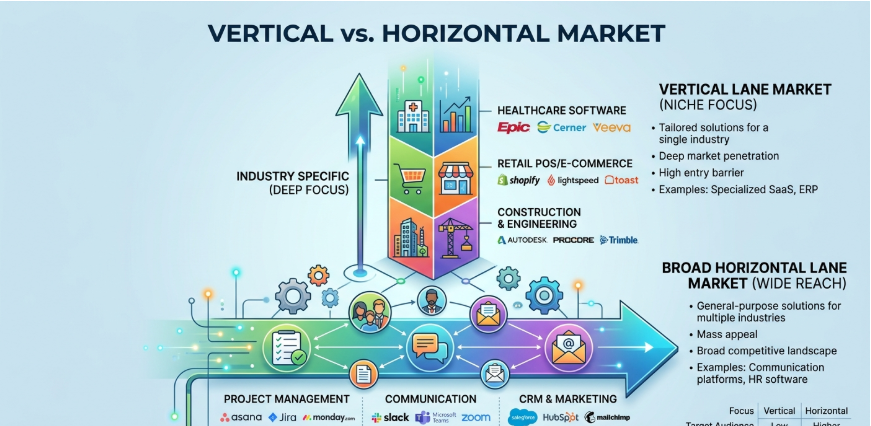
Think of it like lanes on a highway. Each lane is a vertical. Every company driving in that lane is serving the same type of customer, facing similar regulations, competing against similar players, and solving similar problems.
A hospital management software company operates in the healthcare vertical. A platform that sells accounting software to restaurants, law firms, and retailers operates in a horizontal market — because it crosses multiple verticals.
Simple definition for featured snippet:
A business vertical classification category is a way of grouping businesses that operate in the same industry, serve the same type of customer, and compete in the same market segment.
Vertical Market vs Horizontal Market
This is the most important distinction beginners miss.
| Feature | Vertical Market | Horizontal Market |
|---|---|---|
| Focus | One specific industry | Multiple industries |
| Target customer | Narrow and specialized | Broad and general |
| Competition | Industry-specific rivals | General market competitors |
| Messaging | Highly tailored | Generic and broad |
| Product design | Built for one industry | Works across many industries |
| Examples | Healthcare software, legal tech | Microsoft Office, Slack, Zoom |
| Pricing power | Higher — specialists charge more | Lower — more price competition |
| Marketing cost | Lower — targeted audience | Higher — broader targeting needed |
The key insight here is this: vertical businesses almost always charge more and convert better because they solve a specific problem for a specific person. Horizontal businesses compete on volume and price.
The 3-Level Classification Hierarchy
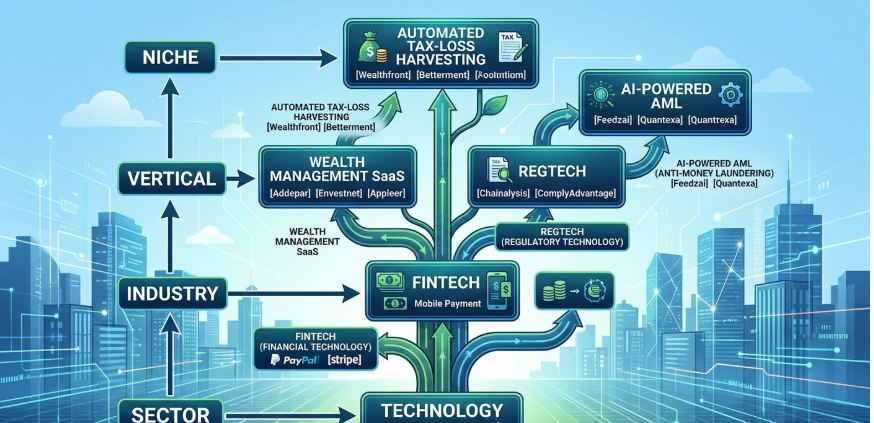
Business verticals are not flat — they have layers. Understanding this hierarchy is what separates beginners from experts.
Level 1 — Sector The broadest grouping. Example: Technology
Level 2 — Industry More specific. Example: Technology → Software
Level 3 — Vertical The actual lane your business operates in. Example: Technology → Software → Legal Tech
Level 4 — Sub-Vertical Even more targeted. Example: Technology → Software → Legal Tech → Contract Management Software
Level 5 — Niche The most specific. Example: Technology → Software → Legal Tech → Contract Management Software → For Solo Attorneys
The narrower your classification, the more targeted your strategy. Most businesses make the mistake of positioning themselves too broadly — at Level 1 or 2 — when they should be operating at Level 3 or 4.
The 10 Core Business Vertical Classification Categories
These are the 10 primary business verticals that cover the modern global economy. Each has its own sub-verticals, regulations, buyer behavior, and competitive dynamics.
1. Technology and Software
This is the largest and fastest-growing vertical in 2026.
It includes software development, cloud computing, cybersecurity, artificial intelligence, SaaS platforms, hardware manufacturing, semiconductors, and IT consulting.
Key sub-verticals:
- Cybersecurity
- Enterprise SaaS
- AI and machine learning platforms
- Cloud infrastructure
- EdTech
- LegalTech
- PropTech
- FinTech (overlaps with Financial Services)
Who competes here: Microsoft, Salesforce, HubSpot, Tenable, Palantir
2026 trend: Vertical SaaS is exploding — software built exclusively for one industry rather than trying to serve everyone
2. Financial Services
One of the most regulated and most lucrative verticals in the world.
It includes banking, insurance, investment management, wealth advisory, payment processing, lending, and financial technology.
Key sub-verticals:
- Retail banking
- Insurance technology (InsurTech)
- Wealth management
- Cryptocurrency and DeFi
- Payments infrastructure
- Microfinance
Who competes here: JPMorgan, Stripe, Robinhood, Lemonade
2026 trend: AI-driven underwriting, embedded finance, and DeFi are reshaping this vertical faster than regulators can keep up
3. Healthcare and Life Sciences
The healthcare vertical is one of the most complex because of strict regulation, long sales cycles, and high stakes for errors.
It includes hospitals, pharmaceutical companies, medical device manufacturers, health insurance, telehealth platforms, and biotech firms.
Key sub-verticals:
- Telehealth
- Pharmaceutical manufacturing
- Medical devices
- Health insurance technology
- Mental health platforms
- Clinical research organizations
Who competes here: Johnson & Johnson, Teladoc, Epic Systems, UnitedHealth
Unique insight: In healthcare, your buyer and your user are often different people. A hospital administrator buys the software. The doctor uses it. Marketing to the wrong person is a very expensive mistake.
4. Retail and E-Commerce
The retail vertical covers any business involved in selling products directly to consumers — whether in physical stores, online, or both.
Key sub-verticals:
- Direct-to-consumer (DTC) brands
- Luxury retail
- Grocery and FMCG
- Fashion and apparel
- Electronics retail
- Marketplace platforms
Who competes here: Amazon, Shopify merchants, Walmart, ASOS
2026 trend: Social commerce, live shopping, and AI-powered personalization are redefining what retail means
5. Manufacturing and Industrial
Often overlooked in digital discussions, this vertical is enormous — and increasingly technology-driven.
It includes automotive, aerospace, consumer goods manufacturing, heavy machinery, chemicals, and industrial equipment.
Key sub-verticals:
- Automotive manufacturing
- Aerospace and defense
- Food and beverage production
- Industrial IoT
- Supply chain technology
Who competes here: Siemens, Boeing, Caterpillar, 3M
Unique insight: Manufacturing was the last vertical to go digital. In 2026, it is one of the fastest adopters of AI and automation tools — which means enormous opportunity for tech companies that understand this vertical deeply.
6. Education and EdTech
The education vertical includes traditional institutions and the exploding online learning market.
Key sub-verticals:
- K-12 education technology
- Higher education platforms
- Corporate learning and development
- Language learning
- Coding bootcamps
- Test preparation
Who competes here: Coursera, Duolingo, Canvas, Chegg
2026 trend: AI tutors, microlearning platforms, and employer-backed education programs are growing faster than traditional degrees
7. Real Estate and PropTech
Real estate is one of the oldest verticals — and one of the most disrupted by technology in recent years.
Key sub-verticals:
- Residential real estate
- Commercial real estate
- Property management software
- Real estate investment platforms
- Construction technology
- Smart building technology
Who competes here: Zillow, CoStar, Buildium, Procore
8. Energy and Utilities
The energy vertical is undergoing its most dramatic transformation in a century — driven by the shift from fossil fuels to renewable energy.
Key sub-verticals:
- Oil and gas
- Solar and wind energy
- Energy storage and batteries
- Utility infrastructure
- Smart grid technology
- Carbon credit markets
Who competes here: ExxonMobil, NextEra Energy, Tesla Energy, Siemens Energy
2026 trend: Green energy sub-verticals are attracting more venture capital than any other sector. If you operate in clean energy, your classification matters enormously for investor conversations.
9. Media, Entertainment, and Advertising
This vertical covers content creation, distribution, and monetization across all formats.
Key sub-verticals:
- Streaming platforms
- Gaming
- Digital advertising technology (AdTech)
- Publishing and journalism
- Music and podcast platforms
- Sports and live events
Who competes here: Netflix, Spotify, The Trade Desk, Unity Technologies
10. Government and Public Sector
Often the most complex vertical to sell into — but also one of the most stable with large, long-term contracts.
Key sub-verticals:
- Defense technology (GovTech)
- Public safety technology
- Smart city infrastructure
- Tax and regulatory technology
- Public health systems
Who competes here: Palantir, Leidos, Accenture Federal, Tyler Technologies
Official Classification Systems: NAICS vs SIC
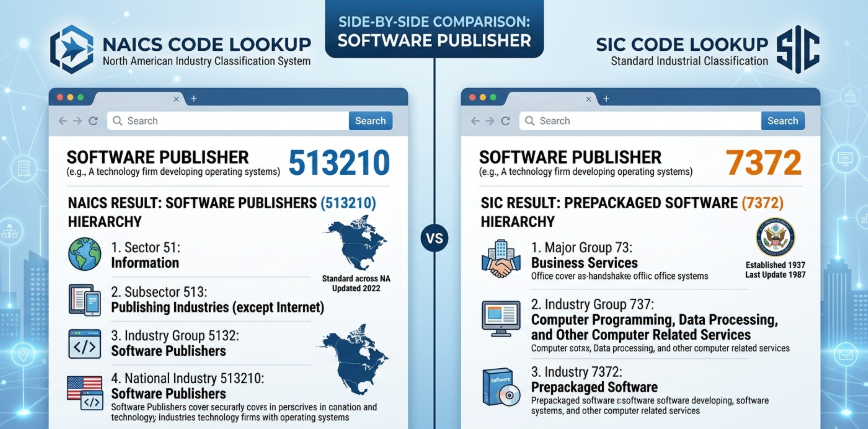
Two official systems dominate business vertical classification in North America — and understanding both matters if you are registering a business, applying for government contracts, or doing market research.
| Feature | NAICS | SIC |
|---|---|---|
| Full Name | North American Industry Classification System | Standard Industrial Classification |
| Year Created | 1997 | 1937 |
| Used By | US, Canada, Mexico | US (legacy), UK still uses SIC |
| Code Length | 6 digits | 4 digits |
| Update Frequency | Every 5 years | Rarely updated |
| Technology Coverage | Strong — includes digital economy | Weak — predates internet |
| Best For | Modern businesses, government contracts | Legacy reporting, older databases |
| Example | 541512 = Computer Systems Design | 7372 = Prepackaged Software |
Which should you use?
For any modern business, NAICS is the standard. If you are submitting bids for US government contracts, NAICS codes are mandatory. For international or legacy reporting, SIC codes may still be required.
Why Business Vertical Classification Matters for SEO
This is where things get practical — and where most guides completely miss the point.
Your business vertical directly affects your SEO strategy in three ways:
1. Keyword targeting Every vertical has its own vocabulary. Healthcare buyers search differently than retail buyers. If you do not understand your vertical, you will target the wrong keywords and attract the wrong traffic.
2. Local SEO and directory listings Google Business Profile, Yelp, and major business directories use vertical-based categories. Choosing the wrong category means appearing in the wrong search results. Choosing the right one can dramatically improve your local visibility.
3. Topical authority Google rewards websites that demonstrate deep expertise in a specific vertical. A cybersecurity blog that covers only cybersecurity topics will always outrank a general tech blog that occasionally covers cybersecurity.
Vertical SaaS vs Horizontal SaaS: The 2026 Investment Debate
This deserves its own section because it is one of the most discussed topics in the startup and investment world right now.
Feature Vertical SaaS Horizontal SaaS Target market One industry All industries Examples Veeva (pharma), Toast (restaurants) Salesforce, HubSpot, Slack Competition Lower — fewer direct rivals Higher — massive players dominate Churn rate Lower — deeply embedded Higher — easier to switch CAC (Customer Acquisition Cost) Lower — targeted marketing Higher — broad targeting Pricing Premium — specialists charge more Competitive — race to bottom Investor interest in 2026 Very high Moderate — market is saturated The investment data backs this up. Vertical SaaS companies consistently show lower churn, higher net revenue retention, and stronger pricing power than their horizontal counterparts.
If you are building a software product in 2026 and you have not decided which vertical to target — this should be your first decision, not your last.
Emerging Business Verticals in 2026
These are the fastest-growing new verticals that did not exist as formal categories five years ago:
1. AI Infrastructure Companies building the picks and shovels of the AI economy — GPUs, training infrastructure, vector databases, AI observability tools.
2. Climate Tech Beyond just renewable energy — carbon accounting software, sustainable supply chain tools, ESG reporting platforms.
3. Creator Economy Tech Tools built specifically for content creators, influencers, and online communities. Patreon, Kajabi, and their competitors operate here.
4. Health Tech and Digital Therapeutics FDA-approved apps that treat medical conditions. A completely new regulatory category that barely existed before 2020.
5. Longevity and Biohacking A niche becoming a vertical — supplements, genetic testing, wearable health monitoring, and longevity clinics.
How to Classify Your Business Correctly: Step by Step
This is the practical section most guides skip entirely.
Step 1: Identify who you actually serve Not what you build — who benefits from it. A software company serving dentists is in the dental/healthcare vertical, not the software vertical.
Step 2: Find your NAICS code Go to census.gov/naics and search by keyword. Find the 6-digit code that most accurately describes your primary activity.
Step 3: Identify your sub-vertical Within your broad vertical, what specific niche do you operate in? The more specific, the better your targeting.
Step 4: Check your competitors’ classifications Look at how your closest competitors describe their vertical in their investor materials, website copy, and LinkedIn company pages.
Step 5: Align your marketing language Your website, ads, and content should use the vocabulary of your vertical — the words your customers actually use to describe their problems.
Step 6: Update your directory listings Make sure Google Business Profile, Yelp, Crunchbase, and any industry-specific directories reflect your correct vertical classification.
Pros and Cons of Vertical Market Specialization
Pros
- Lower customer acquisition cost — targeted marketing reaches the right people faster
- Higher pricing power — specialists always command premium rates
- Stronger word-of-mouth — tight industries talk to each other constantly
- Lower churn — deeply integrated vertical solutions are hard to replace
- Faster trust building — deep industry knowledge signals credibility immediately
- Better SEO — topical authority is easier to build in a defined vertical
Cons
- Smaller total addressable market — you are not serving everyone
- Higher dependency risk — if the vertical struggles, you struggle
- Slower initial growth — narrowing focus feels counterintuitive early on
- Deep industry knowledge required — you cannot fake expertise in a specialized market
- Regulatory complexity — many verticals come with heavy compliance requirements
Common Mistakes in Business Vertical Classification
Mistake 1: Classifying too broadly Saying you are in “technology” is like saying you live “on Earth.” It tells no one anything useful. Go three levels deeper.
Mistake 2: Never revisiting your classification A company that started in retail and now generates 80 percent of revenue from logistics software is no longer a retail company. Reclassify as your business evolves.
Mistake 3: Confusing product category with vertical “SaaS” is not a vertical. “SaaS for independent insurance agencies” is a vertical. The product is how you deliver — the vertical is who you serve.
Mistake 4: Ignoring vertical in SEO strategy Your vertical determines the keywords you target, the content you create, and the authority you build. Ignoring vertical classification in your SEO strategy means competing against everyone instead of dominating your lane.
Mistake 5: Wrong category in business directories Choosing the wrong Google Business category or Crunchbase vertical tag means your business appears in the wrong searches. This is a silent conversion killer most businesses never investigate.
Comparison: Business Vertical Classification by Company Stage
Stage Recommended Approach Idea stage Pick one vertical and go deep — do not try to serve everyone Early startup Validate product-market fit within a single vertical before expanding Growth stage Own your primary vertical before considering adjacent verticals Scale stage Expand into adjacent verticals with similar buyer profiles Enterprise May operate across multiple verticals but maintains vertical-specific product lines
Expert Tips
Tip 1: Your vertical is defined by your buyer — not your technology. A cybersecurity company selling exclusively to hospitals is a healthcare company that uses cybersecurity technology.
Tip 2: In SEO, vertical specialization builds topical authority faster than any other strategy. A website covering only healthcare technology will outrank a general tech site for healthcare tech keywords every time.
Tip 3: When pitching investors, always lead with your vertical. Investors evaluate deals by sector first. A clear vertical classification tells them immediately whether your company fits their thesis.
Tip 4: Use LinkedIn’s industry classification as a research tool. Search competitors and see which vertical they have assigned themselves. This reveals positioning gaps and opportunities.
Tip 5: Do not switch verticals under pressure. Many founders pivot to a broader classification when early sales are slow. This almost always makes things worse. Narrow focus is a competitive advantage — not a limitation.
FAQ Section
What are business vertical classification categories?
Business vertical classification categories are structured systems that group companies based on the specific industry, market, or customer type they serve. Examples include healthcare, financial services, retail, manufacturing, and technology. Each vertical has its own buyer behavior, regulations, and competitive dynamics.
How many business vertical categories are there?
There are 10 core business vertical classification categories that cover the global economy: technology, financial services, healthcare, retail, manufacturing, education, real estate, energy, media, and government. Within each vertical, there are dozens of sub-verticals and niches.
What is the difference between a business vertical and a business niche?
A vertical is a broad industry lane — like healthcare or financial services. A niche is a highly specific segment within that vertical — like mental health apps for teenagers or payment processing for dental practices. Every niche exists inside a vertical, but not every vertical is a niche.
Why does business vertical classification matter for SEO?
Your business vertical determines which keywords you target, which directories you appear in, and how Google categorizes your website. Correct vertical classification helps build topical authority — which is one of the strongest ranking signals in 2026. Wrong classification means competing against irrelevant businesses and attracting the wrong traffic.
What is NAICS and how does it relate to business verticals?
NAICS stands for North American Industry Classification System. It is the official government system for classifying businesses into industry categories using 6-digit codes. It is the most widely used business vertical classification system in the US, Canada, and Mexico and is required for government contract bidding.
What is the difference between a vertical market and a horizontal market?
A vertical market serves one specific industry with tailored products. A horizontal market serves multiple industries with general solutions. Vertical businesses typically have higher pricing power, lower churn, and more targeted marketing. Horizontal businesses have a larger addressable market but face more generic competition.
How do I find my business vertical classification?
Start by identifying who you primarily serve — not what you build. Then use the NAICS code lookup at census.gov/naics to find your official classification. Look at how your closest competitors classify themselves on LinkedIn and Crunchbase. The goal is to find the most specific and accurate vertical that describes your primary market.
Can a business operate in multiple verticals?
Yes, but it is rarely a good strategy for early-stage businesses. Operating across multiple verticals dilutes your messaging, increases your customer acquisition cost, and makes it harder to build topical authority. Most successful companies dominate one vertical before carefully expanding into adjacent ones.
What are the fastest-growing business verticals in 2026?
The fastest-growing business verticals in 2026 include AI infrastructure, climate tech, health tech and digital therapeutics, creator economy tools, and vertical SaaS platforms. These verticals are attracting the highest venture capital investment and showing the strongest revenue growth rates globally.
Is SaaS a business vertical?
No. SaaS is a delivery model, not a vertical. Software as a Service can exist inside any vertical — healthcare SaaS, legal SaaS, retail SaaS. The vertical is defined by the industry you serve, not the technology you use to serve them.
Conclusion
Business vertical classification categories are not a bureaucratic formality. They are a strategic foundation that affects every part of your business — from how you market to how you price, from how you hire to how you rank on Google.
The businesses winning in 2026 are the ones that have stopped trying to serve everyone and started dominating a specific vertical with focused expertise.
Knowing your vertical gives your marketing a target. It gives your SEO a direction. It gives your sales team a story. And it gives investors a clear picture of where you fit in the market.
Start by identifying your true vertical — not the broad sector, but the specific lane. Then build everything — your content, your messaging, your SEO strategy — around owning that lane completely.
The companies that understand this are the ones that grow predictably. The ones that ignore it keep wondering why nothing is working.

Fazilat zulfiqar is an SEO specialist at RankWithLinks, focused on improving search rankings through smart link building and optimization.He helps businesses grow organic traffic and build strong online authority.