
What is guest posting? In plain terms, it is writing an article for a website you do not own, which that website then publishes under your name. The host site gets useful content for its readers. You get your name in front of a new audience, and usually a link back to your own site in your author byline. It is also called guest blogging, and the two terms mean the same thing.
Guest posting is one of the oldest tactics in search marketing, and it is still widely used. It works best when it is treated as publishing, not as a shortcut. A good guest post helps the host site’s readers first. The link is a secondary benefit, not the whole point. This guide explains how guest posting works, what it can and cannot do, how to pitch, and where Google draws the line.
What is guest posting?
Guest posting is the practice of writing and publishing a blog post on another person or company’s website. That is the definition given by Ahrefs in its guest blogging guide, and it is a good one because it keeps the focus where it belongs: on the article and the audience, not on the link alone.
A typical guest post has three parts. First, the article itself, written for the host site’s readers and to that site’s editorial standard. Second, a byline with the writer’s name. Third, a short author bio, which often includes a link back to the writer’s website. Some sites also allow one or two links inside the article body, to pages that genuinely help the reader.
It helps to know what guest posting is not. It is not republishing the same article on many sites. It is not a short, thin post written only to carry a link. And it is not a paid placement dressed up as editorial content. Editors at real publications can spot those quickly, and Google’s rules treat some of them as link spam, as explained later in this guide.
How guest posting works, step by step
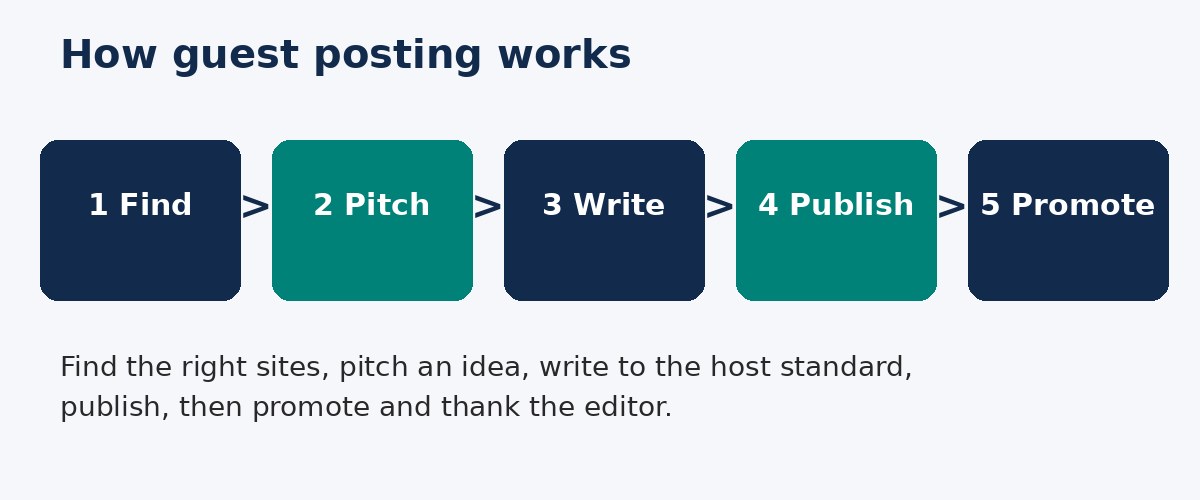
Guest posting follows a simple sequence. Each step matters, and skipping one usually shows in the result.
Step 1: Find the right sites
Start with sites in your field that already publish for an audience you want to reach. Look for real traffic, recent posts, and an editor who actually edits. A site that publishes anything, on any topic, with no clear audience, is a weak choice even if its domain metrics look strong.
Step 2: Pitch an idea, not just yourself
Editors respond to ideas that fit their readers. Read a few recent articles on the site first, then pitch two or three specific titles with a short outline for each. Say why the topic fits their audience. Keep the email short. A pitch that only talks about your site, with no idea attached, is easy to ignore.
Step 3: Write to the host site’s standard
If the pitch is accepted, write the article to the site’s guidelines: length, tone, formatting, and rules on links. Use examples and clear steps. Link to your own site only where it helps the reader, and keep it to one or two links. Good guest posts read like the site’s own content, because in a sense, they are.
Step 4: Publish and promote
The editor may ask for changes before publishing. That is normal. Once the post is live, thank the editor, share the post, and answer any comments. Promotion helps the host site too, and it makes editors more likely to accept your next pitch.
Why businesses use guest posting
Guest posting gives a business four things, in this order of importance: exposure to a new audience, credibility with that audience, referral traffic from readers who click through, and links that can support search rankings.
Ahrefs lists the same benefits for writers: links back to their own site, relationships with editors and site owners, exposure to a new audience, and a stronger reputation. For the host site, the benefit is expert content it did not have to write itself. Ahrefs notes, for example, that it has published guest posts from companies such as Zapier and Pet Keen, sharing first-hand experience it could not have written on its own.
Referral traffic deserves an honest note. Ahrefs surveyed more than 500 bloggers and found that, across 239 guest articles, average referral traffic was only 50 visits per article. A guest post can send useful visitors, but a single post rarely floods a site with traffic. The value builds up over several strong placements on relevant sites, and from the search visibility those links support over time.
What the numbers say about guest posting
The figures below come from named studies, not from guesswork. Read them together: guest posting is popular, outreach is hard work, and links still matter for rankings.
| Statistic | What it shows | Source |
|---|---|---|
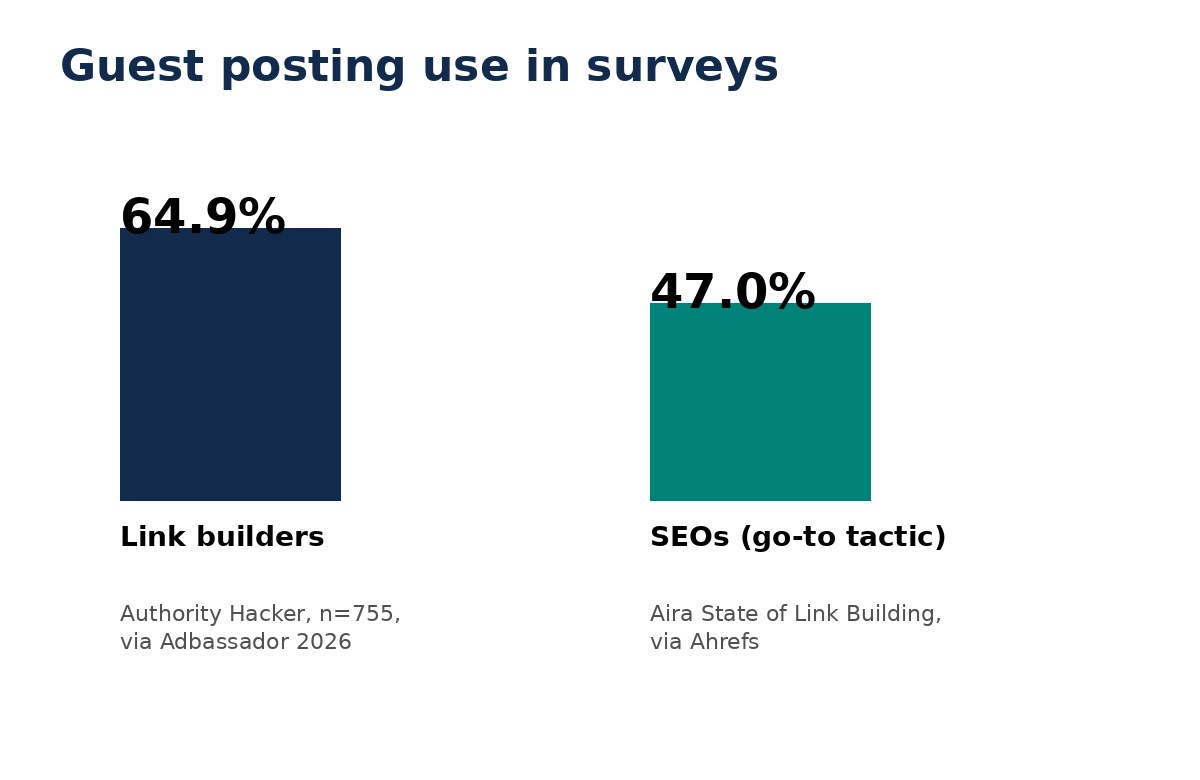
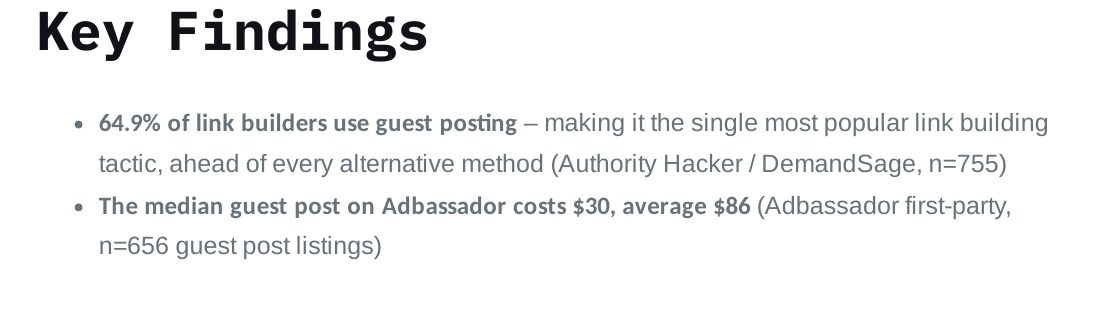
| 64.9% of link builders use guest posting | Guest posting is the most popular link building tactic in this survey (755 link builders) | Authority Hacker survey, reported in Adbassador State of Guest Posting 2026 |
| 47% of SEOs use guest blogging as their go-to tactic | Guest blogging ranks third among link building strategies in this report | Aira State of Link Building, reported by Ahrefs |
| 3.8 times more backlinks for the top result | The result in position 1 has 3.8 times more backlinks than results in positions 2 to 10 | Backlinko (11.8 million results) and Ahrefs (1 million results), reported by Adbassador |
| 8.5% of outreach emails get a reply | Over 9 in 10 pitches go unanswered; about 146 emails are needed per earned link | Backlinko (12 million emails) and Authority Hacker, reported by Adbassador |
| 50 visits average referral traffic | Average referral traffic across 239 guest articles in this survey | Ahrefs blogger survey, reported in the Ahrefs guest blogging guide |
The outreach figures explain why so many campaigns fail. Pitching takes time, most emails get no reply, and a small number of strong placements beats a large number of weak ones. If you want help with outreach done by hand, see our manual link building services.
How to vet a site before you pitch
Before you pitch, run five quick checks. They take a few minutes and save you from placements that do no good.
- Real audience. Does the site have recent posts, comments or shares, and traffic in your topic area? Metrics alone are not proof of a real audience.
- Topical fit. Would the site’s readers care about your topic without being sold to? If not, walk away.
- Editorial standards. Does the site edit its posts, or does it publish anything it is sent? A site with no editing will not help your reputation.
- Link profile. Are its outbound links relevant and restrained, or does every post carry keyword-heavy links to unrelated sites?
- Your own goals. Decide what success looks like before you pitch: brand exposure, referral traffic, or search support. Different goals point to different sites.
A useful warning sign comes from BuzzStream’s analysis of 26,632 sites, reported by Adbassador: fewer than 5% met high-quality thresholds of Domain Rating 71 or higher and 50,000 or more monthly organic visitors. That does not mean only those sites are worth writing for. It means most sites on the market are ordinary, so checking traffic and relevance matters more than chasing one metric.
Guest posting and Google’s rules
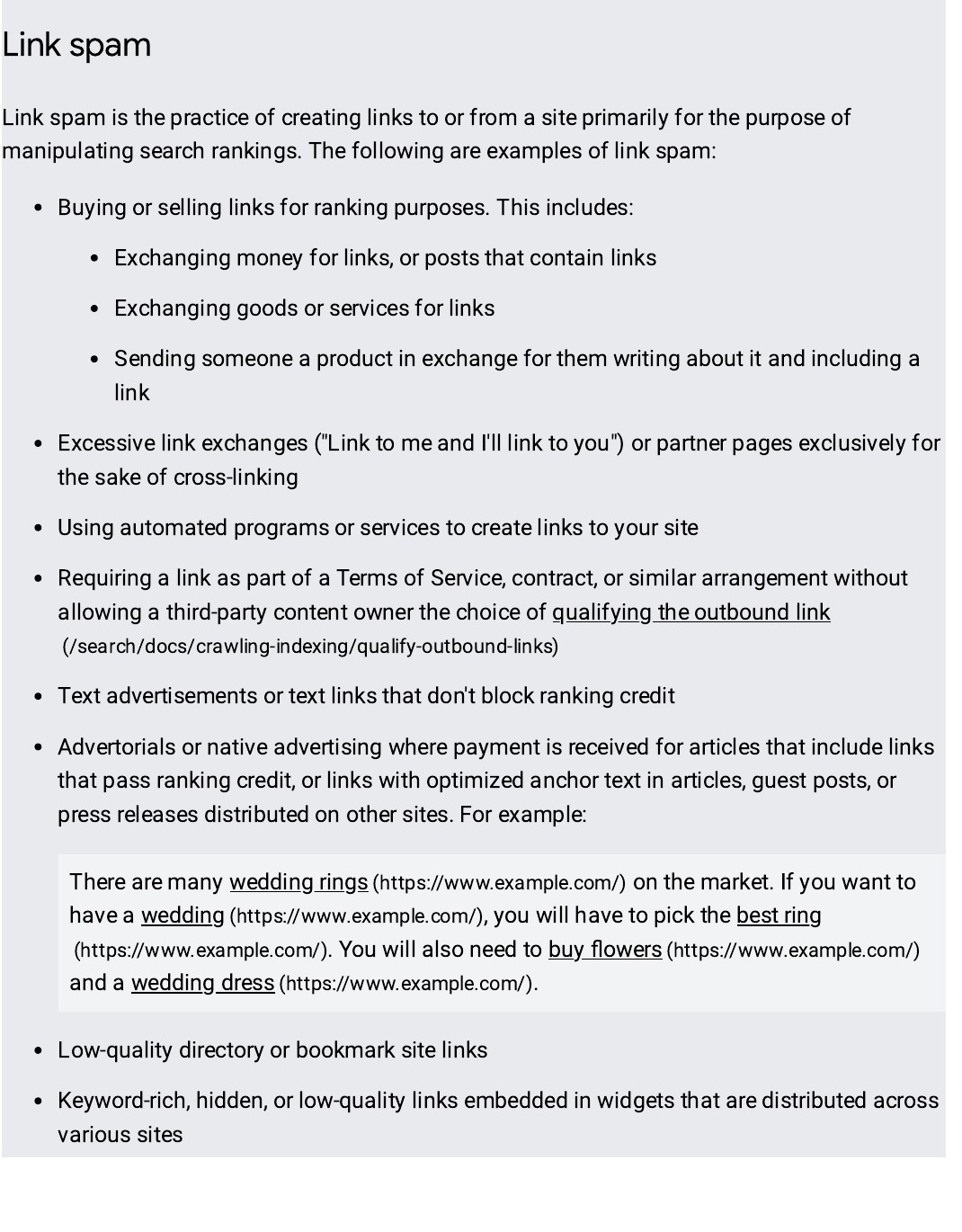
Google does not ban guest posting. Its spam policies target link spam: links created mainly to manipulate rankings. The policies list, as examples of link spam, paid articles that include links passing ranking credit, and links with optimised anchor text in guest posts distributed on other sites.
The safe side of the line is clear. Write a genuinely useful article for a real audience, on a relevant site, with natural links. If money or goods change hands for a link, or a post is sponsored, that link must be qualified with rel=”sponsored” or rel=”nofollow” so it does not pass ranking credit. Google states this plainly in its spam policies: paid or sponsored links are acceptable when qualified in this way.
Site reputation abuse is a related risk. Google introduced this policy for third-party pages posted with little or no oversight from the host site, in order to exploit the host site’s ranking signals. In practice, this means mass-produced guest content on sites that do not edit it is risky, while a well-edited contribution to a relevant publication is not what the policy is aimed at.
Common mistakes to avoid
First, pitching the same generic article to dozens of sites. Editors notice, and readers notice too. Second, stuffing exact-match anchor text into every post. Varied, natural anchors look like editorial links because they are. Third, choosing sites by one metric alone, with no check on traffic or relevance. Fourth, disappearing after publication. A short thank-you and a share cost little and keep the relationship open. Fifth, expecting one post to change rankings on its own. Guest posting supports rankings over time, as part of a wider link building plan, not as a single fix.
Frequently asked questions
Is guest posting still worth it in 2026?
Yes, when it is done as publishing rather than as a volume game. Surveys in 2026 still place guest posting among the most used link building tactics, with 64.9% of link builders in one survey using it. Editors at real sites still want strong articles, and readers still follow authors they trust. What has changed is the standard: thin, mass-produced posts are rejected more often and carry more risk than they used to.
Do guest posts help SEO?
They can help, mainly through editorial links from relevant sites and through the exposure that leads to further links and mentions. Ahrefs’ study of one billion pages found a strong correlation between organic traffic and backlinks from unique websites. That is correlation, not a promise for any single post. A link from a relevant, trusted site helps more than many links from unrelated sites with no real audience.
How many guest posts do I need?
There is no fixed number, and anyone who gives you one without knowing your site is guessing. It depends on your starting point, your competitors, and the quality of the sites you write for. Outreach data shows the work involved: only 8.5% of cold outreach emails get a reply. Start with a small number of strong placements, measure referral traffic and rankings, and build from what works.
Can paying for a guest post cause a penalty?
It can, if the payment buys ranking credit without disclosure. Google’s spam policies treat links bought or sold for ranking purposes as link spam. Paid or sponsored placements must use rel=”sponsored” or rel=”nofollow” so they do not pass ranking credit. The safe course is simple: do not pay for a link that is meant to pass ranking credit, and disclose any paid placement properly.
How do I find sites that accept guest posts?
Search for sites in your niche with contributor or write-for-us pages, and also look at where your competitors have written. Ahrefs suggests using content tools to find blogs covering your topic, then narrowing by relevance and authority. Read each site’s guidelines before pitching, find the right editor, and pitch a specific idea that fits their readers. A targeted pitch to ten good sites beats a generic pitch to one hundred.
Final thoughts
Guest posting, at its best, is simple: write something useful, place it where the right people will read it, and earn trust, traffic, and links over time. It rewards patience and good writing, and it punishes shortcuts. Start with relevant sites, pitch real ideas, write to a high standard, and stay inside Google’s rules. Done that way, guest posting remains one of the most practical ways for a small business to build authority online.

Abdullah Zulfiqar is Co-founder and Client Success Manager at RankWithLinks, an SEO agency helping businesses grow online. He specializes in client relations and SEO strategy, driving measurable results and maximizing ROI through effective link-building and digital marketing solutions.