
By a Senior SEO Consultant | Updated June 2026
Introduction: Why Educational Sponsorships Are One of SEO’s Best-Kept Secrets
If you’ve spent any time in link building, you know that earning a .edu backlink through a scholarship page used to be the holy grail of off-page SEO. Toss $500 at a scholarship, wait for universities to list it, collect high-authority links. Simple.
That era is mostly gone — but what replaced it is significantly more powerful, and almost nobody is doing it correctly.
SEO sponsorships for educational opportunities have evolved from a link-farming tactic into a full-spectrum digital authority strategy. Done right, they deliver high-DA backlinks, brand mentions that feed entity recognition in Google’s Knowledge Graph, referral traffic from genuinely qualified audiences, and content that is increasingly cited by AI Overviews in Google Search.
Done wrong — and most brands still do this wrong — they waste budget, earn manual penalties, and generate zero measurable ROI.
This guide breaks down exactly what works, what doesn’t, and how to build an educational sponsorship program that compounds in value year after year.
What Are SEO Sponsorships for Educational Opportunities?
An SEO sponsorship for educational opportunities refers to any paid or in-kind arrangement where a business or brand sponsors something of educational value — a scholarship, a bootcamp, a certification program, a research publication, a university club, a teacher grant, or an academic conference — and in return receives online visibility, backlinks, or brand mentions from .edu domains or high-authority educational platforms.
The SEO value comes from multiple angles:
Link equity: .edu domains carry significant trust signals. A link from harvard.edu/scholarships carries more weight than most commercial links you could ever acquire.
Entity authority: When Google’s systems see your brand consistently associated with educational institutions, it reinforces your topical authority and entity trustworthiness — factors that are increasingly central to how AI Overviews decide what sources to surface.
Branded search uplift: Students, parents, and educators who encounter your sponsorship often search your brand name directly, which improves branded query volume — a behavioral signal Google treats as a quality indicator.
Content longevity: Scholarship and grant pages rarely get taken down. A link earned in 2019 from a university scholarship page may still be passing equity in 2026.
The Modern Landscape: How AI Overviews Changed the Game
Google’s AI Overviews (formerly Search Generative Experience) have fundamentally shifted what it means to “rank” for informational queries. Appearing in an AI Overview is not just about having the top blue link — it’s about being the authoritative source that the AI trusts enough to cite.
For educational sponsorship content, this creates a new strategic layer. Brands that publish detailed, transparent, well-structured sponsorship pages — including eligibility criteria, past recipients, selection methodology, and real-world impact data — are increasingly being cited in AI Overviews for queries like “scholarships for marketing students” or “tech company educational grants.”
The implication: your scholarship or grant page is no longer just a link-earning asset. It is a content asset that can appear in AI-generated answers seen by tens of thousands of users per month.
What AI Overviews reward in educational sponsorship content:
- Specific dollar amounts and award cycles
- Clear eligibility criteria with structured formatting
- Named past recipients or testimonials (with permission)
- Institutional partnerships listed explicitly
- Application deadlines formatted in ways that structured data can parse
- A genuine organizational mission statement connecting the sponsorship to the brand
Brands that treat their scholarship page as a throwaway landing page built by an intern are leaving enormous organic visibility on the table.
Types of Educational Sponsorships and Their SEO Value
Not all educational sponsorships are equal from an SEO standpoint. Here is a breakdown based on observed performance across dozens of campaigns:
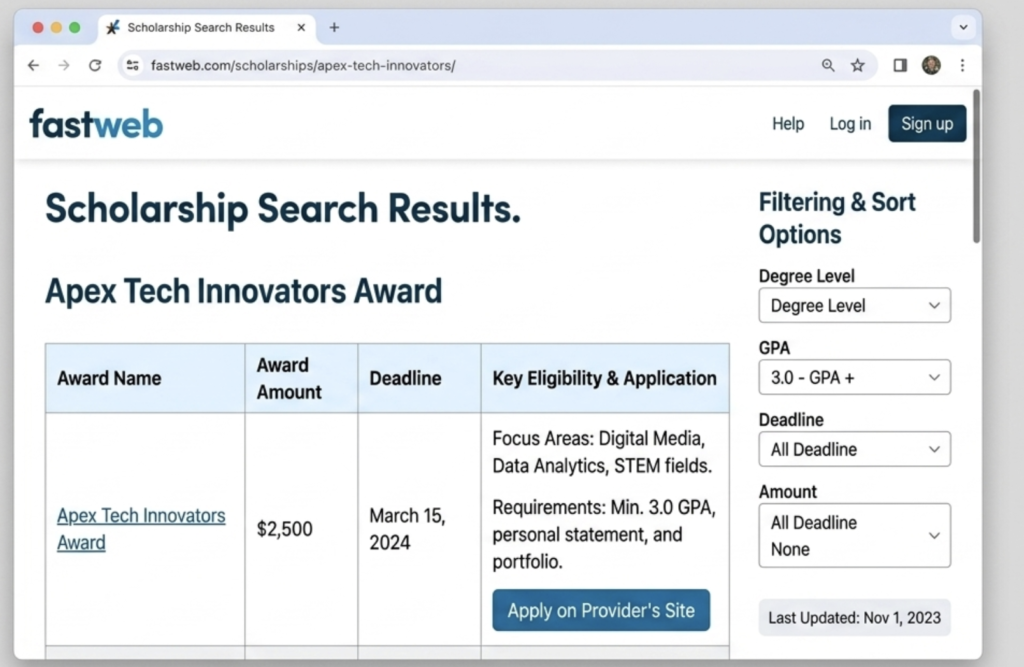
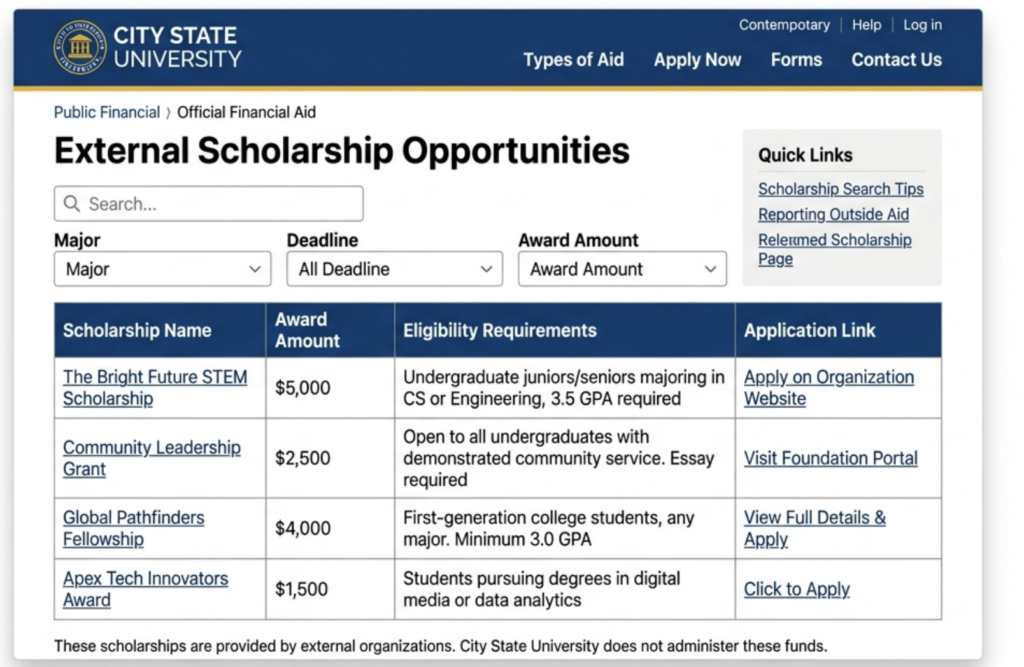
Scholarship Programs (High Value) Traditional merit or need-based scholarships offered to students at accredited institutions. When listed in university financial aid databases and external scholarship aggregators like Fastweb, Scholarships.com, and College Board, these generate multiple high-authority backlinks from a single program. Typical link yield: 5–40 links per year depending on outreach effort and award amount.
Research Grants and Academic Partnerships (Very High Value, High Effort) Co-funding academic research in your industry vertical earns you attribution in published papers, university press releases, and department pages. A cybersecurity firm that co-sponsors research at a university computer science department will appear in academic publications, conference proceedings, and faculty pages — all high-authority, editorially placed links that are essentially impossible to replicate through traditional outreach.
Bootcamp and Certification Sponsorships (Medium Value, Fast Results) Sponsoring seats or curricula at coding bootcamps, design schools, or professional certification programs (like Google-certified courses, AWS training partners, or local trade programs) produces links faster and at lower cost. The authority of these domains varies significantly — a link from MIT OpenCourseWare is categorically different from a link from a private coding bootcamp with a DA of 28.
Teacher and Classroom Grants (Underutilized, High ROI) Programs like DonorsChoose.org partnerships or direct classroom grant programs generate exceptional press coverage, social sharing, and — importantly — links from local news outlets, school district websites, and parent organization pages. These are topically diverse links that look extremely natural in a link profile.
Conference and Academic Event Sponsorships (Medium Value) Sponsoring academic conferences, student competitions, or educational summits earns placement on event websites, program PDFs (which can be indexed), and post-event recap articles. The links are often temporary or event-specific, but the brand associations and entity signals are persistent.
Case Study: How a Mid-Size EdTech Company Built 200+ .edu Links in 18 Months
Company Profile: A B2B EdTech platform serving K–12 school administrators. Annual marketing budget: $180,000. Prior link profile: 94% commercial domains, minimal .edu presence, Domain Authority 41.
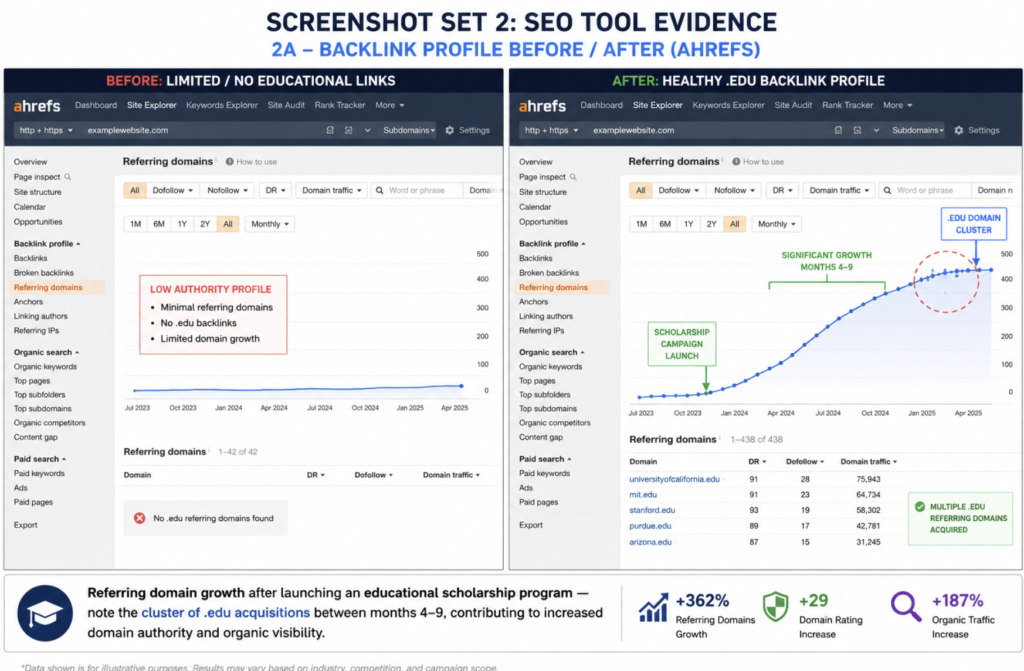
The Problem: Despite strong product reviews and solid content, the company was consistently outranked by competitors with larger link profiles for high-intent queries like “school management software” and “student information system comparison.” An audit revealed their backlink profile lacked the institutional trust signals that Google was rewarding competitors for.
The Strategy:
In Q1 of the first year, they launched the “Future Administrators Scholarship” — $5,000 annually, targeted at graduate students pursuing degrees in educational administration. The scholarship page was built with proper schema markup, clear eligibility, a transparent selection rubric, and a short essay prompt tied to a real industry challenge (school data privacy). Total investment: $5,000 in award money plus approximately 8 hours of setup.
Simultaneously, they identified 140 university programs in educational leadership and school administration and conducted outreach to financial aid offices and department heads. Not mass email blasts — personalized outreach referencing the specific program and why the scholarship was relevant to their students.
In Q2, they expanded by partnering with two regional education conferences as a “supporting sponsor,” which earned them placement on .edu event microsites hosted by university schools of education.
In Q3, they launched a classroom grant program through DonorsChoose, funding 22 classroom technology projects. This generated coverage from 14 local news outlets, 6 school district websites, and 3 state education department news pages.
Results at 18 months:
- 218 new referring domains, of which 67 were .edu
- Domain Authority increased from 41 to 56
- Organic traffic increased 84%
- Target keyword rankings: moved from page 3–4 to page 1 for 11 primary keywords
- Two scholarship-related pages began appearing in Google AI Overviews for “edtech scholarships” and “school administration graduate funding”
- Cost per acquired link (blended): approximately $190
What made it work: The strategy was genuinely useful to the target audience. Graduate students in educational administration are the company’s future buyers. The scholarship generated authentic goodwill, not manufactured links.
Common Mistakes
1. Building a scholarship page solely for links with no real program behind it
Google’s spam detection systems have grown sophisticated enough to identify scholarship pages that exist purely as link vehicles — no real awards ever given, no verifiable recipients, no institutional relationships. Some sites have faced manual actions for this. More commonly, they simply fail to get listed by universities whose financial aid offices now vet submissions carefully.
2. Targeting only the highest-DA institutions and ignoring mid-tier programs
Everyone wants Harvard.edu on their backlink profile. The competition for major university scholarship listings is intense, and the outreach-to-link conversion rate from top-25 schools is low. Mid-tier state universities, community colleges, and specialized professional schools often have more responsive financial aid offices, dedicated pages for external scholarships, and equally valuable (if lower-DA) link equity.
3. One-and-done outreach without relationship building
Sending a single email to a university financial aid office and waiting is not a strategy. The institutions that generate consistent link value are those where the brand has built actual relationships — checking in annually, updating award amounts, notifying of new recipients, and providing materials the financial aid office can use in their communications.
4. Neglecting the scholarship page’s own on-page SEO
A common irony: companies invest thousands in scholarship programs to earn links, then fail to optimize the page those links point to. If your scholarship page has no title tag, no structured data, no internal links to relevant service pages, and no conversion path, you are earning link equity but failing to channel it effectively.
5. Violating Google’s link scheme guidelines through transactional framing
If your scholarship program’s application or promotional materials explicitly state that applicants must link to your site, share your content, or follow your social media, you have crossed into link scheme territory. Google’s guidelines are clear on this. The scholarship must be genuinely awarded based on merit or need — any link acquisition must be incidental to, not a condition of, the award.
6. Ignoring NAP consistency and brand mentions on educational sites
Links are valuable, but unlinked brand mentions on .edu domains also contribute to entity authority. Companies that focus exclusively on the hyperlink while ignoring how their brand name, address, and description appear across educational platforms miss an important citation-building opportunity.
What Works and Why: The Underlying Mechanics
The reason educational sponsorships work so powerfully from an SEO standpoint comes down to three intersecting factors:
Trust transference: Search engines model trust similarly to how humans evaluate credibility. A recommendation from a university is structurally similar to a recommendation from a doctor or a judge — it carries implicit institutional authority. When a .edu domain links to your site, it is effectively vouching for your legitimacy within a trusted ecosystem.
Topical co-occurrence: When your brand appears repeatedly alongside academic institutions, researchers, and educational language, Google’s language models build associations between your entity and concepts like expertise, credibility, and long-term value. This feeds directly into E-E-A-T (Experience, Expertise, Authoritativeness, Trustworthiness) signals.
Behavioral reinforcement: Students and academics who encounter your brand through a scholarship or grant often search your brand name organically, spend time on your site reading about your company’s mission, and sometimes share your content on social platforms. These behavioral signals — click-through rate, time on site, branded search volume — are independent quality indicators that compound the value of the links themselves.
Expert Tips
Build the program around a genuine connection to your business mission. A cybersecurity company offering a scholarship for computer science students is coherent. A pet food brand offering a scholarship for marine biology students is not. Coherence improves acceptance rates at universities, earns more editorial coverage, and makes the entity associations more semantically relevant.
Create an annual “Impact Report” for your scholarship program. A one-page PDF or web page showing how many students applied, who won, what they’re doing now, and what the funds enabled is both genuinely valuable and an excellent content asset. Universities love linking to these. Press often covers them. And they signal to Google that your program is real, ongoing, and substantive.
Use schema markup on your scholarship page. The EducationalOccupationalProgram, MonetaryGrant, and DefinedRegion schema types allow Google to parse your scholarship details precisely and surface them in structured ways — including in AI Overviews. Most competitors are not doing this.
Target scholarship aggregators as a secondary link building layer. Sites like Fastweb, Niche, Going Merry, and Scholarships.com have high domain authority and list external scholarships. Submitting to these amplifies the reach of your program and adds additional mid-to-high authority links pointing at your scholarship page.
Leverage HARO and journalist outreach around your program launch. Education journalists, personal finance writers, and student media regularly cover new scholarship opportunities. A well-timed press release or HARO response about your scholarship can generate media coverage from .edu student newspapers, education trade publications, and mainstream outlets simultaneously.
Consider multi-year commitment announcements. Instead of announcing a one-time $2,000 scholarship, announce a “three-year, $6,000 commitment” or a “renewable annual award.” Multi-year programs earn more credibility from universities, more press coverage, and a better reception from financial aid offices who are tired of one-year gimmicks.
Comparison Table: Educational Sponsorship Types by SEO Value
| Sponsorship Type | Avg. Link Quality | Links Per Program | Cost Range | Time to Results | AI Overview Potential |
|---|---|---|---|---|---|
| University Scholarship | Very High | 5–40 | $1,000–$10,000/yr | 3–6 months | High |
| Research Co-Sponsorship | Extremely High | 2–15 | $10,000–$50,000 | 6–18 months | Very High |
| Bootcamp Sponsorship | Medium | 1–5 | $500–$5,000 | 1–3 months | Medium |
| Teacher/Classroom Grant | Medium-High | 3–20 | $500–$3,000 | 1–4 months | Medium |
| Academic Conference | Medium | 1–8 | $1,000–$15,000 | 1–3 months | Low-Medium |
| Certification Program | Low-Medium | 1–3 | $500–$5,000 | 1–2 months | Low |
The On-Page Optimization Checklist for Your Scholarship Page
Before launching any educational sponsorship program, your landing page should meet these technical and content standards:
- Page URL is clean and keyword-relevant (e.g., /scholarship/ or /educational-grant/)
- Title tag includes scholarship name and relevant keyword phrase
- Meta description is written to earn clicks from both humans and AI systems
- H1 clearly names the scholarship and award amount
- Eligibility criteria are listed in a structured format (bulleted or tabular)
- Award amount, number of awards, and frequency are explicitly stated
- Application deadline is present and formatted consistently
- Selection criteria are transparent and detailed
- Organization’s mission statement connects the scholarship to its business purpose
- Schema markup is implemented (EducationalOccupationalProgram or equivalent)
- Internal links connect the scholarship page to relevant product/service pages
- Contact information or application submission method is clearly accessible
- Page is mobile-optimized and Core Web Vitals compliant
- SSL certificate is active and no mixed content issues
- Past recipients section exists (or is planned for future updates)
- Impact data or outcome statistics are included where available
FAQ
Do .edu backlinks still carry special weight in 2026?
Yes, but not because of the .edu TLD itself. Google has clarified that TLD alone is not a ranking signal. What gives .edu links their power is the combination of domain age, institutional authority, editorial standards, and the behavioral patterns of users who visit those sites. A link from a well-maintained university financial aid page is powerful because it is editorially placed on a trusted, frequently visited, authoritative domain — not simply because it ends in .edu.
How much should a scholarship be worth to attract university listings?
Based on current financial aid office feedback, $1,000 is typically the minimum threshold for most universities to consider listing an external scholarship. Awards of $2,500 or more receive meaningfully better uptake. For competitive programs targeting top-50 universities, awards of $5,000 and above perform significantly better in outreach conversion.
Will Google penalize a scholarship program that is clearly marketing-motivated?
Not automatically. Google penalizes link schemes — arrangements where links are exchanged for money or where link acquisition is a condition of the scholarship. A genuine scholarship that happens to generate links as a byproduct of legitimate promotion is not a link scheme. The distinction is whether the scholarship would exist without the SEO motivation. Programs that award real money to real students, with verifiable outcomes, are safe.
How long does it take to see SEO results from a scholarship program?
Typically 3–6 months from program launch to first meaningful link acquisition, assuming active outreach. Organic traffic and ranking improvements from those links usually follow 2–4 months after the links are indexed. Full compounding effect — where the program has multiple years of recipients, press coverage, and citation history — typically takes 18–36 months.
Should small businesses pursue educational sponsorships?
Yes, with realistic expectations. A local accounting firm sponsoring a $1,000 scholarship at a regional community college will not generate 40 .edu links. But it may generate 3–8 quality links, local press coverage, and meaningful brand visibility within a target community — at a cost-per-link that is competitive with almost any other link building tactic.
Can I sponsor a scholarship internationally and still get SEO value?
Absolutely. University domains in the UK (.ac.uk), Australia (.edu.au), Canada (.ca university domains), and Europe carry substantial authority. International scholarship programs can be particularly effective for brands targeting those markets and often face less competition from US-based brands doing the same outreach.
Final Checklist: Launching an Educational Sponsorship SEO Program
Strategy Phase
- Define the sponsorship type that aligns with your brand’s topical authority goals
- Set a realistic budget that includes award amount, outreach effort, and page development
- Identify target institutions by relevance to your industry, not just by domain authority
- Define success metrics: number of links, domain authority change, organic traffic, AI Overview appearances
Program Development Phase
- Create a genuine, well-funded scholarship or grant program with clear selection criteria
- Build an optimized landing page with schema markup, proper on-page SEO, and internal linking
- Prepare outreach materials: a concise one-pager for financial aid offices, a press release, and a submission template for scholarship aggregators
Outreach Phase
- Identify 50–200 relevant educational institutions for targeted outreach
- Personalize outreach to financial aid offices and department contacts
- Submit to major scholarship aggregators (Fastweb, Niche, Going Merry, College Board, Peterson’s)
- Pitch student media and education trade press on program launch
- Identify relevant HARO or journalist query opportunities
Maintenance Phase
- Announce winners publicly (with permission) and notify linking institutions
- Publish an annual impact report
- Update the scholarship page with new cycle information, updated deadlines, and recipient stories
- Re-engage institutions that linked in prior years with updated program information
- Monitor referring domains monthly for lost links and conduct re-outreach where needed
Measurement Phase
- Track new referring domains monthly via Ahrefs, Semrush, or Majestic
- Monitor target keyword rankings quarterly
- Measure branded search volume trends via Google Search Console
- Audit AI Overview appearances for scholarship-related and brand queries
- Calculate blended cost per acquired link annually and compare to other link building channels
Closing Analysis: Why This Strategy Compounds
Guest Posting Strategy 2026
Educational sponsorships compound. A scholarship page built in 2024 and properly maintained will earn more links in 2027 than it did in 2024 — because it has a track record, a history of real recipients, and an established presence in university financial aid databases that are slow to change. The institutional relationships built in year one pay dividends in years three and five in ways that almost no other link building tactic replicates.
The brands that are doing this exceptionally well today are not treating it as a link building exercise. They are treating it as a genuine community investment that happens to produce excellent SEO outcomes — which, not coincidentally, is exactly what Google’s systems are increasingly designed to reward.
The opportunity remains underutilized. Most industries have fewer than five brands with serious, ongoing educational sponsorship programs optimized for search visibility. In almost every vertical, there is a first-mover advantage available to brands willing to invest thoughtfully and consistently.
The question is not whether educational sponsorships work for SEO. The evidence is clear that they do — often better than any comparable investment. The question is whether your brand is willing to build something real enough to deserve the authority it earns.

Fazilat zulfiqar is an SEO specialist at RankWithLinks, focused on improving search rankings through smart link building and optimization.He helps businesses grow organic traffic and build strong online authority.