
What Is the Best Database Software for Large Datasets?
When dealing with large datasets, not all database software is created equal. Standard relational databases work well for modest data volumes, but once you move into terabytes, petabytes, or billions of rows, you need purpose-built systems designed for scale, speed, and reliability.
The best database software for large datasets in 2026 includes PostgreSQL, Apache Cassandra, Google BigQuery, Snowflake, MongoDB, Amazon Redshift, ClickHouse, Apache HBase, Microsoft Azure Synapse Analytics, and Teradata. Each excels in different scenarios — from real-time analytics to distributed storage to cloud-native data warehousing.
Choosing the wrong database for large-scale data can result in slow query performance, ballooning infrastructure costs, and systems that break under load. Choosing the right one means faster insights, lower costs, and a foundation that scales with your business.
Why Standard Databases Struggle With Large Datasets
Most traditional database systems were designed in an era when gigabytes were considered large. They store data on a single server, use rigid schema structures, and rely on row-based storage that becomes painfully slow when scanning billions of records.
As data volumes have exploded across industries — e-commerce transactions, IoT sensor streams, social media activity, financial records, healthcare data — the limitations of conventional databases have become impossible to ignore.
The problems that emerge at scale include:
- Query slowdowns as table sizes grow beyond what indexes can efficiently handle
- Storage bottlenecks when a single machine cannot hold the full dataset
- Write contention when thousands of concurrent writes compete for the same resources
- Backup and recovery failures when dataset size makes traditional approaches impractical
- Analytical limitations when OLTP databases are forced to run complex aggregations
Modern large-scale database software solves these problems through distributed architecture, columnar storage, horizontal scaling, and intelligent query optimization.Organizations that also invest in AI/ML enabled data integration software can automate how data flows into these systems
Top 10 Best Database Software for Large Datasets in 2026
1. PostgreSQL
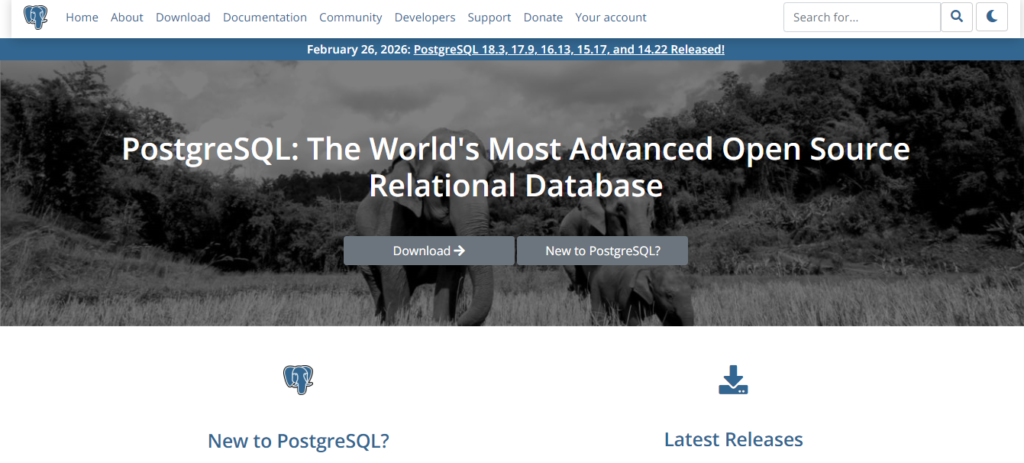
PostgreSQL is the most advanced open-source relational database in the world, and in 2026 it remains a powerhouse for large datasets — particularly when combined with extensions designed for scale. It handles complex queries, massive joins, and enormous table sizes with remarkable efficiency when properly configured.
Key Features:
- Advanced query planner and optimizer for complex workloads
- Table partitioning for managing billions of rows efficiently
- Parallel query execution across multiple CPU cores
- TimescaleDB and Citus extensions for time-series and distributed workloads
- JSONB support for flexible semi-structured data at scale
- Native full-text search across large document collections
- Robust ACID compliance for data integrity at any size
Best For: Organizations that need a reliable, battle-tested relational database with the flexibility to scale through extensions and partitioning strategies.
Weakness: Single-node PostgreSQL has practical limits; true horizontal scaling requires extensions like Citus or external sharding solutions.
2. Apache Cassandra
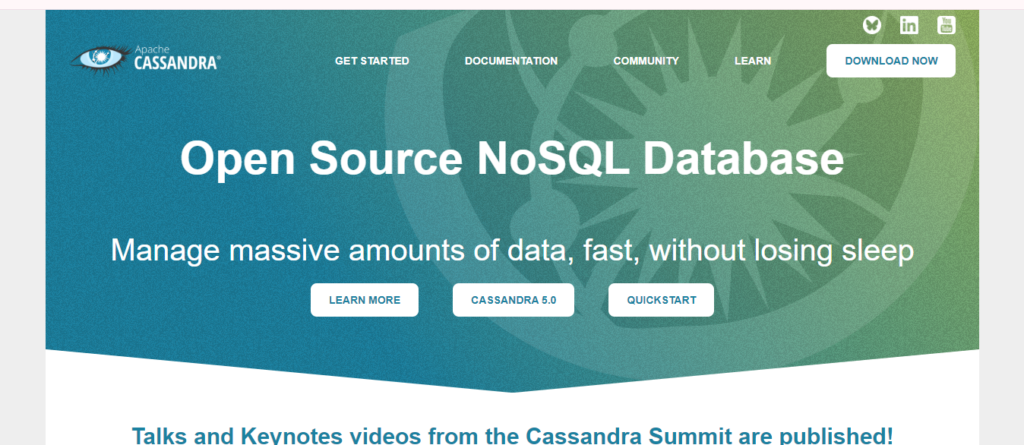
Apache Cassandra is a distributed NoSQL database originally developed at Facebook to handle massive write loads across geographically distributed data centers. In 2026, it remains the top choice for applications that require high availability, fault tolerance, and linear horizontal scalability.
Key Features:
- Masterless distributed architecture with no single point of failure
- Linear scalability — add nodes to increase capacity and throughput
- Tunable consistency for balancing performance and data accuracy
- Optimized for high write throughput across distributed nodes
- Multi-datacenter replication for global applications
- Compaction strategies for managing large datasets on disk
- CQL (Cassandra Query Language) for familiar SQL-like syntax
Best For: Applications with extremely high write volumes, global distribution requirements, and workloads where availability matters more than complex querying — such as IoT data pipelines, messaging platforms, and time-series logging.
Weakness: Limited support for complex joins and ad-hoc analytical queries; data modeling requires careful upfront planning around access patterns.
3. Google BigQuery
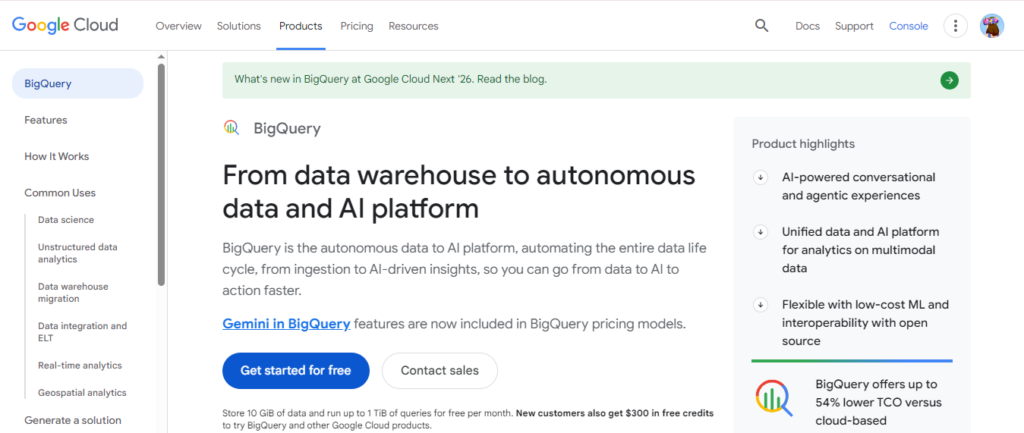
Google BigQuery is a fully managed, serverless cloud data warehouse built for massive-scale analytical workloads. It separates storage from compute, allowing organizations to query petabytes of data without managing any infrastructure whatsoever.
Key Features:
- Serverless architecture with zero infrastructure management
- Columnar storage engine for extremely fast analytical queries
- Standard SQL support with built-in machine learning capabilities
- BigQuery Omni for querying data across AWS and Azure
- Automatic scaling with no capacity planning required
- Real-time data ingestion via BigQuery Streaming
- Built-in geospatial analysis and BI Engine for dashboards
Best For: Data analysts, data science teams, and organizations that need to run complex analytical queries on petabyte-scale datasets without managing servers or clusters.
Weakness: Cost can escalate quickly with poorly optimized queries; not suitable for transactional workloads or low-latency application databases.
4. Snowflake
Snowflake has redefined cloud data warehousing and by 2026 it is one of the most widely adopted platforms for large-scale data analytics across enterprise organizations. Its unique multi-cluster shared data architecture allows virtually unlimited concurrency without performance degradation.
Key Features:
- Separate compute and storage layers for flexible scaling
- Multi-cluster virtual warehouses for concurrent workloads
- Automatic query optimization and result caching
- Data sharing across organizations without copying data
- Time Travel for accessing historical data up to 90 days
- Support for semi-structured data including JSON, Avro, and Parquet
- Native integrations with dbt, Tableau, Power BI, and major ETL tools
Best For: Enterprise data teams, data lakes, and organizations running multiple concurrent analytical workloads that require consistent performance regardless of user load.
Weakness: Costs can be difficult to predict at scale; Snowflake’s credit-based pricing requires careful governance to avoid bill shock.
5. MongoDB
MongoDB is the world’s most popular document database, and in 2026 its Atlas platform makes it one of the most scalable and accessible options for managing large volumes of semi-structured and unstructured data in the cloud.
Key Features:
- Flexible document model with no rigid schema requirements
- Horizontal sharding for distributing data across multiple servers
- Atlas Search for full-text search across large datasets
- Time Series Collections optimized for sequential data
- Aggregation pipeline for complex data transformations
- Multi-cloud and multi-region deployment via Atlas
- Change Streams for real-time data event processing
Best For: Applications with diverse, evolving data structures — such as content platforms, product catalogs, user profile stores, and real-time applications with unpredictable schema changes.
Weakness: Not optimized for complex multi-collection joins or highly relational data models; analytical query performance lags behind dedicated data warehouses.
6. Amazon Redshift
Amazon Redshift is AWS’s flagship cloud data warehouse, built on a massively parallel processing architecture that delivers fast query performance across datasets ranging from gigabytes to petabytes. In 2026, Redshift Serverless has made it more accessible to teams of all sizes.
Key Features:
- Massively parallel processing for fast analytical queries
- Columnar storage with automatic compression
- Redshift Spectrum for querying data directly in S3
- Automatic workload management and query prioritization
- Deep integration with the broader AWS ecosystem
- Redshift Serverless for on-demand scaling without cluster management
- ML-powered automatic table optimization and vacuuming
Best For: Organizations already invested in the AWS ecosystem that need a powerful, tightly integrated data warehouse for large-scale business intelligence and reporting.Redshift works best when paired with AI/ML data integration tools that automate data movement from multiple sources into the warehouse.
Weakness: Performance tuning requires expertise; less flexible than Snowflake for multi-cloud or cross-platform data sharing scenarios.
7. ClickHouse
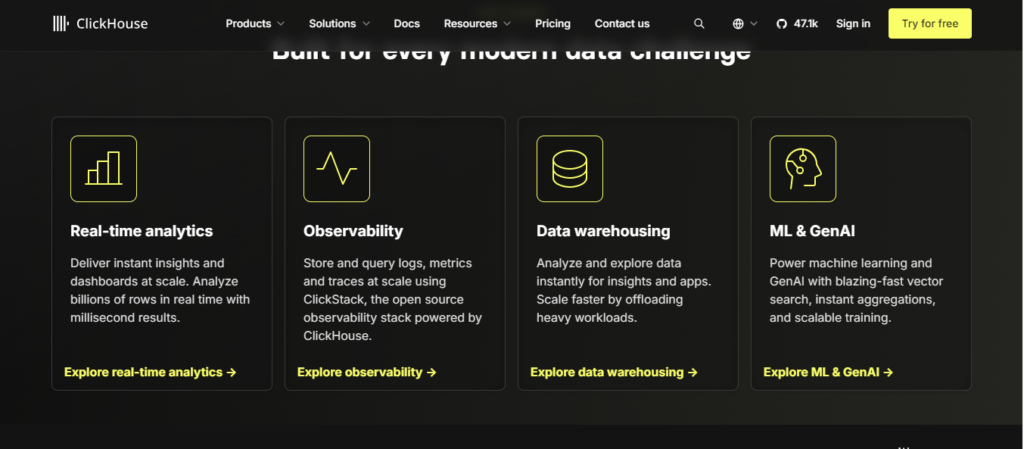
ClickHouse is an open-source columnar database management system purpose-built for real-time analytical queries on very large datasets. In 2026, it has become the go-to solution for organizations that need sub-second query performance on billions of rows of event and log data.
Key Features:
- Columnar storage with exceptional compression ratios
- Vectorized query execution for extreme analytical speed
- Real-time data ingestion without performance penalty
- Distributed table engine for horizontal scaling
- MergeTree engine family optimized for time-series and event data
- SQL support with extensive analytical functions
- ClickHouse Cloud for fully managed deployment
Best For: Product analytics, log analysis, clickstream data, observability platforms, and any workload requiring real-time aggregations over billions of rows.
Weakness: Not designed for transactional workloads; limited support for UPDATE and DELETE operations compared to traditional relational databases.
8. Apache HBase
Apache HBase is an open-source, distributed, non-relational database modeled after Google’s Bigtable. It runs on top of the Hadoop Distributed File System and is designed for random read and write access to extremely large tables — billions of rows and millions of columns.
Key Features:
- Stores billions of rows with millisecond random read access
- Horizontal scaling across commodity hardware clusters
- Strong consistency for all read and write operations
- Native integration with the Hadoop ecosystem
- Coprocessors for server-side data processing
- Automatic region splitting and load balancing
- Bloom filters for efficient data lookups
Best For: Organizations with existing Hadoop infrastructure that need random access to massive datasets — such as telecommunications companies, financial institutions, and large-scale web applications.
Weakness: Complex operational overhead; requires significant expertise to configure and maintain; Hadoop dependency adds infrastructure complexity.
9. Microsoft Azure Synapse Analytics
Azure Synapse Analytics is Microsoft’s unified analytics platform that combines enterprise data warehousing with big data analytics in a single service. In 2026, it has become a central hub for large-scale data workloads within the Microsoft and Azure ecosystem.
Key Features:
- Dedicated SQL pools for structured data warehousing at petabyte scale
- Serverless SQL pools for on-demand querying of data lakes
- Apache Spark integration for big data processing
- Native integration with Power BI for real-time reporting
- Azure Machine Learning integration for in-platform model training
- Data Lake Storage Gen2 as the underlying storage layer
- Synapse Link for near real-time analytics on operational databases
Best For: Enterprises already operating within the Microsoft ecosystem that need a unified platform for data warehousing, big data processing, and business intelligence in one place.
Weakness: Can be complex to architect correctly; licensing and cost management require careful planning across the multiple compute options available.
10. Teradata
Teradata is one of the original enterprise data warehouse platforms, and in 2026 it continues to serve some of the world’s largest organizations — banks, retailers, telecoms, and governments — that manage some of the most complex and voluminous datasets on the planet.
Key Features:
- Massively parallel processing optimized for complex analytical SQL
- Vantage platform combining data warehouse and data lake capabilities
- Advanced workload management for hundreds of concurrent users
- QueryGrid for federated queries across multiple data sources
- In-database machine learning and statistical functions
- Proven at exabyte scale in production environments
- Industry-specific solutions and optimized data models
Best For: Large enterprises with complex, multi-petabyte analytical environments, regulatory compliance requirements, and mission-critical reporting workloads that cannot tolerate downtime.
Weakness: High licensing and infrastructure costs make it impractical for small and mid-sized organizations; less agile than cloud-native alternatives for rapid experimentation.
How to Choose the Best Database Software for Large Datasets
Understand Your Workload Type First
The most important distinction in large-scale database selection is whether your workload is transactional or analytical.
OLTP (Online Transaction Processing) workloads involve frequent reads and writes of individual records — think e-commerce orders, banking transactions, or user account updates. PostgreSQL, MongoDB, and Cassandra excel here.
OLAP (Online Analytical Processing) workloads involve complex queries that scan large portions of a dataset to produce aggregations and reports. BigQuery, Snowflake, Redshift, and ClickHouse are purpose-built for this.
Many modern organizations run both workload types and need separate systems or a platform that bridges both.
Consider Data Structure and Schema Flexibility
If your data is highly structured and relational, PostgreSQL, Redshift, and Snowflake are natural fits. If your data is semi-structured, document-based, or schema-flexible — such as product catalogs, event logs, or user-generated content — MongoDB and Cassandra offer the flexibility you need.Businesses running cloud-based inventory management software often deal with exactly this type of constantly changing product and order data.
Evaluate Scalability Requirements
Ask yourself how your data will grow over the next three to five years. Tools like Cassandra and HBase scale horizontally with near-linear performance gains as you add nodes. Cloud-native platforms like BigQuery and Snowflake scale automatically without any infrastructure management. On-premises solutions require more careful capacity planning.
Match Deployment Model to Your Team
Cloud-managed services like BigQuery, Snowflake, and Redshift Serverless reduce operational overhead dramatically. Self-managed open-source solutions like PostgreSQL, Cassandra, and ClickHouse offer more control and lower licensing costs but require dedicated database administration expertise.
Factor In Query Complexity
If your analytical use case requires complex SQL with many joins, window functions, and nested aggregations, Snowflake, BigQuery, and Redshift handle these elegantly at scale. If your queries are simpler but need to run at extreme speed over billions of rows in real time, ClickHouse is in a class of its own. Even after choosing the right database, the real work starts at implementation. You need to turn workload needs into a working system. This includes data modeling, scaling design, and query planning. These choices decide how well the system performs in real use. In most cases, this requires help from professional software developers who can build and tune the system for production use.
Key Technical Concepts to Understand When Selecting Large Dataset Databases
Columnar vs. Row-Based Storage
Row-based databases store all fields of a record together, which is efficient for retrieving complete individual records. Columnar databases store each field across all records together, which is dramatically more efficient for analytical queries that only read a few columns from millions of rows.
For large dataset analytics, columnar storage is almost always the right choice. BigQuery, Snowflake, Redshift, and ClickHouse all use columnar storage as their foundation.
Horizontal vs. Vertical Scaling
Vertical scaling means upgrading to a more powerful single server. It has a hard ceiling and becomes extremely expensive at scale. Horizontal scaling means adding more servers to the cluster, distributing data and queries across all of them. Cassandra, HBase, and MongoDB are designed from the ground up for horizontal scaling.
Distributed Query Processing
Modern large dataset databases distribute query execution across multiple nodes in parallel, dramatically reducing query time. Massively parallel processing platforms like Redshift and Teradata split a single query into thousands of parallel tasks, each processing a slice of the data simultaneously.
Data Partitioning and Sharding
Partitioning divides a large table into smaller, more manageable segments based on a key — such as date, region, or customer ID. Sharding distributes those partitions across multiple servers. Both techniques are essential for managing billion-row tables efficiently and are supported across most enterprise database platforms.
Common Mistakes When Choosing a Database for Large Datasets
Choosing a Tool Based on Familiarity Alone
Many teams default to the database they already know rather than the one best suited to their scale and workload. Using a standard MySQL or SQLite setup for petabyte-scale analytics is a common and costly mistake. A more strategic approach involves syncing apps with a modern analytics platform purpose-built for high-volume workloads, ensuring that data flows seamlessly across your stack without the performance bottlenecks and scalability ceilings that legacy database configurations typically impose.
Ignoring Future Data Growth
A database that handles your current 500 GB of data comfortably may buckle completely when that grows to 50 TB in two years. Always evaluate tools based on where your data will be, not just where it is today.
Underestimating Operational Complexity
Open-source distributed databases like Cassandra and HBase offer tremendous power but demand significant operational expertise. Without experienced database administrators, these systems can become maintenance nightmares. Cloud-managed options reduce this burden considerably.
Overlooking Cost at Scale
Cloud data warehouses charge by the query, compute hour, or data scanned. Poorly written queries or unoptimized schemas can generate unexpected and substantial costs. Always model your expected query patterns and data volumes against the pricing model before committing.
Using One Database for Everything
Large-scale data architectures often require multiple specialized databases working together — a transactional database for application data, a data warehouse for analytics, and a caching layer for high-speed reads.Organizations using workforce productivity tracking software face this exact challenge as employee activity data must be stored and reported on simultaneously Trying to force a single tool to do everything typically results in mediocre performance across all use cases.
Best Database Software for Large Datasets by Use Case
Best for cloud-native analytics at petabyte scale: Google BigQuery
Best for enterprise data warehousing: Snowflake
Best for high write throughput and global distribution: Apache Cassandra
Best for real-time event and log analytics: ClickHouse
Best for AWS-integrated data warehousing: Amazon Redshift
Best for flexible document data at scale: MongoDB
Best for open-source relational workloads: PostgreSQL
Best for Hadoop-based random access: Apache HBase
Best for Microsoft ecosystem integration: Azure Synapse Analytics
Best for mission-critical enterprise at exabyte scale: Teradata
The Future of Large Dataset Databases in 2026 and Beyond
Several important trends are reshaping the large-scale database landscape in 2026.
AI and machine learning integration is moving from an external step to an in-database capability. Platforms like BigQuery ML, Snowflake Cortex, and Redshift ML allow teams to train and run ML models directly on their data without moving it to a separate system.
Data lakehouse architecture — combining the flexibility of a data lake with the performance and governance of a data warehouse — has gone mainstream. Platforms like Databricks, Snowflake, and Azure Synapse are converging on this model, blurring the traditional line between storage and compute.
Real-time analytics is no longer optional for most organizations. The ability to query fresh data within seconds of it being generated — rather than waiting for overnight batch jobs — is now a competitive necessity. ClickHouse, Apache Kafka integrated pipelines, and streaming-native databases are driving this shift.
Serverless databases continue to mature, making enterprise-grade large-scale data infrastructure accessible to organizations without dedicated infrastructure teams. BigQuery and Redshift Serverless lead this category, but the model is spreading across the industry.
Final Thoughts
Selecting the best database software for large datasets is one of the most consequential technical decisions an organization can make. Get it right and you build a foundation that accelerates every data-driven initiative. Get it wrong and you spend years fighting performance problems, spiraling costs, and systems that cannot keep up with your growth.
In 2026, the good news is that the options have never been better. Whether you need a serverless cloud warehouse, a distributed NoSQL system, a real-time analytical engine, or an enterprise-grade platform with decades of proven reliability, there is a solution built precisely for your requirements.
Start by understanding your workload type, data structure, growth trajectory, and team capabilities. Test your top candidates against real workloads — not benchmarks — before committing. And never assume that the tool that worked at your previous scale will work at your next one.
The right database does not just store your data. It transforms your ability to use it.

Fazilat zulfiqar is an SEO specialist at RankWithLinks, focused on improving search rankings through smart link building and optimization.He helps businesses grow organic traffic and build strong online authority.