
Best CRM Marketing Software for B2C in 2026: The Ultimate Guide
Introduction: Why B2C CRM Marketing Software Matters More Than Ever
Consumer expectations have never been higher. In 2026, buyers expect brands to know who they are, remember what they purchased, anticipate what they need next, and reach them on the channel they actually use. Meeting these expectations at scale — whether you have one thousand customers or ten million — is simply not possible without the right technology.
That technology is B2C CRM marketing software.
This guide is designed to help business owners, marketing managers, and e-commerce operators find the best CRM marketing software for B2C in 2026. You will find detailed platform breakdowns, a feature comparison framework, practical buying advice, and strategic guidance for getting the most out of whichever platform you choose.
Whether you are evaluating CRM software for the first time or reconsidering your current tool after outgrowing it, this article will give you everything you need to make a confident, informed decision.
What Is B2C CRM Marketing Software?
CRM stands for Customer Relationship Management. In a B2C context — business to consumer — a CRM marketing platform is software that helps companies collect, organize, and act on customer data to build stronger relationships and drive more revenue.
B2C CRM marketing software is distinct from B2B CRM tools in several important ways. B2B CRM platforms are built around account management, long deal cycles, and multi-stakeholder sales processes. B2C CRM platforms, by contrast, are designed for:
High volumes of individual customer records — often in the millions. Fast, emotionally driven purchasing decisions that require timely, relevant communication. Multichannel consumer touchpoints including email, SMS, push notifications, social media, and in-store interactions. Automated marketing journeys that run continuously without manual intervention. Personalization at a scale that would be impossible to achieve manually.
When marketers talk about the best CRM marketing software for B2C, they are typically looking for a platform that unifies customer data, enables sophisticated segmentation, powers automated campaigns across multiple channels, and delivers clear reporting on revenue impact.
The State of B2C CRM Marketing in 2026
The CRM landscape has shifted significantly over the past two years. Several forces are reshaping what businesses expect from their marketing CRM software.
Artificial Intelligence Is Now Central, Not Optional
In 2024 and 2025, AI features in CRM platforms were largely experimental — promising but inconsistent. By 2026, AI has become deeply embedded in the core functionality of leading platforms. Predictive send time optimization, churn risk scoring, product recommendation engines, and AI-generated subject line testing are now standard features rather than premium add-ons.
Businesses that are not leveraging AI-powered CRM capabilities are operating at a measurable disadvantage compared to competitors who are.
First-Party Data Has Become the Most Valuable Asset in B2C Marketing
With third-party cookies fully deprecated across all major browsers and privacy regulations tightening in markets worldwide, the data businesses collect directly from their own customers has become extraordinarily valuable. Your email list, your purchase history database, your loyalty program members — this is first-party data, and your CRM is where it lives.
The best B2C CRM marketing platforms in 2026 are built with first-party data management at their core. They help businesses collect data ethically, organize it effectively, and activate it across every marketing channel.
Omnichannel Expectation Is Universal
Consumers in 2026 do not think in channels. They think about brands. A customer might discover your product on Instagram, research it on your website, buy it through your app, and reach out with a question via SMS — all within 48 hours. The best CRM marketing software tracks this customer across every one of those touchpoints and makes sure every interaction feels connected and consistent.
Hyper-Personalization Is Driving Measurable Revenue
Generic email blasts are effectively dead as a high-performing strategy. Research consistently shows that personalized campaigns — those that reference a customer’s specific behavior, preferences, and history — outperform generic campaigns by significant margins. In 2026, the businesses winning in B2C marketing are those using CRM data to personalize every message, every offer, and every experience.
Core Features of the Best B2C CRM Marketing Software
Before comparing specific platforms, it is important to understand which features matter most for B2C marketing. Not every feature on a vendor’s marketing page is equally valuable. These are the ones that directly impact your results.
Unified Customer Profiles
Every interaction a customer has with your brand — every purchase, every email they open, every page they visit, every support ticket they submit — should feed into a single, unified customer profile. This 360-degree view is the foundation of effective personalization and segmentation. Without it, your marketing is based on incomplete data, and your results will reflect that.
Advanced Segmentation
Segmentation is the ability to divide your customer database into meaningful groups and target each group with relevant messaging. The best B2C CRM platforms offer dynamic segmentation, meaning segments update automatically as customer behavior changes. You can build segments based on purchase history, geographic location, engagement level, product category preference, average order value, recency, frequency, and dozens of other variables.
Marketing Automation and Customer Journey Builders
Automation is what makes CRM software economically viable for B2C businesses. Rather than manually sending individual campaigns, you build automated workflows — sequences of messages triggered by specific customer behaviors. A new subscriber triggers a welcome series. An abandoned cart triggers a recovery sequence. A customer who has not purchased in ninety days triggers a win-back campaign. These journeys run around the clock without any manual effort.
The best platforms offer visual journey builders where you can map out these workflows intuitively, including conditional logic that sends different messages based on customer actions.
Email and SMS Marketing
Email remains the highest ROI channel in digital marketing, and SMS has grown dramatically in importance for B2C brands. The best CRM marketing platforms for B2C include both channels natively, connected to the same customer data. This allows you to coordinate campaigns across channels — sending an email first, then following up with an SMS to customers who did not open it, for example. A strong email list helps ensure you are reaching people who actually want to hear from your brand, which improves engagement and results over time. On top of this, an email address finder can support lead generation by helping businesses discover and verify contact details for potential customers more efficiently.
E-Commerce Integration
For retail and e-commerce businesses, deep integration between your CRM and your store platform is non-negotiable. Native integrations with Shopify, WooCommerce, BigCommerce, Magento, or other platforms allow the CRM to automatically sync purchase data, product catalog information, customer order history, and real-time browsing behavior. This integration powers the most effective B2C marketing use cases — cart abandonment, post-purchase upsell, product recommendation, and replenishment reminders.Building on this data, cheap catalog printing enables businesses to create cost-effective, personalized print catalogs based on customer preferences, enhancing offline engagement and supporting targeted marketing efforts.
AI-Powered Features
In 2026, look for CRM platforms that use AI in practical, measurable ways. Predictive lifetime value scoring helps you identify your most valuable customers before they become your most valuable customers. Churn prediction flags customers who are likely to stop buying, giving you time to intervene. Send time optimization analyzes each individual subscriber’s engagement history and delivers your message when they are most likely to open it. Product recommendation engines suggest the right item to the right customer based on behavioral data.
Analytics and Revenue Attribution
Your CRM should show you clearly which campaigns are generating revenue, which customer segments are most profitable, and where your marketing is falling flat. Look for platforms with dashboards that track customer lifetime value, campaign revenue attribution, repeat purchase rate, email revenue per subscriber, and customer acquisition cost. A detailed ranking report can further enhance these insights by showing how your campaigns perform across different channels and audience segments. The ability to connect marketing activity directly to revenue is what separates strategic CRM use from basic email sending.
Customer Retention and Loyalty Features
Acquiring a new customer costs significantly more than retaining an existing one. The best B2C CRM platforms include tools specifically designed to drive repeat purchases and build long-term customer loyalty. This includes loyalty program management, referral tracking, referral program software, win-back automation, VIP customer segmentation, and customer satisfaction measurement tools like Net Promoter Score surveys.. Complementing these retention strategies, call quality monitoring helps ensure that every customer interaction meets high service standards, reinforcing trust and strengthening long-term relationships.
The Best CRM Marketing Software for B2C in 2026
1. Klaviyo — Best for E-Commerce B2C Brands
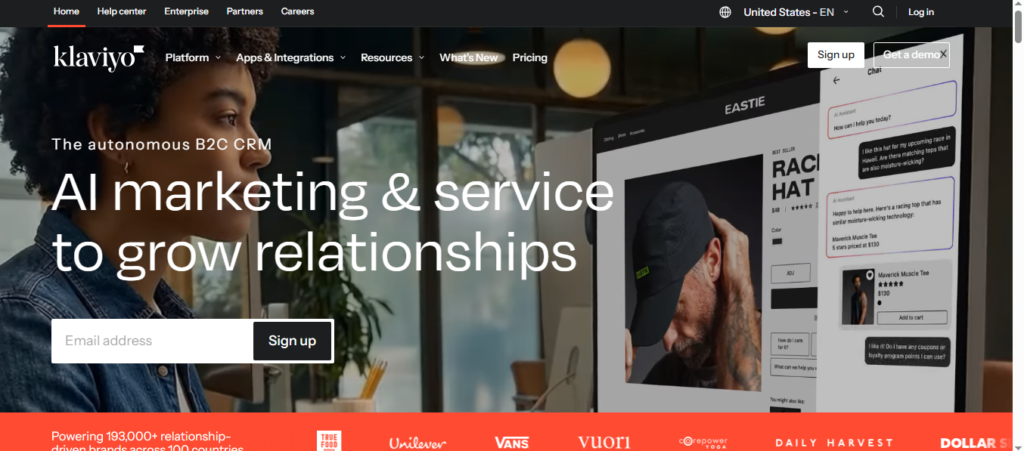
Klaviyo has firmly established itself as the leading CRM marketing platform for e-commerce businesses, and in 2026 it continues to widen its lead through relentless product development and deep platform integration.
Built specifically for consumer brands selling online, Klaviyo’s feature set is precisely aligned with B2C marketing needs. Its integration with Shopify, WooCommerce, BigCommerce, and other major e-commerce platforms is the deepest in the industry, automatically syncing order data, browsing behavior, cart activity, and product catalog information to build rich, real-time customer profiles.
Klaviyo’s flows — its automated journey builder — are the most e-commerce-focused in the market. Pre-built flow templates cover every major B2C use case: abandoned cart recovery, browse abandonment, post-purchase thank-you sequences, customer win-back, sunset flows for unengaged subscribers, and replenishment reminders for consumable products. Each flow can be customized extensively using conditional logic and personalized using any data point in the customer profile.
The platform’s predictive analytics capabilities are among the most sophisticated available. Klaviyo calculates predicted lifetime value, churn risk score, and expected next purchase date for each customer individually. This allows you to create segments like “high predicted LTV, has not purchased in sixty days” and target them with specific campaigns before you lose them.
In 2026, Klaviyo has significantly expanded its AI capabilities. Its AI-powered subject line generator, send time optimization, and campaign content suggestions are now mature features backed by data from billions of marketing interactions. The platform has also strengthened its SMS marketing capabilities, with advanced segmentation and automation for SMS that matches what was previously only possible in email.
Klaviyo’s pricing is contact-based, which can become significant for large lists. But for e-commerce brands that use the platform effectively, the ROI typically justifies the investment many times over.
Best for: E-commerce brands of all sizes, Shopify merchants, direct-to-consumer product businesses, subscription box companies.
Consider if: Your primary marketing channels are email and SMS and your store runs on a major e-commerce platform.
Potential limitations: Less suited for service-based businesses or brands without an e-commerce component.
2. HubSpot Marketing Hub — Best All-in-One CRM for Growing B2C Businesses
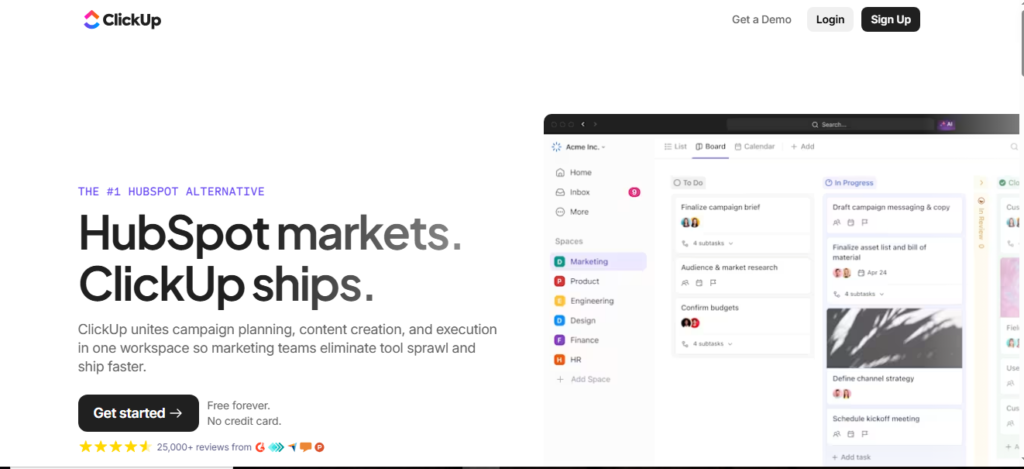
HubSpot remains one of the most widely used and respected CRM marketing platforms in the world, and for B2C businesses that need a comprehensive, integrated marketing suite rather than a channel-specific tool, it is hard to match.
HubSpot’s strength lies in the breadth of its platform. The CRM is the foundation, but built around it is a full marketing hub that includes email marketing, landing page builder, blog and SEO tools, social media management, paid ad management, marketing automation, and detailed analytics — all connected to the same customer database.
For B2C businesses that rely on content marketing, inbound lead generation, and multichannel customer nurturing, this integration is enormously valuable. A customer who finds your brand through a blog post, downloads a resource, subscribes to your email list, and eventually makes a purchase can be tracked through that entire journey within a single platform.
HubSpot’s automation tools are intuitive and powerful. The workflow builder allows you to create sophisticated automated sequences based on any combination of contact properties, behavioral triggers, and CRM data. Its smart content feature lets you personalize website pages, emails, and CTAs dynamically based on who is viewing them.
In 2026, HubSpot has deepened its AI integration through what it calls Breeze AI — a suite of AI tools embedded throughout the platform. These tools assist with content generation, contact enrichment, conversation intelligence, and campaign optimization. The AI features are particularly useful for lean marketing teams that need to produce more output without adding headcount.
HubSpot’s free CRM tier remains genuinely useful for very small businesses, and the platform scales through Starter, Professional, and Enterprise tiers. The pricing at higher tiers can be substantial, particularly as your contact database grows, so it is important to plan your budget accordingly.
Best for: Small to mid-sized B2C businesses, content-driven consumer brands, service businesses that sell to consumers, businesses new to CRM that want a guided onboarding experience.
Consider if: You want one platform that handles CRM, email, content, social, and analytics together.
Potential limitations: Pricing escalates significantly at higher tiers, and some e-commerce-specific features are not as deep as Klaviyo’s.
3. Salesforce Marketing Cloud — Best for Enterprise B2C Organizations
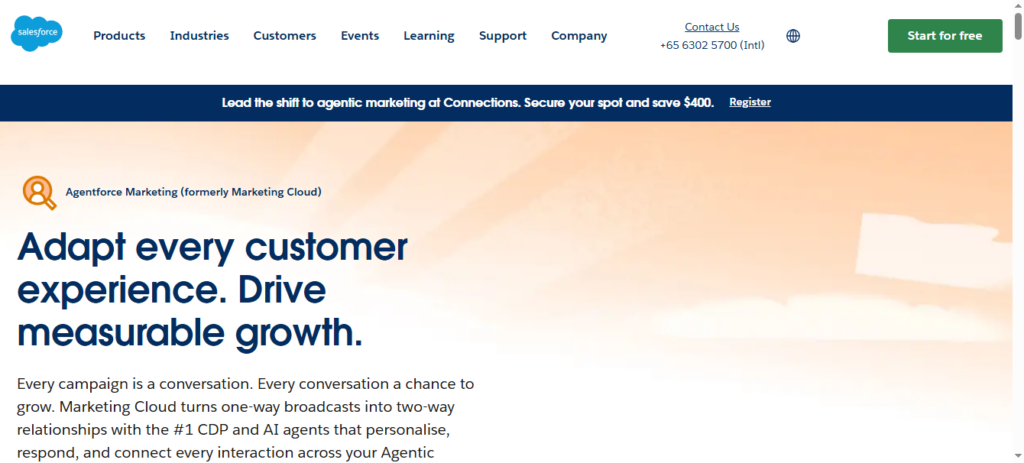
For large consumer-facing organizations — major retailers, airlines, banks, telecommunications providers, healthcare companies — Salesforce Marketing Cloud remains the most powerful and comprehensive CRM marketing platform available.
Its capabilities go beyond what any other platform in this guide can offer. Journey Builder, Salesforce’s flagship feature, allows enterprise marketing teams to design intricate, multi-channel customer journeys that span email, SMS, push notifications, in-app messaging, social advertising, direct mail, and web personalization — all orchestrated from a single canvas and triggered by real-time customer behavior.
Data Cloud, Salesforce’s customer data platform, serves as the intelligence layer underneath Marketing Cloud. It unifies customer data from every source — transactions, CRM records, web behavior, mobile app data, call center interactions, third-party data — into a single customer graph that powers hyper-personalized experiences across every channel.
Einstein AI, Salesforce’s artificial intelligence engine, is embedded throughout the platform. It powers predictive audience segmentation, send time optimization, content recommendations, engagement scoring, and natural language campaign briefing. In 2026, Einstein’s capabilities have expanded significantly, with generative AI features that help marketers create campaign content, build audience segments using natural language prompts, and analyze campaign performance conversationally.
The trade-offs for this power are real. Salesforce Marketing Cloud requires significant investment — both financially and in terms of technical resources to implement and manage. It is not a platform you can set up over a weekend. Most enterprise organizations work with certified Salesforce implementation partners to deploy and configure the platform effectively.
Best for: Enterprise B2C organizations, large retailers, financial services companies, airlines, telecommunications brands, healthcare organizations with large patient or member bases.
Consider if: You have a dedicated marketing operations team, a substantial technology budget, and complex cross-channel marketing requirements.
Potential limitations: High cost, significant implementation complexity, and a steep learning curve make it inappropriate for small or mid-sized businesses.
4. ActiveCampaign — Best for Sophisticated Automation at Mid-Market Scale
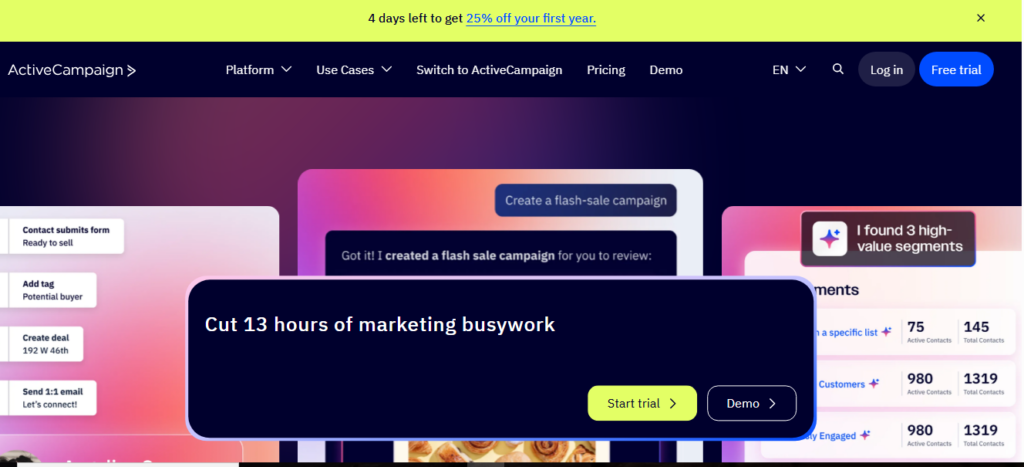
ActiveCampaign occupies a unique position in the B2C CRM market. It is significantly more powerful than entry-level tools like Mailchimp but far more affordable than enterprise platforms like Salesforce. For growing B2C businesses that have outgrown basic email tools but are not ready for enterprise investment, it offers an excellent balance.
The platform’s automation capabilities are genuinely world-class for its price tier. The visual automation builder supports complex conditional logic, split testing within automations, goal-based sequences, and deeply personalized messaging based on any combination of contact data, behavioral triggers, and CRM fields. Building a sophisticated customer lifecycle automation in ActiveCampaign is genuinely straightforward compared to more complex enterprise tools.
ActiveCampaign includes a built-in CRM with deal tracking, lead scoring, and pipeline management. Its site tracking feature monitors what pages customers visit on your website and can trigger automations based on that behavior — a visitor who reads three blog posts about a specific product category can be automatically enrolled in a targeted campaign for that category.
The platform’s machine learning features include predictive sending, which analyzes each contact’s engagement history to deliver emails at the moment they are most likely to open them, and win probability scoring, which helps identify which leads or customers are most likely to convert.
In 2026, ActiveCampaign has continued expanding its e-commerce integrations and has improved its native reporting capabilities significantly. The platform now offers more detailed revenue attribution reporting, making it easier to measure the direct impact of your automation workflows on sales.
Best for: Mid-sized B2C businesses, service-based consumer brands, subscription businesses, businesses that need advanced automation without enterprise pricing.
Consider if: You want deep automation capabilities and a true CRM combined, at a mid-market price point.
Potential limitations: The interface can feel dense and overwhelming for complete beginners, and customer support response times can vary.
5. Brevo — Best Value CRM for B2C Businesses on a Budget
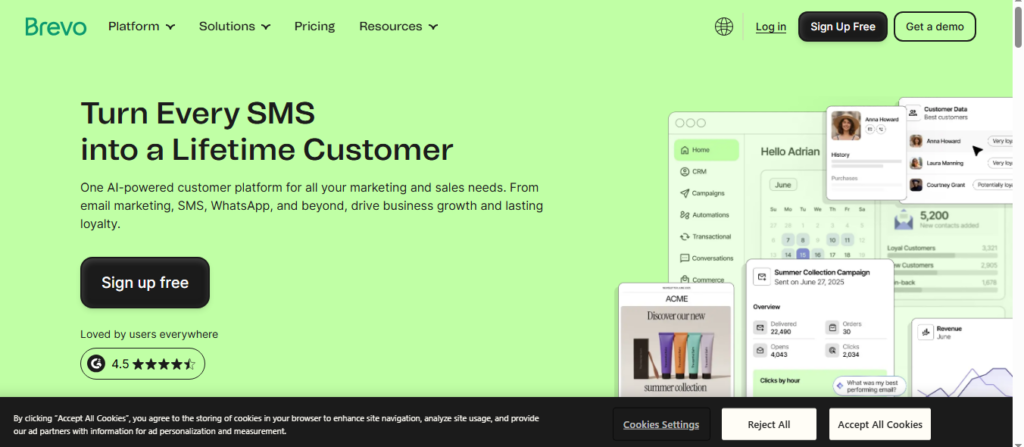
Brevo, formerly known as Sendinblue, has evolved from a simple email marketing tool into a capable multichannel CRM marketing platform that delivers strong performance at a price point that is genuinely accessible for small businesses and startups.
What makes Brevo particularly attractive for budget-conscious B2C businesses is its pricing model. Unlike most competing platforms that charge based on the number of contacts in your database, Brevo charges based on the number of emails you send per month. This means you can maintain a large contact list — say, fifty thousand subscribers — without paying for them all every month. You only pay based on your actual sending volume, which can represent significant savings for businesses with large lists and moderate sending frequency.
The platform covers all the essential B2C CRM marketing bases. Email marketing with a drag-and-drop editor, SMS marketing, WhatsApp messaging, marketing automation with a visual workflow builder, transactional email sending, live chat, and a basic CRM for contact management are all included under one roof.
Brevo’s automation capabilities are solid for its price tier. You can build welcome sequences, abandoned cart reminders, re-engagement campaigns, post-purchase follow-ups, and birthday automations without needing any technical expertise. The workflow builder is clean and intuitive.
The platform has improved its e-commerce integrations in recent years and now connects well with Shopify and WooCommerce. While not as deep as Klaviyo’s integration, it covers the most important use cases for smaller e-commerce businesses.
Best for: Small businesses, startups, nonprofits, businesses with large contact lists and moderate sending frequency, brands prioritizing multichannel messaging on a tight budget.
Consider if: Contact-based pricing from other platforms is straining your budget, or you need email, SMS, and WhatsApp in one affordable platform.
Potential limitations: Less depth in analytics, e-commerce features, and advanced automation compared to Klaviyo or ActiveCampaign.
6. Zoho CRM Plus — Best Integrated Suite for All-in-One B2C Management
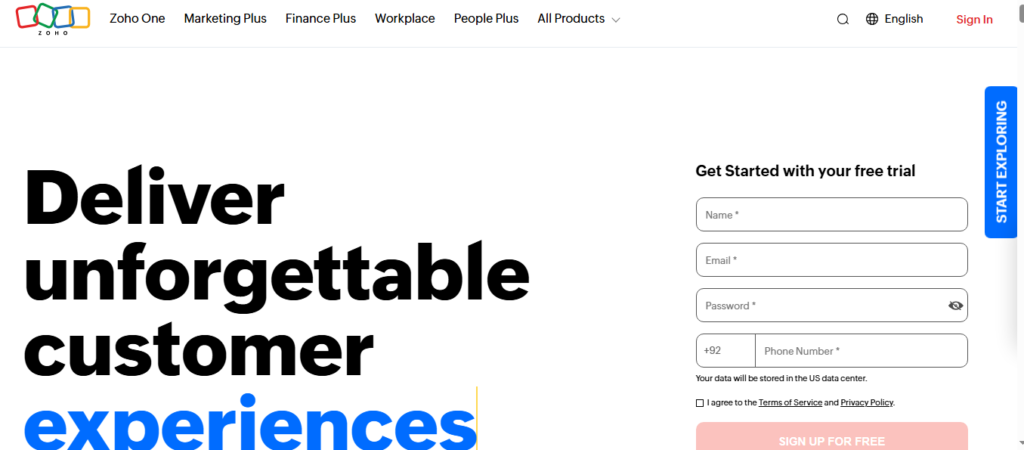
Zoho CRM Plus is a compelling choice for B2C businesses that want a broad, integrated platform covering CRM, marketing, customer service, social media management, and business analytics under a single subscription.
The platform bundles together Zoho CRM, Zoho Campaigns for email marketing, Zoho Desk for customer support, Zoho Social for social media management, Zoho Survey, Zoho Analytics, and several other tools. For businesses that currently pay separately for several of these functions, consolidating onto Zoho CRM Plus can represent meaningful cost savings.
The CRM itself is mature and feature-rich, with contact management, lead scoring, workflow automation, and multichannel communication tools. Its Canvas feature, which allows users to completely redesign the CRM interface without coding, is a standout capability that larger vendors do not offer. Teams that find standard CRM layouts inefficient can create a completely custom interface that matches exactly how they work, often using flexible admin templates to structure dashboards and workflows more efficiently.
Zoho’s AI assistant, named Zia, is embedded throughout the platform and provides predictive sales forecasting, anomaly detection in your data, sentiment analysis on customer communications, and automated data enrichment.
For B2C businesses already using Zoho Books for accounting, Zoho Commerce for e-commerce, or other Zoho applications, CRM Plus fits naturally into an integrated Zoho ecosystem. The data flow between Zoho applications is seamless, which eliminates the integration challenges that come with assembling a stack of tools from different vendors.
Best for: Small to mid-sized B2C businesses, teams already using other Zoho products, businesses that want an all-in-one suite rather than specialized point solutions.
Consider if: You want to consolidate multiple tools under one vendor and one subscription.
Potential limitations: Individual tools within the Zoho suite are generally less powerful than best-in-class standalone alternatives in each category.
7. Insider — Best AI-Driven CRM for Omnichannel B2C Personalization
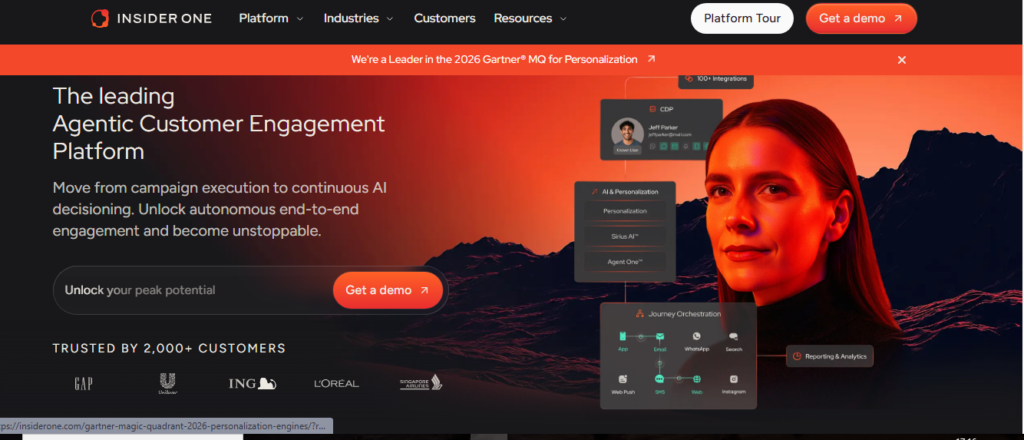
Insider is a newer name in the CRM marketing space but has earned significant attention in 2025 and 2026 as one of the most innovative platforms for omnichannel personalization and AI-driven customer experience.
The platform is designed specifically for B2C brands that operate across multiple channels and need to deliver consistent, personalized experiences at scale. It combines a customer data platform with marketing automation, predictive AI, and activation tools across web, mobile, email, SMS, push notifications, WhatsApp, and onsite personalization — all from a single platform.
Insider’s AI capabilities are among the most advanced available in the mid-market segment. Its Sirius AI layer powers predictive audience building, churn prevention scoring, next best action recommendations, automated A/B testing, and dynamic content personalization. Marketers can describe the segment they want in plain language and the AI builds it automatically, which dramatically reduces the time required to create targeted campaigns.
The platform’s Architect feature — its customer journey builder — is designed for true omnichannel orchestration. You can build journeys that move customers fluidly between channels based on their behavior and engagement, ensuring that your messaging finds each customer where they are most receptive.
Insider is particularly popular with large retail, travel, and financial services brands in high-growth markets. Its case studies consistently show significant uplifts in conversion rate, average order value, and customer retention from brands that implement the platform effectively.
Best for: Mid to enterprise-level B2C brands, omnichannel retailers, travel and hospitality companies, brands that prioritize AI-driven personalization.
Consider if: You need genuine cross-channel journey orchestration and advanced AI personalization beyond what mainstream tools offer.
Potential limitations: Higher price point than most mid-market tools, and implementation typically requires onboarding support.
B2C CRM Marketing Software Comparison: Quick Reference
To help you evaluate options at a glance, here is a summary of how each platform aligns with different business profiles.
Klaviyo is the top choice for e-commerce brands. Its e-commerce integration is unmatched, its predictive analytics are sophisticated, and its email and SMS automation capabilities are the most purpose-built for online retail.
HubSpot is the best all-in-one option for growing businesses. Its breadth of marketing, CRM, and sales tools under one roof makes it ideal for businesses that want a single platform for their entire go-to-market operation.
Salesforce Marketing Cloud is the enterprise standard. No platform matches its depth, scalability, and cross-channel orchestration capabilities for large consumer organizations.
ActiveCampaign delivers the best automation depth for mid-market businesses. It punches well above its price point in terms of automation sophistication and CRM capability.
Brevo is the value leader. Its send-volume-based pricing makes it especially attractive for businesses with large lists and its multichannel capabilities cover the basics well.
Zoho CRM Plus is the best integrated suite. For businesses that want to reduce vendor complexity and consolidate their tools, Zoho’s breadth is genuinely impressive.
Insider is the emerging leader in AI-powered omnichannel personalization. For brands that need sophisticated cross-channel AI capabilities, it is worth serious consideration.
How to Choose the Best B2C CRM Marketing Software for Your Business
Selecting the right platform requires honest self-assessment as much as feature comparison. Here is a practical framework for making the decision.
Step One: Clarify Your Primary Marketing Goals
Start by identifying the two or three marketing outcomes that matter most to your business right now. Is it reducing cart abandonment? Increasing repeat purchase rate? Reactivating lapsed customers? Improving customer lifetime value? Building a loyalty program? The clearer you are about your goals, the easier it becomes to evaluate which platform’s strengths align with what you actually need.
Step Two: Assess Your Current Technology Stack
List every tool your team currently uses for marketing — your e-commerce platform, email tool, analytics suite, ad platforms, customer service software, and anything else. Evaluate which CRM platforms integrate natively with these tools. Strong native integrations eliminate manual data work and keep your customer profiles accurate and complete.
Step Three: Be Realistic About Your Team’s Capacity
A platform is only as valuable as your team’s ability to use it. Consider how much time your team can realistically dedicate to CRM setup, campaign building, and ongoing optimization. If your marketing team is small, prioritize platforms with excellent onboarding resources, intuitive interfaces, and responsive customer support. If you have a dedicated marketing operations function, you can consider more powerful platforms with steeper learning curves.
Step Four: Model the Total Cost of Ownership
Pricing pages do not always tell the full story. Consider not just the monthly or annual subscription cost but also the cost of required integrations, the time investment for implementation and training, and how pricing scales as your contact database grows. Some platforms that appear affordable at entry level become significantly more expensive as you scale.
Step Five: Run a Genuine Free Trial
Every major platform on this list offers either a free trial or a free tier. Use it. Build an actual automation workflow relevant to your business. Import a sample of your real contact data. Send a test campaign. The hands-on experience reveals things that no feature comparison can — how intuitive the interface feels, where the friction points are, and whether the platform fits the way your team thinks about marketing.
Best Practices for B2C CRM Marketing in 2026
Choosing the right software is just the beginning. How you use it determines your actual results.
Treat Your CRM as Your Most Valuable Marketing Asset
Your CRM is not a tool — it is your relationship with your customer base, stored and organized in digital form. Treat it accordingly. Invest in keeping your data clean and complete. Establish clear processes for how customer data is collected, updated, and used. Build a CRM strategy that is connected to your broader business objectives, not just your email calendar.
Build for the Full Customer Lifecycle
Most businesses set up a welcome series and an abandoned cart flow and call their CRM strategy complete. The brands that extract the most value from CRM software are those that build marketing programs for every stage of the customer lifecycle — from first purchase all the way through to advocacy. Map out what the ideal customer journey looks like for your business, then use your CRM to engineer that journey deliberately.
Let Data Drive Your Segmentation Strategy
Start with the segments that are most obviously valuable — new customers, active buyers, lapsed customers, high-value VIPs — and run different programs for each. As you gather more behavioral data, build more nuanced segments. The more precisely you can target, the more relevant your campaigns will be, and relevance is the single biggest driver of email marketing performance.
Test Constantly and Systematically
Every assumption you have about what your customers want to hear, when they want to hear it, and how they want to be reached is a hypothesis that can be tested. Use your CRM’s A/B testing capabilities to test subject lines, send times, offer structures, messaging approaches, and creative formats. Build a culture of systematic testing and let the data guide your decisions.
Measure Revenue, Not Just Engagement
Open rates and click rates are useful indicators, but they are not business outcomes. Configure your CRM to attribute revenue directly to campaigns and automation flows. Measure customer lifetime value growth over time. Track repeat purchase rate. Monitor churn. These are the metrics that tell you whether your CRM marketing is genuinely building your business or just generating activity.
Common Mistakes to Avoid When Implementing B2C CRM Software
Knowing what not to do is as valuable as knowing what to do.
Importing a dirty contact list and building on a broken foundation is one of the most common and costly mistakes. Before migrating your data to a new CRM, clean it thoroughly. Remove duplicates, correct formatting errors, validate email addresses, and standardize field values.
Trying to automate everything at once is another frequent mistake. Start with the two or three workflows that will deliver the most immediate value — typically a welcome series and an abandoned cart recovery flow for e-commerce businesses. Get those working well before expanding to more complex programs.
Failing to integrate properly with your e-commerce platform or website means your CRM is working with incomplete data. Incomplete data means inaccurate segments and irrelevant messaging. Make sure your integrations are configured correctly and that data is flowing accurately before you start running campaigns.
Neglecting list hygiene over time degrades your deliverability and your data quality. Regularly suppress or remove contacts who have been completely unengaged for an extended period. A smaller, highly engaged list outperforms a large, disengaged one in every meaningful metric.
Frequently Asked Questions About B2C CRM Marketing Software
What is the difference between B2C CRM and B2B CRM?
B2C CRM is designed for high-volume consumer relationships where purchasing decisions are individual, often emotional, and relatively fast. B2B CRM is built for account-based relationships with longer sales cycles, multiple decision-makers, and larger deal values. While some features overlap, the best B2C CRM platforms are optimized for consumer-scale data, multichannel direct marketing, and behavioral personalization in ways that B2B tools are not.
How much does B2C CRM marketing software cost?
Pricing varies widely. Brevo offers plans starting from free with paid tiers from around fifteen dollars per month. HubSpot’s free CRM is genuinely functional, with paid Marketing Hub plans starting from around fifty dollars monthly. Klaviyo’s pricing is contact-based and starts from free for small lists. ActiveCampaign plans start from around fifteen dollars per month. Salesforce Marketing Cloud starts at significantly higher price points and is typically quoted through enterprise licensing. The right budget depends on your contact list size, the features you need, and the scale of your marketing operation.
Can I use a CRM for both email and SMS marketing?
Yes. Most leading B2C CRM platforms in 2026 include both email and SMS marketing natively. Klaviyo, HubSpot, Brevo, ActiveCampaign, and Insider all support both channels from a single platform, connected to the same customer data and usable within the same automation workflows.
How long does it take to implement a B2C CRM?
Implementation timelines vary based on the complexity of your data, the depth of your integrations, and the number of automations you want to build. A basic implementation — importing contacts, setting up integrations, and launching a welcome series and abandoned cart flow — can be completed in one to two weeks on most mid-market platforms. A full-featured implementation with complex segmentation, multiple automations, and deep analytics configuration typically takes four to twelve weeks.
What is the most important CRM metric for B2C businesses?
Customer lifetime value is the single most important metric for most B2C businesses. It tells you how much revenue the average customer generates over the full course of their relationship with your brand, which allows you to make smarter decisions about acquisition spending, retention investment, and marketing resource allocation.
Final Verdict: The Best B2C CRM Marketing Software in 2026
After evaluating the full landscape, here is the bottom line.
For e-commerce businesses, Klaviyo is the clear first choice. Its purpose-built e-commerce features, deep integrations, predictive analytics, and sophisticated email and SMS automation make it the most effective platform for online retailers of any size.
For growing B2C businesses that need a comprehensive all-in-one platform, HubSpot Marketing Hub delivers the best combination of breadth, usability, and scalability.
For enterprises with complex cross-channel marketing requirements, Salesforce Marketing Cloud is the most powerful option available, with unmatched depth and flexibility.
For mid-market businesses that need sophisticated automation without enterprise pricing, ActiveCampaign delivers exceptional value.
For small businesses and startups prioritizing affordability and multichannel reach, Brevo is the strongest option.
For businesses that want an integrated all-in-one suite and already operate within or alongside other business tools from a single vendor, Zoho CRM Plus is the most efficient choice.
For brands prioritizing cutting-edge AI-driven omnichannel personalization, Insider is the platform to evaluate seriously.
The most important truth about B2C CRM marketing software is this: the platform you choose matters less than the strategy you bring to it. A clear understanding of your customer lifecycle, a commitment to data quality, a culture of testing and optimization, and a genuine focus on delivering value to your customers — these are what separate brands that thrive with CRM software from those that pay for a platform and underutilize it.
Choose the platform that fits your business today, use it with discipline and strategy, and the results will follow.

Usman Hakim is an SEO specialist at RankWithLinks, focusing on link building and organic growth. He helps brands improve search rankings through white-hat strategies, including guest posting and authority backlinks.