
The way we verify who someone is — over a phone call, inside a banking app, or at a digital checkpoint — is quietly undergoing a fundamental transformation. Three forces are converging to drive that change: the rise of agentic AI, the voice security intelligence of Pindrop, and the decentralized identity architecture of Anonybit. Together, they represent a new frontier in how machines protect human identity.
What Is Agentic AI?
Agentic AI refers to artificial intelligence systems that don’t just respond to prompts — they pursue goals autonomously across multi-step tasks, make decisions independently, and take actions in the real world without waiting for a human to approve every move.
Unlike the chatbots of a few years ago, agentic AI systems can browse the web, execute code, call APIs, manage workflows, and coordinate with other AI agents. They plan, they adapt, and they persist until a task is complete.
This is powerful. It is also dangerous.
The moment AI can act autonomously — book appointments, initiate transactions, authenticate on behalf of users, or impersonate a voice — the attack surface for fraud explodes. Traditional security systems were designed for humans interacting with machines. Agentic AI inverts that assumption entirely. Now you need to verify whether the entity on the other end of a call or session is a human, a trusted AI agent, or a malicious one.
That is precisely the problem that companies like Pindrop and Anonybit were built to solve, even before agentic AI made it urgent.
Pindrop: Securing the Voice Channel in an Age of Synthetic Speech
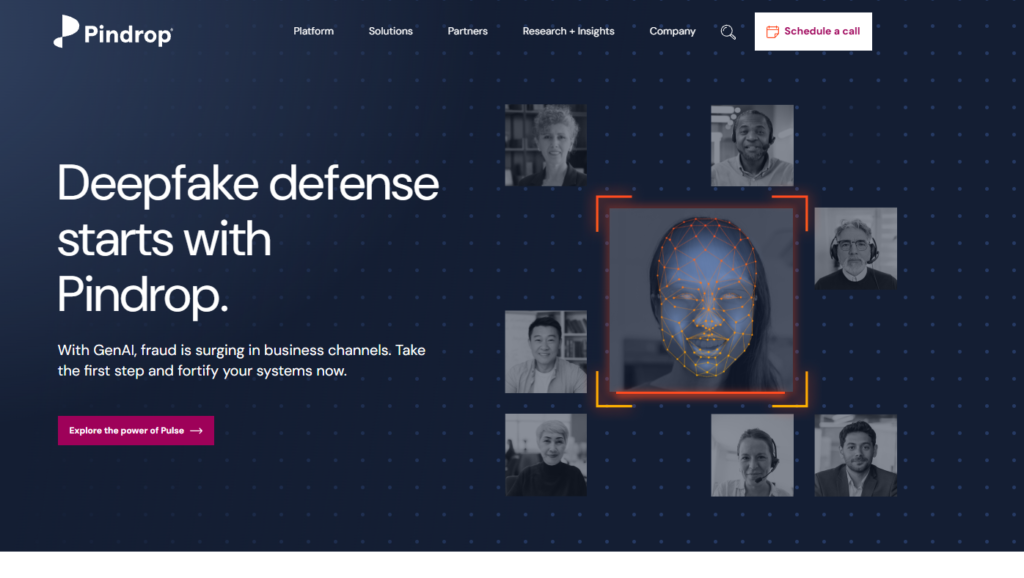
Pindrop is a voice security and authentication company headquartered in Atlanta. Its technology is used by the majority of the largest banks, insurers, and contact centers in the United States to detect fraud in real time during phone calls.
What Pindrop does, at its core, is analyze everything about a phone call that a human wouldn’t notice but a machine can measure with precision: the acoustic properties of the audio, the device the caller is using, the network path the call traveled, behavioral patterns in how someone speaks, and the metadata surrounding the call event.
From these signals, Pindrop builds what it calls a “phoneprint” — a unique fingerprint for that call. When a fraudster attempts to impersonate a legitimate customer, even using sophisticated voice-cloning software, anomalies in the phoneprint betray them.
This matters enormously in the era of agentic AI because voice synthesis has become alarmingly accessible. Tools that clone a voice from just a few seconds of audio are now widely available. Contact centers — which handle billions of calls annually — are on the front lines of this threat. A fraudster deploying an AI agent to call a bank, using a cloned voice of the account holder, and navigating an automated IVR system represents a fully automated attack chain. No human required on the attacker’s side.
Pindrop’s technology sits in the middle of that chain and asks: does this voice, this device, this call pattern match what we know about the legitimate user? If the answer is uncertain, it flags or blocks the interaction before fraud occurs.
The company has expanded its capabilities in response to the generative AI threat specifically. Its deepfake detection research has demonstrated the ability to identify synthetic audio with high accuracy, even as voice AI models improve. The arms race is real, and Pindrop has positioned itself as a core infrastructure layer in defending against AI-generated voice fraud at scale.
Anonybit: Decentralizing Identity So There’s Nothing Left to Steal
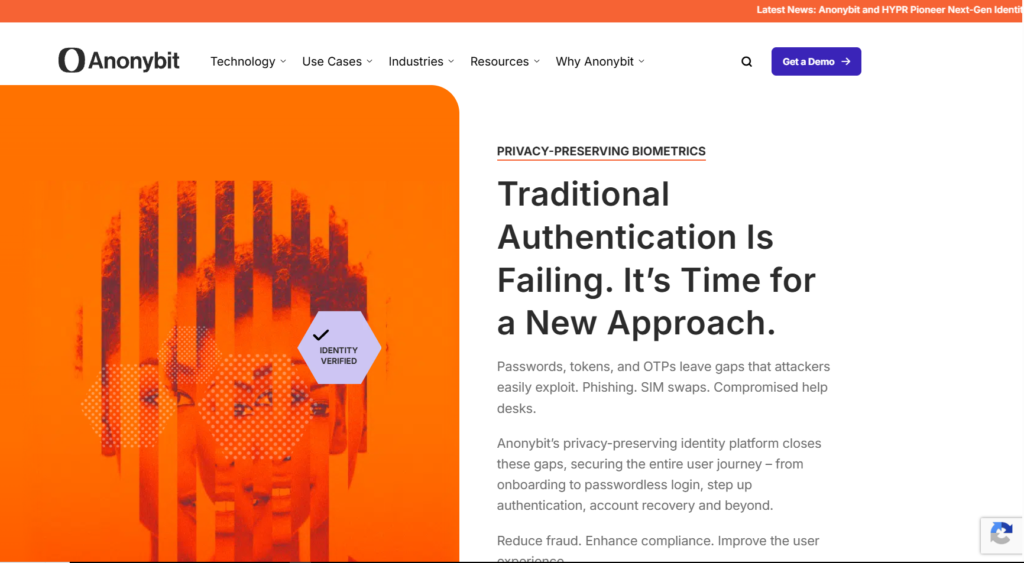
Anonybit approaches the identity problem from a different angle — one that is architecturally radical.
The company’s founding premise is that the traditional model of storing biometric data and personal identity information in centralized databases is fundamentally broken. Every large-scale breach in history follows the same pattern: a centralized repository of sensitive data is compromised and millions of records are exposed. Biometric data is particularly catastrophic when stolen because, unlike a password, you cannot reset your fingerprint.
Anonybit’s solution is to eliminate the centralized store entirely. Using a privacy-preserving architecture based on secure multiparty computation and biometric fragmentation, Anonybit splits identity data into encrypted fragments that are distributed across a decentralized network. No single node holds enough information to reconstruct an individual’s identity. Authentication happens through the network computing a result without any single point ever assembling the complete picture.
The practical result: there is no honeypot for attackers to target. You cannot steal what was never stored in one place.
In an agentic AI context, this architecture becomes even more important. Agentic systems that act on behalf of users — accessing accounts, initiating transactions, completing workflows — need to prove their authorization continuously, not just at login. The traditional session token model is inadequate when an AI agent might operate across hours, systems, and jurisdictions on a user’s behalf.
Anonybit’s decentralized identity model enables continuous, privacy-preserving verification — the agent proves authorization at each step without centralizing sensitive user data that could be intercepted or exploited mid-session.
How Agentic AI Changes the Stakes for Both Companies
The emergence of agentic AI doesn’t just create new threats — it reshapes the entire threat model that security companies operate within.
When AI agents can autonomously conduct social engineering attacks, generate synthetic voices indistinguishable from real people, operate at machine speed and scale, and probe for weaknesses around the clock, the human-speed fraud detection playbooks of the past decade become obsolete.
Pindrop has to detect not just a fraudster pretending to be a customer, but an AI agent orchestrating a perfectly timed, perfectly voiced, multi-call attack strategy designed to bypass each individual security layer separately. The threat is no longer about individual bad actors making mistakes under pressure — it is about optimized AI systems designed to find the path of least resistance through a security architecture.
Anonybit faces a parallel challenge: if an AI agent is authorized to act on behalf of a user, how do you distinguish between a legitimate agentic workflow and a compromised or malicious agent that has hijacked an authorization chain? Decentralized identity and continuous biometric verification offer an answer — the system checks not just that an authorization token exists, but that the biometric proof of the right person continues to underpin that token throughout the session.
Both companies are, in essence, building the infrastructure for a world where the authenticating entity might not be human, where synthetic media can fabricate any credential that relies on perception, and where the attack and defense are both running at machine speed.
The Convergence: What This Means for Enterprises
For enterprises — banks, insurers, healthcare providers, government agencies — the convergence of agentic AI with solutions like Pindrop and Anonybit points toward a new model of trust infrastructure.
Legacy authentication — passwords, knowledge-based questions, SMS one-time codes — was designed for a world of human users on predictable devices. That world is gone. Agentic AI systems can extract passwords from compromised databases, answer knowledge-based questions using publicly available data, and intercept SMS codes through SIM-swapping attacks.
The next model of enterprise trust requires three things that these companies, in different ways, are building toward.
First, it requires behavioral and acoustic intelligence at the point of interaction — understanding not just what credentials are presented, but whether the entity presenting them behaves like the authorized party. This is Pindrop’s domain.
Second, it requires identity infrastructure that cannot be stolen in bulk — where compromising one node or one database does not cascade into mass identity theft. This is Anonybit’s contribution.
Third, it requires all of this to work at the speed and scale of AI — not human authentication flows that take 30 seconds, but machine-speed verification that can keep pace with agentic systems operating across thousands of simultaneous sessions.
The enterprise that solves for all three of these is the one that can actually offer services in an agentic AI world without hemorrhaging to sophisticated automated fraud.
The Deepfake Problem Is the Stress Test
If you want to understand why the intersection of agentic AI, Pindrop, and Anonybit matters, the deepfake problem is the clearest stress test.
Voice deepfakes have already been used to steal money. There are documented cases of executives being impersonated on calls to authorize wire transfers, of customer service agents being fooled by synthetic voices into bypassing account security, and of AI-generated audio being used in targeted fraud against high-value individuals.
Now extend that threat into an agentic AI framework. An attacker builds an AI agent that: scrapes publicly available audio of a target, generates a voice clone, initiates calls to the target’s bank and insurance company, navigates IVR systems autonomously, uses social engineering scripts generated in real time, and attempts account takeover — all without a human ever touching the operation after setup.
This is not a hypothetical future scenario. The component technologies for this attack chain already exist and are accessible. The only things standing between this threat model and widespread damage are detection systems sophisticated enough to identify synthetic voice and behavioral anomalies at the point of contact, and identity architectures robust enough that compromising one layer doesn’t collapse the whole system.
Pindrop represents the first line of defense at the voice interaction layer. Anonybit represents the structural resilience of the identity layer beneath it. Agentic AI is the force that makes both of them urgently necessary right now rather than eventually.
Looking Forward
The trajectory of all three forces points in one direction: toward a world where the boundaries between human and AI identity become increasingly difficult to establish through any single signal or credential.
Pindrop will need to continue evolving its detection capabilities as voice AI improves — it is a genuine arms race, and there are no permanent wins, only the sustained advantage of better models, better data, and faster adaptation.
Anonybit’s decentralized model will likely become more relevant, not less, as agentic systems proliferate. The more autonomous AI agents are operating on behalf of users, the more critical it becomes that the identity infrastructure they rely on is both unforgeable and privacy-preserving by design.
And agentic AI itself will eventually need to develop standardized identity and accountability mechanisms — ways for agents to prove provenance, authorization, and integrity to the systems they interact with. That is a largely unsolved problem today, and it represents a significant opportunity for companies that can define the trust layer for machine-to-machine interaction.
The convergence of these three areas — autonomous AI action, voice-layer fraud detection, and decentralized biometric identity — is one of the more consequential intersections in enterprise technology right now. The organizations that understand it early will be significantly better positioned than those that respond only after the threat landscape has already shifted beneath them.

Abdullah Zulfiqar is Co-founder and Client Success Manager at RankWithLinks, an SEO agency helping businesses grow online. He specializes in client relations and SEO strategy, driving measurable results and maximizing ROI through effective link-building and digital marketing solutions.