
Introduction: The AI Search Revolution Has Changed Everything
Not long ago, getting your brand noticed online meant ranking on Google’s first page. That game still matters — but a new one has started alongside it.
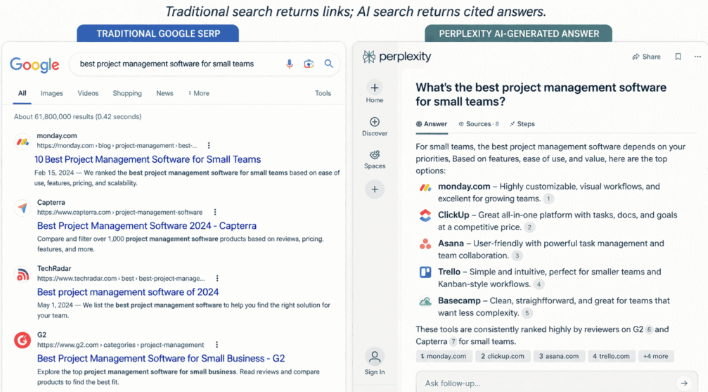
AI search engines are reshaping how people find information. Tools like ChatGPT, Perplexity AI, Google AI Overviews, and Microsoft Copilot don’t just return a list of blue links. They generate direct, conversational answers. They cite sources. They recommend brands by name — or leave them out entirely.
If your brand isn’t showing up in these AI-generated answers, you’re invisible to a growing segment of your audience.
So what strategies improve brand visibility in AI search engines? That’s exactly what this guide answers — in plain language, with actionable steps you can start using today.
What Are AI Search Engines?
AI search engines use large language models (LLMs) and generative AI to interpret user questions and deliver synthesized, natural-language answers — rather than just a ranked list of links.
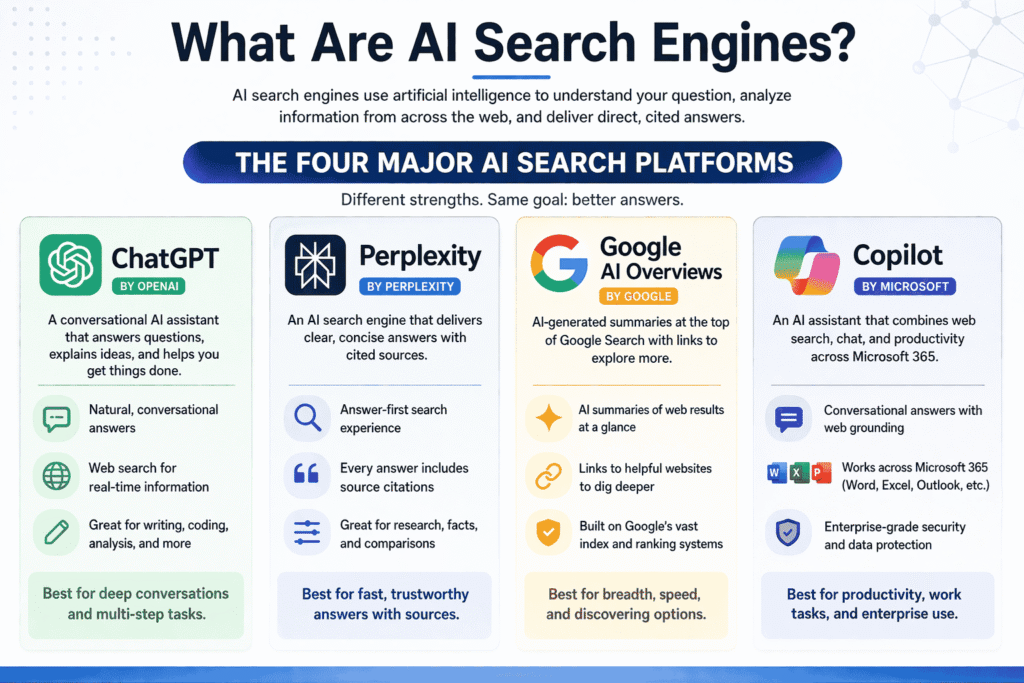
Here are the major players you need to know:
ChatGPT (with browsing) — OpenAI’s conversational AI can now browse the web in real time, pull in sources, and recommend brands or services when users ask questions like “what’s the best CRM for small businesses?”
Perplexity AI — A search engine built entirely around AI-generated answers with cited sources. It’s growing fast and is heavily used by researchers, professionals, and tech-savvy users.
Google AI Overviews — Google’s AI-generated summary boxes that appear at the very top of search results, above traditional organic listings. These are triggered by informational and conversational queries.
Microsoft Copilot — Integrated into Bing and Microsoft 365, Copilot provides AI-generated answers with cited web sources, blending search and productivity.
Claude (Anthropic) — Used by millions for research, analysis, and recommendations, often citing or referencing known brands and sources.
Each of these platforms uses a combination of training data, real-time web browsing, and source credibility signals to decide what to say — and who to mention.
How AI Search Differs from Traditional Search
Understanding the difference is crucial before you can optimize for it.
Traditional SEO focuses on keywords, backlinks, page speed, and structured data to help Google’s algorithm rank your pages. The goal is to appear in a list of 10 blue links.
AI search optimization is different in these key ways:
- AI engines synthesize answers, meaning your content may be quoted, paraphrased, or cited — but the user might never click through to your site.
- AI models are trained on massive corpora of web content, meaning your brand’s presence across the entire web — not just your own site — matters enormously.
- Authority and trust signals are weighted more heavily. AI systems favor sources that have been cited, discussed, and referenced across multiple credible platforms.
- Entity recognition plays a huge role. AI models build knowledge graphs about brands, people, and organizations — and brands that are well-defined entities in these graphs get cited more often.
- Conversational queries dominate. Users ask AI tools full questions, not keyword fragments. Your content needs to match that natural language pattern.
Think of traditional SEO as winning a popularity contest by page. AI SEO is about building a credible identity that the AI trusts enough to recommend.
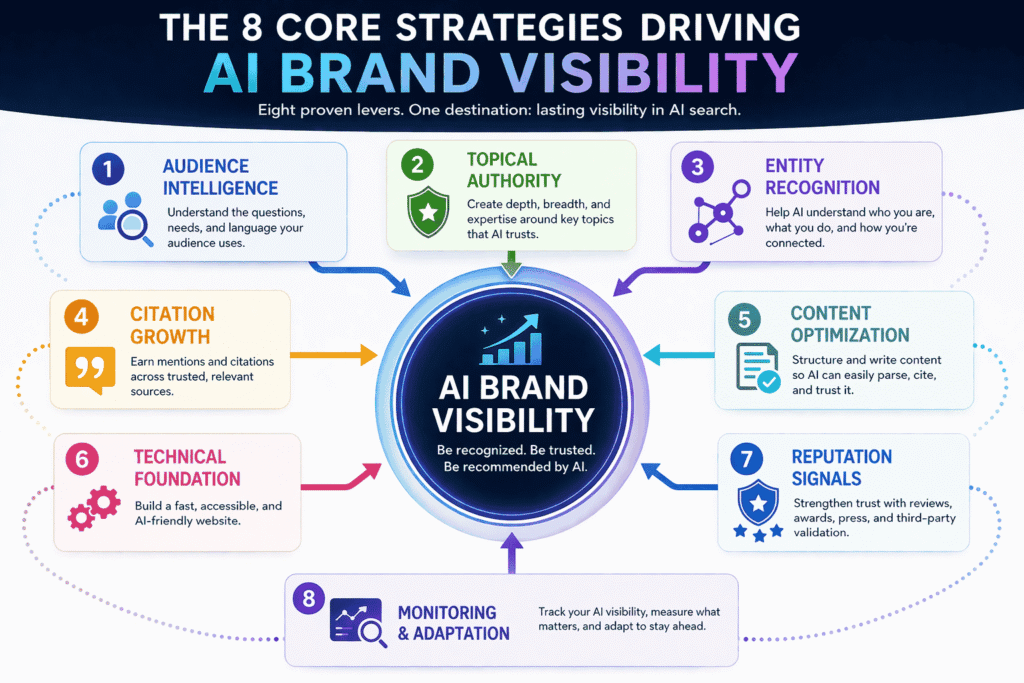
What Strategies Improve Brand Visibility in AI Search Engines?
Here is the definitive breakdown of the most effective strategies.
1. Build Authoritative, Structured Content
AI models are trained on — and actively crawl — high-quality, well-structured content. If your website is a collection of thin pages with no clear expertise, you’re unlikely to be cited.
What to do:
- Write comprehensive, long-form content that genuinely answers user questions in depth.
- Use clear heading structures (H1, H2, H3) so AI can parse your content logically.
- Create topic clusters — a main pillar page supported by related subtopic pages — to signal deep subject matter expertise.
- Include original data, research, case studies, and expert quotes. AI systems specifically value unique insights that can’t be found elsewhere.
- Keep your content updated. AI models that browse in real time favor fresh, accurate content.
Real-world example: HubSpot consistently appears in AI-generated answers about marketing and CRM because their blog publishes thousands of structured, expert-level articles covering every angle of their niche.
2. Establish Brand Mentions and Citations Across the Web
AI doesn’t just read your website. It reads the entire internet. When your brand is consistently mentioned, recommended, and linked to from trusted sources, AI systems recognize you as a credible entity.
This is sometimes called “unstructured citation building” — and it’s one of the most powerful AI search strategies available.
What to do:
- Get your brand mentioned on industry publications, news sites, and authority blogs — even without a link.
- Build a strong presence on platforms that AI models heavily index: Reddit, Quora, G2, Trustpilot, LinkedIn, Wikipedia, and industry directories.
- Encourage genuine customer reviews on third-party review platforms. These count as citations.
- Seek co-mentions alongside established brands in your category. If a top-tier publication writes “similar to Salesforce, brands like [your brand]…” — that’s gold for AI recognition.
- Pursue podcast appearances, expert interviews, and guest articles. These create diverse brand mentions at scale.
Why this works: AI models like GPT-4 and Gemini learn from patterns of mention. The more contexts your brand appears in as a credible answer to a question, the more likely it is to be surfaced in response to similar questions.
3. Optimize for Entity Recognition (E-E-A-T, Schema, Knowledge Graphs)
AI engines are built on knowledge graphs — interconnected webs of entities (people, brands, products, concepts) and the relationships between them. Brands that are well-defined entities in these graphs are cited far more often.
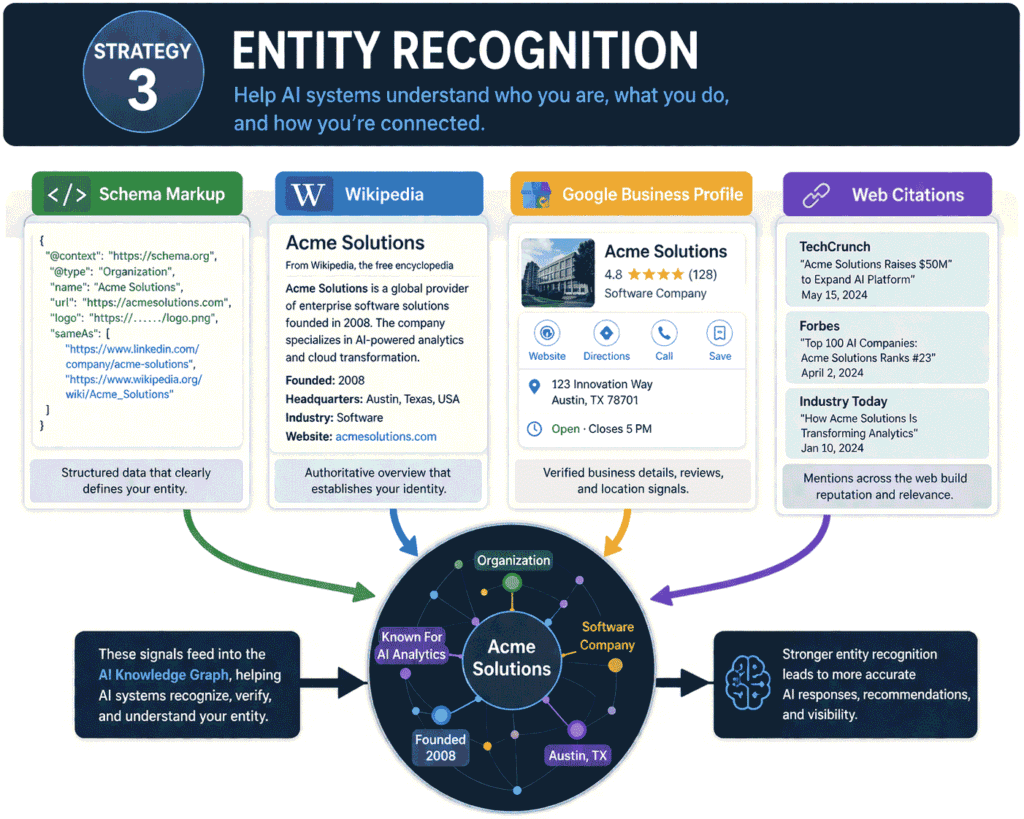
What to do:
- Implement structured data markup (Schema.org) across your website. Use Organization schema, Product schema, FAQ schema, Article schema, and Person schema for your team members.
- Claim and fully complete your Google Business Profile, LinkedIn company page, Wikidata entry, and any industry-specific profiles.
- Create (or contribute to) a Wikipedia page for your brand if you meet notability guidelines. Wikipedia is one of the most heavily indexed sources for AI training data.
- Build your E-E-A-T signals (Experience, Expertise, Authoritativeness, Trustworthiness). This means adding author bios with credentials, publishing original research, and getting cited by authoritative sources.
- Use consistent NAP (Name, Address, Phone) data and brand descriptions across all platforms. Consistency reinforces your entity definition in AI knowledge graphs.
Real-world example: When users ask Perplexity “who are the best cybersecurity companies?”, companies like CrowdStrike and Palo Alto Networks appear consistently — not just because of SEO, but because they are strongly defined entities with structured data, Wikipedia entries, and thousands of consistent citations across the web.
4. Create Conversational and Question-Based Content
AI search engines are built around natural language queries. If your content only targets short keywords (“SEO tools”), it may miss the questions your potential customers are actually asking AI systems (“what are the best SEO tools for a small e-commerce site?”).
What to do:
- Research the exact questions your audience is asking using tools like Answer the Public, AlsoAsked, and Reddit.
- Create dedicated FAQ pages and Q&A sections using natural language questions as headings.
- Write in a direct, question-answer format where possible. AI systems love pulling clean, concise answers from well-structured content.
- Add FAQ Schema markup to your Q&A content to increase the likelihood of appearing in AI Overviews and featured snippets.
- Create content that mirrors conversational intent. For example, if users are asking “how do I choose an accounting software for my startup?”, write a guide that answers that exact question — not just a product feature page.
Pro tip: Think about what questions a knowledgeable friend would answer on your topic. That’s exactly what AI is trying to replicate. Be that friend’s trusted source.
5. Execute Digital PR and Build High-Authority Backlinks
Backlinks have always mattered for SEO. For AI visibility, high-authority links from credible publications carry even more weight because they signal that real experts and institutions trust your brand enough to cite it.
What to do:
- Pitch original research, unique data, and expert commentary to major industry publications and news outlets. Data-driven stories get picked up and cited widely.
- Use digital PR tactics like expert commentary on trending topics (“newsjacking”) to earn mentions in timely news articles.
- Partner with universities, research institutes, and industry associations for studies or reports. These carry very high authority in AI training data.
- Create link-worthy assets: original research reports, interactive tools, comprehensive guides, and infographics that naturally attract citations.
- Target publications that AI models heavily reference: Forbes, TechCrunch, Harvard Business Review, industry-specific journals, and major news sites.
Why this matters for AI: Many AI models like Perplexity and ChatGPT browsing specifically pull from high-authority publications. If Forbes cites your research, Perplexity may quote that article — and in doing so, surface your brand.
6. Monitor AI-Generated Results and Brand Mentions
You cannot optimize what you don’t measure. AI search is an evolving landscape, and your brand’s current visibility (or invisibility) in AI-generated answers is a critical data point.
What to do:
- Regularly search for your brand name and key product/service categories in ChatGPT, Perplexity, Google AI Overviews, and Copilot. Ask questions your customers would ask and see who gets cited.
- Use tools like Brand24, Mention, or Semrush’s brand monitoring features to track unstructured brand mentions across the web.
- Set up Google Alerts for your brand name, key executives, and main product names.
- Audit competitor mentions in AI answers. When a competitor is cited and you’re not, reverse-engineer why. Where are they getting published? What content do they have that you don’t?
- Track changes in your organic traffic from AI Overviews in Google Search Console under the “Search Appearance” filter.
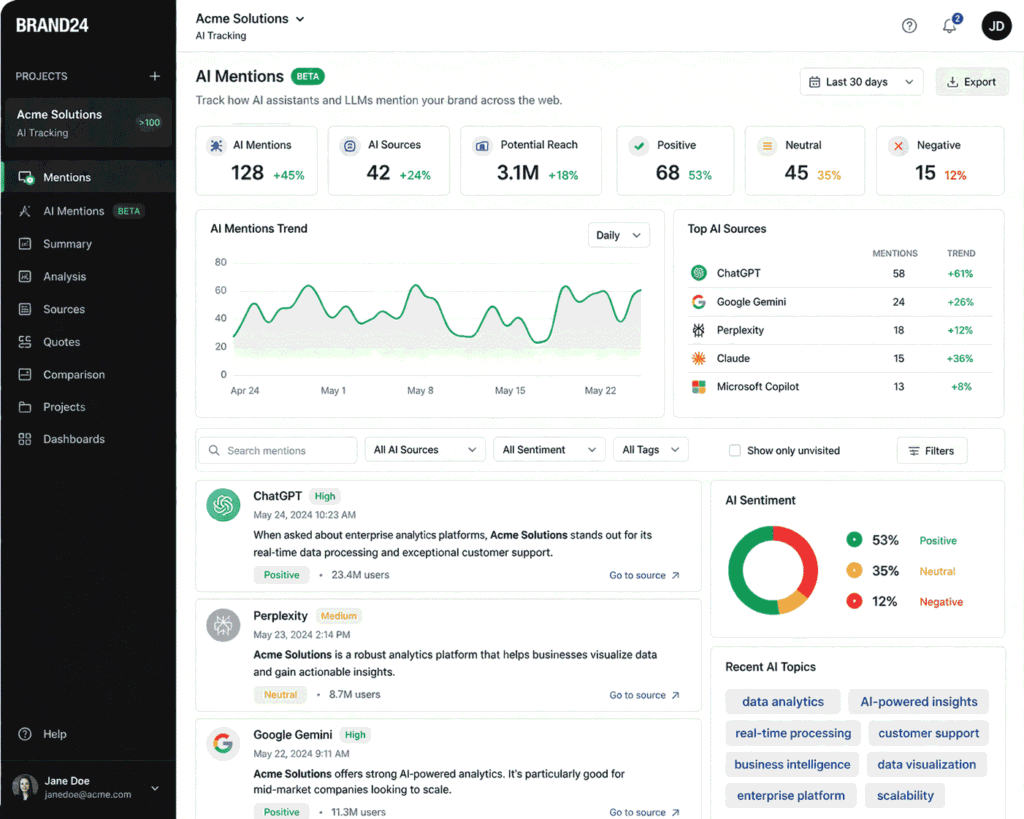
The AI monitoring mindset: Think of your brand’s AI visibility as a separate KPI from traditional SEO rankings. Set a quarterly goal to appear in X% of AI answers for your target queries — and measure progress.
7. Leverage First-Party Data and Unique Insights
AI models are awash in generic content. What they — and their users — hunger for is original, proprietary information that can’t be found anywhere else. Your first-party data is a competitive moat.
What to do:
- Publish annual or quarterly industry reports using your own customer data, platform data, or survey results. These become heavily cited assets.
- Share proprietary benchmarks, statistics, and case studies in your content. AI systems actively seek out data-backed claims.
- Develop a unique point of view or methodology in your industry. Brands with a defined intellectual framework (think HubSpot’s “inbound marketing” concept) get cited as authorities far more readily.
- Create original research in collaboration with industry analysts or academic institutions to amplify reach and credibility.
- Use your proprietary customer insights to write content that no competitor can replicate — because it comes from your unique position in the market.
Example: When Salesforce publishes their “State of Sales” report, it becomes one of the most-cited data sources in AI answers about sales trends — because no one else has access to that data.
The same effect works at much smaller scale. Independent publishers that run their own measurements — for instance benchmark comparisons of AI coding models with verified cost figures — get cited precisely because the numbers exist nowhere else. You do not need Salesforce’s data volume, only data someone else has to source from you.
8. Build Topical Authority Through Content Depth
AI systems recognize topical authority — the depth and breadth of your coverage on a subject — not just individual page rankings. A brand that has deeply covered every angle of a topic is far more likely to be cited as an expert source.
What to do:
- Map out every question, subtopic, and angle within your niche and create dedicated content for each.
- Use internal linking strategically to connect related content, reinforcing topical relationships for both AI and traditional search engines.
- Publish consistently over time. Topical authority is built through sustained content output, not a single viral post.
- Create comparison content (“Brand A vs Brand B”), best-of lists, and how-to guides that AI engines frequently use to answer evaluative questions.
- Update older content regularly to maintain relevance and accuracy — key trust signals for AI systems.
How AI Search Engines Select and Cite Sources
Understanding how AI decides who to cite is the foundation of every strategy above.
AI search systems prioritize sources based on several overlapping factors:
Training data weight — Content that was widely indexed and cited before the model’s training cutoff is deeply embedded in what the model “knows.”
Real-time retrieval quality — For AI tools with live browsing (Perplexity, ChatGPT with search), the freshness, authority, and relevance of currently indexed pages matter.
Citation patterns — If authoritative sources consistently cite your brand in context, AI models learn that your brand is a trusted reference for certain topics.
Entity strength — Brands that are well-defined in structured data, knowledge graphs, and consistent web presence are recognized as reliable entities.
Content clarity — AI systems favor content that is clearly structured, concise, and directly answers the question being asked. Vague, keyword-stuffed, or poorly organized content gets skipped.
The key insight is this: AI doesn’t rank pages like Google does. It builds a mental model of which entities are trustworthy authorities on which topics — and then cites them accordingly.
The Risks of Low Visibility in AI-Generated Answers
If your brand is invisible in AI search, the consequences compound over time:
- Competitors who are cited in AI answers capture brand awareness at zero marginal cost per impression.
- Users who get their answer from AI never visit your website — and never discover your brand.
- Trust deficits build: if AI doesn’t know your brand well enough to mention it, users may unconsciously interpret that as a signal that you’re not a major player.
- As AI search adoption grows (and it’s growing fast), the gap between AI-visible and AI-invisible brands will widen.
Brands that invest in AI search optimization now are building a durable advantage for the next decade of search.
Actionable Step-by-Step Strategy Summary
Here’s a quick-start plan you can begin this week:
- Audit your current AI visibility — search for 10 core queries in Perplexity and ChatGPT and record who’s being cited.
- Implement Organization and FAQ Schema on your website this week.
- Identify 5 high-authority publications in your niche and pitch one original data story.
- Write or update one comprehensive “pillar” piece of content answering the top question in your niche.
- Claim and complete all major third-party profiles (Wikipedia, Google Business, Wikidata, industry directories).
- Set up brand monitoring alerts to track your web mentions monthly.
- Plan one original research project (survey, data report, case study) to publish this quarter.
- Review your content library and add Q&A sections with FAQ Schema to your top 10 pages.
Conclusion: Future-Proofing Your Brand in the Age of AI Search
The question isn’t whether AI search will matter for your brand — it already does. The question is whether you’re building the authority, credibility, and structured presence that AI systems need to confidently recommend you.
What strategies improve brand visibility in AI search engines? In short: become the most credible, well-documented, consistently cited entity in your niche. Create content that genuinely helps people. Build relationships with authoritative publishers. Define your brand as a clear entity across every digital touchpoint.
The brands that win in AI search won’t be those who game the algorithm. They’ll be the ones the algorithm genuinely trusts.
Start building that trust today.
Frequently Asked Questions (FAQs)
Q1: What is the difference between traditional SEO and AI search optimization? Traditional SEO focuses on ranking individual web pages for specific keywords in a list of links. AI search optimization focuses on building your brand’s authority, entity definition, and citability so that AI systems mention and recommend you in their synthesized, conversational answers — even when no click-through occurs.
Q2: How do I know if my brand is appearing in AI search results? The most direct method is manual testing: search for 10–20 queries relevant to your brand in ChatGPT (with browsing enabled), Perplexity, and Google AI Overviews, and observe whether your brand is cited. For ongoing monitoring, use tools like Brand24, Semrush, or Google Search Console’s AI Overview filter to track brand mentions and AI-generated traffic patterns.
Q3: Does having a Wikipedia page really help with AI search visibility? Yes, significantly. Wikipedia is one of the most heavily weighted sources in AI training data and real-time retrieval. A well-written, cited Wikipedia entry dramatically strengthens your brand’s entity recognition in AI knowledge graphs. If your brand meets Wikipedia’s notability guidelines, creating and maintaining a page is one of the highest-ROI AI SEO actions available.
Q4: How long does it take to see results from AI search optimization? Results vary depending on your starting point. Tactical wins like Schema implementation and FAQ content can begin influencing AI Overviews within weeks. Building topical authority, earning high-authority citations, and strengthening entity recognition typically take 3–12 months of consistent effort. Think of it as brand building — the results compound over time.
Q5: Can small brands compete with large ones in AI search? Absolutely. AI search rewards depth of expertise and clarity of entity definition, not just domain authority or marketing budget. A small brand that publishes the definitive resource on a niche topic, maintains consistent citations across the web, and implements strong structured data can absolutely outrank — or out-cite — larger competitors who haven’t optimized for AI search.

Abdullah Zulfiqar is Co-founder and Client Success Manager at RankWithLinks, an SEO agency helping businesses grow online. He specializes in client relations and SEO strategy, driving measurable results and maximizing ROI through effective link-building and digital marketing solutions.