
Introduction: A New Search Landscape Has Arrived
For decades, brands tracked their online presence through a relatively predictable set of signals.Google rankings. Backlinks. Social media mentions. Review scores. The rules were well understood, and an entire industry of SEO and reputation management tools grew up around them.
Then AI search arrived — and changed everything.
Today, millions of people are getting their answers not from a list of blue links but from AI-generated responses. ChatGPT. Google’s AI Overviews. Perplexity AI. Microsoft Copilot. These systems read, synthesize, and summarize information — and in doing so, they decide which brands to mention, recommend, or ignore entirely.
This raises an urgent question for marketers, brand managers, and business owners: is it possible to track brand mentions in AI search?
The short answer is yes — but it requires a completely different approach from traditional brand monitoring. This article explains what AI search brand tracking means, why it matters more than ever, what the challenges are, and how to start doing it effectively today.
What Is AI Search and Why Does It Change Brand Monitoring?
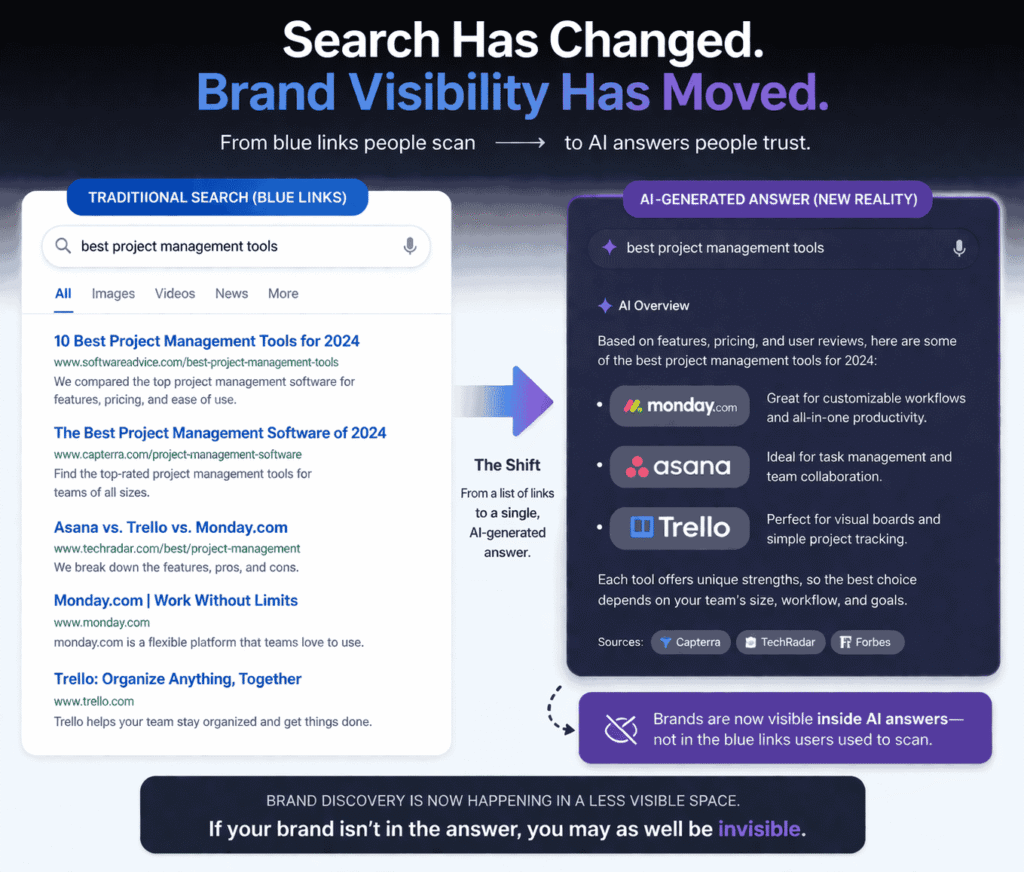
Traditional search engines work by indexing web pages and ranking them based on relevance signals. When someone searches for “best project management software,” Google returns a list of pages. The brand monitoring task is straightforward: are your pages ranking? Are you being mentioned on pages that rank?
AI search works differently. Systems like ChatGPT, Perplexity, Google AI Overviews, and Microsoft Copilot generate natural language answers by drawing on vast training data and, increasingly, real-time web results. Instead of showing ten blue links, they produce a single synthesized response.
That response might mention your brand — or it might not. It might describe your product accurately — or it might not. It might recommend you to a potential customer — or it might recommend your competitor.
The critical difference is this: in traditional search, you can see exactly where you rank. In AI search, your brand’s presence is embedded inside a generated paragraph that changes every time someone asks a slightly different question, which makes it far harder to observe, measure, and influence without advanced AI SEO packages designed to optimize visibility across AI-driven search experiences.
This is why tracking brand mentions in AI search has become one of the most important and most challenging new frontiers in digital marketing.
Why Tracking Brand Mentions in AI Search Matters
Before diving into how to track AI brand mentions, it is worth understanding why this matters so deeply for businesses of all sizes.
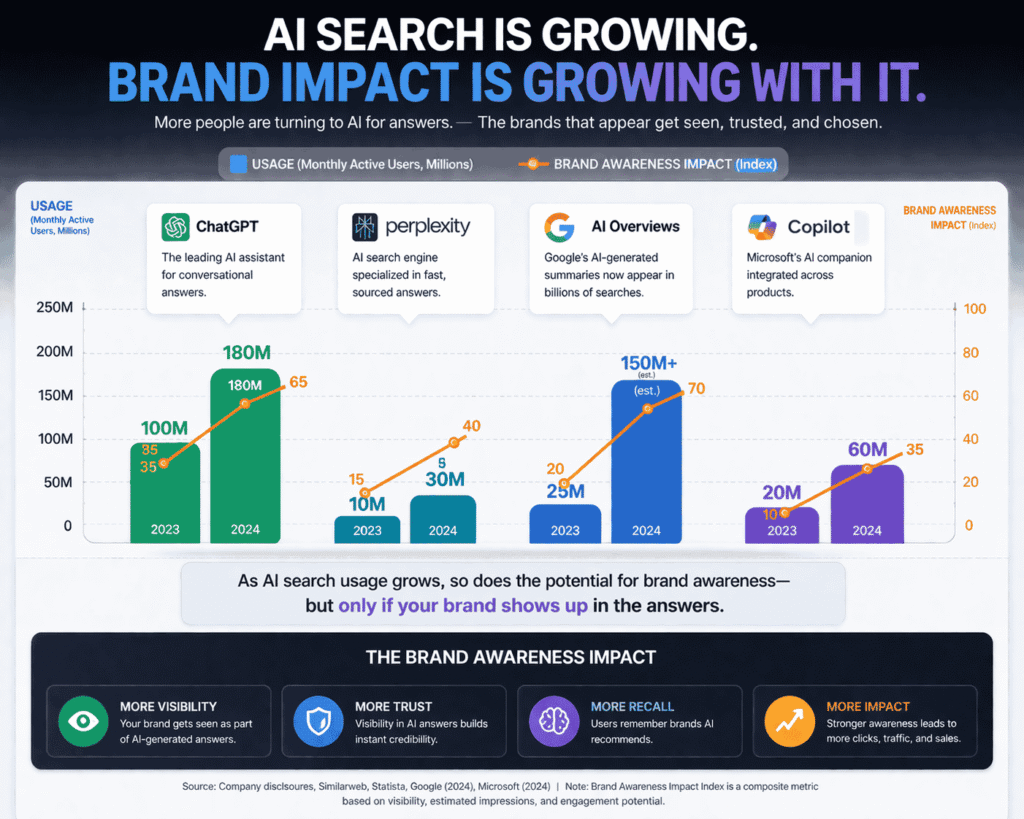
AI search is growing fast. Google’s AI Overviews now appear for a significant proportion of searches. ChatGPT has hundreds of millions of users. Perplexity is growing rapidly as a research and discovery tool. The share of information journeys that begin and end with an AI-generated answer — without a user ever clicking through to a website — is rising every month.
AI answers influence purchasing decisions. When a potential customer asks an AI system “what is the best CRM for a small business” and your brand is not mentioned, you have effectively lost that customer before they ever reached your website. When you are mentioned positively, you gain trust and consideration that no paid ad can replicate.
AI systems can spread inaccurate information about your brand. Language models sometimes hallucinate — generating plausible-sounding but factually incorrect information. Your product might be described with outdated pricing, wrong features, or fabricated claims. Without monitoring, you would never know.
Competitors are already paying attention. The brands that establish strong visibility in AI search results now are building a compounding advantage. The longer you wait, the harder it becomes to close the gap.
The Core Challenge: Why AI Brand Tracking Is Hard
Tracking brand mentions in AI search is genuinely difficult, and understanding why helps you approach it more intelligently.
AI responses are not indexed. Unlike web pages, the answers generated by AI systems are not stored in a publicly accessible database. Each response is generated fresh, often with variation, making systematic monitoring a moving target.
There is no universal API for brand mention data. Traditional brand monitoring tools pull from social media APIs, news feeds, and search indices. Most AI search platforms do not offer equivalent access to their generated outputs at scale.
Responses vary by query phrasing. Ask “best accounting software for freelancers” and you might get one set of brand mentions. Ask “top accounting tools for self-employed people” and the answer might be entirely different. The space of possible queries is enormous.
Attribution is opaque. Even when an AI system mentions your brand, it rarely explains why — what sources it drew on, what signals elevated your brand over a competitor, or what you could change to appear more prominently.
Despite these challenges, meaningful tracking is possible. Here is how.
Is It Possible to Track Brand Mentions in AI Search? Yes — Here Are the Methods
Method 1: Manual Query Monitoring
The most basic approach is also the most accessible. Create a structured list of queries that are relevant to your brand — questions your target customers are likely to ask — and regularly run them through major AI search platforms.
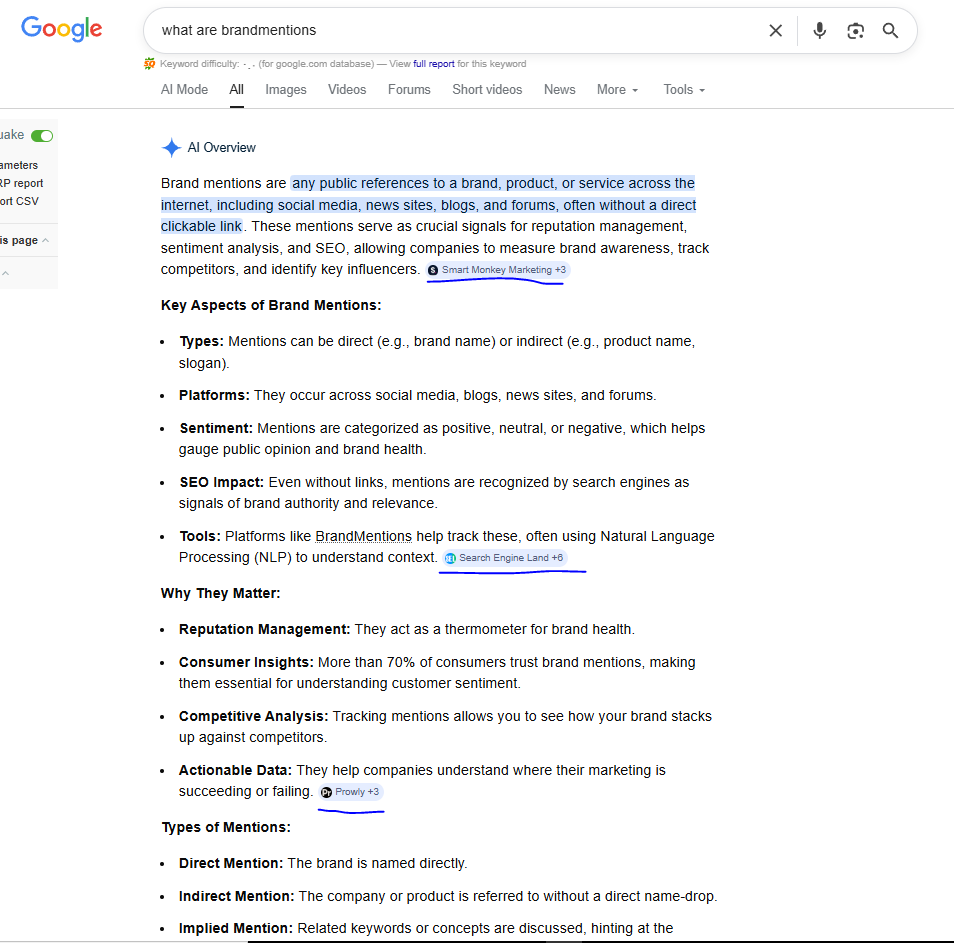
Platforms to monitor include:
- ChatGPT (OpenAI) — the most widely used AI assistant globally
- Google AI Overviews — integrated into billions of Google searches
- Perplexity AI — popular for research and discovery queries
- Microsoft Copilot — integrated into Bing and Microsoft 365
- Claude (Anthropic) — growing rapidly in professional use cases
- Gemini (Google DeepMind) — Google’s standalone AI assistant
For each platform, run your target queries and document whether your brand is mentioned, how it is described, whether the description is accurate, and which competitors appear alongside or instead of you.
This approach is time-consuming but invaluable for building an initial baseline understanding of your AI search presence.
Method 2: Dedicated AI Search Monitoring Tools
A new category of software tools has emerged specifically to address AI brand tracking. These tools automate the query-and-monitor process at scale. As of 2025, notable options include:
Brandwatch and Mention have begun incorporating AI search monitoring features alongside their traditional social listening capabilities.
Profound is a purpose-built tool focused specifically on tracking brand visibility across AI search platforms, offering dashboards that show how often and how favorably brands appear in AI-generated responses.
Peec AI and Otterly.AI are newer entrants designed specifically for generative engine optimization, helping brands understand and improve their presence in AI answers.
Semrush and Ahrefs have been developing AI visibility features within their broader SEO platforms, recognizing that AI search tracking is becoming a standard part of the digital marketing toolkit.
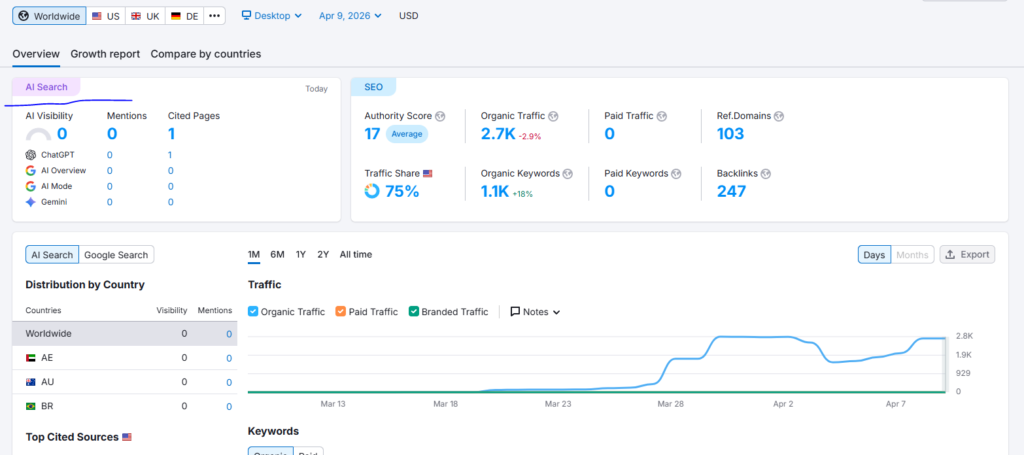
These tools vary in capability, platform coverage, and price. Evaluate them based on which AI platforms matter most to your audience and what level of reporting detail you need.
Method 3: API-Based Custom Monitoring
For organizations with technical resources, building a custom monitoring system using available APIs offers the most flexibility.
OpenAI, Perplexity, and Anthropic all offer API access to their models. A technical team can build a system that:
- Runs a curated set of brand-relevant queries on a scheduled basis
- Logs and stores the AI-generated responses
- Parses responses to detect brand mentions, sentiment, and competitive context
- Generates reports and alerts when your brand appears or disappears
Before you design the schedule, check the limits you will be running into. Provider quotas are measured on several dimensions at once and are applied per project rather than per API key, so spinning up extra keys will not buy you more headroom — how AI provider rate limits actually work covers the mechanics and the tier threshold
This approach requires engineering investment but produces proprietary data that off-the-shelf tools cannot replicate. It also carries a running cost that is easy to underestimate — a monitoring rig firing hundreds of queries a day is a metered workload, and the difference between subscription and per-token pricing decides whether that is a fixed line item or a variable one.For large brands or agencies managing multiple clients, the investment is often justified.
Method 4: Source Monitoring as a Proxy
AI search systems — especially those with web access like Perplexity and Google AI Overviews — draw heavily on authoritative sources. If the sources that AI systems trust are mentioning your brand positively, your chances of appearing in AI-generated answers increase significantly.
This means traditional media monitoring becomes a proxy for AI brand visibility. Track your brand mentions in:
- High-authority industry publications
- Wikipedia (a heavily cited source for AI systems)
- Reddit and Quora (increasingly referenced by AI tools)
- Review platforms like G2, Capterra, and Trustpilot
- Academic and research publications relevant to your industry
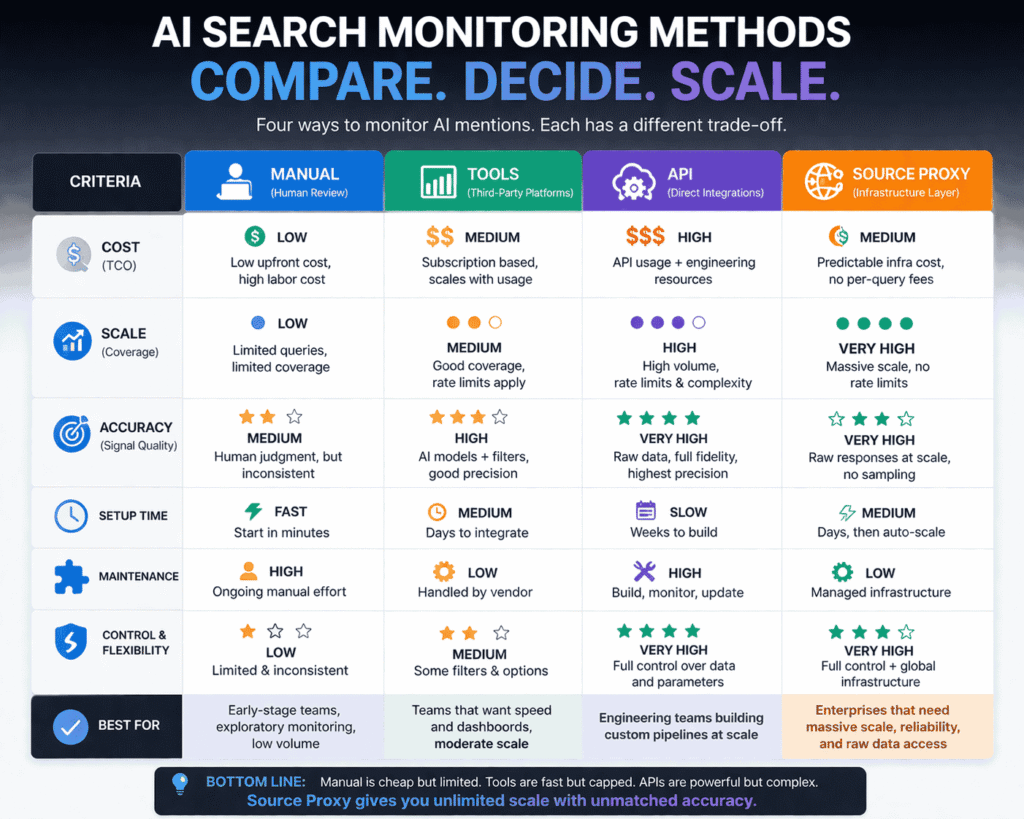
If these sources mention your brand accurately and favorably, you are building the foundation for strong AI search visibility even when you cannot observe AI outputs directly.
What to Measure When Tracking AI Brand Mentions
Once you have a monitoring system in place — manual, tool-based, or custom — you need to know what to look for. Here are the key metrics for AI brand mention tracking.
Mention frequency. How often does your brand appear in AI responses to relevant queries? Track this over time to identify trends.
Share of voice. When AI systems answer questions in your category, how often are you mentioned compared to competitors? A brand appearing in 40% of relevant AI responses while a competitor appears in 70% has a clear gap to close.
Sentiment and framing. When your brand is mentioned, how is it described? Positively, neutrally, or negatively? Accurately or with errors? AI systems often reflect the prevailing sentiment of their source material.
Accuracy. Are the facts AI systems state about your brand correct? Wrong pricing, discontinued products, or fabricated features are reputational risks that require active correction.
Query coverage. Which types of queries trigger your brand mention? Understanding this helps you identify where you have strong AI visibility and where you have gaps.
Competitive context. Which competitors appear alongside you — or instead of you — in AI responses? This shapes how potential customers compare options.
Real-World Example: How Brands Are Responding
Several forward-thinking brands have already begun building AI search visibility strategies.
HubSpot has invested heavily in producing comprehensive, authoritative content that AI systems are likely to draw on when answering questions about marketing and CRM software. Their strategy of owning the “definitive guide” space has translated directly into strong AI search presence.
Shopify is frequently mentioned in AI responses to e-commerce questions, in large part because of its extensive developer documentation, active community forums, and presence on high-authority review platforms — all of which AI systems trust as sources.
Smaller brands have found success by dominating niche query spaces — becoming the most authoritative source on a specific, well-defined topic so that AI systems default to mentioning them whenever that topic arises.
The common thread is deliberate content and reputation strategy, executed with AI search visibility as an explicit goal.
How to Improve Your Brand Mentions in AI Search
Tracking is only half the equation. Here is how to improve what you find.
Publish authoritative, well-structured content. AI systems favor sources that are comprehensive, accurate, and clearly organized. Long-form guides, comparison articles, and FAQ pages that directly answer common questions in your category are particularly effective.
Get mentioned on sources AI systems trust. Wikipedia, major industry publications, G2, Reddit, and Quora carry significant weight. A sustained PR and content marketing strategy that earns mentions on these platforms feeds directly into AI visibility.
Ensure factual accuracy everywhere. AI systems aggregate information from many sources. If your own website, press releases, and product documentation are accurate and consistent, you reduce the risk of AI systems generating incorrect information about you.
Use structured data markup. Schema.org markup helps AI systems understand and correctly attribute information about your brand, products, and services.
Build a strong review presence. AI systems increasingly draw on review platforms when making recommendations. A strong, recent, and detailed review profile on relevant platforms improves your chances of appearing in AI-generated recommendations.
The Future of AI Brand Tracking
The tools and techniques for tracking brand mentions in AI search are evolving rapidly. Several developments on the horizon will change the landscape significantly.
AI search platforms are likely to introduce more transparent citation and sourcing systems, making it easier to understand where AI responses draw their information — and therefore easier to monitor and influence your brand’s presence.
Regulatory pressure, particularly in Europe under the EU AI Act and related transparency requirements, may force AI platforms to provide more visibility into how they generate responses and which sources they rely on.
The field of Generative Engine Optimization — GEO — is maturing quickly, with dedicated practitioners, tools, and best practices emerging alongside traditional SEO.
Brands that invest in understanding and tracking their AI search presence now will be far better positioned as these systems become even more central to how people discover, evaluate, and choose products and services.
In this evolving landscape, the ability to optimize ai costs helps businesses manage resources efficiently while scaling their AI search strategies for long-term growth.
Conclusion: Start Tracking Your AI Brand Presence Today
So — is it possible to track brand mentions in AI search? Absolutely. It requires new tools, new methods, and a new mindset, but it is not only possible — it is increasingly essential.
The brands that treat AI search as a black box and hope for the best are ceding ground to competitors who are actively monitoring, measuring, and optimizing their AI presence. The monitoring methods available today — from manual query tracking to dedicated tools to custom API systems — give every brand a viable starting point.
Start small. Pick your five most important customer queries. Run them through ChatGPT, Google AI Overviews, and Perplexity today. Document what you find. Then build from there.
The AI search landscape is still young enough that early movers have a real advantage. The question is not whether tracking brand mentions in AI search is possible. The question is whether your brand will be visible when it counts.
Frequently Asked Questions
Q1: Can I use Google Alerts to track brand mentions in AI search?
Google Alerts monitors traditional web pages and news sources but does not track AI-generated responses. It remains useful as a proxy — since AI systems draw on web content, strong traditional mentions indirectly support AI visibility — but it cannot directly monitor what AI systems say about your brand. Dedicated AI monitoring tools like Profound or Otterly.AI are better suited for direct AI search tracking.
Q2: How often should I monitor my brand mentions in AI search?
For most brands, a weekly monitoring cadence is a reasonable starting point. Fast-moving industries, brands undergoing reputation challenges, or companies in highly competitive categories may benefit from daily monitoring. The key is consistency — tracking the same set of queries over time produces the trend data that makes monitoring actionable.
Q3: What should I do if an AI system is spreading inaccurate information about my brand?
First, identify the likely source of the inaccuracy — outdated web content, incorrect third-party listings, or old press coverage are common culprits. Correct those sources directly. Publish clear, accurate, and authoritative content on your own platforms. For serious inaccuracies, some AI providers offer feedback mechanisms or content correction request processes. The EU AI Act also establishes rights around challenging automated outputs, which may be relevant depending on your jurisdiction.
Q4: Does traditional SEO still matter if AI search is growing?
Yes — more than ever. AI search systems draw heavily on the same signals that traditional SEO optimizes for: authoritative content, strong backlink profiles, accurate structured data, and presence on trusted platforms. Strong traditional SEO creates the foundation for strong AI search visibility. The difference is that AI search also rewards comprehensiveness, accuracy, and presence on non-traditional sources like Reddit, Quora, and review platforms that traditional SEO sometimes underweights.
Q5: Is tracking brand mentions in AI search affordable for small businesses?
Manual monitoring costs nothing but time. A structured weekly review of five to ten key queries across major AI platforms is accessible to any business. Paid tools range from affordable entry-level options to enterprise pricing. Small businesses can get significant value from manual monitoring combined with strong traditional content and PR strategies, without needing to invest in expensive dedicated tools until their AI search presence justifies the cost.

Abdullah Zulfiqar is Co-founder and Client Success Manager at RankWithLinks, an SEO agency helping businesses grow online. He specializes in client relations and SEO strategy, driving measurable results and maximizing ROI through effective link-building and digital marketing solutions.