

If you have ever searched for “your topics | multiple stories” and found yourself confused about what it actually means, you are not alone. This phrase refers to a powerful content strategy where you take a single topic and expand it into multiple stories, angles, and pieces of content. Used correctly, your topics | multiple stories approach can transform how you create content, build SEO authority, and grow your audience faster than any single-post strategy ever could.
What is “Your Topics | Multiple Stories”?
Your topics | multiple stories is a content creation and SEO strategy in which one core topic is broken down into many individual stories, subtopics, and content pieces. Instead of writing one large article and moving on, you mine a single topic for dozens of unique angles — each one becoming its own post, video, newsletter, or social update.
The pipe symbol “|” in the phrase acts as a separator, suggesting a direct relationship: from your topics comes multiple stories. Think of it as a content multiplication system. A topic like “email marketing” is not one story — it is hundreds: beginner guides, tool comparisons, case studies, mistakes, templates, and more.
This strategy is widely used in SEO content planning, editorial calendars, and brand storytelling. It is the backbone of what SEO experts call topical authority — the idea that covering a subject from every possible angle signals deep expertise to Google and earns dominant rankings.
Breaking Down the Two Parts
What Are “Topics”?
A topic is any broad subject area relevant to your audience. It is the starting point — not the finish line. Examples include:
- Weight loss
- Personal finance
- Digital marketing
- Parenting
- Python programming
- Travel in Europe
Topics are intentionally broad. They are not titles. They are not keywords. They are the umbrella under which all your content lives.
What Are “Multiple Stories”?
Stories are the individual content pieces you extract from a topic. Each story takes one angle, one question, one sub-idea, or one experience and turns it into a complete piece of content.
For the topic “weight loss,” multiple stories could be:
- “Why You Are Not Losing Weight Despite Dieting”
- “How I Lost 20 Pounds Without Giving Up Coffee”
- “The Real Reason Crash Diets Fail After Week Two”
- “Weight Loss for People Who Hate Exercise”
Each story stands alone. Together, they build authority.
How Do Topics and Stories Connect?
The relationship is strategic. Your topic gives you a permanent content territory to own. Your stories colonize that territory piece by piece. Every new story adds a new entry point for search traffic, a new internal link opportunity, and a new layer of topical depth that Google rewards with higher rankings.
The Core Strategy: Topic-Based Content System
The multiple stories strategy works as a structured content system with three layers:
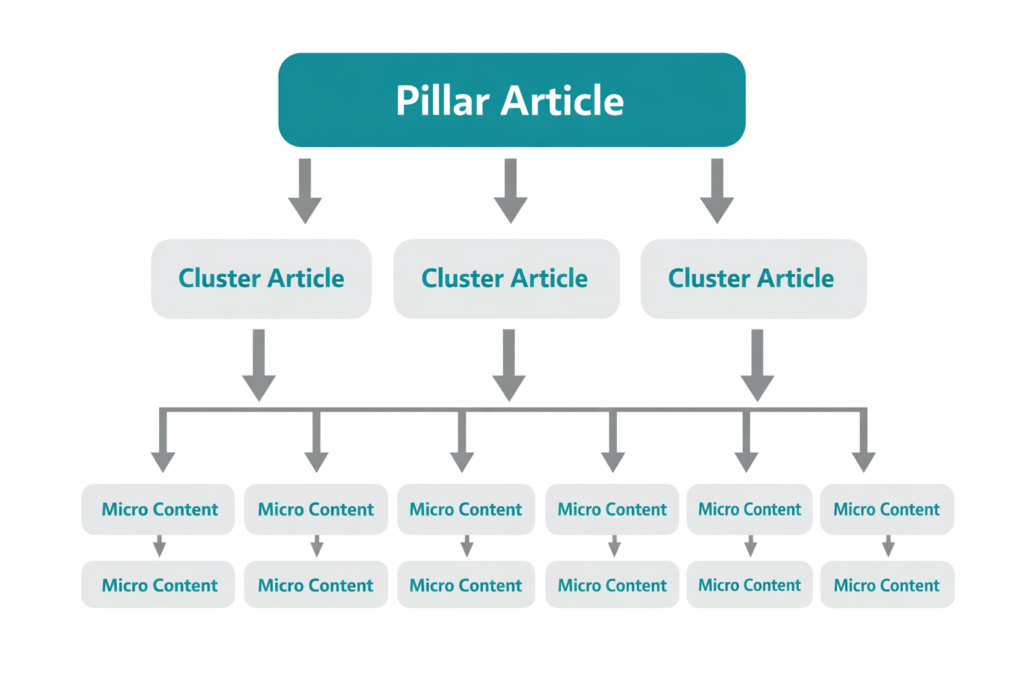
Layer 1 — The Pillar: A comprehensive overview article covering the entire topic (2,000–4,000 words). This is your foundation.
Layer 2 — The Clusters: Individual stories that each cover one specific angle in depth. These link back to the pillar and to each other.
Layer 3 — The Micro-Content: Short-form social posts, email snippets, and quote cards derived from the cluster articles.
This structure creates a content web, not a content list. Each piece reinforces the others, and Google reads the entire web as evidence of expertise.
Content Scaling Through Multiple Stories
One topic, executed properly, can generate an entire year of content:
- 1 pillar article
- 10–20 cluster blog posts
- 50+ social media posts
- 10 email newsletters
- 5 video scripts
- 3 lead magnets or downloadable guides
That is 70+ pieces of content from a single topic decision.
SEO Clustering
Search engines reward depth. When your site covers “email marketing” from 30 different angles, Google understands that your site is genuinely authoritative on that subject. This is called semantic SEO — satisfying not just one keyword but the entire universe of related queries.
Step-by-Step Guide: How to Use the Multiple Stories Strategy
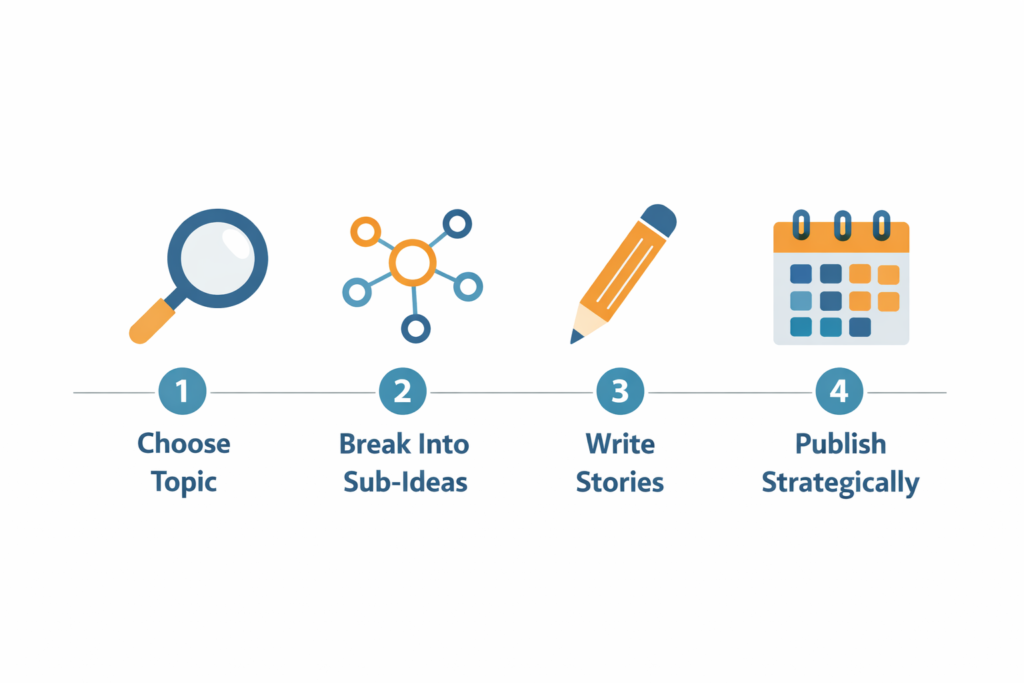
Step 1: Choose Your Topic
Pick a topic that is relevant to your audience, has genuine search demand, and is broad enough to generate at least 20 sub-ideas. Use tools like Google’s “People Also Ask,” Answer the Public, or simple keyword research to validate the topic.
Good topics have:
- A clear audience (who searches for this?)
- Long-term relevance (not a trend that dies in 3 months)
- Multiple sub-angles visible at first glance
Step 2: Break the Topic Into Sub-Ideas
Sit with your topic and generate every possible angle. Ask yourself:
- What questions do beginners ask?
- What mistakes do people make?
- What tools or methods exist?
- What case studies or examples apply?
- What does the expert know that the beginner does not?
- What comparisons would help someone decide?
Write every sub-idea down without filtering. You want 30–50 ideas before you cut anything.
Step 3: Turn Each Sub-Idea Into a Story
A story is not a bullet point. It is a piece of content with a specific angle, a clear audience, and a human entry point. Transform your sub-ideas by:
- Adding a “who” (beginners, freelancers, parents, small businesses)
- Adding a “problem” (struggling with, confused about, tired of)
- Adding a “promise” (how to fix it, what actually works, the truth about)
“Email subject lines” becomes “7 Email Subject Line Formulas That Actually Get Opened.”
Step 4: Publish Strategically
Do not publish randomly. Use a sequence:
- Publish the pillar article first
- Publish 2–3 cluster articles per week
- Link every cluster back to the pillar
- Link clusters to each other where relevant
- Update the pillar every 6 months to include new clusters
This sequence builds topical authority progressively, signaling to Google that you are systematically owning the subject.
100 Story Ideas From One Topic: “Productivity”
Here is how one topic — productivity — becomes 100 stories:
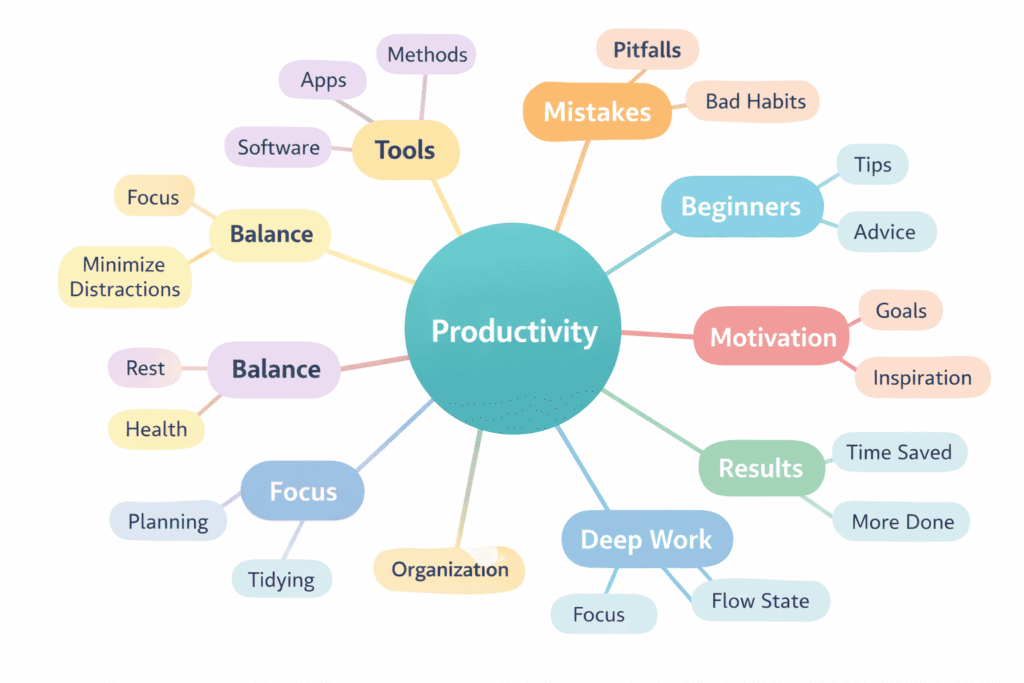
Beginner Angles
- What productivity actually means (and what it does not)
- The biggest productivity myths busted
- Productivity for people who hate schedules
- How to start your first productivity system
- Why to-do lists alone do not work
- The simplest productivity method for beginners
- Morning routines that actually improve output
- What productive people do differently on Sundays
- How long your focus sessions should actually be
- The one habit that changed everything for my workflow
Tools and Methods
- Notion vs. Obsidian for productivity
- How to use time-blocking for a chaotic schedule
- The Pomodoro Technique: does it actually work?
- How to build a second brain in 30 days
- The best free productivity apps for 2025
- Paper planner vs. digital planner: a real comparison
- How to set up a weekly review system
- Using Google Calendar as a productivity tool
- The best task managers for freelancers
- How to automate repetitive tasks without coding
Deep Productivity
- The science of deep work explained simply
- How to do more in 4 hours than most do in 8
- Why multitasking is destroying your output
- The hidden cost of context switching
- How to protect your peak performance hours
- Energy management vs. time management
- What flow state is and how to enter it
- How to eliminate decision fatigue
- The 80/20 rule applied to your task list
- Why saying no is a productivity skill
For Specific Audiences
- Productivity for ADHD: what actually helps
- Remote work productivity tips that are not obvious
- Productivity for parents with no quiet time
- Student productivity: how to study less but retain more
- Freelancer productivity: managing yourself without a boss
- Productivity for night owls who cannot wake up early
- How introverts can protect their energy and stay productive
- Productivity strategies for creative people
- Solopreneur productivity: doing everything alone
- Productivity for people recovering from burnout
Mistakes and Fixes
- Why you keep getting distracted (and the real fix)
- Stop optimizing your system and start working
- The productivity trap: planning instead of doing
- Why your morning routine is making you less productive
- Overcomplicating productivity: when tools hurt more than help
- The myth of inbox zero
- Why hustle culture destroys real productivity
- What to do when your productivity system collapses
- The mistake of scheduling every minute
- Why rest is a productivity strategy
Results and Outcomes
- How I wrote a book while working full time
- What 90 days of deep work taught me
- How to ship a side project without burning out
- Doubling output without working more hours
- A week of extreme productivity: what I learned
- How to finish your most dreaded task first
- What happened when I deleted social media for a month
- The one change that made my calendar work for me
- How tracking my time changed my priorities
- Productivity lessons from CEOs who work 40 hours a week
Advanced Concepts
- Building systems that work without motivation
- The compounding effect of small daily habits
- Why accountability changes everything
- How to do a personal productivity audit
- Creating a shutdown ritual that actually ends your day
- The power of weekly and quarterly reviews
- How to design your environment for focus
- Time auditing: how to find your wasted hours
- The relationship between sleep and output
- Why boredom is essential for creative productivity
Comparisons and Opinions
- GTD vs. time-blocking: which works better?
- The 1-3-5 rule vs. the MIT method
- Analog vs. digital productivity systems
- Working from home vs. coworking for productivity
- Short workdays vs. long workdays: the data
- Reactive vs. proactive scheduling
- Productivity books ranked: which ones actually deliver
- What productivity gurus get wrong
- The best and worst productivity advice on YouTube
- Is hustle culture dead?
Seasonal and Timely
- Productivity reset for the new year
- Summer productivity: staying on track when routines break
- Back-to-school productivity habits that stick
- Year-end review: how to audit your productivity
- How to stay productive during the holiday season
That is 100 stories. From one topic.
Real-World Examples
Example 1: A Blogger in Personal Finance
Topic: “Saving Money”
Stories generated: emergency fund guide, how to save on a low income, high-yield savings account comparison, saving money on groceries, the 52-week savings challenge explained, how to save for a house, saving money as a college student, apps that automate saving, the psychology of saving, and 40 more.
Result: A personal finance blog that ranks for hundreds of long-tail keywords, drives consistent organic traffic, and earns affiliate revenue from multiple entry points.
Example 2: A B2B SaaS Company
Topic: “Project Management”
Stories generated: project management methodology comparisons, onboarding templates, remote team management tips, how to handle scope creep, project manager career advice, tool reviews, integrations explained, and client reporting templates.
Result: A content hub that attracts project managers at every stage of their career, builds brand trust, and generates demo sign-ups from search traffic.
Example 3: A Personal Brand Coach
Topic: “LinkedIn Growth”
Stories generated: how to write a LinkedIn headline, the best LinkedIn post formats, how to grow from 0 to 5,000 followers, LinkedIn algorithm explained, LinkedIn for introverts, how to get clients from LinkedIn, content ideas for LinkedIn, and profile optimization checklist.
Result: Seen as the go-to expert on LinkedIn growth. Attracts coaching clients organically through content.
SEO Benefits of the Multiple Stories Strategy
Topical Authority: Google’s algorithm favors sites that demonstrate comprehensive coverage of a subject. Publishing multiple stories around one topic signals expertise, which lifts rankings for every piece in the cluster.
Internal Linking: Each story becomes a natural internal link opportunity. A strong internal link structure distributes page authority across your site, helping all pages rank higher.
Keyword Domination: One topic contains dozens of keywords. By covering all angles, you capture the full keyword universe — from high-volume head terms to long-tail questions — without keyword stuffing a single page.
Reduced Bounce Rate: When readers finish one story, a relevant next story is always available. This increases time on site, which is a positive ranking signal.
Faster Indexing: Sites that publish consistently and internally link new content get crawled and indexed faster by Google.
Traditional Blogging vs. Multiple Stories Strategy
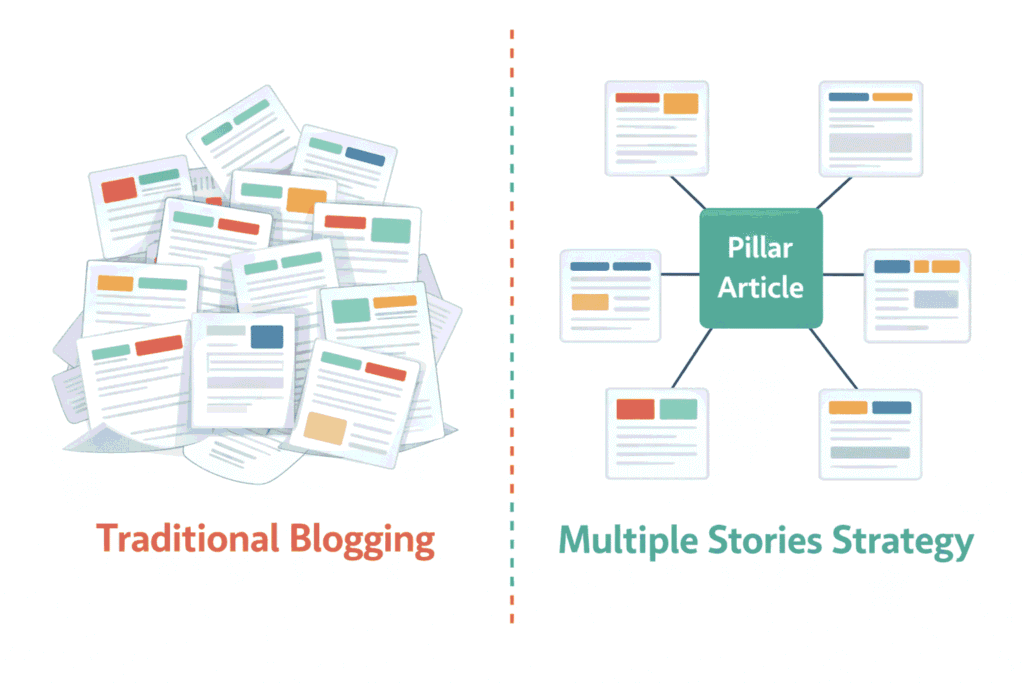
| Factor | Traditional Blogging | Multiple Stories Strategy |
|---|---|---|
| Content plan | Random topics | Clustered by theme |
| SEO depth | Surface-level | Topical authority |
| Internal linking | Weak or accidental | Systematic and strategic |
| Traffic growth | Slow and unpredictable | Compounding over time |
| Audience retention | Low (no clear journey) | High (related content visible) |
| Authority signals | Scattered | Concentrated and strong |
Traditional blogging writes whatever feels interesting. The multiple stories strategy builds a content territory.
Common Mistakes to Avoid
Mistake 1: Treating every story as isolated. Stories must link to each other and to the pillar. Isolated content does not build topical authority.
Mistake 2: Choosing topics too narrow. A topic that only generates five sub-ideas will not sustain a cluster strategy. Choose broad enough to generate 30+ stories.
Mistake 3: Skipping the pillar article. The pillar is the foundation. Publishing only cluster articles without a strong pillar leaves your strategy structurally weak.
Mistake 4: Publishing all stories at once. Spreading publication over weeks gives Google time to crawl and index each piece before the next arrives, building momentum gradually.
Mistake 5: Ignoring search intent. Not every story needs to be SEO-driven, but knowing whether a reader is in informational, navigational, or transactional mode helps you write each piece correctly.
Mistake 6: Duplicating content across stories. Each story must have a unique angle. Thin, overlapping content triggers duplicate content issues and dilutes authority.
Mistake 7: Never updating the pillar. As cluster articles are published, the pillar must grow to reference them. A static pillar article weakens the entire cluster over time.
Frequently Asked Questions
What does “your topics | multiple stories” mean? It refers to a content strategy where one topic is systematically expanded into many individual stories, articles, or content pieces. The pipe symbol separates the two concepts: your chosen topic, and the multiple stories you create from it.
Is it a strategy or a tool? It is a strategy — a method of planning and organizing content. It does not require any specific tool, though content calendars, keyword research tools, and SEO platforms help execute it more effectively.
Is the multiple stories strategy good for SEO? Yes. It is one of the most effective modern SEO strategies available. It builds topical authority, improves internal linking, captures more keywords, and creates compounding traffic over time.
How many stories should I create per topic? A minimum of 10–15 stories per topic is needed to build meaningful topical authority. The most successful content sites create 30–100+ stories per topic over time.
Can this work for social media, not just blogs? Absolutely. The same topic can generate Instagram carousels, Twitter/X threads, LinkedIn posts, YouTube videos, and TikToks. The strategy is platform-agnostic.
How do I choose which topic to start with? Choose the topic most relevant to your primary audience and most aligned with your business goals. Validate it with keyword research to confirm search demand before investing in cluster creation.
How long does it take to see SEO results? Typically 3–6 months before significant ranking improvements appear, though early traffic can arrive within weeks for low-competition long-tail keywords in your cluster.
Do I need a large website to use this strategy? No. Even brand-new websites can build topical authority in a niche by focusing deeply on one topic before expanding to others.
What is the difference between a pillar article and a cluster article? A pillar article covers the entire topic broadly (1,500–4,000 words). A cluster article covers one specific sub-angle in depth (800–2,000 words) and links back to the pillar.
Can I use this strategy for e-commerce or product websites? Yes. E-commerce brands can build topic clusters around product categories, use cases, buyer guides, and comparison content — each linking to relevant product pages.
Conclusion
The your topics | multiple stories strategy is not a content hack. It is a long-term system for building genuine authority, capturing search traffic at scale, and creating content that compounds in value over time.
The formula is simple: choose one topic, extract every possible angle, turn each angle into a story, and publish them in a connected, strategic sequence. Repeat this across three to five core topics and you will have more content, more traffic, and more authority than competitors who are still writing one-off posts with no strategic framework.
Stop publishing in isolation. Start building a content territory. Your topics are not one story — they are many. Use all of them.

Abdullah Zulfiqar is Co-founder and Client Success Manager at RankWithLinks, an SEO agency helping businesses grow online. He specializes in client relations and SEO strategy, driving measurable results and maximizing ROI through effective link-building and digital marketing solutions.