
Productivity tracking has become one of the most important operational priorities for businesses managing hybrid teams, remote workforces, and distributed operations. The right workforce software does not just monitor hours — it gives leaders meaningful visibility into how work actually gets done, where time is being lost, and which teams and individuals are performing at their best.
With dozens of platforms competing for attention in this space, choosing the best workforce software for productivity tracking requires a clear understanding of what each tool does well, who it is built for, and what it actually measures.
This guide covers the top workforce software platforms available in 2026, what makes each one stand out, and how to match the right solution to your organization’s specific needs.
What Is Workforce Software for Productivity Tracking?
Workforce software for productivity tracking is a category of business tools designed to monitor, measure, and analyze how employees spend their working time. These platforms go beyond basic time clocks to provide detailed insights into task completion, application usage, project progress, output quality, and team efficiency.
The best workforce productivity tools help managers answer critical questions: Are deadlines being met consistently? Where are the biggest time drains in the workflow? Which teams are operating efficiently and which ones are struggling? How does actual time spent compare to estimated time on projects?
In 2026, with hybrid work firmly established as the dominant model across most knowledge-work industries, these tools have evolved significantly. Modern workforce software combines time tracking, project management, employee engagement measurement, and AI-powered analytics into unified platforms that serve both operational and strategic needs.
Why Productivity Tracking Software Matters for Modern Businesses
The shift to hybrid and remote work removed the visual cues that managers traditionally used to assess productivity. Seeing someone at their desk was never a reliable measure of output, but its absence forced organizations to develop more structured, data-driven approaches to understanding how work gets done.
Workforce productivity software fills that gap with objective, measurable data. When implemented thoughtfully, it reduces micromanagement, improves resource allocation, surfaces bottlenecks before they become crises, and helps employees understand their own work patterns and habits.
The business case is straightforward. Organizations that track productivity effectively make better staffing decisions, deliver projects more consistently on time and within budget, and identify underperformance early enough to address it constructively rather than reactively.
Key Features to Look for in Workforce Productivity Software
Before reviewing specific platforms, understanding the features that define a high-quality workforce productivity tool helps you evaluate options against your actual needs.
Time tracking and timesheets — Accurate, easy-to-use time logging that employees will actually adopt. Manual entry, automatic tracking, and timer-based options each suit different work styles and organizational cultures.
Project and task management integration — The ability to connect time data to specific projects, tasks, and deliverables so productivity is measured in context rather than in isolation. Enterprise project management software can centralize workflows and enhance visibility across teams for better tracking and coordination.
Activity monitoring — For remote teams, application usage tracking and activity levels provide a layer of visibility that pure time tracking cannot. The best tools balance visibility with employee privacy and trust.
Reporting and analytics — Customizable dashboards that surface actionable insights rather than overwhelming managers with raw data. The ability to view productivity trends by individual, team, project, and time period is essential.
Payroll and billing integration — For agencies and service businesses, connecting tracked time directly to payroll processing and client billing eliminates manual reconciliation and reduces errors.
Goal and OKR tracking — Aligning individual productivity metrics to broader team and company goals gives context to the numbers and connects daily work to strategic outcomes.
Employee self-service and transparency — Tools that give employees visibility into their own productivity data build trust and encourage self-management rather than surveillance anxiety.
The Best Workforce Software for Productivity Tracking in 2026
1. Hubstaff
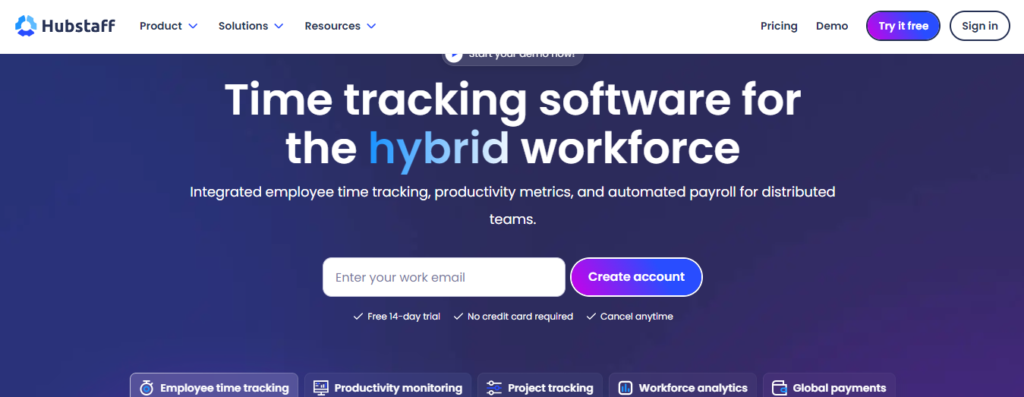
Hubstaff is one of the most widely used workforce productivity platforms for remote and distributed teams. It combines time tracking, activity monitoring, GPS tracking for field teams, payroll automation, and project budgeting into a single, well-integrated platform.
Its activity monitoring features — including optional screenshot capture, application usage tracking, and keyboard and mouse activity levels — make it particularly popular with companies managing large remote workforces where output visibility is a priority.
Hubstaff’s reporting suite is comprehensive, offering insights into time usage by project, team, and individual, along with budget tracking that alerts managers when projects approach their allocated hours.
Best for: Remote teams, field service businesses, agencies, and companies managing distributed workforces across multiple time zones
Strengths: Detailed activity monitoring, GPS tracking, payroll integration, project budgeting, strong mobile app
Considerations: Activity monitoring features require careful implementation to avoid creating a culture of surveillance that damages morale and trust
2. Toggl Track
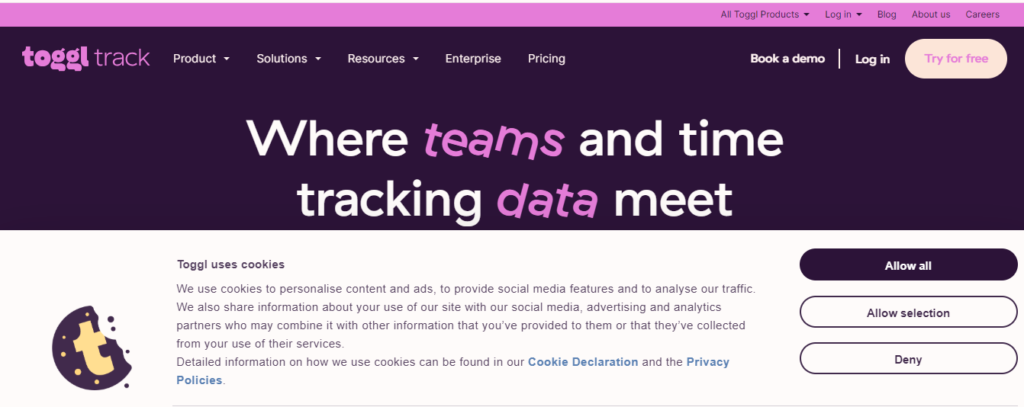
Toggl Track has built a loyal following by making time tracking genuinely simple and frictionless. Its one-click timer, browser extension, and mobile app make logging time fast enough that employees actually do it consistently — which is the fundamental challenge with any time tracking implementation.
Beyond its ease of use, Toggl Track offers powerful reporting that breaks down time by project, client, tag, and team member. Its integrations with over 100 project management and productivity tools mean it slots into existing workflows without requiring a complete operational overhaul.
Toggl Track is particularly well suited for creative agencies, consulting firms, and professional services businesses where accurate client billing and project profitability analysis are critical.
Best for: Agencies, freelancers, consultants, and small to mid-sized professional services teams
Strengths: Exceptional ease of use, strong reporting, extensive integrations, transparent and fair pricing
Considerations: Lighter on activity monitoring features compared to platforms like Hubstaff — better suited for output-focused cultures than surveillance-focused ones
3. Monday.com
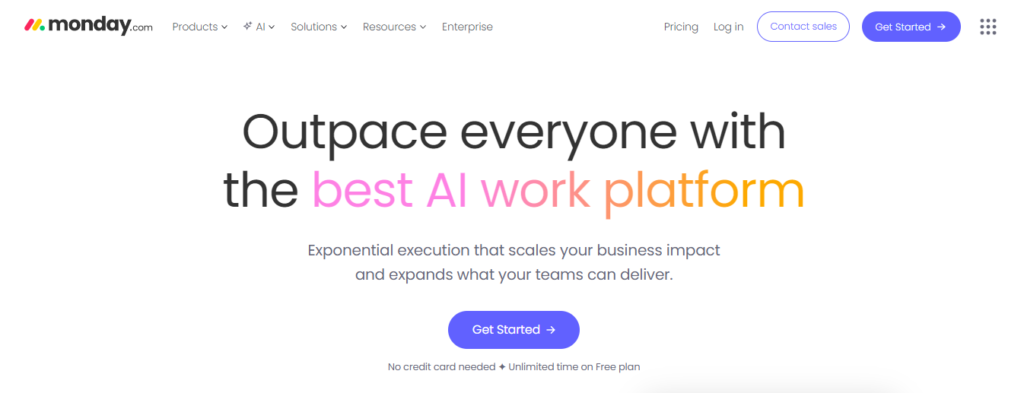
Monday.com occupies a different position in the workforce software landscape. Rather than leading with time tracking, it leads with work management — giving teams a visual, highly customizable platform for planning, executing, and tracking projects and workflows.
Its productivity tracking capabilities come through workload management views, time tracking integrations, deadline monitoring, and automation features that surface bottlenecks and delays before they escalate.
In 2026, Monday.com has continued expanding its AI-powered features, including intelligent workload balancing suggestions, automated status updates, and predictive timeline analysis that helps teams identify at-risk deadlines weeks in advance.
Best for: Project-driven teams, marketing departments, operations teams, and organizations that want productivity insights embedded within their core project management workflow
Strengths: Visual work management, highly customizable, strong automation, growing AI capabilities, excellent collaboration features
Considerations: Time tracking requires integration with third-party tools or add-ons rather than being a core native feature
4. Clockify
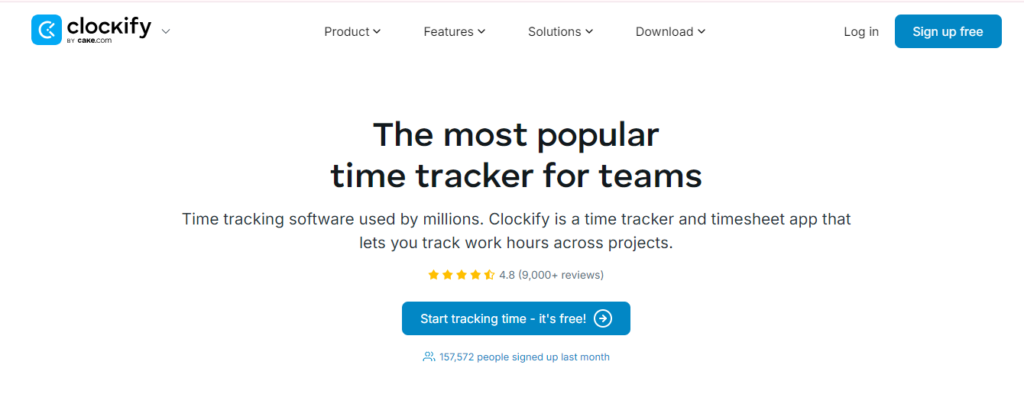
Clockify stands out in the workforce software market for one compelling reason: its core time tracking features are genuinely free for unlimited users. For startups, small businesses, and non-profits operating on tight budgets, this makes it an accessible entry point into structured productivity tracking.
Despite being free at its base level, Clockify offers a surprisingly robust feature set including timesheet management, project tracking, team reporting, and a visual calendar view of tracked time. Paid tiers add features like GPS tracking, screenshots, kiosk time clock for physical locations, and advanced reporting.
Best for: Small businesses, startups, non-profits, and teams needing a budget-friendly productivity tracking solution
Strengths: Free unlimited users on base plan, clean interface, solid reporting, strong mobile app, kiosk mode for on-site teams
Considerations: Advanced features require paid upgrades; activity monitoring is less sophisticated than dedicated remote monitoring tools
5. Rippling
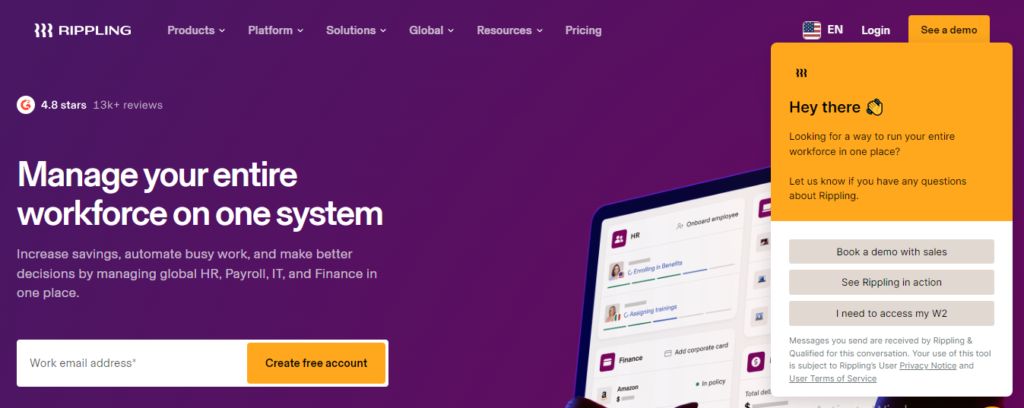
Rippling takes a fundamentally different approach to workforce software by unifying HR, IT, and finance operations into a single platform. Its productivity tracking capabilities sit within a broader workforce management suite that connects employee data, payroll, device management, application access, and performance management in one place.
For productivity tracking specifically, Rippling offers time and attendance management, scheduling tools, and workforce analytics that connect individual and team performance data to compensation, headcount planning, and organizational structure.
Its real power emerges at scale, where the ability to connect productivity data to payroll, benefits, and IT provisioning in a single workflow creates operational efficiency that standalone productivity tools cannot match.
Best for: Mid-sized to large companies that want workforce productivity tracking embedded within a comprehensive HR and operations platform
Strengths: Deep platform integration, HR and IT unification, strong analytics, global workforce support, automation across the employee lifecycle
Considerations: Broader scope and higher cost than standalone productivity tools — best suited for organizations ready to consolidate multiple systems
6. ActivTrak
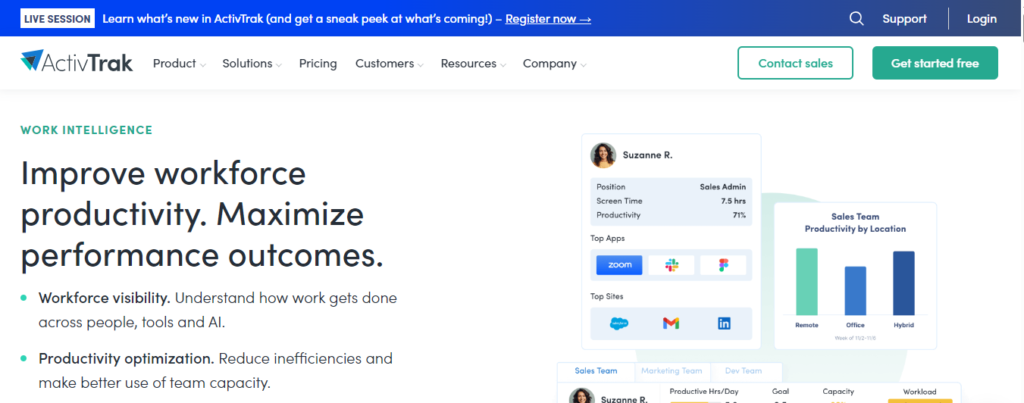
ActivTrak positions itself specifically as a workforce analytics platform, going deeper than basic time tracking to provide behavioral insights about how employees work throughout the day.
Its Productivity Lab feature analyzes work patterns across teams and individuals, identifying peak productivity hours, common workflow interruptions, application usage patterns, and focus versus distraction ratios. This data allows managers to optimize team schedules, reduce meeting overload, and redesign workflows around natural productivity rhythms rather than arbitrary schedules.
ActivTrak also includes workload balance analysis that flags employees who are consistently overworked or underutilized — a valuable tool for preventing burnout and optimizing resource allocation.
Best for: Organizations that want deep behavioral analytics and workforce optimization insights beyond simple time tracking
Strengths: Advanced productivity analytics, workload balance monitoring, focus and distraction analysis, strong reporting, employee wellness signals
Considerations: More sophisticated than many teams need; requires thoughtful implementation and clear communication with employees about how data is used
How to Choose the Right Workforce Productivity Software for Your Business
With so many strong options available, the selection process comes down to matching platform capabilities to your specific organizational context.
Define What Productivity Means for Your Organization
Productivity means different things in different contexts. For a software development team, productivity might mean story points delivered per sprint and deployment frequency. For a creative agency, it might mean billable hours per team member and project profitability. For a customer service operation, it might mean tickets resolved per hour and first-contact resolution rates.
Before evaluating any platform, define the specific metrics that matter most to your business. This prevents you from being seduced by features you will never use while missing the capabilities that would actually move the needle.
Consider Your Team’s Work Style and Culture
The best workforce productivity software is the software your team will actually use consistently. A platform with powerful features that generates employee resistance, workarounds, and inconsistent adoption will always underperform a simpler tool that becomes genuinely embedded in daily workflow.
If your culture emphasizes trust and autonomy, choose tools that give employees visibility into their own data and frame productivity tracking as a tool for self-improvement rather than surveillance. If your operational context requires detailed accountability monitoring, choose tools designed for that purpose and communicate the rationale transparently.
Evaluate Integration Requirements
Standalone productivity tools only deliver their full value when they integrate with the other systems your team already uses. Check carefully that your preferred platform connects with your existing project management tools, communication platforms, payroll systems, and HR software before committing.
Poor integrations create data silos that require manual reconciliation and undermine the operational efficiency the tool was supposed to create.
Start With a Pilot Before Rolling Out Organization-Wide
The most effective way to evaluate any workforce productivity platform is to run a structured pilot with a single team or department before committing to an organization-wide rollout. A pilot reveals adoption challenges, integration issues, and feature gaps that no demo or free trial can fully surface.
Run the pilot for four to six weeks, gather structured feedback from participants, measure adoption rates and data quality, and use those insights to make a fully informed purchasing decision.
The Role of AI in Workforce Productivity Software in 2026
Artificial intelligence has transformed what workforce productivity software can do. In 2026, the most advanced platforms are moving beyond data collection and reporting toward genuine prediction and prescription.
AI-powered productivity features now include automated anomaly detection that flags unusual work patterns before they become performance issues, intelligent workload balancing that prevents burnout by surfacing early warning signals, predictive project timeline analysis that identifies at-risk deliverables weeks in advance, and natural language reporting that allows managers to ask questions about their team’s productivity data in plain English and receive instant, contextualized answers.
The platforms investing most heavily in AI capabilities — Monday.com, Rippling, ActivTrak, and Jira among them — are pulling ahead in terms of the strategic value they deliver beyond basic operational monitoring.
Workforce Productivity Tracking Best Practices
Implementing productivity tracking software successfully requires more than choosing the right platform. How you implement it determines whether it becomes a trusted management tool or a source of employee resentment.
Be transparent from the start — Tell your team exactly what is being tracked, why it is being tracked, who has access to the data, and how it will be used. Employees who understand and accept the rationale for tracking are far more likely to engage with it constructively.
Focus on outcomes not activity — The most effective productivity tracking measures what gets done, not just how busy someone appears. Tracking application usage and keyboard activity tells you very little about actual output quality and business impact.
Use data to support not punish — Productivity data is most valuable when it helps managers identify where support, resources, or process improvements are needed. Using it primarily to catch and penalize underperformers creates fear that drives gaming behavior rather than genuine improvement.
Give employees access to their own data — Platforms that give individuals visibility into their own productivity patterns empower self-management and reduce the surveillance anxiety that damages morale and engagement.
Review and adjust regularly — Productivity metrics that made sense when you implemented them may become irrelevant as your business evolves. Review your tracking approach quarterly and update it to reflect current priorities.
Common Mistakes When Implementing Workforce Productivity Software
Tracking everything instead of what matters — More data is not better data. Identify the three to five metrics that genuinely reflect productivity in your context and focus your tracking and reporting on those.
Implementing without employee buy-in — Deploying productivity monitoring without transparent communication and genuine explanation creates suspicion and resistance that undermines adoption and accuracy.
Confusing activity metrics with productivity metrics — Hours logged, keystrokes per hour, and application usage data tell you how busy someone appears, not how much value they are creating. Build your measurement framework around outputs and outcomes, not activity proxies.
Choosing software based on features alone — The most feature-rich platform is rarely the best choice. Adoption, ease of use, and cultural fit matter as much as capability breadth.
Neglecting manager training — Productivity software only improves management decisions when managers know how to interpret the data, have conversations about it constructively, and use it to support their teams rather than police them.
Final Thoughts
The best workforce software for productivity tracking in 2026 is not a single platform — it is the platform that most accurately fits your team’s size, work style, industry context, and productivity measurement priorities.
Hubstaff and Time Doctor lead for remote team accountability and detailed activity monitoring. Toggl Track and Clockify excel for simple, frictionless time tracking in agency and professional services environments. Monday.com, Asana, and Jira deliver productivity insights embedded within powerful project management workflows. ActivTrak provides the deepest behavioral analytics for organizations serious about workforce optimization. Rippling offers the most comprehensive workforce management integration for mid-market and enterprise organizations. And Workforce.com remains the strongest choice for shift-based and hourly workforce management.
Whatever platform you choose, remember that the technology is only as valuable as the culture and management practices surrounding it. Productivity software built on a foundation of trust, transparency, and genuine employee development will always outperform the same software implemented as a surveillance mechanism.
Invest in the right tool, implement it thoughtfully, and use what it reveals to build a workforce that is not just measurably productive but genuinely engaged in doing meaningful work well.

Fazilat zulfiqar is an SEO specialist at RankWithLinks, focused on improving search rankings through smart link building and optimization.He helps businesses grow organic traffic and build strong online authority.