
Introduction
The way businesses manage their operations is changing fast. Traditional software tools that once required hours of manual data entry, endless spreadsheets, and slow reporting are being replaced by something far more powerful — AI-driven ERP systems.
For Nusaker, understanding and embracing AI-driven ERP systems is not just a technology decision. It is a strategic move that will define how competitive, efficient, and future-ready the business becomes in the years ahead.
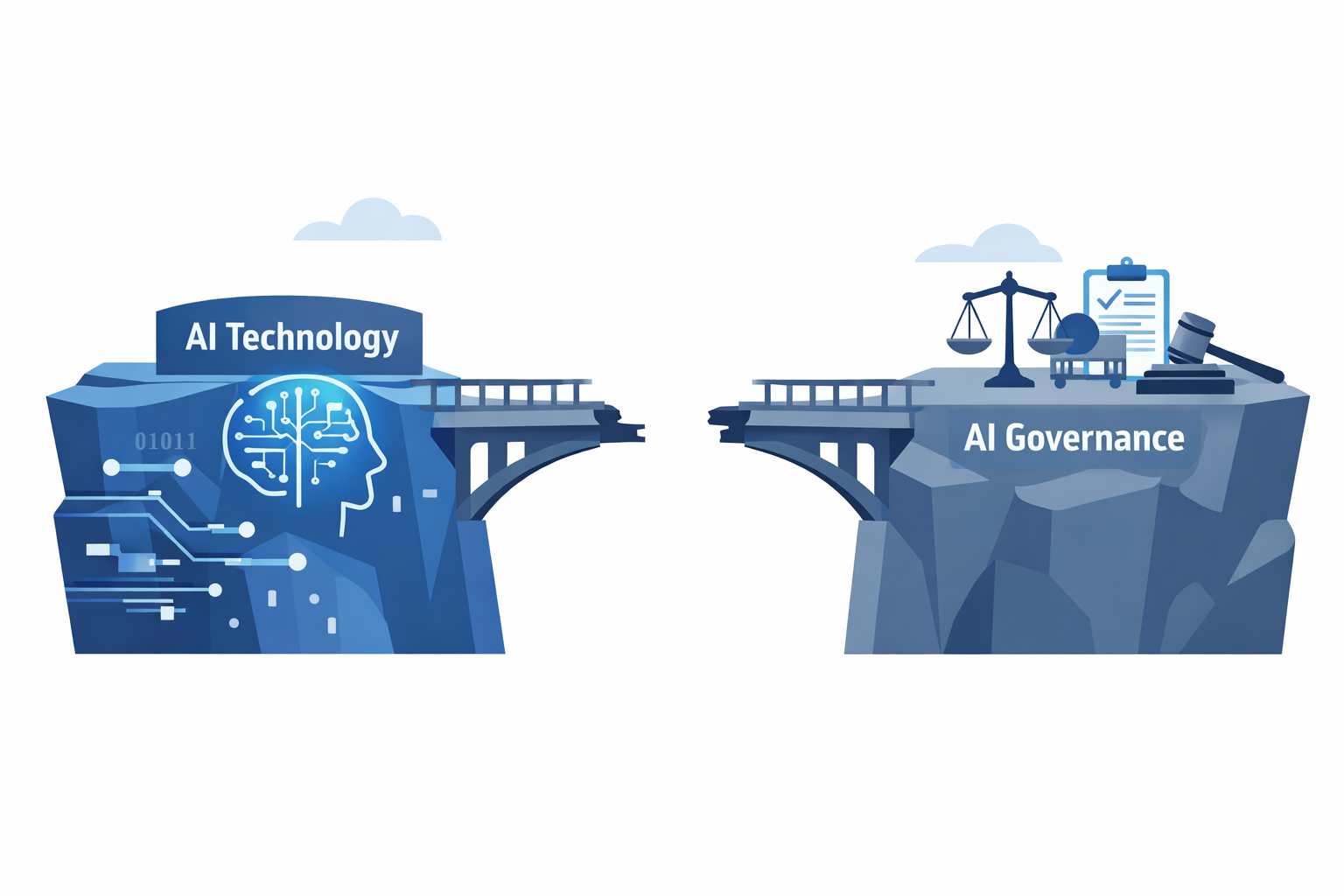
In this article, you will learn exactly what AI-driven ERP systems are, why they matter, how they work, what benefits they bring, and what the future looks like for Nusaker as intelligent ERP technology continues to evolve. Whether you are a business owner, a developer, or someone just learning about ERP, this guide gives you everything you need to know.
What Is an ERP System?
Before diving into AI, it helps to understand what an ERP system is.
ERP stands for Enterprise Resource Planning. It is a type of software that helps businesses manage and connect all their core operations in one place. This typically includes:
- Finance and accounting
- Human resources and payroll
- Inventory and supply chain management
- Sales and customer relationship management (CRM)
- Manufacturing and production
- Procurement and vendor management
- Project management and reporting
Think of an ERP system as the central nervous system of a business. Every department sends data to it, and it helps leadership make informed decisions based on a complete, real-time picture of the organization.
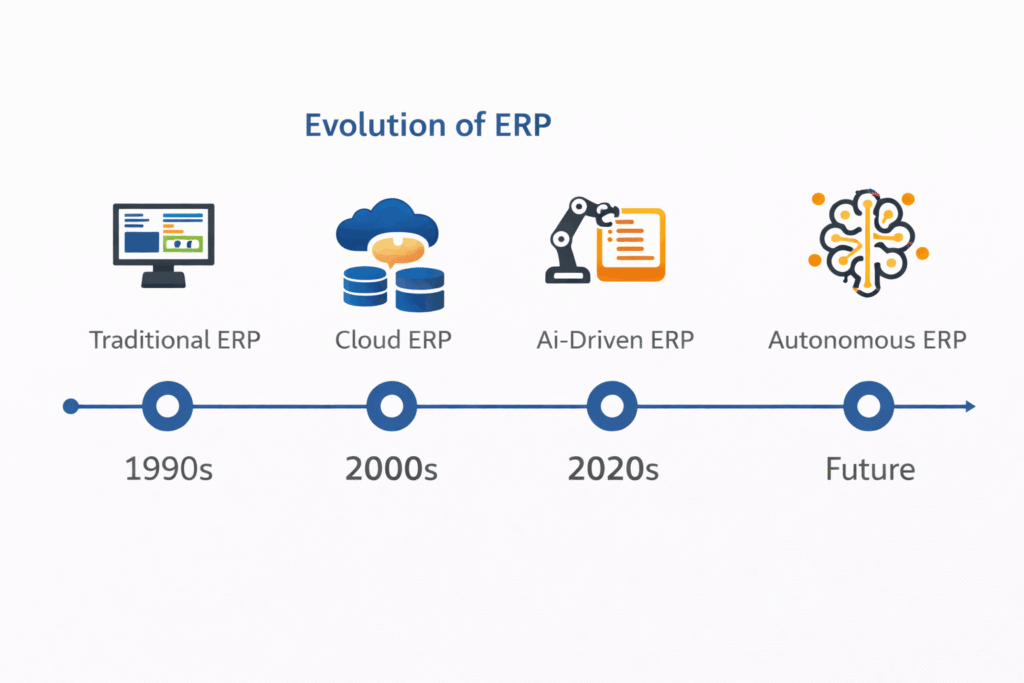
Traditional ERP systems have been around since the 1990s. They were powerful for their time but required heavy manual input, rigid workflows, and expensive customization. That era is coming to an end.
What Is an AI-Driven ERP System?
An AI-driven ERP system is a next-generation enterprise platform that uses artificial intelligence technologies — including machine learning, natural language processing, predictive analytics, and automation — to make the ERP smarter, faster, and more proactive.
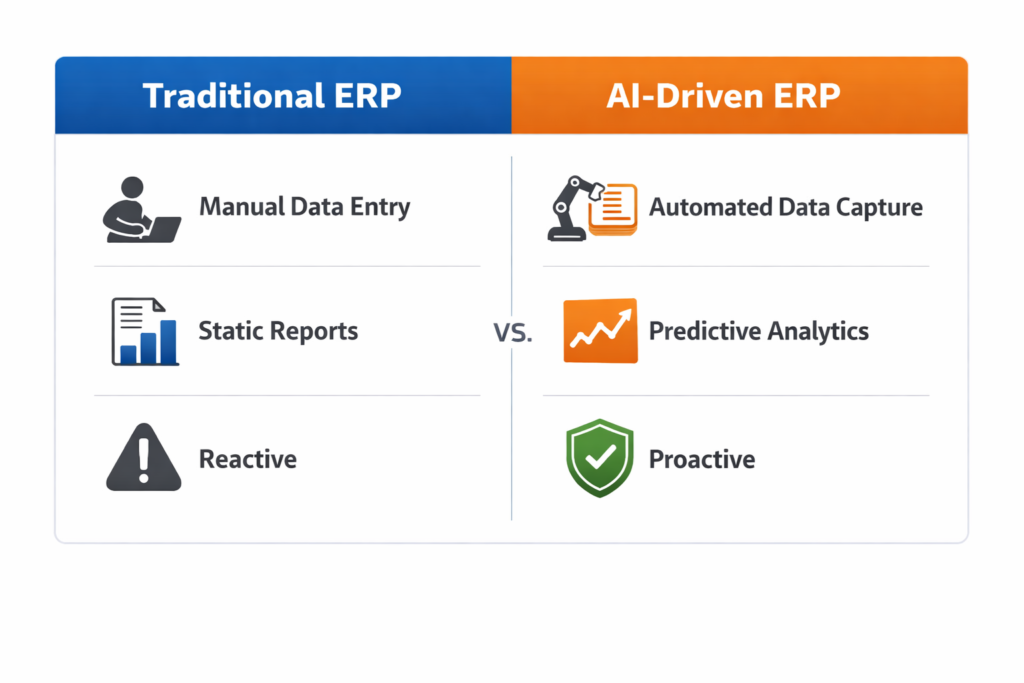
Instead of simply storing and displaying data, an AI-driven ERP system:
- Learns from historical data to identify patterns
- Predicts future outcomes before they happen
- Automates repetitive tasks without human input
- Flags anomalies and risks in real time
- Provides intelligent recommendations to decision-makers
- Understands natural language queries from users
In short, where a traditional ERP tells you what happened, an AI-driven ERP tells you what is happening right now and what is likely to happen next — and often takes action on your behalf.
In short, where a traditional ERP Software tells you what happened, an AI-driven ERP tells you what is happening right now and what is likely to happen next — and often takes action on your behalf.
Why AI-Driven ERP Systems Matter for Nusaker
For Nusaker, the shift toward AI-driven ERP is not a distant future concept — it is happening right now across industries worldwide. Here is why it matters directly:
Faster decision-making. AI processes enormous volumes of data in milliseconds and surfaces the insights that matter most, so leadership can act quickly and confidently.
Reduced operational costs. By automating routine tasks like invoice processing, inventory reordering, payroll calculations, and report generation, AI dramatically reduces the time and cost of running daily operations.
Fewer human errors. Manual data entry is one of the biggest sources of business errors. AI automation eliminates most of this risk by capturing and processing data accurately and consistently.
Competitive advantage. Businesses that adopt AI-driven ERP earlier gain a significant edge over competitors still using legacy systems. They operate leaner, respond faster, and serve customers better.
Scalability. As Nusaker grows, an AI-driven ERP grows with it — handling more data, more users, more complexity — without requiring a complete system overhaul.
Key Features of AI-Driven ERP Systems
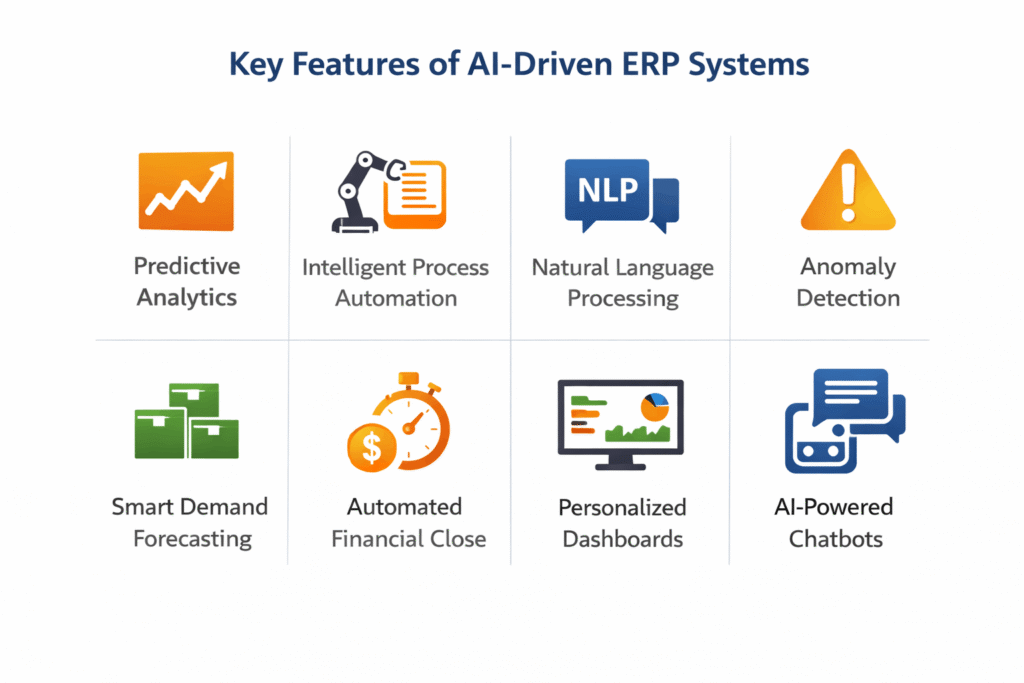
Here are the most important AI-powered features that define modern intelligent ERP platforms:
Predictive Analytics
This is one of the most valuable features of any AI-driven ERP. The system analyzes historical and real-time data to forecast future trends — such as sales demand, cash flow, inventory needs, or employee turnover.
Example: Instead of waiting until stock runs out, the system predicts three weeks in advance that a particular product will run low based on seasonal trends and places a purchase order automatically.
Intelligent Process Automation (IPA)
AI-driven ERPs go beyond basic rule-based automation. They use machine learning to handle complex, variable workflows — adapting to new situations rather than breaking when something unexpected happens.
Example: Automatically routing invoices for approval based on amount, vendor history, and budget availability — without a human manually deciding where each invoice should go.
Natural Language Processing (NLP)
NLP allows users to interact with the ERP system using plain, everyday language instead of navigating complex menus and reports.
Example: A manager types or says, “Show me last month’s sales performance by region compared to the same period last year,” and the system instantly generates the report.
Anomaly Detection and Risk Alerts
AI continuously monitors all business data streams and flags unusual patterns that could indicate fraud, financial risk, supply chain disruption, or compliance violations.
Example: The system detects that a vendor invoice has been submitted twice with slightly different amounts and immediately alerts the finance team before any payment is made.
Smart Demand Forecasting
Particularly valuable for supply chain and inventory management, AI-driven demand forecasting uses machine learning models trained on sales history, market trends, seasonality, and external data to predict what customers will need and when.
Example: A retailer avoids overstocking seasonal items by 30% after implementing AI-driven demand forecasting in their ERP.
Automated Financial Close
AI accelerates the financial close process — the period at the end of each month or quarter when accounting teams reconcile all financial data. Tasks that once took days can be completed in hours.
Personalized User Dashboards
AI learns each user’s role, preferences, and habits, then automatically surfaces the most relevant data, reports, and alerts on their dashboard — reducing the time spent searching for information.
AI-Powered Chatbots and Virtual Assistants
Embedded AI assistants help users navigate the ERP, answer questions, trigger workflows, and generate reports — all through a conversational interface.To ensure these interactions remain accurate and reliable, llm model evaluation plays a critical role in continuously assessing performance, improving response quality, and maintaining consistency across enterprise workflows.
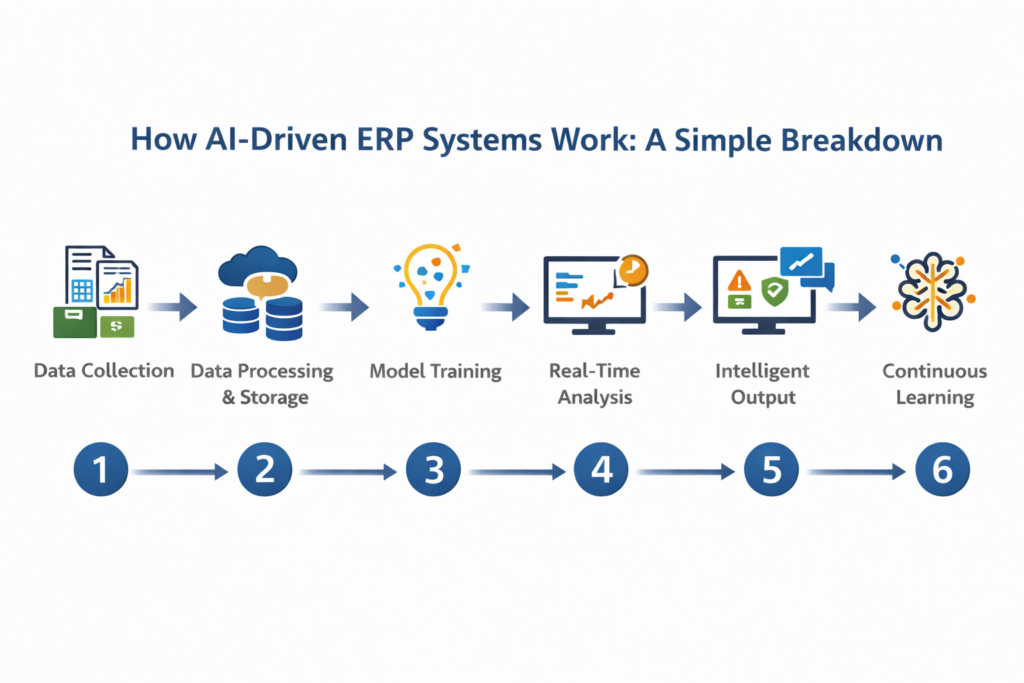
How AI-Driven ERP Systems Work: A Simple Breakdown
Understanding the technology behind AI-driven ERP does not require a computer science degree. Here is a simple explanation of how it all fits together.
Step 1 — Data Collection The ERP system collects data from every department and connected source — sales transactions, HR records, inventory movements, customer interactions, financial entries, and even external data like market prices or weather (relevant for logistics and agriculture).
Step 2 — Data Processing and Storage All collected data is cleaned, organized, and stored in a centralized data structure — typically a cloud-based data warehouse or lake. This is the foundation that AI models learn from.
Step 3 — Machine Learning Model Training AI models are trained on historical data to recognize patterns. For example, a model might learn that sales of a certain product always spike in October, or that a particular supplier tends to deliver late in Q4.
Step 4 — Real-Time Analysis Once trained, the AI models run continuously, analyzing incoming data in real time and comparing it against learned patterns to detect anomalies, opportunities, and risks.
Step 5 — Intelligent Output The system delivers its intelligence in the form of predictions, recommendations, automated actions, alerts, and visualizations — directly inside the ERP interface that users already work in every day.
Step 6 — Continuous Learning The more data flows through the system, the smarter the AI becomes. This is the compounding advantage of AI-driven ERP — it gets better over time, not worse.
Real-World Examples of AI-Driven ERP in Action
Seeing how other organizations use AI-driven ERP makes the concept much more concrete.
Manufacturing A car parts manufacturer uses AI-driven ERP to monitor machine performance in real time. The system detects micro-vibrations in a production machine that indicate it will fail within 48 hours. A maintenance order is automatically generated and scheduled — preventing a costly production shutdown.
Retail A clothing retailer uses AI demand forecasting inside their ERP to optimize inventory across 200 store locations. The system recommends exactly how many units of each product to stock in each location based on local sales trends, events, and weather forecasts. Overstock and stockouts are reduced by 40%.
Healthcare A hospital network uses AI-driven ERP to manage procurement for medical supplies. The system predicts consumption rates based on patient admissions and automatically triggers purchase orders — ensuring critical supplies are never out of stock while reducing waste.
Finance and Banking A financial services firm uses AI anomaly detection inside their ERP to monitor thousands of daily transactions for signs of fraud or compliance violations. Suspicious patterns are flagged and escalated to compliance teams within seconds — far faster than any manual review process.
Logistics and Supply Chain A logistics company uses AI-driven ERP to dynamically reroute deliveries in real time based on traffic, weather, and vehicle availability — reducing fuel costs and improving on-time delivery rates.
The Future of AI-Driven ERP Systems for Nusaker
The evolution of AI-driven ERP is accelerating. Here is what the near and medium-term future looks like — and what it means for Nusaker.
Hyperautomation
Hyperautomation is the next level beyond standard automation. It combines AI, machine learning, robotic process automation (RPA), and process mining to automate virtually every repeatable business process end to end — with minimal human involvement.
For Nusaker, this means entire workflows — from purchase order creation to vendor payment — could run autonomously, with humans only stepping in for exceptions and strategic decisions.
Generative AI Integration
Generative AI tools — the same technology behind advanced AI assistants — are being embedded directly into ERP platforms. Users will be able to generate detailed reports, draft business documents, create financial summaries, and design workflows simply by describing what they want in plain language.
Example: “Generate a quarterly performance report comparing our top five product lines, with recommendations for Q3 budget allocation.” The ERP produces a complete, formatted report in seconds.
Autonomous ERP Agents
The next frontier is autonomous AI agents inside ERP systems — software that can independently monitor business conditions, make decisions within defined parameters, and take action without being prompted by a human user.
Example: An autonomous procurement agent that monitors supplier markets, identifies cost-saving opportunities, negotiates within pre-approved parameters, and executes purchase contracts — all without human involvement.
Deeper IoT Integration
As the Internet of Things (IoT) expands — with smart sensors in warehouses, factories, vehicles, and retail floors — AI-driven ERP systems will ingest real-time physical-world data to make even more precise decisions.
Example: Smart shelf sensors in a warehouse automatically update inventory counts in the ERP the moment a product is moved, eliminating manual stock counts entirely.
Industry-Specific AI ERP Solutions
Rather than one-size-fits-all ERP platforms, the future belongs to industry-specific AI ERP solutions built with deep domain knowledge for sectors like healthcare, agriculture, construction, education, and logistics.
For Nusaker, this means access to ERP tools trained specifically on the data patterns, regulations, and workflows of your particular industry — delivering far more relevant insights than a generic platform ever could.
Explainable AI in ERP
One current challenge with AI systems is that they can feel like a “black box” — giving recommendations without clearly explaining why. The future of AI-driven ERP includes explainable AI, where the system shows its reasoning alongside every recommendation.
Example: Instead of simply recommending a 15% price increase on a product, the ERP explains: “Based on competitor pricing trends, a 12% reduction in your supply costs, and a 23% increase in demand over the past 60 days, a 15% price adjustment is projected to increase gross margin by 8.4%.”
How to Prepare Nusaker for AI-Driven ERP Adoption
Moving to an AI-driven ERP is a major step. Here is how to approach it strategically.
Audit your current systems first. Understand what data you already have, how it is stored, and what processes are currently manual or inefficient. This gives you a baseline and helps you prioritize where AI can have the biggest impact.
Prioritize data quality. AI is only as good as the data it learns from. Before any AI-driven ERP can deliver value, your data needs to be clean, consistent, and well-organized. Invest in data governance early.
Start with high-impact, lower-risk use cases. Do not try to automate everything at once. Start with one or two processes where AI can deliver clear, measurable value — such as demand forecasting, invoice automation, or financial reporting.
Choose a scalable, cloud-based platform. Cloud-based AI ERP platforms are more affordable, faster to deploy, and easier to scale than on-premise systems. Look for platforms with strong AI capabilities built in — not bolted on as an afterthought.
Invest in change management and training. Technology is only half the challenge. People need to understand how to work alongside AI tools, trust the recommendations the system provides, and know when to override automated decisions. Training and communication are critical.
Measure, learn, and iterate. Set clear KPIs for your AI ERP implementation — cost savings, processing time, error rates, forecast accuracy. Review them regularly and adjust your approach based on what the data tells you.
Best Practices for AI-Driven ERP Implementation
- Always align ERP goals with overall business strategy — technology should serve business objectives, not the other way around.
- Involve end users early in the selection and design process to ensure the system fits real workflows.
- Keep data security and privacy compliance at the center of every AI ERP decision, especially when handling customer or employee data.
- Choose vendors with a clear AI development roadmap — the platform you adopt today should be actively investing in the features you will need tomorrow.
- Do not underestimate integration complexity. Map all the systems your ERP needs to connect with before choosing a platform.
Common Mistakes to Avoid
Choosing a platform based on price alone. The cheapest ERP option rarely delivers the AI capabilities needed to drive real transformation. Evaluate total value, not just upfront cost.
Skipping the data preparation phase. Many ERP implementations fail not because of bad software, but because of bad data fed into that software. Clean data is non-negotiable.
Expecting instant results. AI-driven ERP delivers compounding value over time as it learns from more data. Set realistic timelines and measure progress at 30, 60, and 90-day intervals.
Ignoring user adoption. A powerful ERP that nobody uses is worthless. Invest heavily in onboarding, training, and ongoing support.
Over-customizing the system. Heavy customization makes upgrades painful and expensive. Where possible, adapt your processes to fit the platform rather than forcing the platform to fit every legacy process.
Summary
AI-driven ERP systems represent a fundamental shift in how businesses plan, operate, and grow. For Nusaker, the future is one where data flows automatically, decisions are supported by intelligent predictions, routine tasks run themselves, and leadership has a real-time, complete view of the entire organization at all times.
The core message is simple: AI-driven ERP systems are not a luxury reserved for large enterprises. They are rapidly becoming accessible to businesses of every size — and the organizations that adopt them early will be the ones that lead their industries in the years ahead.
The future of Nusaker runs on intelligent, AI-driven ERP. The question is not whether to make the move — it is when and how to do it right.
Frequently Asked Questions (FAQs)
Q1: What is the main difference between a traditional ERP and an AI-driven ERP system? A traditional ERP system is primarily a record-keeping and reporting tool — it stores data and displays it in structured reports. An AI-driven ERP goes much further. It actively analyzes data, learns from patterns, predicts future outcomes, automates complex workflows, and delivers intelligent recommendations in real time. In short, a traditional ERP is reactive — it tells you what happened. An AI-driven ERP is proactive — it tells you what is likely to happen and often acts before you need to.
Q2: Is AI-driven ERP suitable for small and medium-sized businesses? Absolutely. While AI-driven ERP was initially adopted by large enterprises, cloud-based platforms have made intelligent ERP systems affordable and accessible for small and medium-sized businesses. Many modern platforms offer modular pricing, meaning you only pay for the features you actually use. Small businesses can start with AI-powered invoicing or inventory management and expand from there as they grow.
Q3: How long does it take to implement an AI-driven ERP system? Implementation timelines vary depending on the size of the organization, the complexity of existing systems, and the scope of the deployment. A small business implementing a cloud-based AI ERP for core functions might go live in 2 to 3 months. A large enterprise deploying a full AI-driven ERP across multiple departments and locations could take 12 to 24 months. Proper planning, data preparation, and change management are the biggest factors that determine how smooth and fast the process goes.
Q4: What industries benefit most from AI-driven ERP systems? Every industry that manages inventory, finances, people, or customer relationships can benefit from AI-driven ERP. The industries seeing the greatest impact right now include manufacturing, retail and e-commerce, healthcare, logistics and supply chain, financial services, construction, and agriculture. As AI models become more industry-specific, the value delivered in each sector continues to increase.
Q5: What are the biggest risks of implementing an AI-driven ERP system? The most common risks include poor data quality feeding inaccurate insights to the AI, low user adoption due to inadequate training, over-reliance on AI recommendations without human oversight, integration failures with existing systems, and choosing a vendor whose platform lacks a strong long-term AI roadmap. All of these risks can be managed with careful planning, strong project management, and a commitment to change management throughout the implementation process.

Abdullah Zulfiqar is Co-founder and Client Success Manager at RankWithLinks, an SEO agency helping businesses grow online. He specializes in client relations and SEO strategy, driving measurable results and maximizing ROI through effective link-building and digital marketing solutions.