
If you have searched for SEO help as a small business owner, you have almost certainly experienced the same confusion: prices ranging from $99 per month to $10,000 per month, with every provider claiming their service is the one that actually works. The gap is not random. It reflects genuinely different products being sold under the same name.
This guide is honest about what affordable SEO actually means — what it delivers at each price point, what it does not deliver, and how to get the most out of a limited budget without falling for tactics that will hurt your site more than help it.
| What this guide covers What the five SEO pricing tiers actually include A side-by-side breakdown of what you get at each level Red flags that signal cheap SEO will backfire The best free SEO tools to stretch any budget How to prioritise when money is tight What to do this week, whatever your budget |
1. What does ‘affordable SEO’ actually mean?
The word affordable is relative — but in the context of SEO, it typically refers to services priced between $0 and $1,500 per month, aimed at small businesses, local service providers, freelancers, and early-stage companies that cannot justify a large agency retainer.
The key distinction is not between cheap and affordable. It is between cheap (low quality, often harmful) and affordable (good value — delivering meaningful results within a constrained budget). These are not the same thing, and conflating them is one of the most expensive mistakes small business owners make.
A $500/month freelancer who improves your title tags, builds your Google Business Profile, and publishes two optimised blog posts per month is affordable SEO that compounds over time. A $99/month service that automates backlink generation and spins content is cheap SEO that can result in a Google penalty — and penalties can take months or years to recover from.
| The core question to ask of any affordable SEO provider “What specifically will you do each month, and how will I be able to verify it was done?” Any provider who cannot give a clear, concrete answer to this question — or who deflects with vague talk of ‘algorithms’ and ‘proprietary methods’ — should be disqualified immediately. |
2. The five SEO pricing tiers: a complete breakdown
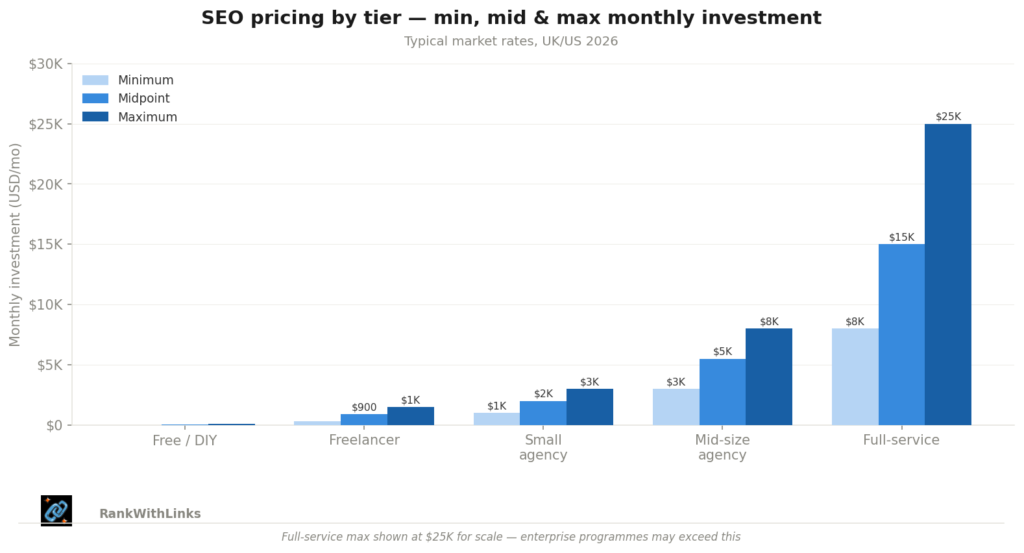
The table below shows what you actually get at each investment level. The ranges are realistic for the UK and US markets in 2026 — but note that pricing varies by location, niche competitiveness, and the specific provider.
| Tier | Monthly investment | What’s included | Best for |
| Free / DIY | $0 – $100/mo | Your own time + free tools (Google Search Console, Ubersuggest) | Solopreneurs, hobbyists, very early-stage |
| Freelancer | $300 – $1,500/mo | Core on-page SEO, basic keyword research, monthly reporting | Small businesses, local services |
| Small agency | $1,000 – $3,000/mo | Full on-page, some link building, content, strategy | Growing SMBs, local brands |
| Mid-size agency | $3,000 – $8,000/mo | Multi-channel SEO, PR, dedicated account manager | Established businesses, ecommerce |
| Full-service | $8,000+/mo | Enterprise-level: technical, content, digital PR, custom reporting | Large companies, competitive verticals |
Tier 1: Free / DIY ($0 – $100/month)
DIY SEO is not a cop-out — it is a viable strategy for businesses in low-competition niches, local services with little online competition, or anyone who genuinely has more time than money. What it requires is consistent effort and a willingness to learn.
The core DIY activities that move the needle:
- Setting up and maintaining Google Search Console and Google Analytics 4 — these two tools alone give you more actionable insight than most paid dashboards
- Claiming and optimising your Google Business Profile with accurate NAP (name, address, phone), photos, services, and responding to every review
- Writing optimised title tags and meta descriptions for every page on your site
- Publishing at least one well-researched, genuinely useful piece of content per month targeting a specific keyword your customers actually search for
- Building local citations: consistent listings on Yelp, Trustpilot, Yell, and relevant directories
What free SEO cannot do: it cannot generate links at scale, produce content volume, or implement complex technical fixes. If your site has structural issues — a problematic crawl, JavaScript rendering problems, or a bloated redirect chain — you will need paid help to address them.
Tier 2: Freelancer ($300 – $1,500/month)
A skilled SEO freelancer at this price point is the best value in the market for most small businesses. The model works because there is minimal overhead: you are paying for expertise and execution, not agency infrastructure, account managers, or office space.
What a good freelancer at this tier delivers:
- A proper keyword research document — not a list of terms you already know, but a mapped opportunity set showing volume, difficulty, and intent
- On-page optimisation across your key pages, with title tags, headers, internal links, and schema where relevant
- A technical audit and a prioritised list of fixes with clear instructions for your developer
- Monthly reporting with genuine commentary — not just a traffic graph
What a freelancer typically cannot do at this price: high-volume link building, significant content creation, or rapid scaling. If your market is highly competitive — personal injury law, financial products, or national ecommerce — a freelancer budget will not move the needle fast enough.
How to find a good one: look for a freelancer who asks detailed questions about your business before quoting, who can show you specific examples of sites they have improved (not just testimonials), and who is transparent about what they will and will not include.
Tier 3: Small agency ($1,000 – $3,000/month)
At this tier, you gain access to a team rather than a single person. Small agencies at this price point typically have a strategist, an on-page specialist, a content writer, and either an in-house or outsourced link builder. The quality of the output depends heavily on whether the agency has genuine specialists in each of these areas, or whether one generalist is wearing all the hats.
Questions to ask a small agency before signing:
- Who will be working on my account day-to-day, and what is their specific background?
- How many other clients does each team member manage?
- Can I see a recent client case study with verifiable traffic data?
- What is your process when a tactic is not working?
Tier 4 and 5: Mid-size and full-service agencies ($3,000+/month)
Once you move above $3,000 per month, you enter territory where the investment can generate significant returns — but where the quality range also widens considerably. At this level, you should expect a dedicated account manager, a documented strategy reviewed quarterly, and reporting that connects organic search to actual revenue, not just traffic.
For most small businesses, spending $3,000+ per month on SEO is premature unless the business is generating enough revenue to justify the acquisition cost. If organic search is not yet a meaningful channel for you, investing in the DIY or freelancer tier first — until you understand your keyword landscape and have baseline data — is a more efficient use of capital.
3. What you get at each price tier: side-by-side
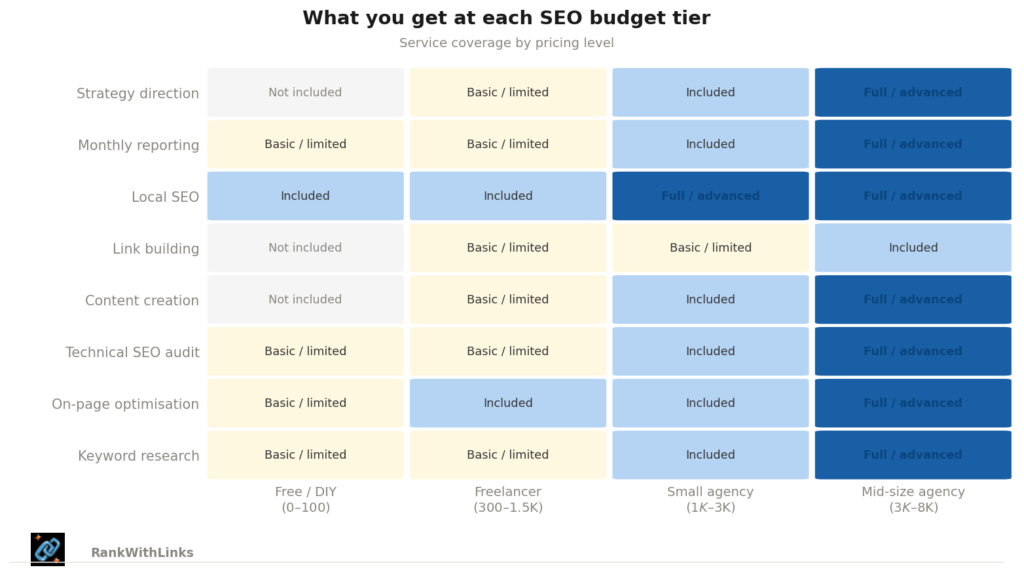
The table below breaks down the specific deliverables you should expect across the three most commonly used tiers for small businesses.
| Service area | Free / DIY | Freelancer ($300–$1,500) | Small agency ($1K–$3K) |
| Keyword research | Basic (limited) | Core terms only | Full universe mapping |
| On-page optimisation | DIY with guides | Yes | Yes + QA process |
| Technical SEO audit | Screaming Frog free | Quarterly | Monthly / ongoing |
| Content creation | You write it | Briefs only | Included |
| Link building | Manual outreach (slow) | Limited | Systematic |
| Local SEO | GBP self-managed | GBP + citations | Full local programme |
| Monthly reporting | DIY dashboards | Basic report | Custom dashboard |
| Strategy direction | None | Light-touch | Dedicated strategist |
4. Red flags: when cheap SEO will hurt you
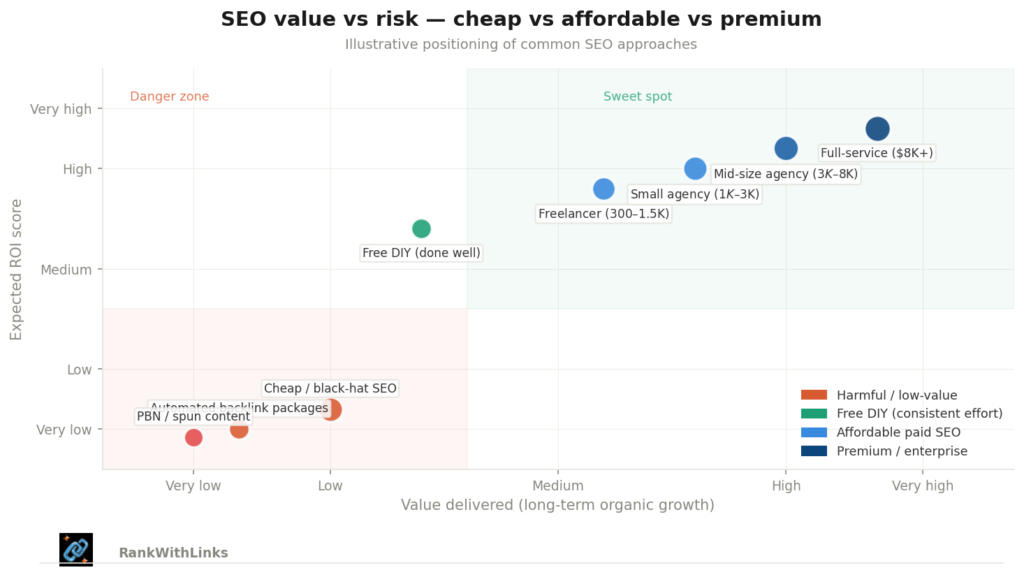
Not all low-cost SEO is good value. Some of it is actively harmful — capable of triggering algorithmic penalties that tank your rankings and require expensive remediation work to reverse. The following practices are widely used by bottom-of-market providers and should disqualify any vendor immediately.
| Practices that indicate a provider uses harmful tactics |
- Private Blog Network (PBN) links: links from networks of fake or low-quality sites built solely to pass PageRank. Google has been penalising these for over a decade and continues to improve at detecting them.
- Spun or AI-generated content at volume: thin, low-value content published at scale. Since Google’s Helpful Content updates, this approach reliably reduces rather than improves rankings.
- Keyword stuffing: abnormally high keyword density that makes content read unnaturally. Modern search algorithms penalise this and it damages user experience simultaneously.
- Guaranteed #1 rankings: no ethical provider can guarantee specific rankings. Search results are dynamic and depend on dozens of factors outside any agency’s control. Any guarantee of this kind is a dishonest sales tactic.
- Reporting without transparency: monthly reports that show traffic going up but cannot explain which pages improved, which keywords moved, or what specific work caused the change. This often signals that nothing meaningful was done.
- Automated backlink packages: ‘500 high-DA links for $49’ is not a deal — it is a liability. These links are typically from irrelevant, low-quality sites and can trigger manual penalties.
The cost of recovering from a Google penalty — whether manual or algorithmic — consistently exceeds the saving from hiring the cheap provider in the first place. A manual penalty requires a documented link disavow process and a reconsideration request to Google. An algorithmic hit from a core update can persist for six months or more, even after the harmful content or links are removed.
5. Best free SEO tools to stretch your budget
Whatever tier you are operating at, these tools are free, legitimate, and used by professional SEO agencies alongside their paid equivalents. If you are on a tight budget, mastering these before spending on paid tools will make every subsequent pound or dollar go further.
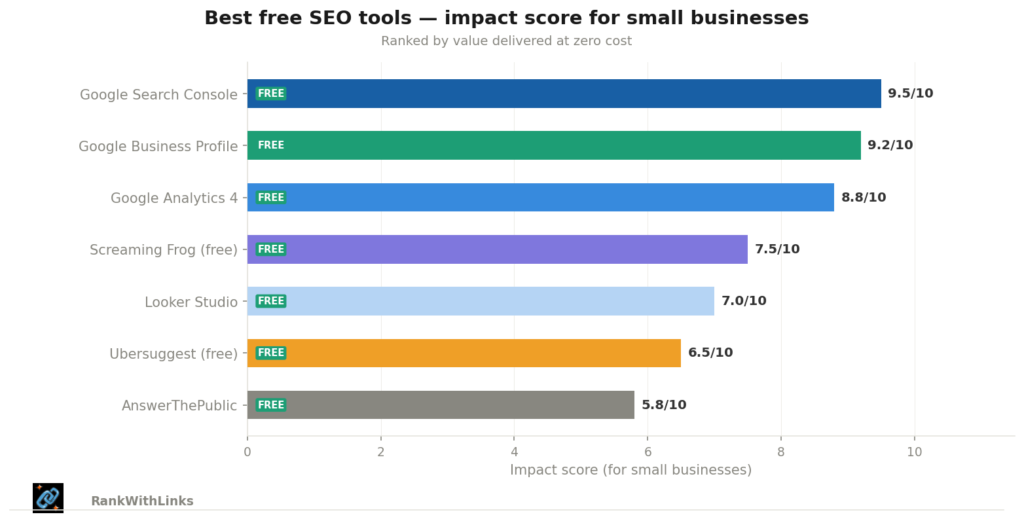
| Tool | Category | Why it matters |
| Google Search Console | Performance & indexing | Tracks rankings, clicks, impressions, crawl errors. Essential baseline for any SEO programme. |
| Google Analytics 4 | Traffic & behaviour | Organic traffic, landing page performance, conversion tracking. Free and non-negotiable. |
| Ubersuggest (free) | Keyword research | Limited daily searches but solid for finding seed keywords and basic competitor data. |
| Screaming Frog (free) | Technical audit | Crawls up to 500 URLs free. Finds broken links, duplicate titles, missing metadata. |
| Google Business Profile | Local SEO | The single most impactful free tool for local search. Keep it updated, respond to reviews. |
| AnswerThePublic | Content ideation | Visualises question-based queries around any topic. Useful for finding content gaps. |
| Looker Studio | Reporting | Build custom dashboards connecting GSC, GA4, and other sources. Free and powerful. |
When to upgrade to paid tools: once you are producing content regularly and want to do competitive keyword research beyond a handful of terms, a paid tool like Semrush or Ahrefs (starting around $100–$130/month) unlocks significant additional capability. But this is a second-step investment — get the free stack working first.
6. How to get good SEO on a tight budget
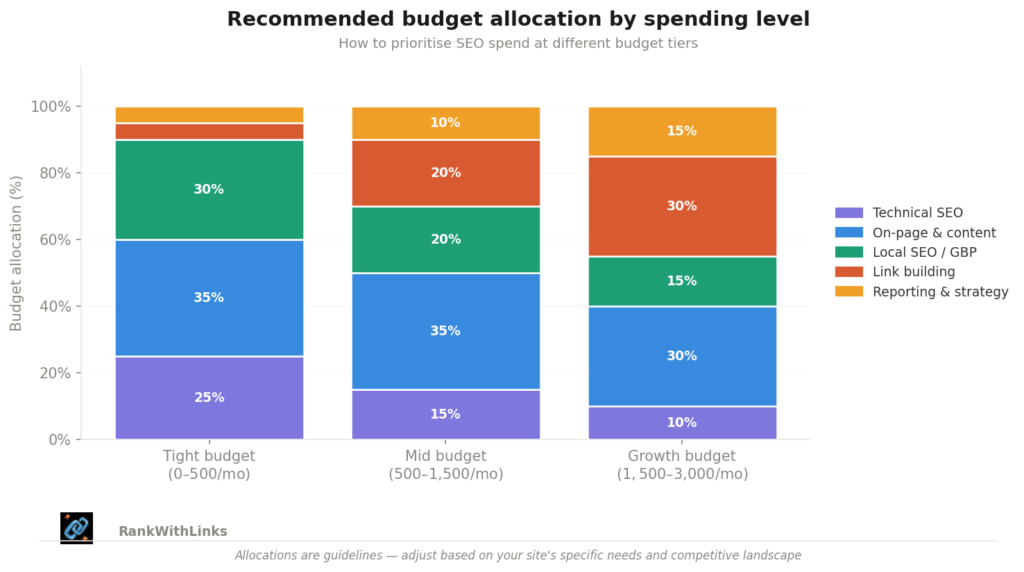
Budget constraints force prioritisation — which is not a disadvantage. Businesses with unlimited SEO budgets sometimes spread effort across dozens of tactics simultaneously and see diluted results across all of them. A constrained budget, applied to the right priorities, often outperforms a larger budget spent on the wrong ones.
Priority 1: Fix what is broken before building on top of it
Technical issues are multipliers. A site with slow page speed, broken internal links, duplicate title tags, or unindexed pages will see reduced return from every piece of content you publish and every link you build. The first use of any SEO budget — whether it is your own time or paid help — should be a technical audit and remediation of critical issues.
Priority 2: Google Business Profile before anything else for local businesses
If your business serves a specific geographic area — a restaurant, a dental practice, a plumber, a solicitor — your Google Business Profile is the highest-leverage SEO asset you have. It is free, it directly influences your appearance in local map results, and a well-optimised listing can generate enquiries within weeks rather than months.
Minimum viable GBP optimisation:
- Complete every section: business description, services/products, hours, website, phone
- Add at least ten recent photos, updated quarterly
- Ask every satisfied customer for a review — respond to every review, positive and negative
- Post an update at least twice a month (offers, news, FAQs)
- Use the Q&A section proactively — add the questions you are most frequently asked and answer them yourself
Priority 3: One piece of excellent content beats ten pieces of average content
The content volume arms race is a trap for businesses with limited budgets. Publishing mediocre content at high frequency generates little organic traffic, dilutes your site’s topical authority, and creates a maintenance burden. A single piece of genuinely comprehensive, well-structured content targeting a specific keyword — updated regularly to stay accurate — will outperform it.
What ‘excellent content’ means in practice:
- Answers the search intent completely — the reader should not need to visit another site
- Structured with clear headers that match the subtopics users actually search for
- Includes original insight, data, or perspective that other pages on the topic lack
- Internally links to related pages on your site
- Has a clear, relevant call to action
Priority 4: Defer link building until on-page is solid
Many small businesses invest in link building before their own pages are in a state to benefit from the authority those links pass. If your landing pages have weak on-page SEO, thin content, or poor conversion rate optimisation, links built to them will underperform.
A practical rule of thumb: do not prioritise active link building until you have at least ten well-optimised, substantive pages on your site and at least three months of Google Search Console data showing which pages are getting impressions without ranking on page one. Those are the pages where links will have the most immediate impact.
7. Affordable SEO for specific business types
Local service businesses (plumbers, dentists, solicitors, tradespeople)
Local SEO is the most accessible form of affordable SEO. The competition is rarely national — you are competing against other local providers, most of whom have not invested meaningfully in their online presence. The priorities are: Google Business Profile, local citations, location-specific landing pages, and reviews.
Budget allocation for a local service business: 50% GBP management and local citations, 30% on-page optimisation of service pages, 20% content (FAQs, service area pages, local guides).
Ecommerce businesses
Ecommerce SEO on a tight budget requires ruthless prioritisation. You cannot optimise every product page immediately. Instead, identify your highest-margin or highest-converting product categories and optimise those first. Category pages typically drive more organic traffic than individual product pages and are worth the investment disproportionately.
One free tactic with immediate ecommerce impact: structured data markup for products. Adding schema (product name, price, availability, reviews) to your product pages enables rich snippets in search results — star ratings and pricing visible directly in Google — which meaningfully improves click-through rate at zero cost beyond implementation time.
SaaS and B2B companies
For SaaS and B2B businesses, the highest-ROI affordable SEO strategy is almost always bottom-of-funnel content: comparison pages, alternative pages, and ‘best [product category]’ content targeting buyers who are already in the consideration stage. These pages convert at much higher rates than informational content and tend to be less competitive than top-of-funnel terms.
A $500/month freelancer focusing exclusively on these high-intent pages will typically deliver more revenue impact than a $2,000/month agency producing high volumes of awareness-stage blog content.
8. What to do this week — at any budget
The most common reason small businesses see no return from SEO investment is inaction, not budget. These five steps can be completed in a single afternoon at zero cost and will give you a clearer picture of your current position than most paid audits.
| Five things to do this week |
- Verify Google Search Console is set up and your sitemap is submitted. Check the Coverage report for any pages marked as excluded or errored.
- Audit your Google Business Profile. Fill in every blank field, add at least five recent photos, and check that your address and phone match exactly what appears on your website.
- Check your five most important pages in Google Search Console’s Performance report. Look at which queries each page is appearing for — you may find you are ranking on page two or three for valuable terms that a small on-page improvement would push to page one.
- Run your homepage through Screaming Frog (free, up to 500 URLs) or PageSpeed Insights. Note the three highest-priority issues it flags and make a plan to address them.
- Write down the three most common questions your customers ask you. Search for each one in Google. If there is no good answer in the top results, that is a content opportunity you can own with one well-written page.
Final thoughts
Affordable SEO works — but only if you are honest about what it can and cannot accomplish at a given budget, and only if the tactics being used are legitimate. The businesses that see the best results from modest SEO budgets share two traits: they are consistent, and they prioritise ruthlessly.
Consistency means publishing content on schedule, keeping your GBP updated, and checking your Search Console data monthly rather than quarterly. Ruthless prioritisation means choosing the two or three SEO activities most likely to move the needle for your specific business and ignoring everything else until those are working.
The worst outcome is not spending nothing on SEO — it is spending $99 per month on a service that generates fake links and thin content, accumulating a liability that will take years to unwind. If your budget is truly limited, the free tier — executed consistently and correctly — will outperform any low-quality paid service.
If and when you are ready to invest, the questions in this guide will help you identify a provider who is genuinely affordable rather than simply cheap.

Abdullah Zulfiqar is Co-founder and Client Success Manager at RankWithLinks, an SEO agency helping businesses grow online. He specializes in client relations and SEO strategy, driving measurable results and maximizing ROI through effective link-building and digital marketing solutions.