
What Is Procure-to-Pay Software and Why Does It Matter for Office Supplies?
Every organization, whether a lean startup or a sprawling enterprise, goes through a predictable cycle when buying office supplies. Someone notices the printer paper is running low. A request gets raised. Someone approves it. A purchase order gets sent to a vendor. The goods arrive. An invoice comes in. Finance matches it, approves it, and pays it. Then the whole cycle repeats itself, week after week, month after month.
This process sounds deceptively simple, but without the right system in place, it becomes a breeding ground for delays, duplicate orders, maverick spending, and reconciliation nightmares. That is exactly the problem procure-to-pay software is designed to solve.
Procure-to-Pay, commonly abbreviated as P2P, refers to the complete end-to-end process of requesting, approving, ordering, receiving, and paying for goods and services. When applied specifically to office supplies, P2P software helps organizations standardize their buying behavior, stay within budget, reduce administrative overhead, and build stronger, more strategic vendor relationships.
The right platform eliminates the email chains, spreadsheet-based tracking, and manual invoice matching that plague procurement teams across industries. It replaces them with automated workflows, real-time spend visibility, AI-assisted recommendations, and seamless integration with accounting or ERP systems.
In 2026, the market for P2P software has matured significantly. Artificial intelligence is no longer a novelty feature but a core driver of automation, anomaly detection, and spend intelligence. Organizations are also increasingly prioritizing sustainability reporting and supplier diversity tracking within their procurement tools, reflecting broader ESG commitments. On top of this, remote and hybrid work models have made mobile-first procurement workflows more important than ever before.
Choosing the right tool for managing office supply procurement requires a clear understanding of your organization’s size, complexity, integration needs, sustainability goals, and budget. This comprehensive guide covers everything you need to know to make the best decision for your team in 2026.
Why Office Supply Procurement Deserves Its Own System
Office supplies may not represent the largest spend category in most organizations, but they are among the most frequent and widely distributed purchasing activities. Hundreds or thousands of employees across multiple departments, locations, and cost centers are placing small, routine orders on a regular basis. Left unmanaged, this creates significant challenges.
Tail spend, which refers to the large volume of low-value, unmanaged purchases that fall outside formal procurement controls, is a persistent issue for finance and procurement teams. Office supplies are a classic example. When employees bypass approved channels to order what they need quickly from unapproved vendors, organizations lose pricing leverage, visibility, and compliance.
A well-implemented P2P platform addresses this by creating a structured, guided buying experience. Employees still get the items they need, but they do so through approved channels, at negotiated prices, with proper budget coding and approval controls in place. The result is less waste, stronger vendor relationships, better budget adherence, and dramatically less administrative burden for finance teams at month end.
In 2026, procurement leaders are also using P2P data to make smarter strategic decisions. Which vendors are delivering on time? Where are there consolidation opportunities? Which departments are overspending on supplies? These questions are answerable in seconds when you have the right platform in place.
Key Features to Look for in Procure-to-Pay Software in 2026
Before evaluating specific platforms, it is essential to understand what separates a truly excellent P2P solution from a merely adequate one, particularly when the focus is on day-to-day office supply procurement.
AI-Powered Spend Intelligence
In 2026, AI is embedded throughout the best P2P platforms. This goes well beyond basic automation. Modern systems use machine learning to automatically classify spend, flag anomalous purchases, recommend preferred suppliers based on historical data, predict budget overruns before they happen, and even suggest optimal reorder timing based on consumption patterns. For office supply management, AI-driven insights can surface opportunities to consolidate vendors, negotiate better pricing tiers, or switch to higher-quality items at lower total cost.
Catalog Management and Punch-Out Integration
Office supply procurement typically involves large, frequently updated product catalogs from major vendors. The best P2P platforms support punch-out catalog integration, which allows employees to browse a supplier’s live catalog from within the procurement system, add items to a virtual cart, and return that cart as a structured purchase requisition. This keeps buying standardized while giving employees the flexibility to find exactly what they need without leaving the approved procurement environment.
Guided Buying Experience
Related to catalog management but distinct from it, guided buying is about shaping purchasing behavior at the point of request. When an employee searches for a desk organizer or a box of gel pens, the system should surface approved items from preferred suppliers first, with clear indicators of pricing, availability, and compliance status. This reduces maverick spending without creating friction or frustrating end users.
Configurable Requisition and Approval Workflows
A strong approval workflow engine is non-negotiable. The best platforms let you configure multi-level approvals based on department, cost center, spend threshold, item category, or any combination of these factors. For office supplies, low-value consumables like sticky notes and printer cartridges might auto-approve, while ergonomic furniture or bulk technology accessories trigger a manager review. Configurable workflows dramatically reduce bottlenecks without sacrificing financial control.
Automated Purchase Order Generation
Once a requisition clears the approval process, the system should automatically generate a properly formatted purchase order and transmit it to the supplier via email, EDI, or API connection. Manual PO creation wastes time and introduces errors. Automating this step is one of the highest-return improvements any procurement team can make.
Three-Way Matching
When a supplier invoice arrives, the best software automatically matches it against the original purchase order and the goods receipt. This three-way matching process catches discrepancies, billing errors, and potential fraud before payment is authorized. It is a foundational risk management feature that also dramatically speeds up the accounts payable process.
Real-Time Spend Analytics and Reporting
Visibility into where money is going is essential for managing office supply costs with any degree of strategic discipline. Modern P2P platforms provide rich, real-time dashboards showing spend by category, vendor, department, cost center, and time period. The ability to identify consolidation opportunities, spot rogue spending, benchmark against budgets, and track savings initiatives is one of the most tangible value drivers of a well-implemented P2P system.
Seamless ERP and Accounting Integration
Your P2P platform must integrate cleanly with your financial systems. Whether your organization runs SAP, Oracle, NetSuite, Microsoft Dynamics, QuickBooks, or another ERP, the ability to sync vendor master data, general ledger codes, budget data, and payment records in real time is critical. Poor integration creates duplicate data entry, reconciliation errors, and frustrated finance teams.
Mobile-First Accessibility
Employees and approvers are not always at their desks. A well-designed mobile interface or dedicated app ensures that purchase requests get submitted and approvals happen quickly, even when people are traveling, working from home, or on the production floor. In 2026, mobile-first design is not a nice-to-have feature but a basic expectation.
Supplier Relationship and Performance Management
Beyond processing transactions, a mature P2P platform helps you manage your supplier base strategically. This includes vendor onboarding, contract storage, compliance document collection, performance scorecarding, and preferred supplier list management. Strong supplier management capabilities drive compliance with negotiated agreements and support more productive annual review conversations with your key vendors.
Sustainability and ESG Reporting
In 2026, an increasing number of organizations are tracking the environmental and social impact of their procurement decisions. The best platforms include features for capturing supplier sustainability certifications, measuring carbon emissions associated with purchased goods, tracking spend with diverse or local suppliers, and generating ESG-aligned procurement reports for executive and board-level audiences.
The Best Procure-to-Pay Software for Office Supplies in 2026
1. Coupa
Coupa remains one of the most comprehensive and widely adopted business spend management platforms in the world. It covers the full procure-to-pay cycle and is particularly well-suited for mid-market to large enterprise organizations that need robust control, deep analytics, and global scalability.
For office supply procurement specifically, Coupa delivers in several important ways. Its community intelligence feature benchmarks your spending against anonymized data from thousands of other Coupa customers, helping procurement teams quickly identify whether they are overpaying for common office items relative to market norms. This kind of data-driven leverage is difficult to replicate manually and becomes a genuine competitive advantage for procurement teams.
The platform supports punch-out catalog integration with all major office supply vendors, making guided buying a seamless experience for employees. Its approval workflows are highly configurable without requiring deep technical expertise to maintain, and the three-way matching engine is reliable and well-proven at enterprise scale.
Coupa’s analytics suite has been continuously enhanced with AI capabilities, offering predictive spend forecasting, automated anomaly detection, and supplier risk signals. In 2026, these features are more polished and actionable than in previous years, making Coupa a genuinely intelligent platform rather than simply a transactional processing engine.
The trade-offs are cost and implementation complexity. Coupa is an enterprise-grade solution with pricing and deployment timelines to match. Organizations with fewer than 100 employees or limited procurement complexity may find that it exceeds their practical needs.
Best for: Large enterprises and multi-site organizations with complex approval hierarchies, significant office supply spend, and a need for sophisticated analytics and supplier management capabilities.
2. SAP Ariba
SAP Ariba is one of the most established and deeply embedded procurement platforms in the enterprise technology landscape. With access to the Ariba Network, one of the world’s largest B2B commerce ecosystems connecting millions of buyers and suppliers, it offers unmatched reach and connectivity for organizations managing a broad and complex supply base.
For office supply procurement, Ariba’s catalog management capabilities are a major strength. The platform supports both hosted and punch-out catalogs, giving procurement teams flexibility in how they manage supplier content. The guided buying interface directs employees toward approved suppliers and contracted pricing, reducing the likelihood of off-contract purchasing.
Ariba’s compliance enforcement tools are particularly valuable for organizations with national or regional supply agreements with major office vendors. You can configure buying channels so that employees are channeled automatically toward contracted sources at negotiated prices, which protects pricing advantages and drives compliance without requiring constant manual monitoring.
In 2026, SAP has continued to deepen its AI integration within Ariba, including more intelligent spend classification, automated contract compliance monitoring, and enhanced supplier risk management. For organizations already running SAP S/4HANA or other SAP ERP modules, the integration between Ariba and the broader SAP ecosystem remains the tightest and most seamless available.
The challenge with SAP Ariba is its implementation complexity and total cost of ownership. Deployment projects can run for months, and ongoing administration benefits from dedicated procurement technology resources. It is best suited to organizations already invested in the SAP ecosystem.
Best for: SAP-centric enterprises looking for deeply integrated, large-scale procurement management with extensive supplier network access.
3. Jaggaer

Jaggaer has built a strong reputation as a purpose-built, highly capable procurement platform with particular depth in higher education, healthcare, manufacturing, and public sector organizations. Its indirect procurement modules, which cover categories like office supplies, facilities, and IT consumables, are mature and well-designed.
One of Jaggaer’s most appealing qualities is its modular deployment model. Organizations can implement core P2P functionality first and expand into supplier management, contract management, or sourcing capabilities over time. This phased approach reduces implementation risk and allows procurement teams to demonstrate value quickly before tackling more complex transformation initiatives.
For office supply procurement, Jaggaer supports punch-out catalog integration, configurable multi-tier approval workflows, automated PO generation, and robust three-way matching. Its analytics dashboards have been consistently praised for being accessible to non-technical procurement professionals, striking a good balance between analytical depth and day-to-day usability.
In 2026, Jaggaer’s AI-powered spend classification engine has become noticeably more accurate, reducing the manual effort required to clean and categorize procurement data. This is a meaningful improvement for teams that struggle with messy historical spend data when implementing the platform or refreshing their analytics.
Jaggaer also has strong sustainability tracking features, reflecting the growing importance of ESG considerations in procurement decision-making across its core vertical markets.
Best for: Mid-market to enterprise organizations in regulated industries, educational institutions, healthcare systems, or any organization that wants a modular approach to procurement technology adoption with strong analytics.
4. Ivalua
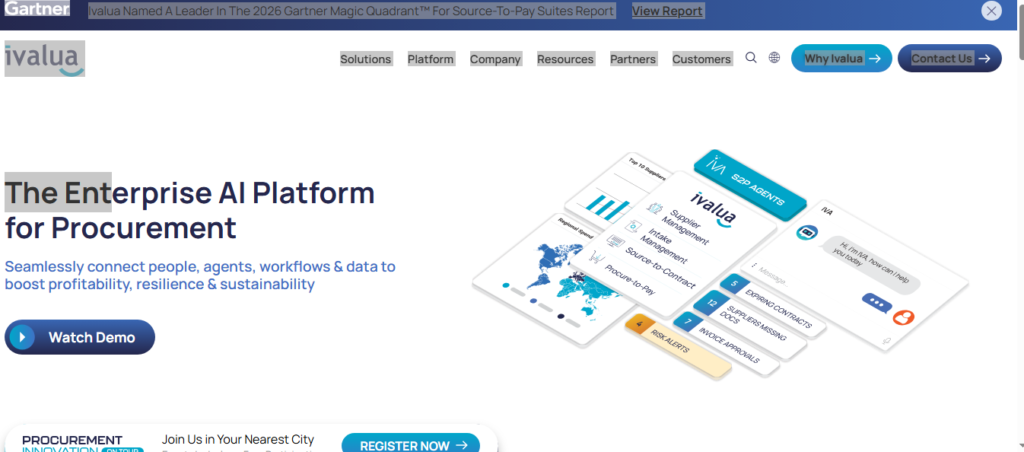
Ivalua positions itself as the most configurable end-to-end procurement platform on the market, covering the complete source-to-pay lifecycle without requiring heavy custom development. Its hallmark claim is that virtually any procurement process, no matter how complex or organization-specific, can be configured within the platform’s native framework rather than requiring custom code.
For office supply procurement, this configurability translates into a highly adaptable requisitioning and approval experience. Procurement administrators can tailor the buying interface, approval chains, budget controls, and supplier catalog presentation to match exactly how their organization operates. This is particularly valuable for organizations that have tried out-of-the-box solutions and found them too rigid to accommodate their specific processes.
Ivalua’s reporting and analytics capabilities are robust, with real-time spend visibility available across every stage of the procurement cycle. The platform integrates well with major ERP systems, and in 2026 its API framework has been expanded to support faster and more flexible integration with third-party financial tools and data platforms.
One area where Ivalua particularly stands out is its supplier collaboration capabilities. The platform provides a dedicated portal through which suppliers can receive purchase orders, submit invoices, manage their profile and compliance documents, and communicate with procurement teams. For organizations with active supplier relationship programs, this adds meaningful value beyond basic transactional processing.
Best for: Organizations that need maximum configurability without custom development, particularly those with complex or unique procurement workflows that standard out-of-the-box solutions struggle to accommodate.
5. Procurify
Procurify has established itself as the go-to modern P2P platform for growing mid-sized businesses. It consistently earns high marks for ease of use, fast implementation, and a clean interface that employees actually enjoy using, which is a critical factor in driving adoption and reducing off-contract purchasing behavior.
The platform covers the full P2P cycle, including purchase requests, multi-level approvals, purchase order generation, receiving, and invoice management. Its mobile application is particularly well-regarded, making it easy for employees to submit supply requests and for managers to review and approve them from anywhere at any time.
In 2026, Procurify has continued to invest in its analytics capabilities, adding more granular spend reporting and budget tracking features that give finance and procurement teams a clearer, real-time picture of where office supply budgets are being used. The platform also deepened its native integrations with popular accounting tools including QuickBooks Online, Xero, and NetSuite, reducing the friction of keeping procurement and financial data aligned.
One of Procurify’s strongest selling points is its pricing model, which is transparent and accessible for mid-market organizations that cannot justify enterprise-level software costs. Implementation timelines are short compared to enterprise alternatives, and the support team is consistently praised by customers for being responsive and knowledgeable.
The platform’s limitations become apparent at the high end of complexity. Organizations with highly intricate approval hierarchies, global multi-entity procurement requirements, or the need for advanced supplier management may eventually outgrow Procurify. For most mid-sized businesses managing routine office supply procurement, however, it delivers excellent value.
Best for: Growing mid-sized companies that want modern, user-friendly P2P functionality with fast deployment, clean mobile access, and transparent pricing.
6. Zip
Zip has emerged as one of the most exciting newer entrants in the procurement technology market, gaining rapid adoption among technology companies, scale-ups, and modern enterprises that prioritize user experience and workflow automation. Founded with a clean-sheet design philosophy, Zip has been built for the way modern businesses actually operate rather than retrofitted from legacy enterprise software.
The platform’s intake and orchestration model is its defining differentiator. Instead of forcing every purchase request through a single rigid workflow, Zip routes requests intelligently based on what is being purchased, from whom, at what value, and for which team. For office supply procurement, this means that a request for pens and notebooks follows a different, faster path than a request for ergonomic furniture, with no manual intervention required to make that distinction.
Zip integrates deeply with tools that technology and modern enterprise teams already use, including Slack, Microsoft Teams, Coupa, NetSuite, and Workday, making it easy to embed procurement workflows into existing communication and operational rhythms.
In 2026, Zip has expanded its analytics and vendor management capabilities significantly, addressing earlier gaps compared to more established enterprise platforms. It now offers solid spend visibility, supplier onboarding tools, and contract repository features that make it competitive for a broader range of organizations.
Best for: Technology companies, scale-ups, and modern enterprises that prioritize user experience, workflow flexibility, and seamless integration with collaborative work tools.
7. Tradogram
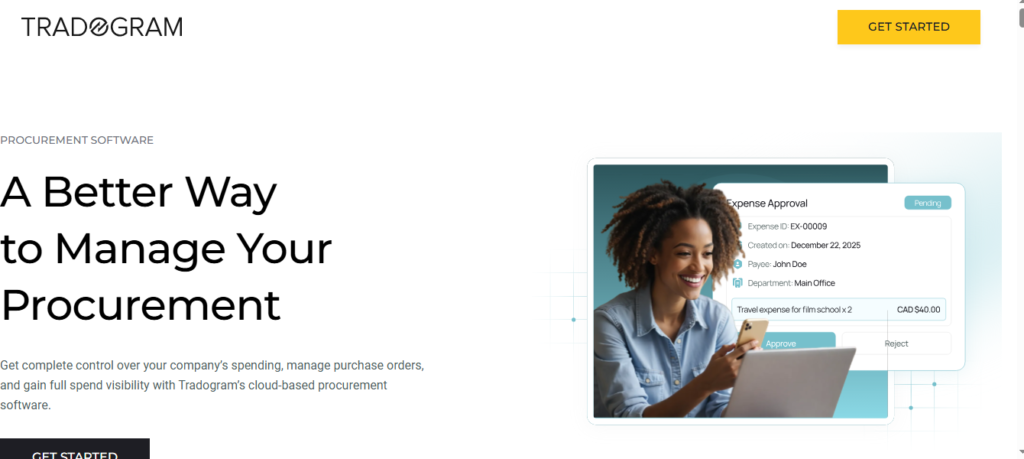
Tradogram is a practical, budget-conscious procurement platform that delivers solid core P2P functionality without the complexity or pricing of enterprise solutions. For small businesses, nonprofits, and teams that are just beginning to formalize their procurement processes, Tradogram provides an accessible and sensible starting point.
The platform covers the essential P2P workflow: purchase requisitions, approval routing, purchase order creation, supplier management, and basic spend reporting. The interface is clean and easy to navigate, and most teams find they can get up and running in a matter of days rather than weeks.
While Tradogram lacks some of the advanced features found in more sophisticated platforms, including AI-driven analytics, native punch-out catalog support, and deep ERP integration, it delivers reliable core functionality at a price point that is genuinely accessible for resource-constrained organizations.
In 2026, Tradogram has added improved reporting templates and enhanced supplier communication tools, making it a modestly more capable option than in prior years without abandoning its core identity as a simple, affordable procurement tool.
Best for: Small businesses, nonprofits, educational institutions with limited budgets, and teams that need straightforward purchase order management without a significant financial or technical investment.
8. Amazon Business with Procurement Controls
Amazon Business deserves a prominent place in any discussion of office supply procurement in 2026. While it is not a traditional P2P platform, Amazon Business includes a growing suite of procurement-oriented features, including configurable approval workflows, purchase order field integration, spend analytics, buying policy controls, and multi-user account management, that make it a practical and highly effective option for many organizations.
The appeal is undeniable. Amazon’s catalog covers virtually every office supply imaginable at competitive prices, delivery speeds are exceptional, and the user experience is already familiar to practically every employee. For organizations that source the bulk of their office supplies through Amazon anyway, layering the Business account’s procurement controls on top of existing buying behavior can formalize and govern spending without requiring employees to adopt an entirely new system.
Amazon Business also integrates with several major P2P platforms through punch-out catalog connections, making it possible to combine the governance of a dedicated procurement system with the product breadth and convenience of Amazon’s marketplace. This hybrid approach has become increasingly popular in 2026, particularly among mid-market organizations that want the best of both worlds.
The limitations are real. Amazon Business works best as a procurement channel rather than a standalone P2P platform. It lacks contract management, supplier diversity tracking, three-way invoice matching, and the deeper workflow configurability of dedicated procurement tools. For organizations with complex needs, it functions best as one node in a broader procurement ecosystem rather than the entire foundation.
Best for: Organizations that already rely heavily on Amazon for office supplies and want to add approval controls and spend visibility, or those using Amazon Business as a punch-out channel within a broader P2P platform.
9. Kissflow Procurement Cloud
Kissflow offers a distinctive approach to procurement technology through its no-code and low-code business process platform. Rather than delivering a fixed set of workflows that organizations must adapt to, Kissflow empowers procurement administrators to design their own requisition forms, approval chains, purchase order templates, and reporting views using visual, drag-and-drop tools.
For office supply procurement in organizations with non-standard processes, this flexibility is genuinely powerful. You can build a buying workflow that mirrors exactly how your teams operate, incorporate unique budget coding requirements, and update the process over time without relying on a software vendor to make changes.
Kissflow integrates with Google Workspace, Microsoft 365, Slack, and several popular ERP and accounting systems, making it easy to connect procurement workflows with the tools teams already use daily. Its pricing model is accessible, and the platform scales reasonably well from small teams up to mid-sized enterprise environments.
In 2026, Kissflow has improved its pre-built procurement templates, reducing the setup effort for organizations that want sensible defaults rather than building everything from scratch. This makes it a more practical option for teams that want configurability without spending weeks on initial design.
Best for: Organizations with non-standard procurement workflows, teams that want full control over process design without custom development, and businesses already embedded in Google Workspace or Microsoft 365 environments.
10. Oracle Fusion Cloud Procurement
Oracle Fusion Cloud Procurement is the enterprise-grade procurement solution within Oracle’s broader cloud ERP ecosystem. It covers the full procure-to-pay lifecycle and is designed for large organizations that require deep functionality, high transaction volumes, and tight integration with financial management, supply chain, and human capital management systems.
For office supply procurement within a large organization running Oracle ERP, Fusion Cloud Procurement delivers a consistent, well-integrated experience from requisition through payment. The platform’s self-service procurement module provides employees with a consumer-grade buying interface backed by enterprise-grade controls, including catalog management, spending limits, approval workflows, and policy enforcement.
In 2026, Oracle has continued to embed its AI capabilities throughout the procurement module, including intelligent invoice processing, automated spend classification, and supplier risk scoring. These features reduce manual work for procurement and finance teams while improving the accuracy and completeness of spend data.
Oracle Fusion Cloud Procurement is not the right choice for organizations that are not already invested in the Oracle ecosystem. Implementation is complex, licensing costs are substantial, and the platform is most valuable when it serves as the procurement layer within a broader Oracle ERP deployment.
Best for: Large enterprises running Oracle ERP that want a tightly integrated, enterprise-grade P2P solution with full lifecycle coverage.
How to Choose the Right P2P Software for Your Office Supply Needs in 2026
Selecting the right platform is never purely about features. It is about fit, and finding the right fit requires honest clarity about several key factors.
Understand Your Organization’s Size and Complexity
Large enterprises with hundreds of cost centers, complex global approval hierarchies, and tens of thousands of procurement transactions per month need platforms built for that scale, such as Coupa, SAP Ariba, or Oracle Fusion. Growing mid-sized companies with straightforward needs are better served by modern, accessible tools like Procurify or Zip. Small businesses and nonprofits should look first at Tradogram or Kissflow before committing to the overhead of an enterprise deployment.
Evaluate Your Integration Requirements Honestly
The procurement platform you choose will only deliver its full value if it integrates cleanly with your existing financial systems. Before evaluating software, map out your current ERP, accounting tools, and any other systems that procurement data needs to flow into or out of. Confirm that integration is native and well-supported rather than relying on manual exports or fragile middleware connections.
Prioritize User Adoption
A sophisticated platform that employees do not use is worse than a simple platform that they do. The single biggest driver of P2P ROI is adoption. If employees find the system frustrating or overly complicated, they will find workarounds, and maverick spending will continue. Involve end users in the evaluation process, run usability tests, and weight user experience heavily in your decision.
Consider Total Cost of Ownership
Licensing fees are only part of the picture. Factor in implementation costs, training time, ongoing administration requirements, and the cost of integrations. Enterprise platforms often carry substantial hidden costs that are not apparent in initial pricing conversations. Get a complete cost estimate before making a commitment, and compare it against the value you expect to generate from better spend control and process efficiency.
Think About Where You Are Going, Not Just Where You Are
The platform that fits your organization today should also be able to grow with you over the next three to five years. Consider whether the vendor has a clear product roadmap, a strong customer community, and a track record of continuous innovation. In a rapidly evolving technology landscape, vendor stability and commitment to improvement matter as much as current feature sets.
Do Not Overlook Support and Implementation Resources
Even the best-designed platform will require onboarding, configuration, and ongoing support. Evaluate the vendor’s implementation methodology, the quality of their customer success resources, and the depth of their partner ecosystem. Organizations that underinvest in implementation tend to achieve significantly lower ROI from their procurement technology, regardless of which platform they choose.
The ROI of Getting Office Supply Procurement Right
Organizations that implement a well-chosen P2P platform for office supply procurement consistently report meaningful, measurable returns. The most commonly cited benefits include a reduction in maverick spending as employees are guided toward approved channels and preferred vendors, faster cycle times from requisition to receipt as approval bottlenecks are eliminated, lower invoice processing costs as three-way matching automates what was previously manual reconciliation work, stronger vendor pricing as spend is consolidated and negotiated agreements are actually enforced, and better budget visibility as finance teams gain real-time insight into committed and actual spend rather than discovering variances at month end.
In 2026, organizations are also beginning to attribute additional value to procurement platforms in areas like carbon footprint tracking, supplier sustainability scoring, and diversity spend reporting, as ESG accountability expands beyond the C-suite and into day-to-day operational decisions.
The investment required to implement and maintain a P2P platform is real, but for any organization spending meaningfully on office supplies and struggling with the inefficiencies of unmanaged procurement, the return on that investment is typically achieved within the first year of deployment.
Final Thoughts
The best procure-to-pay software for office supplies in 2026 is not a single platform. It is the one that matches your organization’s specific size, complexity, integration landscape, user experience expectations, and budget. Coupa and SAP Ariba lead the market for large enterprises. Procurify and Zip serve the modern mid-market with elegance and speed. Tradogram and Kissflow provide accessible entry points for smaller organizations or those with unique workflow requirements. Oracle Fusion rounds out the picture for large Oracle-centric environments, and Amazon Business continues to play a meaningful role as a sourcing channel within broader procurement ecosystems.
Whatever platform you choose, the most important outcome is the same: a structured, visible, controlled buying process that gives your employees what they need, protects your budget, and gives your procurement and finance teams the data they need to make smarter decisions. In 2026, there has never been a better set of tools available to make that outcome a reality. h

Usman Hakim is an SEO specialist at RankWithLinks, focusing on link building and organic growth. He helps brands improve search rankings through white-hat strategies, including guest posting and authority backlinks.