
Enterprise SEO is not a larger version of small business SEO. It is a fundamentally different discipline — one that demands dedicated tooling, cross-functional coordination, and a long-term investment mindset that most general-purpose agencies are not built to deliver.
If you are evaluating enterprise SEO services for the first time, the range of providers, price points, and promised outcomes can be genuinely confusing. This guide cuts through the noise. It explains exactly what enterprise SEO services include, what they realistically cost in 2026, and what you should expect from a credible provider — so you can make an informed decision without relying on sales pitches.
| What you will learn in this guide What separates enterprise SEO from standard SEO The six core services every enterprise SEO engagement should include What enterprise SEO tools your agency should be using Realistic pricing at every tier, with a side-by-side comparison How to evaluate providers and avoid the most common mistakes |
1. What is enterprise SEO — and how is it different?
Enterprise SEO refers to search engine optimisation for large, complex websites. The defining characteristics are scale, technical complexity, and organisational friction — not company size alone. A 10,000-page ecommerce site run by a 50-person company has enterprise SEO needs. A 50-page brochure site owned by a Fortune 500 company does not.
The challenges that make enterprise SEO distinct from standard SEO include:
- Scale: Sites with tens of thousands of pages require automated auditing, templated fixes, and crawl budget management rather than page-by-page optimisation.
- Technical depth: JavaScript-rendered content, complex redirect chains, international hreflang implementation, and log file analysis are routine requirements at enterprise scale.
- Organisational complexity: Getting an SEO recommendation implemented at a large company typically requires sign-off from engineering, legal, brand, and product teams. Agencies that understand this dynamic build it into their process.
- Competitive intensity: Enterprise-level keywords attract enterprise-level competition. Winning requires sustained authority-building, not quick wins.
- Reporting requirements: Enterprise stakeholders need custom dashboards, ROI attribution, and board-ready reporting — not a monthly traffic summary.
| Key distinction: Enterprise SEO vs. traditional SEO Traditional SEO focuses on a manageable set of pages, keywords, and links, usually managed by one or two people. Enterprise SEO involves coordinating across teams, automating at scale, managing crawl budgets, and reporting to senior leadership. The tools, timelines, and team structures are categorically different. |
2. What enterprise SEO services include
A credible enterprise SEO engagement should cover six core areas. Be cautious of providers who offer a narrower scope without a clear rationale — gaps in any of these areas will limit your results.
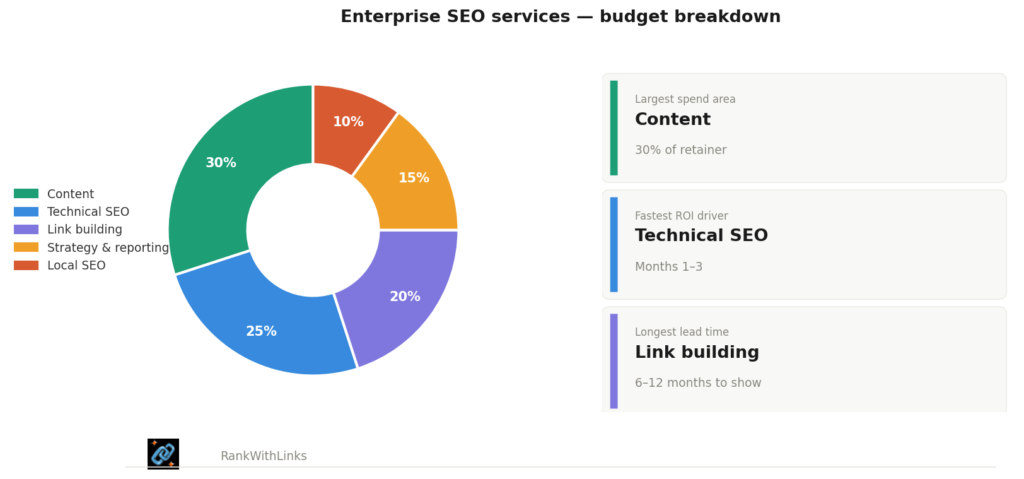
Technical SEO at scale
Technical SEO is the foundation of any enterprise programme. At scale, the goal shifts from fixing individual issues to implementing systematic solutions that prevent problems from recurring.
This includes:
- Full site crawl and prioritised issue remediation (not just a report)
- Crawl budget analysis and optimisation — ensuring Google crawls your highest-value pages first
- Log file analysis to understand how search engines actually navigate your site
- JavaScript SEO: ensuring dynamic content is rendered and indexed correctly
- Core Web Vitals and page experience optimisation
- Internal linking architecture at scale
- Handling duplicate content, canonical tags, and redirect chains
Keyword strategy and content planning
Enterprise keyword strategy goes beyond finding high-volume terms. It involves mapping thousands of keywords to the right pages, identifying cannibalisation, and building a content architecture that supports both users and crawlers.
Deliverables to expect:
- Full keyword universe mapping — every keyword your site should target, assigned to a URL
- Content gap analysis against top competitors
- Topical authority planning — ensuring content clusters are complete, not isolated
- Editorial calendar aligned to seasonal trends and business priorities
Content creation and optimisation
Most enterprise SEO providers either produce content directly or work alongside your in-house team. The distinction matters: agencies that produce content themselves operate faster but require more editorial oversight. Those that support your team produce more on-brand output but depend on your bandwidth.
Either model should include:
- SEO briefs for every new piece of content
- On-page optimisation (title tags, meta descriptions, header structure, structured data)
- Refresh strategy for existing content — identifying pages that can be improved rather than replaced
- E-E-A-T signals: author bios, citations, trust content
Link acquisition and digital PR
Authority still matters. At enterprise scale, link building typically involves a mix of digital PR campaigns, reactive media outreach, and systematic competitor gap analysis.
Quality over quantity is the only viable approach at this level. A single high-authority link from a relevant publication is worth more than dozens of directory links — and carries no penalty risk.
Local SEO (if applicable)
Enterprise businesses with physical locations — retailers, hospitality groups, healthcare providers, financial services firms — require local SEO management at scale. This means:
- Google Business Profile management across hundreds or thousands of locations
- Local citation consistency
- Localised landing pages with genuine differentiated content
- Local rank tracking and reporting by location
Analytics, reporting, and strategic direction
Reporting is where many enterprise SEO agencies fall short. Traffic is not a business outcome. Your provider should report on metrics that connect to revenue: organic-assisted conversions, cost-per-acquisition from organic, and the opportunity cost of unranked keywords.
At minimum, expect:
- Monthly executive reporting with clear narrative (not just data)
- Custom dashboards in Looker Studio or equivalent, connected to GA4 and your rank tracker
- Quarterly strategy reviews with roadmap updates
- Clear attribution model — how is organic credit assigned across the funnel?
3. Enterprise SEO tools: what your agency should be using
The tooling your agency uses is a reasonable proxy for their technical capability. Enterprise SEO requires tools built for scale — general-purpose tools that work fine for small sites often break down or become unmanageably slow on sites with hundreds of thousands of pages.
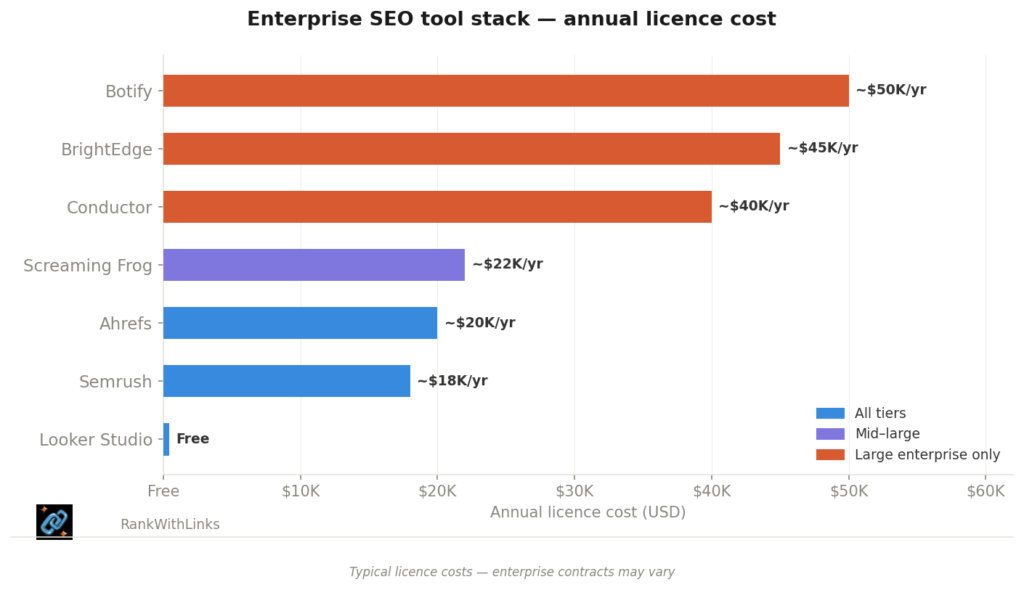
The table below covers the primary tools used across enterprise SEO programmes. A credible agency will use the majority of these — or have a clear reason why they do not.
| Tool | Category | Primary use case | Who uses it |
| Semrush | All-in-one platform | Keyword research, site audit, rank tracking, competitor analysis | All tiers |
| Ahrefs | Backlink & keyword | Backlink analysis, content gap, keyword explorer | All tiers |
| Screaming Frog | Technical crawler | Site crawl, broken links, redirect chains, duplicate content | Mid–large |
| Botify | Enterprise crawler | Log file analysis, JavaScript rendering, crawl budget | Large enterprise |
| Conductor | Enterprise platform | Content intelligence, team workflow, ROI reporting | Large enterprise |
| BrightEdge | Enterprise platform | Data Cube, forecasting, AI recommendations | Large enterprise |
| Looker Studio | Reporting | Custom dashboards, GA4 integration, stakeholder reporting | All tiers |
Note: Botify and Conductor carry significant licensing costs ($20,000–$80,000+ annually). For sites under ~500,000 pages, Screaming Frog combined with Semrush or Ahrefs is often sufficient — and a provider recommending Botify for a 50,000-page site may be over-engineering the engagement.
4. Enterprise SEO pricing: what does it actually cost?
Enterprise SEO pricing ranges from $2,000 to $50,000+ per month, depending on site complexity, scope of services, and the type of provider. The table below gives an honest breakdown of what you get at each tier.
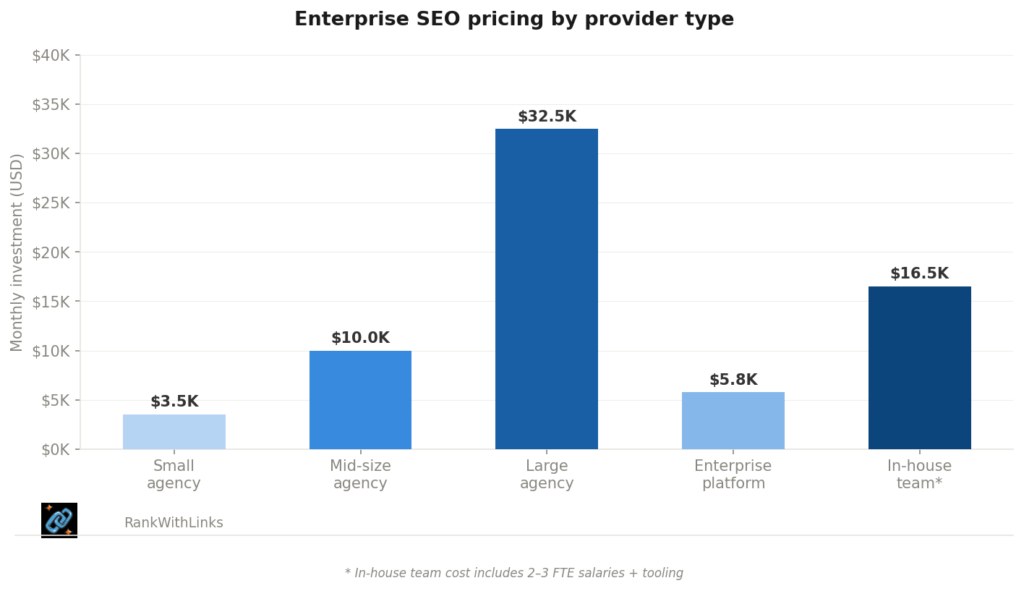
| Provider type | Monthly investment | Scope | Best for |
| Small / boutique agency | $2,000 – $5,000/mo | Core SEO: audits, on-page, monthly reporting | Mid-market companies |
| Mid-size agency | $5,000 – $15,000/mo | Full-service: technical, content, link building, analytics | Growing enterprises, 100–500 pages |
| Large / specialist agency | $15,000 – $50,000/mo | Dedicated team, strategy, PR, custom tooling | Large enterprises, complex sites |
| Enterprise SEO platform | $1,500 – $10,000/mo | Software + managed service, self-serve dashboards | In-house teams with budget |
| In-house team only | $8,000 – $25,000/mo* | Salaries + tools + training + headcount | Orgs wanting full ownership |
* In-house team costs include estimated salaries for 2–3 FTEs (SEO manager, content specialist, technical SEO) plus tooling. Actual costs vary significantly by location and seniority.
What drives the cost up
- International SEO: multi-language and multi-region implementations add significant complexity
- Site migration: a domain or platform migration requires dedicated resource and project management
- Content at scale: if the agency is producing 20+ pieces per month, content costs dominate
- Highly competitive verticals: finance, healthcare, and legal keywords require deeper investment to move rankings
- Enterprise tooling: Botify, BrightEdge, and Conductor carry substantial licence fees that get passed through
What drives the cost down
- In-house technical resource: if your engineering team can implement recommendations without delays, less agency time is wasted on re-briefing
- Existing content library: sites with a strong existing content base need less creation and more optimisation
- Narrower geographic scope: domestic-only campaigns are simpler to manage than international
| Red flag: the race to the bottom If a provider quotes $800–$1,500 per month for ‘enterprise SEO’, that is not enterprise SEO. At that price point, you are buying a monthly audit report and perhaps some keyword tracking. Link building, content creation, technical implementation, and strategic direction are not included. The cost of poor SEO — algorithmic penalties, wasted crawl budget, thin content — typically far exceeds the saving from a cheap provider. |
5. Enterprise SEO timelines: what to realistically expect
SEO does not produce results overnight. For enterprises, the timeline to meaningful outcomes is longer than for smaller sites — but the eventual scale of those outcomes is proportionally larger.
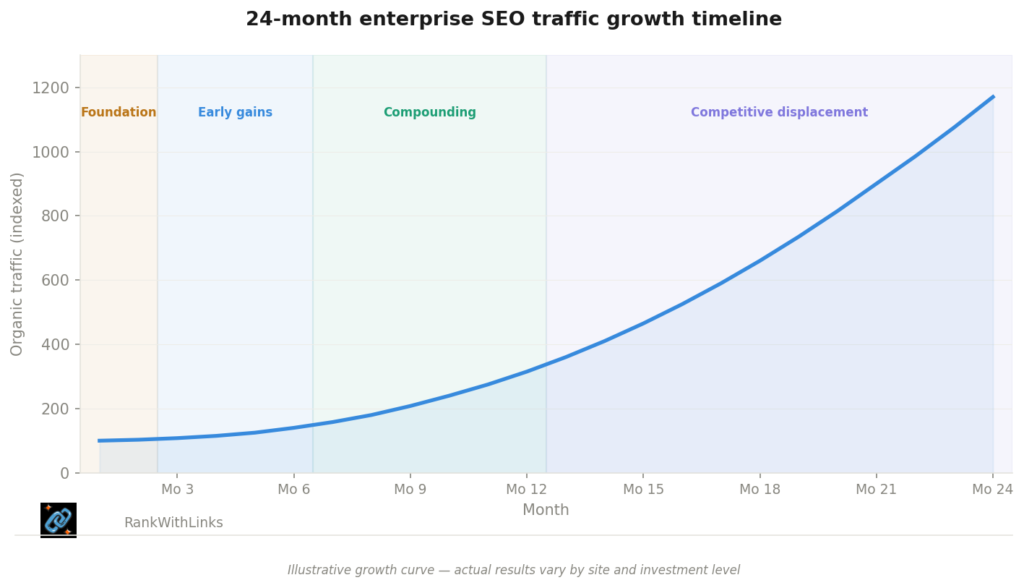
Months 1–2: Foundation and audit
The first 60 days of an enterprise SEO engagement should be spent on discovery and technical foundations. Expect:
- Full technical audit with prioritised remediation roadmap
- Keyword universe mapping and opportunity sizing
- Baseline reporting setup — dashboards, benchmarks, tracking
- Competitor gap analysis
Results during this phase: minimal. Any agency promising significant ranking movements in the first two months either has misaligned expectations or is using short-term tactics that carry risk.
Months 3–6: Implementation and early gains
As technical fixes are implemented and content is published, early signals emerge — usually on lower-competition terms and pages where the gap was largest. Expect:
- Indexation improvements and crawl efficiency gains
- Early ranking movements on long-tail terms
- Organic traffic beginning to trend up on optimised pages
Months 6–12: Compounding returns
The compounding nature of SEO becomes visible in the second half of year one. Pages with strong content and growing authority begin to rank for wider keyword sets. Organic traffic from the optimised cluster should be measurably above baseline.
Year 2+: Competitive displacement
The most significant returns come from sustained, consistent investment over 18–24 months. This is when enterprise programmes begin displacing established competitors, ranking for high-volume head terms, and generating organic traffic at a scale that delivers clear revenue impact.
6. How to build an in-house enterprise SEO team
For organisations that prefer ownership over outsourcing, building an in-house team is a viable alternative — but it requires a longer ramp-up and a clear hiring sequence.
The recommended order of hiring:
Hire 1: Senior SEO manager (or director)
This person sets the strategy, owns the roadmap, and communicates with leadership. Without strong strategic leadership, even a talented team operates reactively. Look for someone who has managed large sites (50,000+ pages) and can read a log file analysis as fluently as a keyword report.
Hire 2: Technical SEO specialist
Technical issues are the most common limiter on large-site performance, and they are the hardest skill to train. A dedicated technical SEO brings crawl analysis, JavaScript SEO, and site architecture expertise that a generalist SEO manager typically cannot cover at depth.
Hire 3: Content strategist or SEO content lead
Once technical foundations are stable, content volume becomes the primary growth lever. A content specialist who understands topical authority, briefing, and E-E-A-T requirements accelerates publishing output without sacrificing quality.
Tool budget alongside an in-house team should be a minimum of $2,000–$5,000 per month for a combination of Semrush or Ahrefs, a rank tracker, a crawling tool (Screaming Frog or similar), and a reporting layer (Looker Studio is free; enterprise platforms carry additional cost).
7. How to choose an enterprise SEO provider: evaluation checklist
The difference between a credible enterprise SEO agency and an expensive one is not always obvious in a proposal. Use the checklist below to evaluate any provider before signing a contract.
| Checklist: evaluating an enterprise SEO agency |
- Can they show you case studies with comparable site complexity — not just comparable company size?
- Do they have a dedicated technical SEO specialist, or does their ‘technical SEO’ mean running Screaming Frog once a quarter?
- How do they handle implementation dependency? Do they have a process for working within your engineering sprint cycle?
- What does their reporting look like? Ask to see a sample report — does it connect to business outcomes?
- Who will actually work on your account? Confirm the senior people presenting are the people who will do the work.
- What is their process for handling algorithm updates? Can they demonstrate how they responded to a recent core update?
- Do they have a clear escalation path if results are not meeting agreed benchmarks?
- What is the contract term and exit clause? 12-month lock-ins with no performance clause are a warning sign.
Final thoughts
Enterprise SEO is a long-term infrastructure investment, not a marketing activation. The organisations that get the most from it treat it as a compounding asset — one that grows in value with each month of consistent, high-quality execution.
The single most common mistake enterprises make is underfunding the discipline relative to other channels. Paid search budgets of $500,000 per month alongside SEO retainers of $3,000 per month are not uncommon — and they represent a significant misallocation. Organic search typically delivers a lower cost-per-acquisition, higher purchase intent, and results that do not disappear the moment spend is paused.
If you are at the stage of evaluating providers, the checklist in section 7 will save you time. If you are building in-house, start with strategy and technical expertise before hiring for content volume. And if you are just beginning to understand what enterprise SEO involves, the most important thing to internalise is this: the agencies and teams that win are the ones that treat SEO as a permanent, cross-functional programme — not a project with a finish line.

Abdullah Zulfiqar is Co-founder and Client Success Manager at RankWithLinks, an SEO agency helping businesses grow online. He specializes in client relations and SEO strategy, driving measurable results and maximizing ROI through effective link-building and digital marketing solutions.