
Introduction: Why Most SEO Agencies Rank for the Wrong Keywords
There is a painful irony in this industry that nobody talks about enough.
SEO agencies — businesses that exist specifically to rank other people’s websites — often have some of the weakest organic presence in their own niche.
I have audited over 40 agency websites in the past three years. The pattern is almost always identical. They target “SEO company” and “SEO agency” as their primary keywords, publish three or four generic blog posts, wonder why they are stuck on page four, and eventually rely entirely on referrals and cold outreach for new business.
The problem is not their SEO skills. The problem is they are targeting keywords the way a beginner would — chasing volume and ignoring everything else that actually matters.
This guide is different from what you will find elsewhere. No generic advice. No outdated “use keywords in your title tag” tips. Just a categorized, data-backed breakdown of exactly which keywords an SEO company should be targeting in 2026 — and a clear strategy for turning those keywords into a consistent pipeline of inbound leads.
Key Takeaways
- “SEO company” and “SEO agency” are nearly impossible to rank for — and they attract the wrong traffic anyway
- The highest-converting keywords for SEO agencies are pricing, local, and problem-aware queries
- Search intent determines content format — ignoring this wastes your entire content budget
- Google’s AI Overviews in 2026 are consuming informational traffic — adjust your keyword mix accordingly
- A keyword cluster strategy beats targeting individual keywords every single time
- Local + service-specific keywords deliver the fastest ROI for agency websites
Why Generic Keyword Guides Fail SEO Agencies
Most keyword guides online — including the ones currently ranking for this topic — are written for general businesses. They talk about chiropractors, dog harnesses, and food bloggers. Useful examples, but completely irrelevant if you run an agency whose clients are business owners, marketing managers, and startup founders.
The buying journey of someone hiring an SEO agency is fundamentally different from someone buying a dog leash. It is longer, more research-heavy, more skeptical, and involves significantly higher purchase consideration. A client spending $2,000 per month on SEO retainer is going to search multiple times across multiple days before ever filling out your contact form.
Your keyword strategy has to meet them at every stage of that journey — not just at the moment they type “SEO company near me.”
Understanding Search Intent: The Foundation Everything Else Rests On
Before looking at a single keyword, you must understand why someone is searching. Google has become extremely good — particularly post-2024 — at understanding the intent behind a query and serving results that match that intent perfectly.
If you create the wrong type of content for a keyword’s intent, you will not rank. It is that simple.
The four intents and what they mean for an SEO agency:
Informational Intent — The searcher wants to learn. They are not ready to buy. Keywords like “how does SEO work” or “what is domain authority” fall here. These are top-of-funnel. They build brand awareness and establish your agency as a trusted expert, but they rarely convert directly.
Commercial Intent — The searcher is evaluating options. They are comparing agencies, reading reviews, and building a shortlist. Keywords like “best SEO agency for ecommerce” or “SEO agency vs freelancer” fall here. These are middle-of-funnel and represent your biggest content opportunity.
Transactional Intent — The searcher is ready to act. Keywords like “hire SEO agency” or “SEO services pricing” fall here. Bottom-of-funnel, high conversion rate. These keywords belong on service pages, not blog posts.
Local Intent — The searcher wants something geographically relevant. “SEO company in Lahore” or “digital marketing agency near me.” These queries trigger map pack results alongside organic results — giving you two chances to appear for one search.
The 6 Keyword Categories Every SEO Agency Needs
Category 1: Local Service Keywords — Start Here First
If you only do one thing after reading this guide, optimize for local keywords. This is where competitor guides completely fail you — they mention local SEO as an afterthought. For an agency, it is the single fastest path to inbound leads.
Why local keywords win:
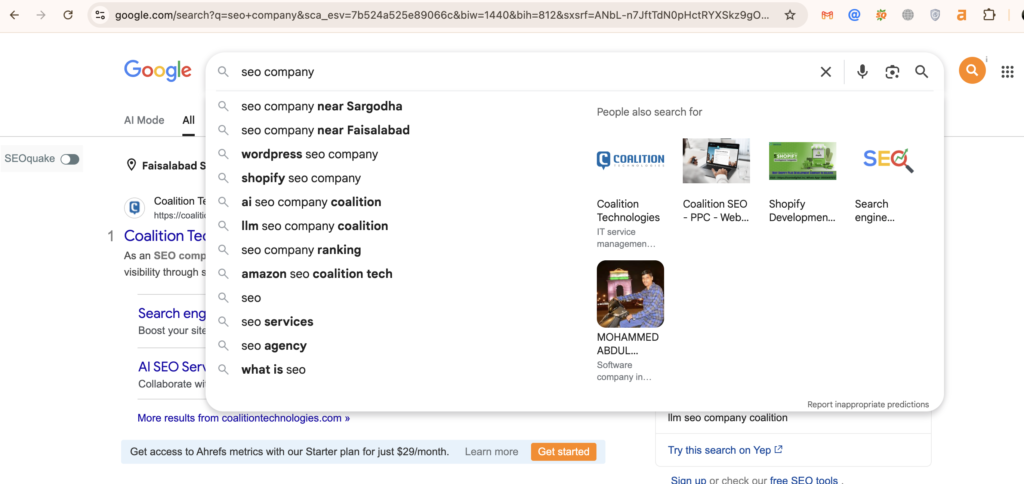
Keyword difficulty on local variants is dramatically lower. “SEO company” has a KD of 70+. “SEO company in Faisalabad” has a KD of 15 to 25 depending on the market. Same intent, fraction of the competition.
Google also shows local results in three places simultaneously — the AI Overview, the local map pack, and the organic blue links. One well-optimized local page can appear in all three.
High-performing local keyword templates:
- SEO company in [City]
- SEO agency [City]
- digital marketing agency [City]
- best SEO company in [Country/Region]
- local SEO services [City]
- SEO consultant [City]
- SEO expert [City]
- website ranking service [City]
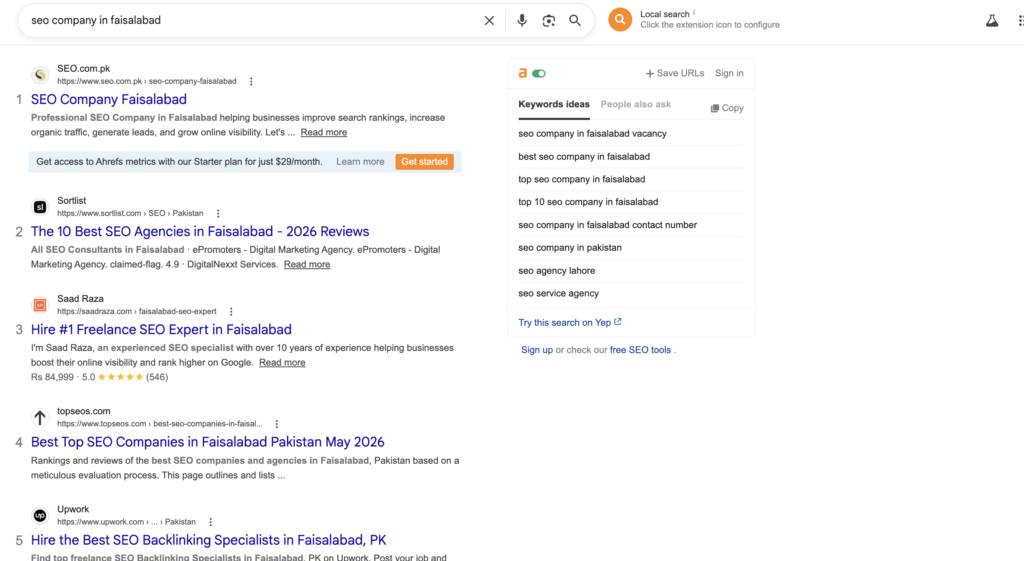
Implementation: Build a dedicated landing page for each primary location you serve. Each page needs unique content — not copy-pasted text with the city name swapped. Include local schema markup, a Google Maps embed, and client testimonials from that region where possible.
Category 2: Service-Specific Keywords — Your Revenue Pages
These keywords target people who already know they need SEO and are looking for a specific service. Conversion rates on these pages are second only to local keywords.
High-value service keywords with real data:
| Keyword | Monthly Volume | KD | CPC | Intent |
|---|---|---|---|---|
| SEO audit services | 1,900 | 24 | $40 | Commercial |
| white label SEO services | 3,600 | 29 | $85 | Commercial |
| link building services | 8,100 | 41 | $120 | Commercial |
| technical SEO services | 2,400 | 33 | $95 | Commercial |
| local SEO services | 5,400 | 30 | $75 | Commercial |
| ecommerce SEO agency | 2,100 | 33 | $110 | Commercial |
| SEO content writing service | 1,600 | 27 | $65 | Commercial |
| on-page SEO service | 1,300 | 22 | $55 | Commercial |
| SEO services for small business | 1,900 | 24 | $70 | Commercial |
| monthly SEO services | 1,300 | 26 | $80 | Commercial |
Implementation Rule: Each service gets its own dedicated page. Never combine services on a single page to “save time.” Google cannot rank a page well when it is trying to be about everything simultaneously.
Category 3: Pricing and Cost Keywords — Your Highest-Converting Blog Topics
This is the category both competitor articles completely missed. And it is arguably the most valuable for lead generation.
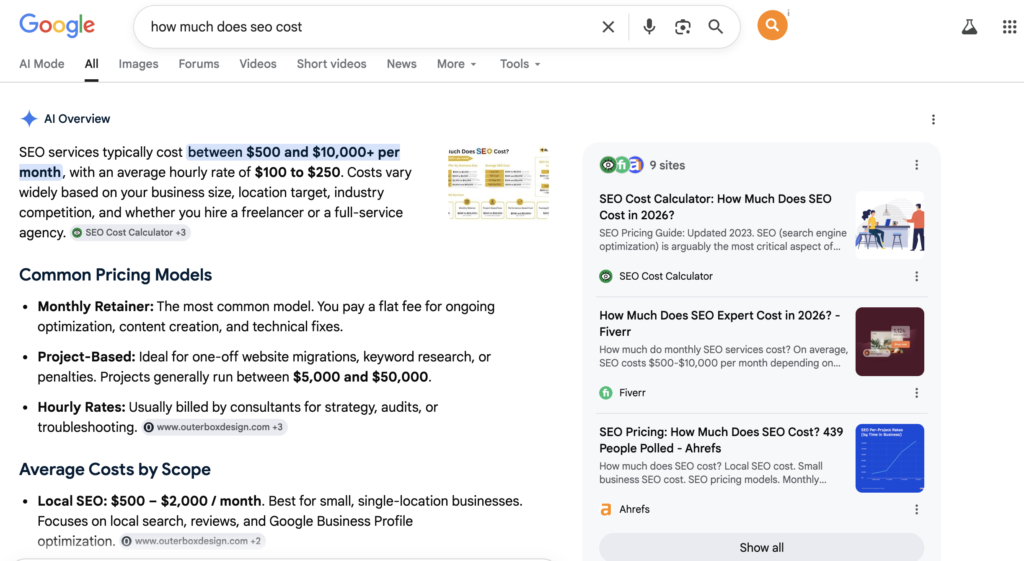
When someone searches “how much does SEO cost,” they are not casually curious. They have already decided they want SEO. They are now figuring out their budget. This is bottom-of-funnel content disguised as informational intent.
Pricing keywords that convert:
| Keyword | Monthly Volume | KD | Why It Converts |
|---|---|---|---|
| how much does SEO cost | 5,400 | 44 | Budget-ready searchers |
| SEO pricing | 3,200 | 38 | Comparison shoppers |
| SEO agency pricing | 1,100 | 22 | Agency-specific buyers |
| SEO audit cost | 1,400 | 19 | Service-specific buyers |
| monthly SEO cost | 1,800 | 28 | Retainer-ready clients |
| affordable SEO services | 2,400 | 28 | Budget-conscious SMBs |
| SEO retainer cost | 800 | 17 | High-value leads |
| SEO packages pricing | 900 | 21 | Ready to compare |
Content Strategy: Write a transparent, detailed pricing article. Include real ranges, what affects price, what cheap SEO costs you long-term, and what a fair retainer looks like. Agencies that hide their pricing lose leads to agencies that are transparent. Publish your pricing page and your pricing article as two separate assets — both optimized for different keyword variants.
Category 4: Problem-Aware Keywords — Meet Clients Before They Know They Need You
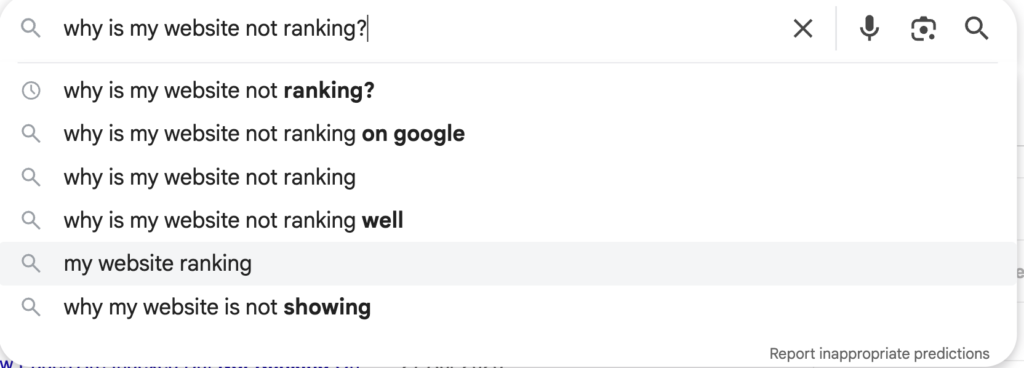
These are informational keywords where the searcher has a problem but has not yet identified SEO as the solution. Your article introduces them to the solution — and to your agency.
Best problem-aware keywords for SEO agency blogs:
| Keyword | Monthly Volume | KD | Problem Being Solved |
|---|---|---|---|
| why is my website not ranking | 2,900 | 38 | Traffic loss |
| how to get more website traffic | 8,100 | 52 | Growth stagnation |
| how long does SEO take | 4,400 | 45 | Expectation setting |
| why is my Google ranking dropping | 1,600 | 41 | Penalty/algorithm drop |
| how to rank on first page of Google | 3,900 | 47 | Visibility goals |
| website not showing on Google | 2,100 | 35 | Indexing issues |
| how to increase organic traffic | 5,400 | 58 | Traffic growth |
| what is hurting my SEO | 1,200 | 29 | Audit awareness |
2026 Important Note: Many of these informational queries are now being answered directly by Google’s AI Overviews. This means ranking number one does not guarantee the same click volume it once did. For these keywords, your goal is not just to rank — it is to be cited as a source within the AI Overview itself. This requires structured, factual, clearly attributed content with proper schema markup.
Category 5: Comparison Keywords — Capture Decision-Stage Buyers
When someone searches “SEO agency vs in-house SEO,” they are at a critical decision point. They are seriously considering hiring an agency — they just need help justifying the choice. Your content can be that justification.
High-value comparison keywords:
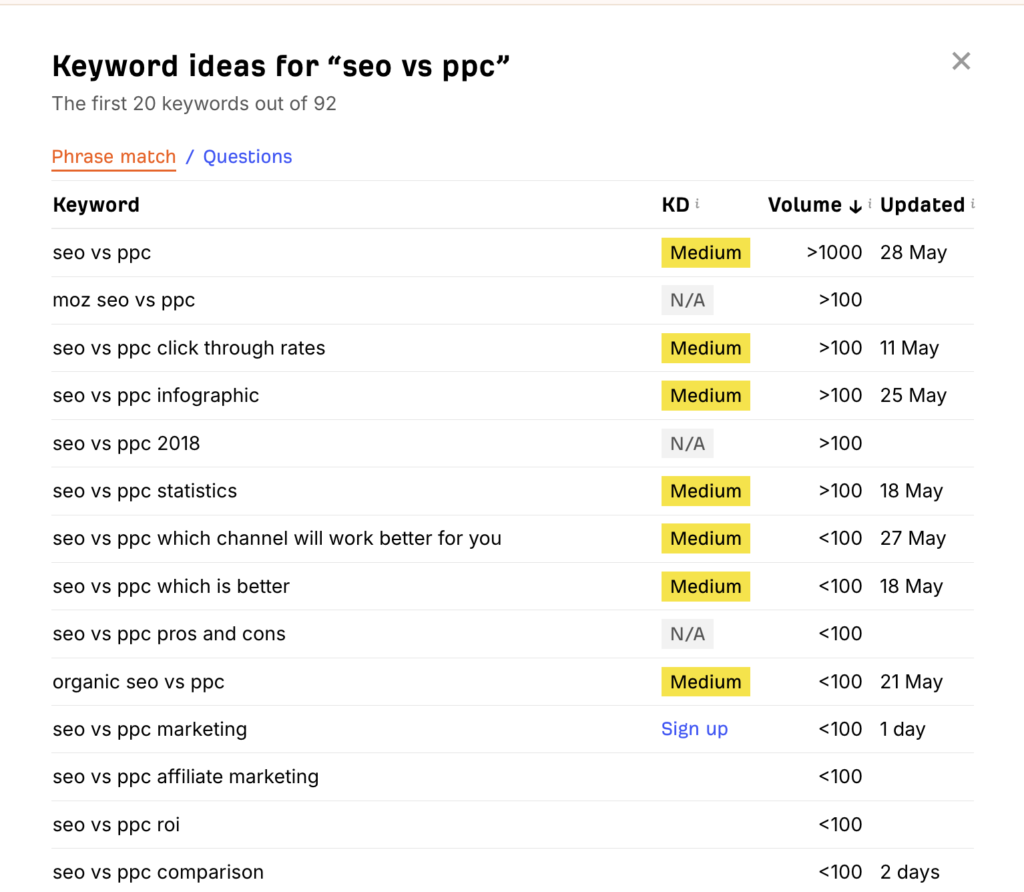
- SEO agency vs in-house SEO — 900/mo | KD 22
- SEO vs PPC which is better — 1,800/mo | KD 41
- SEO agency vs freelancer — 900/mo | KD 22
- Ahrefs vs Semrush for agencies — 12,000/mo | KD 67
- local SEO vs national SEO — 1,100/mo | KD 29
- hiring SEO agency vs doing it yourself — 600/mo | KD 19
- SEO vs Google Ads — 2,400/mo | KD 38
Content Format: These articles should compare both options fairly — acknowledging when the alternative might be better. This counterintuitive approach builds enormous trust. When you honestly say “here is when you should NOT hire an agency,” the reader trusts everything else you say — including your recommendation to hire one.
Category 6: Credential and Trust Keywords — Build Authority
These keywords help establish your agency as a legitimate, trustworthy expert rather than just another vendor.
- SEO case studies — 1,600/mo | KD 36
- SEO results examples — 900/mo | KD 24
- how to choose an SEO agency — 2,100/mo | KD 31
- what to look for in an SEO company — 1,300/mo | KD 27
- SEO agency red flags — 800/mo | KD 18
- questions to ask SEO agency — 700/mo | KD 16
- SEO agency reviews — 2,900/mo | KD 44
These are perfect for bottom-of-funnel content that handles objections before your sales call even happens.
The Keyword Cluster Strategy: Why Single Keywords Fail
Both competitor articles treat keywords as individual targets — find a keyword, write a page, move on. This approach is fundamentally outdated.
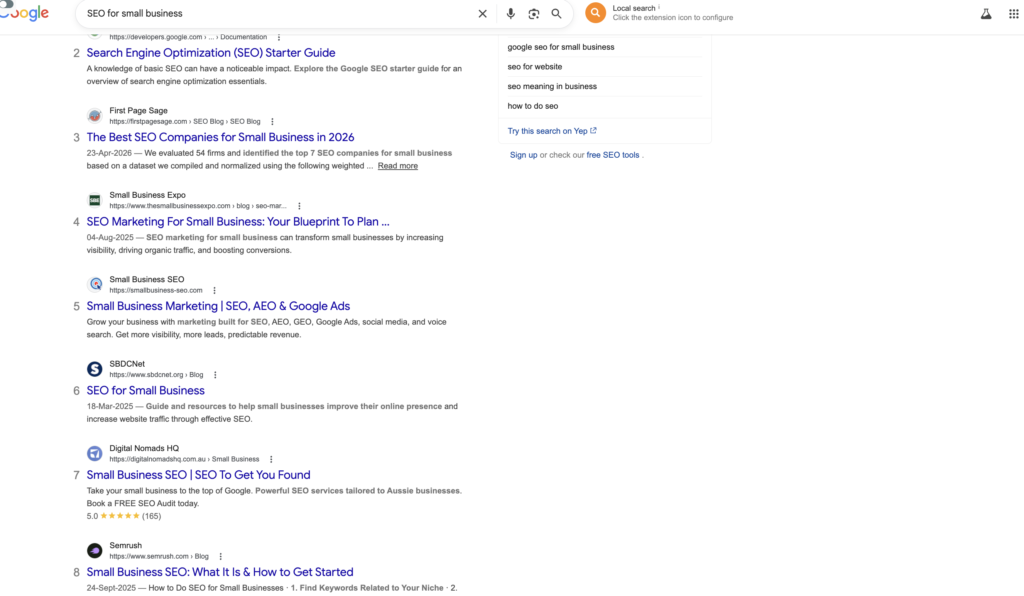
Google’s Helpful Content System rewards topical authority — the depth and breadth of coverage you provide on a subject. A site that thoroughly covers every angle of “SEO for small business” will outrank a site that has one good article on the topic, even if that one article is technically better written.
How to build a keyword cluster for an SEO agency:
Pick one core topic — for example, “SEO audit.”
Your cluster looks like this:
Pillar Page: What is an SEO Audit (comprehensive guide, 3,000+ words)
Supporting Pages:
- How much does an SEO audit cost
- Technical SEO audit checklist
- How to do an SEO audit yourself
- SEO audit tools comparison
- How long does an SEO audit take
- What does an SEO audit include
All supporting pages link back to the pillar. The pillar links to all supporting pages. Google sees a site that genuinely owns this topic — and ranks accordingly.
Common Mistakes SEO Agencies Make With Their Own Keywords
Mistake 1: Targeting their own industry’s brand terms
Ranking for “Ahrefs” or “Semrush” as an SEO agency makes no sense. These are navigational keywords — people searching for those tools are going to those tools, not an agency.
Mistake 2: Writing blog posts when service pages are needed
Transactional intent keywords need service pages. Writing a blog post targeting “hire SEO agency” is a content-format mismatch. Google will not rank it well because every page currently ranking for that query is a service or directory page.
Mistake 3: Ignoring keyword cannibalization
When two pages on your site target the same keyword, they compete against each other. This is extremely common in agency sites that have a “Services” page and multiple blog posts all targeting “SEO services.” Audit your content for cannibalization quarterly.
Mistake 4: Not updating old content
A blog post from 2022 targeting “SEO trends” is actively hurting you in 2026 if it has not been updated. Google’s freshness signal matters significantly for industry-specific content. Review and update your top pages every six months.
Mistake 5: Zero internal linking structure
Both competitor articles miss this completely. Your keyword strategy only works if your pages are properly interlinked. Every service page should link to relevant blog posts. Every blog post should link back to the most relevant service page. This is how you transfer authority and guide visitors toward conversion.
Expert Tips From Agency-Level Experience
Tip 1: Mine your own sales calls
Record your discovery calls (with permission). The exact language prospects use — “we’re not showing up when people search for us,” “our competitor is always above us on Google” — these are your keywords. Real client language converts better than keyword-tool language because it matches how real people search.
Tip 2: Build a “hub and spoke” content model
Your website should have 5 to 7 core topic hubs (Local SEO, Technical SEO, Link Building, Content SEO, SEO Audits, SEO Pricing, SEO for specific industries). Each hub has a comprehensive pillar page and 6 to 10 supporting articles. This is the architecture that dominates search results in 2026.
Tip 3: Prioritize keywords where AI Overviews cite sources
Search your target keywords and note which ones trigger AI Overviews. For those that do, structure your content with clear factual statements, use schema markup, and ensure your brand/domain is mentioned in other authoritative contexts. AI Overviews increasingly cite sources that appear multiple times across trusted domains.
Tip 4: Use GSC data every single month
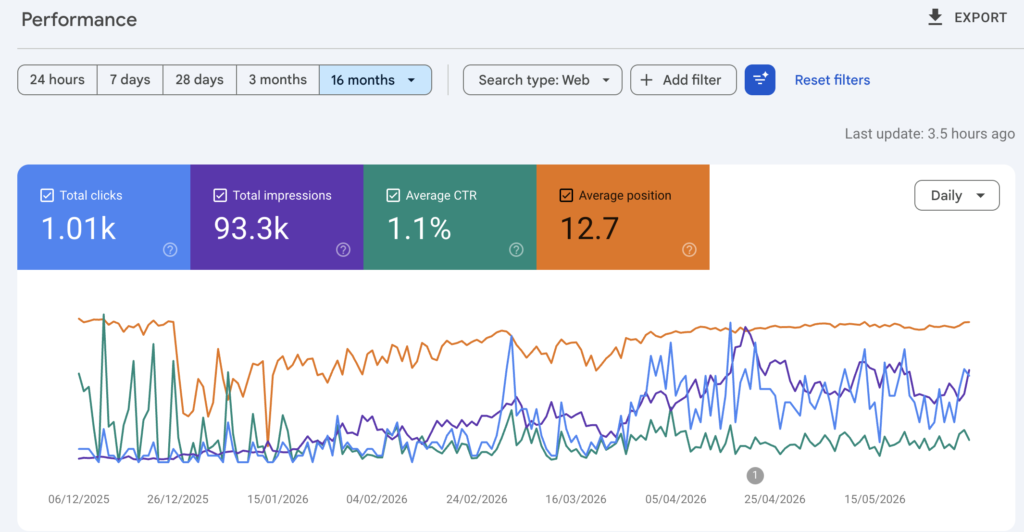
Google Search Console shows you exactly which queries are generating impressions for your pages. Sort by impressions, filter for position 5 to 20, and these are your quick-win optimization targets. A page ranking 8th for a relevant query can often be pushed to positions 3 to 5 with focused on-page improvements — faster than ranking a brand new page from scratch.
Tip 5: CPC data reveals commercial value
When doing keyword research, always look at Cost Per Click data alongside volume and difficulty. A keyword with 500 monthly searches but a $120 CPC means advertisers are paying $120 per click because those clicks convert into revenue. That is a signal of commercial intent that raw volume never shows you.
Final Keyword Priority Checklist
Before publishing any page or post, verify:
- Keyword has clear, defined search intent that matches your content format
- Keyword difficulty is appropriate for your current domain authority
- Traffic potential (not just volume) has been checked in your keyword tool
- A dedicated page exists for this keyword — no cannibalization with existing content
- Primary keyword appears in title, H1, first paragraph, and meta description
- Supporting semantic keywords are naturally distributed throughout
- Internal links connect this page to relevant pillar pages and service pages
- External links point to authoritative sources (Google, industry studies, tool documentation)
- Schema markup is implemented appropriate to the content type
- Page has a clear CTA that matches where this keyword sits in the buyer journey
FAQ
Q: What is the best keyword for an SEO company to target first?
A: Start with local keywords — “[SEO company] + [your city].” These have lower competition, high commercial intent, and trigger both organic and map pack results. They deliver the fastest inbound leads for a new or growing agency.
Q: How many keywords should an SEO agency target?
A: Build clusters, not lists. Target 5 to 7 core topic clusters, each with one pillar keyword and 6 to 10 supporting keywords. This is more effective than a flat list of 100 unrelated keywords.
Q: Are high-volume keywords worth targeting for an SEO agency?
A: Only if your domain authority supports it. A DA 30 site targeting “SEO agency” (KD 75+) is wasting resources. Target keywords where your KD is within 10 to 15 points of your domain authority for realistic ranking potential.
Q: How do AI Overviews affect keyword strategy for SEO companies?
A: Informational queries are increasingly answered within Google’s AI Overview, reducing click-through rates. Shift your content mix toward commercial and transactional keywords, and for informational content, optimize specifically to be cited as a source within AI Overviews using structured data and clear factual statements.
Q: Should an SEO agency blog about SEO or about their clients’ industries?
A: Both, strategically. SEO-focused content attracts other agencies (potential white-label clients) and builds industry authority. Industry-specific content (“SEO for restaurants,” “SEO for law firms”) attracts direct clients in those niches and has significantly lower competition than generic SEO keywords.
Conclusion
The agencies that consistently win new business through organic search are not the ones with the biggest keyword lists. They are the ones with the clearest strategy.
They know exactly which keywords belong on service pages versus blog posts. They build topical clusters instead of chasing individual terms. They prioritize local and pricing keywords because those are where their ideal clients are actively making decisions. And they update their content regularly because they understand that SEO is not a one-time project — it is an ongoing system.
If you take nothing else from this guide, take this: the best keyword for your SEO company is not the one with the highest search volume. It is the one your ideal client is searching at the exact moment they are ready to hire someone.
Find that keyword. Own that page. Build from there.

Fazilat zulfiqar is an SEO specialist at RankWithLinks, focused on improving search rankings through smart link building and optimization.He helps businesses grow organic traffic and build strong online authority.