
Introduction: Why Accounting Automation Is No Longer Optional
Managing finances manually in 2026 is like navigating with a paper map in the age of GPS. It works, technically, but you are burning time, inviting errors, and falling behind every competitor who has already moved on. Accounting automation software has matured dramatically over the past few years, and the best platforms today do not just crunch numbers — they think ahead, flag risks, reconcile transactions in real time, and give business owners actionable clarity without requiring a finance degree to operate.
The demand for intuitive accounting automation tools has surged because businesses of every size are dealing with more complexity: multi-currency transactions, remote teams, subscription billing, tax compliance across jurisdictions, and investor reporting that once required a full finance department. The right software handles all of that quietly in the background while you focus on running your business.
This guide covers the best intuitive accounting automation software available in 2026, what makes each one stand out, who each one suits best, and what to look for before you commit to a platform.
What Makes Accounting Software Truly Intuitive in 2026
Before diving into specific tools, it is worth defining what “intuitive” actually means in the context of accounting automation, because the word gets thrown around loosely in marketing materials.
Truly intuitive accounting software in 2026 shares several defining characteristics. First, it requires minimal onboarding. A business owner with no accounting background should be able to set up a chart of accounts, connect bank feeds, and generate a profit and loss statement within hours, not weeks. Second, it automates the repetitive work without requiring users to configure complex rules every time. Recurring invoices, bank reconciliation, expense categorization, and tax calculations should happen automatically or with one click. Third, it surfaces insights proactively. Rather than waiting for you to run a report, the best platforms alert you when cash flow dips below a threshold, when an invoice is overdue, or when a vendor payment is coming up. Fourth, it integrates without friction. In 2026, your accounting software is the financial hub connecting your CRM, payroll provider, e-commerce platform, and banking institution. Seamless, low-configuration integrations are a baseline expectation.
With those criteria in mind, here are the top platforms that genuinely deliver on the promise of intuitive accounting automation in 2026.
1. QuickBooks Online Advanced — Best for Small to Mid-Sized Businesses

QuickBooks Online has been a cornerstone of small business accounting for years, and its Advanced tier in 2026 has evolved into one of the most capable automated accounting platforms available. The automation improvements introduced in recent versions make it far more than a glorified ledger.
What Sets It Apart
QuickBooks Online Advanced now includes AI-driven expense categorization that learns your business patterns over time. When you connect your bank account, the software begins categorizing transactions automatically. Within a few weeks, its accuracy improves substantially as it recognizes vendor names, transaction amounts, and categories based on your historical approvals.
The batch invoicing feature is a significant time saver for service businesses billing multiple clients on similar schedules. You can generate, customize, and send dozens of invoices in minutes rather than individually processing each one. Automatic payment reminders reduce the administrative burden of chasing late payments, and the integrated payment processing means clients can pay directly from the invoice email.
The cash flow planner tool uses your current receivables, payables, and historical trends to project your bank balance weeks or months into the future. For businesses managing tight cash cycles, this kind of forward visibility is genuinely valuable.
Automation Highlights
Bank reconciliation in QuickBooks Online Advanced is largely automatic when bank feeds are connected. The system matches transactions to entries in real time and flags exceptions for your review rather than requiring you to manually match every line. Month-end close, which used to consume days of work, becomes a matter of reviewing flagged items and approving the reconciliation.
Automated workflows allow you to set triggers for internal processes. You can configure the system to notify your team when an invoice reaches a certain amount, require manager approval for expenses above a threshold, or automatically assign categories to specific vendors.
Best For
QuickBooks Online Advanced is best suited for small to mid-sized businesses with between five and one hundred employees, particularly those in service industries, retail, or professional services. It handles multi-user access well and includes role-based permissions that allow you to give bookkeepers, accountants, and managers appropriate access without exposing sensitive data unnecessarily.
2. Xero — Best for Global Businesses and Multi-Currency Operations
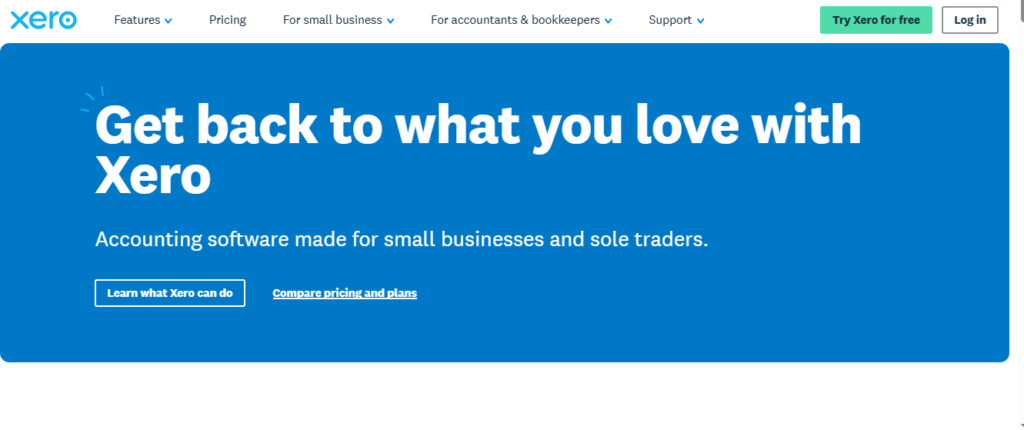
Xero has built a strong reputation as the preferred accounting automation platform for businesses operating across borders, and its 2026 feature set reinforces that position decisively. If your business deals with multiple currencies, international suppliers, or overseas clients, Xero handles that complexity with remarkable elegance.
What Sets It Apart
Xero’s interface is genuinely clean and well-organized. The dashboard gives you an immediate visual summary of outstanding invoices, upcoming bills, bank account balances, and expense claims without requiring any configuration. New users consistently report that Xero feels less intimidating than many competitors, which is a real advantage when you are onboarding non-finance staff to help with expense reporting or invoice approvals.
The bank reconciliation feature in Xero is arguably the smoothest in the industry. Suggested matches appear with confidence scores, and you can accept or reject them with a single click. The system learns from your decisions and improves its matching accuracy continuously.
Automation Highlights
Xero’s automated invoice reminders allow you to set up a sequence of payment reminder emails that go out automatically at specified intervals before and after an invoice due date. You write the templates once, configure the schedule, and the system handles the follow-up without any ongoing effort.
Repeating bills and invoices cover recurring transactions automatically. If you pay a software subscription or a monthly retainer every first of the month, Xero creates and posts the bill automatically so it is always reflected in your accounts without manual entry.
The Xero Analytics Plus feature, included in higher-tier plans, provides short-term cash flow forecasting and scenario modeling. You can see how different payment timing or upcoming expenses would affect your cash position, which supports better decision-making without requiring spreadsheet manipulation.
Best For
Xero is best for growing businesses, freelancers scaling into small companies, and any organization with international operations. Its multi-currency support is genuinely strong, handling exchange rate calculations and revaluations automatically. It is also the preferred choice of many accountants and bookkeepers in the UK, Australia, and New Zealand, making collaboration with external financial advisors smoother.
3. FreshBooks — Best for Freelancers and Service-Based Businesses
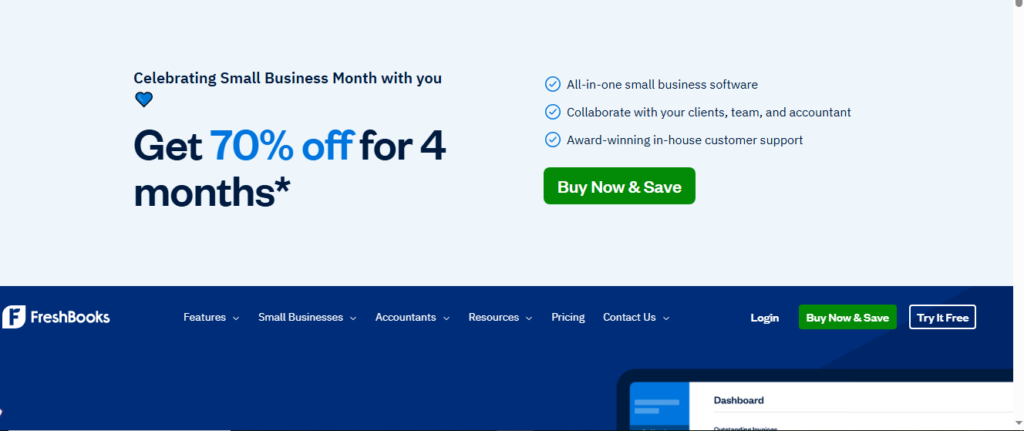
FreshBooks occupies a specific and well-defended niche: service-based small businesses and solo professionals who need polished, client-facing features alongside solid financial automation. Its time tracking, project billing, and invoice automation capabilities are among the best available anywhere.
What Sets It Apart
FreshBooks was designed from the beginning for people who sell their time and expertise, not physical inventory. As a result, its workflow aligns naturally with how consultants, designers, lawyers, coaches, and other service professionals actually operate. Time tracking is built into the core product, and logged hours convert to invoice line items automatically. There is no exporting, reformatting, or manual calculation involved.
The client portal gives your customers a branded experience where they can view invoices, see project history, make payments, and communicate with you in one place. For freelancers trying to project a professional image, this kind of polished client interaction is a meaningful differentiator.
Automation Highlights
Automated late payment fees are a standout feature for businesses struggling with slow-paying clients. You can configure FreshBooks to automatically add a percentage-based late fee to overdue invoices after a specified number of days. Combined with automated reminder emails, this creates a systematic approach to collections that requires no ongoing attention.
Automatic expense capture through the mobile app allows you to photograph receipts, which are then parsed and categorized automatically. The system extracts vendor names, amounts, and dates from receipt images and creates expense records ready for review. For professionals who accumulate receipts during client site visits or business travel, this eliminates significant manual data entry.
Recurring invoices with automatic payment collection round out the automation picture. If you have clients on retainer or subscription arrangements, FreshBooks can charge their saved payment method automatically on the schedule you define and send them a receipt without any manual intervention.
Best For
FreshBooks is the clear choice for freelancers, independent consultants, and small professional service firms with fewer than twenty-five employees. It is not designed for product-based businesses with complex inventory needs, but for its target audience, it delivers a level of polish and automation that larger, more general-purpose platforms often cannot match.
4. Sage Intacct — Best for Mid-Market and Finance Teams Needing Advanced Automation
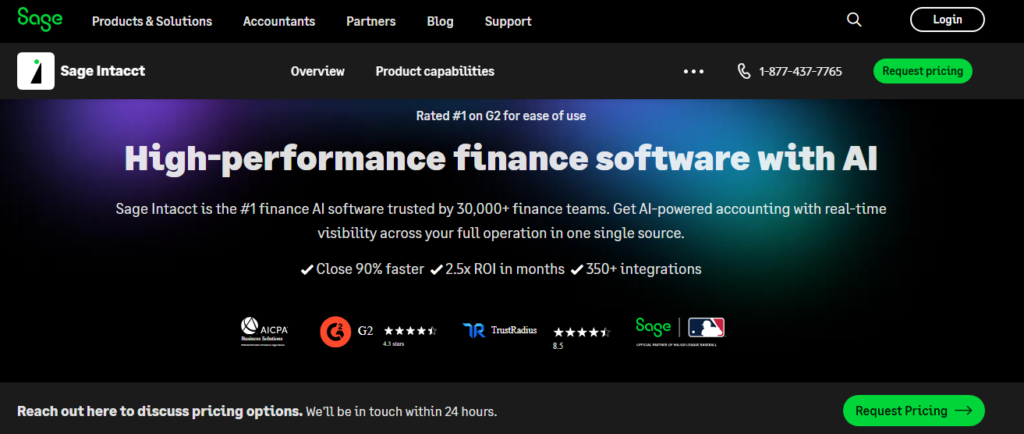
Sage Intacct operates in a different tier than the platforms discussed above. It is built for mid-market businesses and organizations with dedicated finance teams who need sophisticated automation, multi-entity consolidation, and deep reporting capabilities. If you have outgrown QuickBooks or Xero but are not ready for enterprise ERP software, Sage Intacct is the platform most worth evaluating.
What Sets It Apart
Sage Intacct’s multi-entity and multi-currency capabilities are genuinely powerful. Organizations running multiple subsidiaries, divisions, or project-based entities can manage all of them within a single instance of the software, with automated consolidation eliminating the spreadsheet gymnastics that typically accompany multi-entity reporting.
The platform’s dimensional accounting model is one of its most distinctive features. Rather than relying solely on a chart of accounts, Sage Intacct allows you to tag every transaction with multiple dimensions such as department, location, project, and cost center. This makes it possible to slice and analyze financial data in almost any combination without creating an unwieldy chart of accounts.
Automation Highlights
Accounts payable automation in Sage Intacct handles the full invoice lifecycle from capture to payment. Vendor invoices can be submitted electronically, routed through configurable approval workflows based on amount, department, or vendor type, and then scheduled for payment automatically once approved. The system maintains a complete audit trail at every step.
Revenue recognition automation is a critical feature for software companies, professional services firms, and any business subject to complex revenue recognition standards. Sage Intacct can automate the recognition schedule based on the terms of each contract, ensuring compliance without manual calculation.
Best For
Sage Intacct is best suited for mid-market companies with revenues between five million and five hundred million dollars, particularly those in software, professional services, nonprofit, or healthcare sectors. It requires more implementation effort than consumer-grade accounting tools, but the depth of automation and reporting it provides justifies that investment at the right scale.
5. Zoho Books — Best Value for Growing Businesses Already Using Zoho
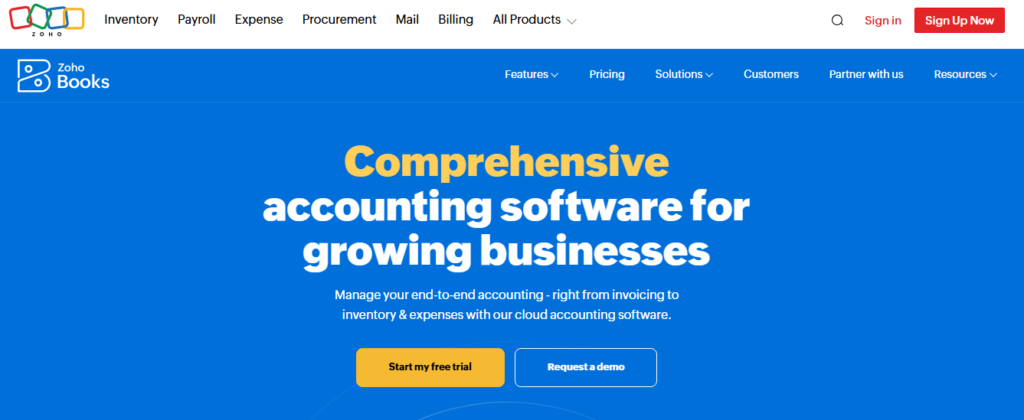
Zoho Books is the accounting component of the broader Zoho ecosystem, and if your business already uses Zoho CRM, Zoho Projects, or other Zoho applications, it offers an almost unbeatable combination of capability and value. Even for businesses not already in the Zoho ecosystem, it deserves consideration for its feature depth relative to its price point.
What Sets It Apart
Zoho Books covers the full range of accounting automation features — bank feeds, automated reconciliation, recurring invoices, expense tracking, and multi-currency support — at pricing that undercuts most major competitors. The interface has improved significantly over recent versions and is now genuinely competitive in terms of usability.
The client portal and vendor portal features support self-service access that reduces administrative back-and-forth. Clients can view their transaction history, download statements, and make payments without contacting your team. Vendors can submit invoices directly into your accounts payable workflow, reducing manual entry on your end.
Automation Highlights
Zoho Books includes a workflow automation engine that allows you to create custom triggers and actions across the platform. For example, you can configure the system to automatically send a thank-you email when a client makes a payment, create a follow-up task when an invoice goes past due, or notify a team member when a new vendor bill exceeds a certain amount. These workflows are configured through a visual interface that does not require any programming knowledge.
Payment reminders, recurring transactions, and bank reconciliation all work automatically with minimal setup. The tax management features are particularly strong for businesses operating in multiple tax jurisdictions, handling GST, VAT, and sales tax calculations automatically based on the customer or vendor location.
Best For
Zoho Books is ideal for small to mid-sized businesses looking for strong automation at a lower price point, and especially for any organization already using other Zoho products. The integration between Zoho Books and Zoho CRM, for example, creates a seamless flow from closed deal to invoice to payment collection that eliminates manual handoffs between systems.
6. Pilot — Best for Startups and Venture-Backed Companies
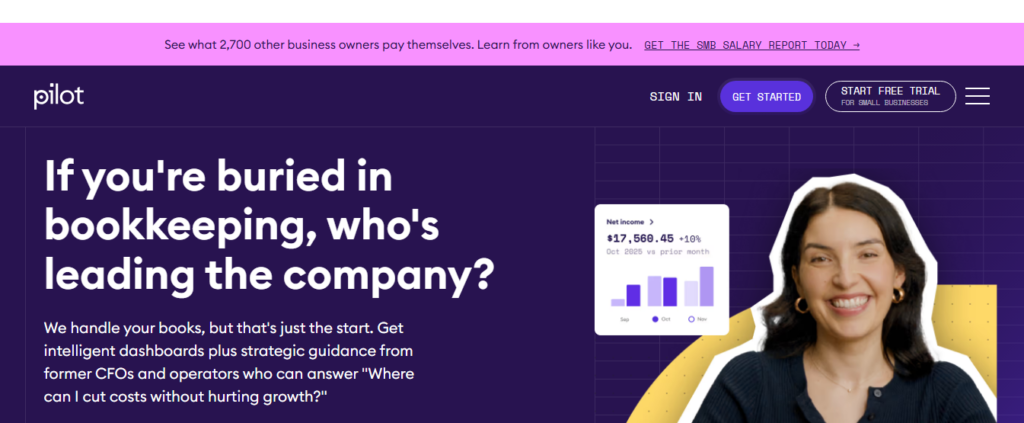
Pilot takes a fundamentally different approach to accounting automation. Rather than selling software for businesses to operate themselves, Pilot combines purpose-built software with a team of human accountants who manage your books on your behalf. The result is a service that is fully automated where automation makes sense and human-reviewed where judgment is required.
What Sets It Apart
Pilot’s software layer handles data ingestion, transaction categorization, and report generation automatically. Its human accountants review the output, handle complex categorizations, and prepare monthly financial packages including a profit and loss statement, balance sheet, and cash flow statement. For startup founders who do not want to think about accounting but need accurate, investor-grade financials, this combination is compelling.
The platform integrates with the tools startups typically use: Stripe, Gusto, Rippling, Brex, Ramp, and major banks. Transactions from all of these sources flow into Pilot automatically, reducing the manual data entry burden to near zero.
Best For
Pilot is purpose-built for venture-backed startups and high-growth businesses that need clean, accurate financials for investor reporting, board meetings, and due diligence processes. It is more expensive than self-service software but substantially cheaper than building an in-house finance team at the early stages of company growth.
Key Features to Prioritize When Choosing Accounting Automation Software in 2026
With so many capable platforms available, choosing the right one requires thinking clearly about your specific situation. Several features and considerations should drive your evaluation.
Bank Feed Connectivity and Reconciliation Quality
The foundation of any automated accounting system is its ability to pull transaction data from your bank accounts, credit cards, and payment processors reliably. Evaluate how many financial institutions each platform supports, how frequently feeds update, and how accurately the system matches transactions to existing records. A platform with excellent reconciliation automation saves hours every month and dramatically reduces the risk of human error.
Integration Ecosystem
Your accounting software does not exist in isolation. It needs to communicate with your payroll system, your CRM, your e-commerce platform, your expense management tool, and potentially your inventory management system. Before committing to any platform, map your existing software stack and verify that native integrations exist for the tools you rely on most.
Scalability
The accounting software that serves you well at ten employees may become a constraint at fifty or one hundred. Evaluate not just your current needs but where your business is likely to be in three to five years. Moving accounting systems is disruptive and expensive, so choosing a platform with headroom to grow is a worthwhile investment of evaluation effort.
Compliance and Tax Automation
Tax rules change regularly, and the burden of staying compliant falls heavily on businesses that rely on manual processes. The best accounting automation platforms update their tax calculation engines automatically as rules change, support filings across multiple jurisdictions, and reduce the risk of errors that trigger audits or penalties.
Reporting and Financial Visibility
The value of automated accounting is not just time savings. It is also clarity. Your software should make it easy to understand where your money is coming from, where it is going, and what your financial trajectory looks like. Look for platforms that offer real-time dashboards, customizable reports, and cash flow forecasting without requiring you to export data to spreadsheets.
How AI Is Reshaping Accounting Automation in 2026
Artificial intelligence has moved from a marketing buzzword to a functional component of the best accounting platforms in 2026. The practical applications are meaningful and worth understanding.
Intelligent transaction categorization now goes far beyond simple keyword matching. Modern AI models analyze transaction amounts, timing patterns, vendor information, and your historical decisions to categorize new transactions with accuracy that often exceeds manual categorization. Over time, these systems require less and less correction as they learn the specifics of your business.
Anomaly detection is another area where AI adds genuine value. Rather than requiring you to comb through reports looking for errors or irregularities, AI-powered accounting platforms flag unusual transactions, duplicate entries, or deviations from normal patterns automatically. This is particularly valuable for fraud prevention and error detection in businesses processing large transaction volumes.
Predictive cash flow modeling has become more accurate as AI models incorporate more data sources. The best platforms now factor in not just your internal financial data but also external signals like payment behavior patterns of your specific clients, seasonal trends in your industry, and upcoming known expenses to generate cash flow projections with genuinely useful precision.
Natural language querying is an emerging capability that allows non-finance users to ask questions of their financial data in plain English. Rather than building a custom report, a business owner can type “what were my top five expense categories last quarter compared to the year before” and receive an immediate, accurate answer. This capability is still maturing across platforms but represents an important shift in how business owners will interact with financial data going forward.
Making the Right Choice: A Decision Framework
Choosing accounting automation software is a decision with real long-term consequences. The wrong platform creates friction, limits your visibility, and eventually requires a painful migration. The right platform becomes a competitive advantage that compounds over time.
Start by mapping your current pain points honestly. If bank reconciliation consumes two days at month end, prioritize reconciliation automation. If you are losing money because clients pay late, prioritize invoice automation and payment collection features. If you cannot answer basic questions about your financial position without calling your accountant, prioritize real-time reporting and dashboards.
Next, be realistic about your technical resources. Some platforms require meaningful configuration effort to deliver their full value. If you do not have the internal capacity to manage that setup, either budget for implementation support or choose a simpler platform that delivers good results out of the box.
Finally, take advantage of free trials seriously. The most accurate way to evaluate whether a platform is truly intuitive is to spend a few hours using it for real tasks. Import a month of bank transactions, create an invoice, run a profit and loss report. If those basic workflows feel natural and the results look right, that is a strong signal. If you find yourself fighting the interface or confused by the logic, that friction will only grow as your usage increases.
Conclusion: The Best Accounting Automation Software Pays for Itself
The investment in quality accounting automation software in 2026 is not a cost. It is a return on time, accuracy, and financial clarity that compounds every month. For freelancers and small businesses, platforms like FreshBooks and Zoho Books deliver professional-grade automation at accessible price points. Growing businesses and those with international operations will find Xero and QuickBooks Online Advanced to be powerful, flexible platforms that scale well. Organizations with more complex needs and dedicated finance teams should look seriously at Sage Intacct. Startups that prefer a fully managed experience will find Pilot worth its premium pricing.
The common thread across all of the best platforms is this: they remove the distance between your business activity and your financial understanding. When accounting automation works well, you always know your cash position, your obligations, your revenue trends, and your tax exposure. That clarity is not just convenient. It is a genuine competitive advantage in a business environment that punishes uncertainty and rewards fast, well-informed decisions.

Usman Hakim is an SEO specialist at RankWithLinks, focusing on link building and organic growth. He helps brands improve search rankings through white-hat strategies, including guest posting and authority backlinks.