
Human Resources Information Systems have become the backbone of modern workforce management. Whether you are running a 50-person startup or a global enterprise with thousands of employees, choosing the right HRIS tool can dramatically affect how efficiently your HR team operates, how engaged your employees feel, and how compliant your business stays with labor laws.
This guide breaks down the best HRIS tools available today, what makes each one stand out, and how to match the right platform to your organization’s specific needs.
What Is an HRIS Tool and Why Does It Matter?
An HRIS, or Human Resources Information System, is software that centralizes employee data, automates HR processes, and streamlines everything from payroll and benefits administration to performance management and compliance tracking.
Modern HRIS platforms go far beyond digital record-keeping. They serve as operational command centers for HR teams, reducing manual workload, minimizing errors, and giving leaders real-time visibility into workforce data.
The right HRIS tool saves time, reduces compliance risk, and improves the employee experience across every stage of the employee lifecycle — from hire to retire.
How to Choose the Best HRIS Tool
Before reviewing specific platforms, it helps to understand the key criteria that separate a great HRIS from a mediocre one.
Core functionality — Does it handle payroll, benefits, time tracking, onboarding, and compliance in one place?
Scalability — Can it grow with your business from 50 to 5,000 employees without requiring a platform switch?
User experience — Is it intuitive enough that HR managers and employees actually use it daily?
Integration capability — Does it connect with your existing tools like accounting software, ATS platforms, or collaboration tools?
Support and implementation — How strong is the vendor’s customer support and how complex is the setup?
Pricing model — Is pricing per employee per month, or is there a flat rate that makes sense for your headcount?
The Best HRIS Tools in the HR Software Industry
1. Workday HCM
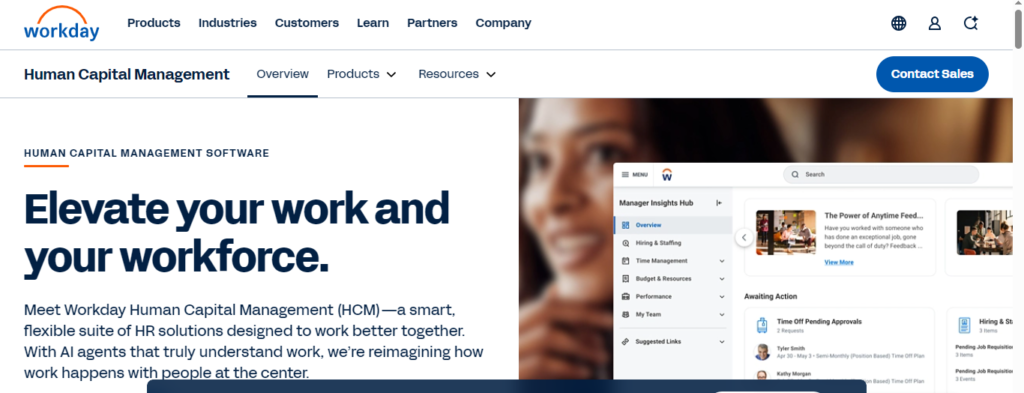
Workday is widely regarded as the gold standard for enterprise HR software. It combines human capital management, financial management, and workforce planning into a single unified platform.
Workday excels in areas like advanced analytics, succession planning, and global payroll support. It is best suited for large organizations with complex HR operations and the budget to match.
Best for: Large enterprises and multinational companies Strengths: Deep analytics, financial and HR integration, global compliance Considerations: High cost and longer implementation timeline
2. BambooHR
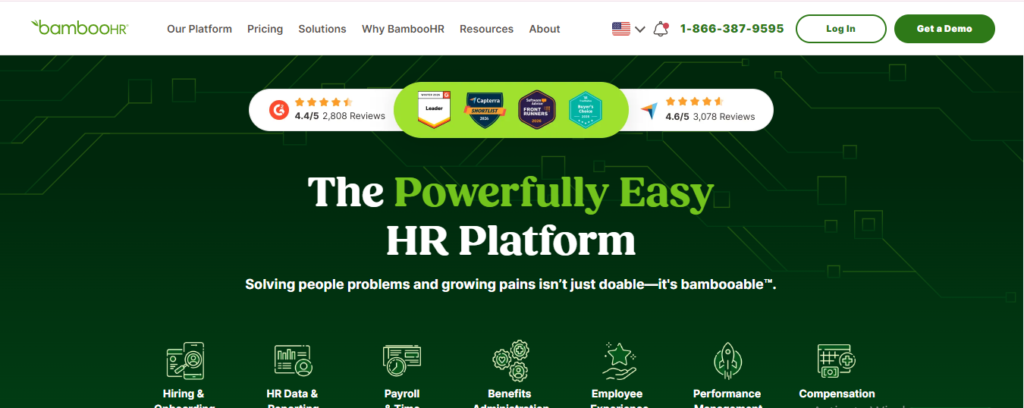
BambooHR has become the go-to HRIS for small to mid-sized businesses that want powerful functionality without enterprise-level complexity. Its clean interface and employee self-service features make it one of the most user-friendly platforms on the market.
It handles applicant tracking, onboarding, time-off management, performance reviews, and basic payroll in an accessible, well-designed package.
Best for: Small and mid-sized businesses (10–500 employees) Strengths: Ease of use, strong onboarding tools, transparent pricing Considerations: Limited advanced payroll features for complex needs
3. ADP Workforce Now
ADP has been a dominant force in payroll for decades, and Workforce Now brings that expertise into a comprehensive HRIS suite. It handles payroll, benefits administration, time and attendance, and compliance management with a level of depth that few competitors match.
ADP is particularly strong for businesses that prioritize payroll accuracy and tax compliance. Its integrations with accounting platforms and benefits carriers are extensive and battle-tested.
Best for: Mid-market to large businesses prioritizing payroll and compliance Strengths: Industry-leading payroll accuracy, extensive integrations, compliance tools Considerations: Interface can feel dated; customer service experiences vary
4. Rippling
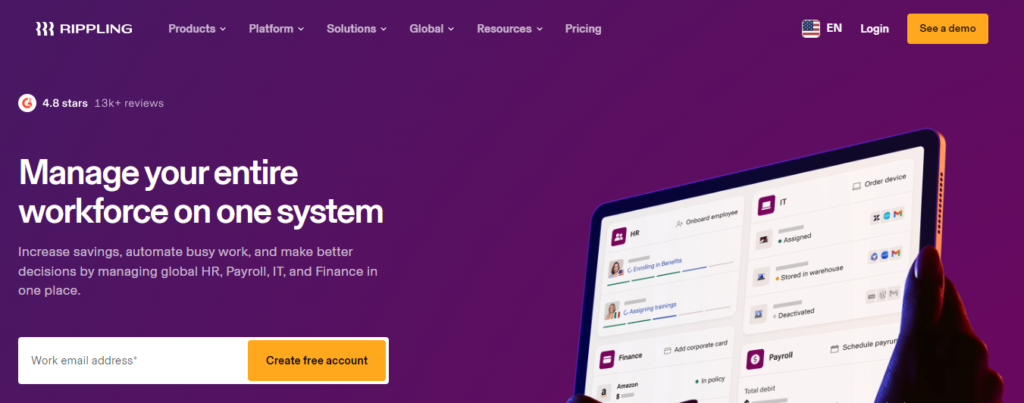
Rippling has disrupted the HRIS space by combining HR, IT, and finance operations into a single platform. When you onboard a new employee in Rippling, it can simultaneously set up their payroll, provision their laptop, assign software licenses, and enroll them in benefits.
This unified approach is particularly valuable for technology-forward companies where HR and IT overlap constantly.
Best for: Tech companies and fast-growing startups Strengths: HR and IT unification, fast onboarding, global capabilities Considerations: Can be overwhelming in scope for organizations with simple HR needs
5. Gusto
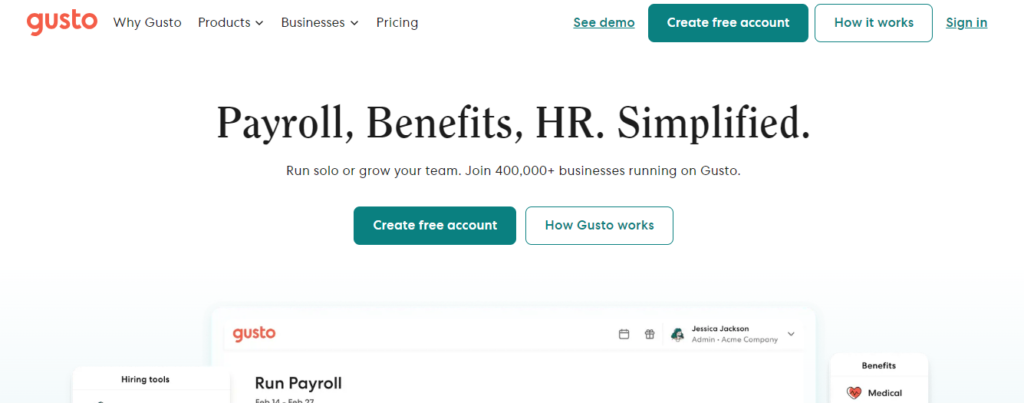
Gusto built its reputation on making payroll simple and approachable for small businesses, and it has steadily expanded into a full-service HRIS. It handles payroll, benefits, hiring, onboarding, and time tracking with a refreshingly simple user experience.
Gusto is especially popular among startups, agencies, and small businesses that are running HR without a dedicated HR team.
Best for: Small businesses and startups (1–100 employees) Strengths: Simple payroll, built-in benefits marketplace, accessible pricing Considerations: Not built for complex, large-scale HR operations
6. SAP SuccessFactors
SAP SuccessFactors is a cloud-based HCM suite designed for enterprise organizations. It is particularly strong in talent management, offering robust tools for learning management, performance and goals, compensation planning, and succession management.
It integrates natively with SAP’s broader enterprise ecosystem, making it a natural fit for organizations already running SAP ERP systems.
Best for: Large enterprises, especially those already using SAP Strengths: Talent management depth, global HR capabilities, enterprise integration Considerations: Complex to implement; best with experienced SAP consultants
7. Paychex Flex
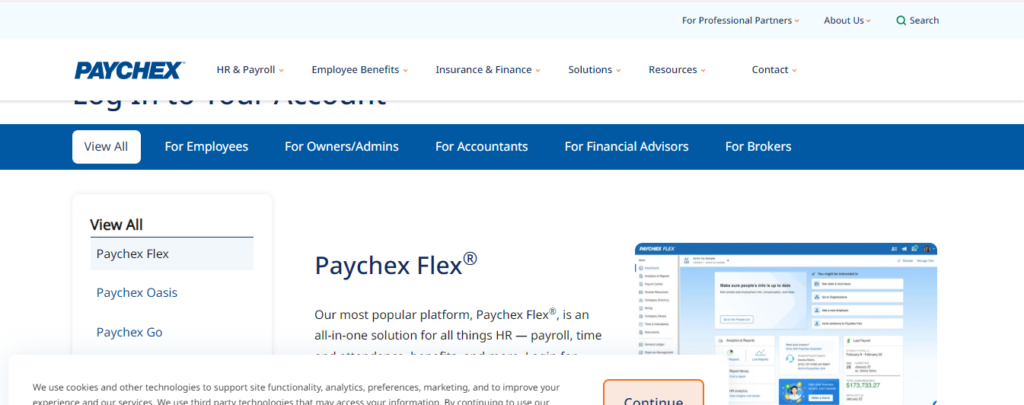
Paychex Flex is a flexible HRIS and payroll platform designed to scale with businesses of varying sizes. It covers payroll processing, HR administration, benefits, time and attendance, and compliance support.
Where Paychex stands out is in its dedicated HR advisor service, which gives smaller businesses access to certified HR professionals who can guide them through compliance questions and HR strategy.
Best for: Small to mid-sized businesses that want HR advisory support Strengths: Dedicated HR advisors, strong payroll capabilities, scalable plans Considerations: Interface and reporting tools lag behind newer platforms
8. UKG Pro (formerly Ultimate Software)
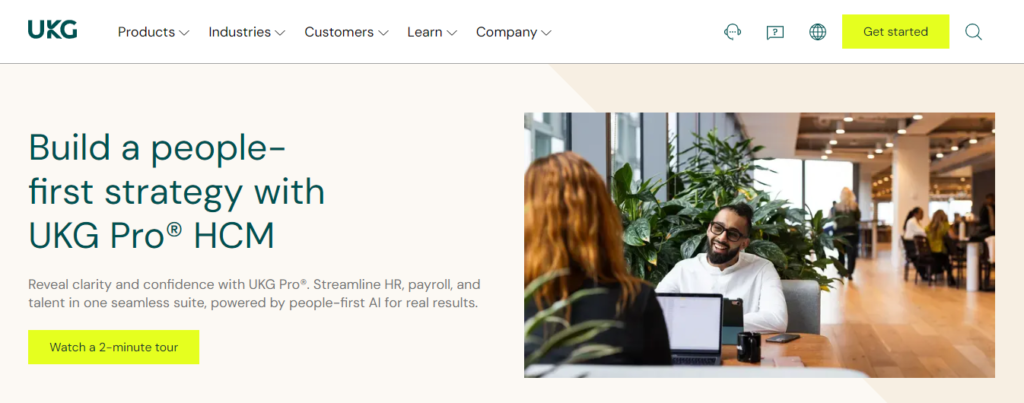
UKG Pro focuses heavily on employee experience and workforce management. It is built around the idea that engaged employees drive better business outcomes, and the platform reflects that with strong tools for pulse surveys, workforce scheduling, and predictive people analytics.
UKG Pro is a strong choice for service industries like healthcare, retail, and hospitality where workforce scheduling complexity is high.
Best for: Mid-market to enterprise businesses in service industries Strengths: Workforce management, employee engagement tools, predictive analytics Considerations: Premium pricing; implementation requires dedicated resources
HRIS Features You Should Prioritize in 2026
The HR software landscape has shifted significantly in recent years. Here are the features that matter most when evaluating any HRIS platform today.
Employee Self-Service Portals
Modern employees expect to access their pay stubs, update personal information, request time off, and review benefits without emailing HR. A strong self-service portal reduces administrative burden dramatically.
Automated Compliance and Tax Management
Employment law changes constantly. The best HRIS platforms automatically update to reflect new federal, state, and local regulations, reducing your legal risk without requiring constant manual monitoring.
People Analytics and Reporting
Raw data is useless without context. Top HRIS platforms provide dashboards that surface turnover trends, compensation equity gaps, headcount projections, and engagement metrics in a format that supports strategic decision-making.
Onboarding Automation
First impressions matter. HRIS platforms that automate document collection, equipment provisioning, benefit enrollment, and training assignments reduce time-to-productivity for new hires and free HR teams from repetitive manual tasks.
Integration with the Broader Tech Stack
Your HRIS should talk to your applicant tracking system, your accounting software, your learning management system, and your collaboration tools. Poor integrations create data silos that undermine the value of the entire platform.
HRIS vs. HCM vs. HRMS: Understanding the Differences
These three terms often get used interchangeably, but they describe different scopes of functionality.
HRIS (Human Resources Information System) focuses on storing and managing employee data, payroll, benefits, and compliance.
HRMS (Human Resources Management System) extends HRIS capabilities to include time and attendance tracking and more comprehensive workforce management features.
HCM (Human Capital Management) is the broadest category, encompassing everything in HRIS and HRMS while adding strategic talent management capabilities like succession planning, learning development, and workforce analytics.
When vendors call their product an HCM, they are typically signaling a more comprehensive, enterprise-grade platform.
Which HRIS Tool Is Right for Your Business?
The best HRIS tool is the one that aligns with your size, budget, industry, and HR priorities.
- If you are a small business under 100 employees, Gusto or BambooHR will cover your needs without overwhelming your team.
- If you are a mid-sized company scaling rapidly, Rippling or Namely offer the flexibility and automation to match your pace.
- If you are an enterprise with global operations, Workday or SAP SuccessFactors provides the depth, compliance coverage, and analytics your team requires.
- If payroll accuracy is your top priority, ADP Workforce Now or Paychex Flex are the most established names in the space.
- If employee engagement and performance are central to your HR strategy, Lattice or UKG Pro offer specialized tools that go beyond basic record-keeping.
Final Thoughts
The HRIS market has never been more competitive, and that is good news for businesses of every size. Whether you need a simple payroll and onboarding tool or a sophisticated platform with predictive workforce analytics, there is a solution built for your situation.
Take the time to audit your current HR pain points, involve your HR team in the evaluation process, and request demos before committing. The best HRIS tool is not necessarily the most feature-rich — it is the one your team will actually use effectively, every single day.
Investing in the right HR software is ultimately an investment in your people, and that always pays dividends

Fazilat zulfiqar is an SEO specialist at RankWithLinks, focused on improving search rankings through smart link building and optimization.He helps businesses grow organic traffic and build strong online authority.