
Risk-based vulnerability management (RBVM) has become the gold standard for organizations that want to move beyond traditional patch-everything approaches. Instead of treating every vulnerability equally, RBVM software helps security teams prioritize threats based on actual risk to their specific environment — saving time, reducing exposure, and making remediation efforts far more effective.
If you’re evaluating the best risk-based vulnerability management software available today, this guide breaks down the top platforms, what to look for, and how to choose the right solution for your organization.
What Is Risk-Based Vulnerability Management Software?
Risk-based vulnerability management software is a security tool that identifies, assesses, and prioritizes vulnerabilities based on contextual risk factors rather than just CVSS scores alone. These platforms combine threat intelligence, asset criticality, exploitability data, and business context to help teams focus on what matters most.
The core idea is simple: not every critical vulnerability poses the same real-world threat. A flaw in an internet-facing production server is far more urgent than the same flaw sitting on an isolated internal test machine. RBVM software makes that distinction automatically and at scale.
Why Traditional Vulnerability Management Falls Short
Traditional vulnerability scanners generate thousands of findings with little guidance on what to fix first. Security teams end up overwhelmed, chasing CVEs that may never actually be exploited while genuinely dangerous vulnerabilities sit unpatched.
Key limitations of legacy approaches include:
- Over-reliance on CVSS scores, which don’t reflect real-world exploitation likelihood
- No consideration of asset business value or exposure level
- Lack of integration with threat intelligence feeds
- High alert fatigue due to undifferentiated vulnerability lists
- Poor alignment between security and IT remediation workflows
Risk-based vulnerability management software solves these problems by layering intelligence on top of raw scan data.
Key Features to Look for in Risk-Based Vulnerability Management Software
Before comparing specific platforms, understand what separates a true RBVM solution from a basic scanner with a risk label attached.
Threat Intelligence Integration
The best platforms continuously ingest threat intelligence from sources like CISA KEV (Known Exploited Vulnerabilities), dark web monitoring, exploit databases, and threat actor activity feeds. This allows the software to flag vulnerabilities that are actively being weaponized in the wild.
Asset Context and Criticality Scoring
Effective RBVM software understands your environment. It knows which assets are internet-facing, which systems are business-critical, and which machines handle sensitive data. This context reshapes the priority of every vulnerability finding.
Exploit Prediction and Likelihood Scoring
Some platforms use machine learning models to predict how likely a vulnerability is to be exploited based on historical data, current threat actor behavior, and technical characteristics of the flaw. This goes well beyond what a static CVSS score can offer.
Remediation Workflow Integration
Great software doesn’t just identify risk — it helps you eliminate it. Look for platforms that integrate with ITSM tools like ServiceNow and Jira, enable automated ticket creation, and track remediation SLAs.
Risk Scoring Dashboards and Reporting
Executive-level dashboards, risk trend reports, and compliance-ready outputs are essential for communicating vulnerability posture to leadership and auditors without requiring deep technical knowledge.
Best Risk-Based Vulnerability Management Software in 2025
1. Tenable One
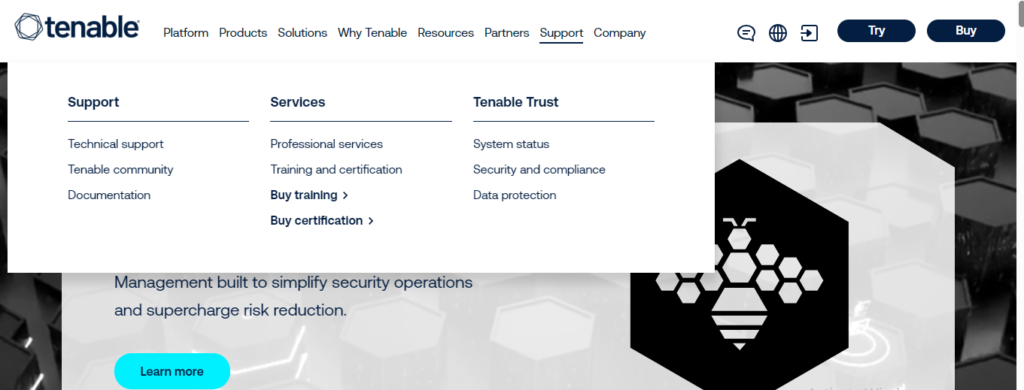
Tenable One is one of the most widely deployed risk-based vulnerability management platforms on the market. Built on the Tenable Nessus engine — widely regarded as the most accurate vulnerability detection scanner available — Tenable One adds an exposure management layer that contextualizes findings across IT, OT, cloud, and active directory environments.
Standout features:
- Asset Exposure Score (AES) that weighs criticality, exploitability, and threat context
- Lumin Exposure View for business-aligned risk communication
- Integration with Tenable’s extensive vulnerability research and threat intelligence
- Support for hybrid environments including cloud, on-premises, and OT/IoT
Tenable One is best suited for mid-to-large enterprises that need comprehensive coverage across complex, mixed environments.
2. Qualys VMDR (Vulnerability Management, Detection and Response)
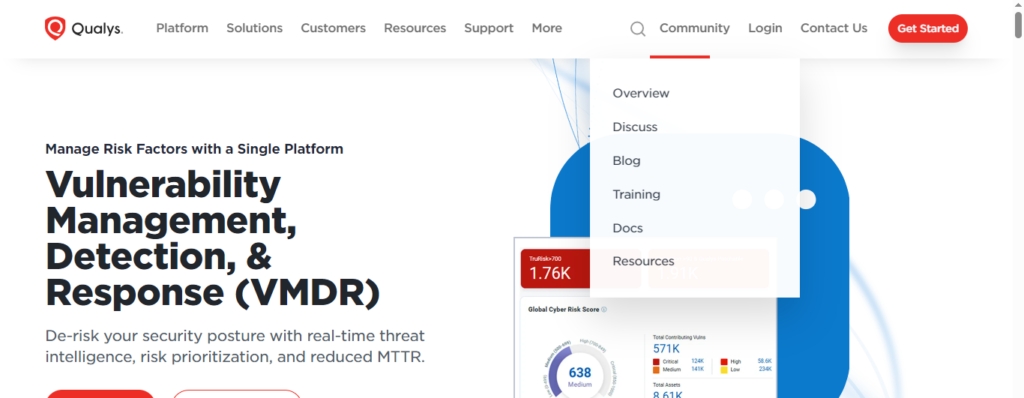
Qualys VMDR is a cloud-native platform that combines vulnerability management with threat prioritization and automated response capabilities in a single unified workflow. It uses TruRisk scoring, a proprietary risk model that incorporates asset criticality, threat intelligence, and exploit availability to generate meaningful prioritization.
Standout features:
- TruRisk scoring for asset and vulnerability-level risk calculation
- Continuous monitoring with real-time detection
- Native integration with Qualys CSAM for asset inventory accuracy
- Automated patching workflows and response orchestration
- Strong compliance reporting for frameworks like PCI-DSS, HIPAA, and SOC 2
Qualys VMDR suits organizations that want a deeply integrated, cloud-first platform with strong compliance reporting capabilities.
3. Rapid7 InsightVM
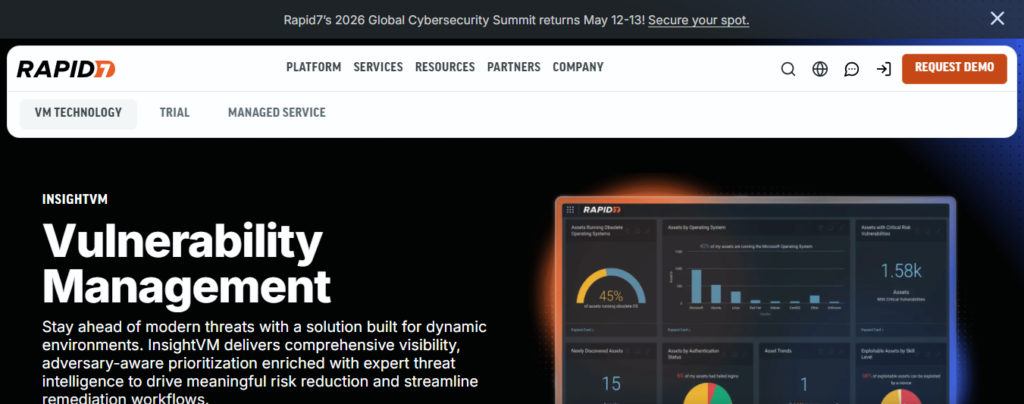
Rapid7 InsightVM is a mature risk-based vulnerability management solution that excels in live network discovery, real-world risk scoring, and deep integration with Rapid7’s broader security ecosystem including SIEM and SOAR tools.
Standout features:
- Real Risk Score that factors in CVSS, exploit exposure, and asset importance
- Live dashboards with dynamic remediation tracking
- Integration with Rapid7 InsightIDR for combined VM and detection capabilities
- Container and cloud security scanning
- Strong remediation project management features for IT teams
InsightVM is particularly well-suited for teams that want tight integration between vulnerability management and incident detection workflows.
4. CrowdStrike Falcon Spotlight
CrowdStrike Falcon Spotlight takes an agentless approach built directly on the Falcon sensor already deployed for endpoint detection. This means vulnerability data is collected continuously without requiring separate scans, making it one of the fastest platforms for real-time vulnerability visibility.
Standout features:
- Continuous, agent-based vulnerability assessment with no scan windows
- ExPRT.AI scoring that predicts exploitation likelihood using machine learning
- Direct integration with CrowdStrike’s threat intelligence on active adversary behavior
- Zero additional infrastructure required if Falcon is already deployed
- Fast time-to-visibility, especially in large distributed environments
Falcon Spotlight is ideal for organizations already invested in the CrowdStrike ecosystem and prioritizing speed and simplicity.
5. Ivanti Neurons for RBVM
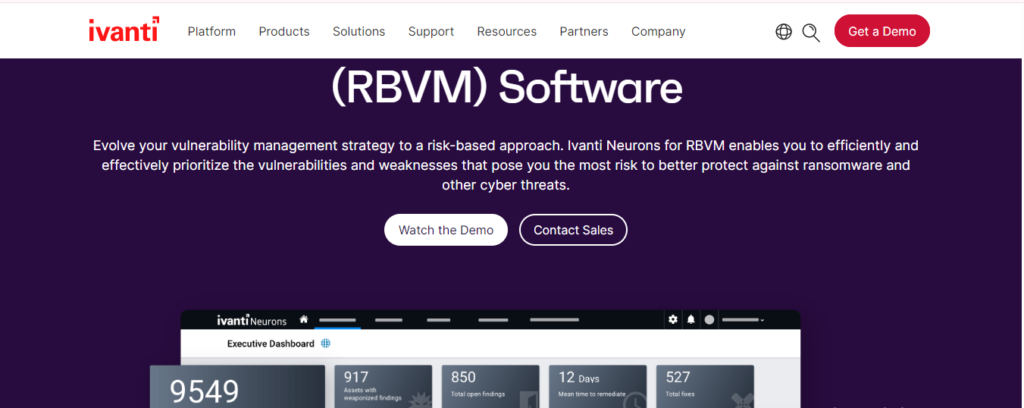
Ivanti Neurons for RBVM is purpose-built around the risk-based prioritization concept, combining vulnerability intelligence with patch management automation in a tightly coupled platform. Its use of Ivanti’s Risk-Based Prioritization engine makes it one of the more automated options available.
Standout features:
- Predictive risk scoring using active threat intelligence and exploit data
- Deep integration with Ivanti patch management for end-to-end remediation
- Bot-powered automated remediation for low-risk, high-volume vulnerabilities
- Strong support for remote and distributed workforces
- Unified visibility across endpoints, servers, and cloud workloads
Ivanti is a strong choice for IT security teams that want vulnerability management and patch deployment managed within a single vendor relationship.
6. Brinqa
Brinqa takes a connector-first approach, positioning itself as a cyber risk management platform that aggregates data from existing scanners, cloud security tools, and threat intelligence sources into a unified risk graph. Rather than replacing your scanners, it makes them more intelligent.
Standout features:
- Risk graph that maps relationships between assets, vulnerabilities, and business impact
- Aggregates findings from Tenable, Qualys, Rapid7, and others
- Highly customizable risk scoring models aligned to business objectives
- Strong workflow automation for large-scale remediation programs
- Excellent for organizations with mature, multi-tool security environments
Brinqa works best for large enterprises that already have multiple scanning tools and need an intelligence layer to unify and prioritize findings across them.
7. ServiceNow Vulnerability Response
ServiceNow Vulnerability Response is a strong option for organizations deeply embedded in the ServiceNow ecosystem. It connects vulnerability scan data from external tools with IT service management workflows, making it a natural fit for teams where security and IT operations run through ServiceNow.
Standout features:
- Seamless integration with ServiceNow ITSM for automated ticket creation and tracking
- Risk scoring that incorporates asset criticality and threat intelligence
- Native connection to ServiceNow CMDB for accurate asset context
- SLA tracking and compliance reporting built into the remediation workflow
This platform is best for enterprises that want vulnerability management tightly coupled with their existing IT operations tooling.
How to Choose the Right RBVM Software for Your Organization
With so many capable platforms available, selection comes down to your specific operational context. Consider these factors:
1. Size and Complexity of Your Environment
Smaller organizations often benefit from all-in-one platforms like Qualys VMDR or Tenable One. Larger enterprises with diverse tooling stacks may prefer an aggregation-first approach like Brinqa.
2. Existing Tool Investments
If you already run CrowdStrike for endpoint security, Falcon Spotlight is a low-friction addition. If your IT operations live in ServiceNow, ServiceNow Vulnerability Response is a logical extension.
3. Level of Automation Required
Teams with limited bandwidth should prioritize platforms with strong automated remediation capabilities, such as Ivanti Neurons or Qualys VMDR.
4. Cloud vs. On-Premises Coverage
Cloud-native environments call for platforms with strong cloud security posture management integration. Tenable One and Qualys VMDR lead in this area.
5. Compliance Requirements
If your primary driver is regulatory compliance — PCI-DSS, HIPAA, FedRAMP — look for platforms with pre-built compliance dashboards and audit-ready reports.
Risk-Based Vulnerability Management vs. Traditional Vulnerability Scanning
Understanding the difference helps justify investment in dedicated RBVM software:
| Factor | Traditional VM | Risk-Based VM |
|---|---|---|
| Prioritization basis | CVSS score | Risk score + threat context |
| Exploit likelihood | Not considered | Actively modeled |
| Asset context | Minimal | Central to scoring |
| Threat intelligence | Limited | Continuously integrated |
| Remediation focus | All critical CVEs | Top exploitable risks |
| Alert fatigue | High | Significantly reduced |
The Role of Threat Intelligence in RBVM
One of the most important differentiators among RBVM platforms is the quality and currency of their threat intelligence. The best solutions pull data from:
- CISA’s Known Exploited Vulnerabilities catalog
- National Vulnerability Database (NVD) enrichment
- Proprietary threat research teams
- Dark web and exploit kit monitoring
- Active adversary campaign tracking
Platforms that maintain large internal research teams — like Tenable, Rapid7, and CrowdStrike — tend to surface critical exploitation activity faster than those relying solely on public feeds.
Common Mistakes When Implementing RBVM Software
Even with the right tool, implementation errors can undermine the value of risk-based vulnerability management:
- Incomplete asset inventory: RBVM scoring is only as accurate as your asset data. Gaps in discovery lead to blind spots.
- Ignoring business context: Failing to define asset criticality means risk scores won’t reflect actual business impact.
- Not setting remediation SLAs: Without defined timelines tied to risk level, high-priority fixes get treated the same as low-priority ones.
- Skipping integration with IT: Vulnerability management only works when security and IT operations teams share workflows and accountability.
- Treating RBVM as a one-time project: Threat landscapes change constantly. Continuous reassessment and rescoring are essential.
Final Thoughts
The best risk-based vulnerability management software doesn’t just find vulnerabilities — it tells you which ones can hurt you and helps you fix them fast. Whether you choose Tenable One for its breadth, CrowdStrike Falcon Spotlight for its speed, Qualys VMDR for its automation, or Brinqa for its aggregation capabilities, the right platform is the one that fits your environment, integrates with your existing workflows, and gives your team clear, actionable direction.6The shift from scanning to risk intelligence isn’t just a technology upgrade. It’s a fundamental change in how security teams operate — moving from reactive patching to proactive exposure reduction. Organizations that make that shift gain a measurable advantage in protecting their most critical assets.

Fazilat zulfiqar is an SEO specialist at RankWithLinks, focused on improving search rankings through smart link building and optimization.He helps businesses grow organic traffic and build strong online authority.