
metric verification is becoming more accessible. Facial recognition technology that once required expensive hardware now runs on a standard smartphone camera, bringing enterprise-grade identity verification to businesses of any size.
Real-time labor cost visibility is becoming a standard expectation. Modern platforms increasingly surface labor cost data in real time as schedules are built and shifts are worked, giving managers instant feedback on whether they’re staying within budget.
Integration depth is also expanding. The best platforms are building tighter connections not just with payroll systems but with POS systems, demand forecasting tools, and HR platforms — creating a more complete picture of workforce productivity and cost.
Businesses that invest in capable time clock and scheduling software today are not just solving a current administrative problem. They’re building the data foundation that will power smarter workforce decisions for years to come.
Final Verdict: Which Time Clock Software Should You Choose?
There’s no single best time clock software for every business — but there are clear winners for different situations.
If you run a small business with hourly workers and want the most value for the money, Homebase is the place to start. The free plan is genuinely capable, and the paid tiers are reasonably priced.
If scheduling complexity is your primary pain point — multiple locations, shifting demand, complex rotations — When I Work or Deputy will serve you better.
If your team works in the field and location accountability is critical, ClockShark is purpose-built for exactly that challenge.
If you’re already in the QuickBooks ecosystem, QuickBooks Time is the path of least resistance to
Claude’s response was interruptedRetry
You said: write the artical 2026
write the artical 2026
5:01 PM
Claude responded: Best Time Clock Software for Employee Scheduling in 2026: The Complete Guide
If you manage a team — whether it’s five people or five hundred — you already know the headache of tracking hours, building schedules, and making sure everything lines up before payday. Spreadsheets break. Paper timesheets go missing. Manual scheduling eats hours you simply do not have. That is exactly why the right time clock software can feel like hiring an extra manager who never sleeps, never calls in sick, and never makes a math error.
But with dozens of platforms competing for your attention in 2026, choosing the best time clock software for employee scheduling is not a simple decision. Some tools are built for massive enterprises. Others are designed for small businesses watching every dollar. Some prioritize scheduling flexibility; others lead with payroll integration, AI-powered forecasting, or compliance automation.
This guide cuts through the noise with everything you need to make a confident, informed decision — from the features that actually matter to a thorough breakdown of the top platforms available right now.
What Is Time Clock Software and Why Does It Matter More Than Ever in 2026
Time clock software is a digital system that records when employees start and end their shifts, tracks total hours worked, manages breaks, and integrates directly with scheduling and payroll tools. It replaces the traditional punch card or paper timesheet with an automated, cloud-based solution that reduces errors, eliminates guesswork, and saves meaningful administrative time every single week.
In 2026, modern time clock platforms do far more than log clock-ins and clock-outs. The best solutions combine employee scheduling, attendance tracking, overtime alerts, leave management, real-time labor cost monitoring, and payroll syncing into a single unified dashboard. For managers and business owners, this means less time buried in administrative tasks and more time focused on growing and running the actual business.
The financial case is more compelling than ever. Time theft — through buddy punching, inflated hours, or accidental over-reporting — continues to cost businesses billions of dollars annually across industries. Automated time tracking with GPS verification, biometric login, or AI-assisted facial recognition dramatically reduces these losses. Even modest-sized teams routinely recoup the full cost of their time clock software subscription within the first few weeks of use.
Beyond cost savings, workforce expectations have shifted. Employees in 2026 expect digital-first tools. They want to view their schedules, request time off, swap shifts, and confirm their hours from a smartphone — not from a bulletin board in the break room or a paper form on someone’s desk. Businesses that still rely on manual time tracking are not just losing money. They are losing employees to competitors who offer a better work experience.
Key Features to Look for in Time Clock Software in 2026
Before diving into specific platforms, it helps to understand what separates a mediocre time clock tool from a truly excellent one. The landscape has matured significantly, and in 2026, several features that were once considered premium additions are now baseline expectations.
Ease of Use Across All Devices If employees cannot figure out how to clock in without calling a manager, the software has already failed. The best time clock tools in 2026 have clean, intuitive interfaces that work equally well on smartphones, tablets, and desktop computers, with minimal training required. Friction at clock-in time means missed punches, inaccurate records, and frustrated staff.
AI-Powered Scheduling Artificial intelligence has moved from a buzzword to a practical scheduling tool. Leading platforms now use AI to generate optimized schedules based on historical demand patterns, employee availability, labor cost targets, and even local weather forecasts for industries where foot traffic is weather-dependent. This capability saves managers hours of planning time every week.
GPS Tracking and Geofencing For businesses with remote workers, field teams, or multiple job sites, GPS tracking and geofencing are no longer optional. Geofencing restricts clock-ins to approved physical locations, ensuring employees are not clocking in from home, their car down the street, or anywhere else they should not be. In 2026, this feature is expected across all serious workforce management platforms.
Biometric and Facial Recognition Verification Buddy punching — one employee clocking in on behalf of another — remains one of the most common forms of time theft. Modern platforms now use AI-driven facial recognition running directly on employee smartphones or shared kiosk devices to verify identity at clock-in. No special hardware is required, making this accessible to businesses of all sizes.
Real-Time Labor Cost Visibility Scheduling decisions have direct financial consequences. The best 2026 platforms display real-time labor cost estimates as managers build schedules, showing projected costs against budget targets before the schedule is even published. This turns scheduling from a pure logistics exercise into a financially informed decision-making process.
Payroll Integration Your time data is only as useful as what you do with it. Top-tier software integrates directly with payroll platforms like QuickBooks, Gusto, ADP, Paychex, and others — automatically exporting hours so there is no manual data entry and no room for costly transcription errors. In 2026, seamless payroll integration is a non-negotiable requirement, not a premium feature.
Overtime and Break Management Labor law compliance is non-negotiable, and it is more complex than ever in 2026 as regulations continue to evolve across different states and jurisdictions. Good software automatically tracks overtime thresholds, enforces mandatory break rules, and flags potential violations before they become expensive legal problems.
Mobile App Quality A large and growing percentage of the workforce manages their work life entirely from a phone. A well-designed, reliable mobile app is not a bonus feature in 2026 — it is the primary interface through which most employees will interact with the software every single day.
Team Communication Integration Standalone messaging tools are losing ground to workforce platforms that build communication directly into the scheduling and time tracking experience. When a shift opens, an alert goes out. When a schedule changes, the affected employees are notified instantly. This integration reduces the chaos of last-minute staffing changes.
Best Time Clock Software for Employee Scheduling in 2026: Top Platforms Reviewed
1. Homebase — Best Overall for Small to Medium Businesses
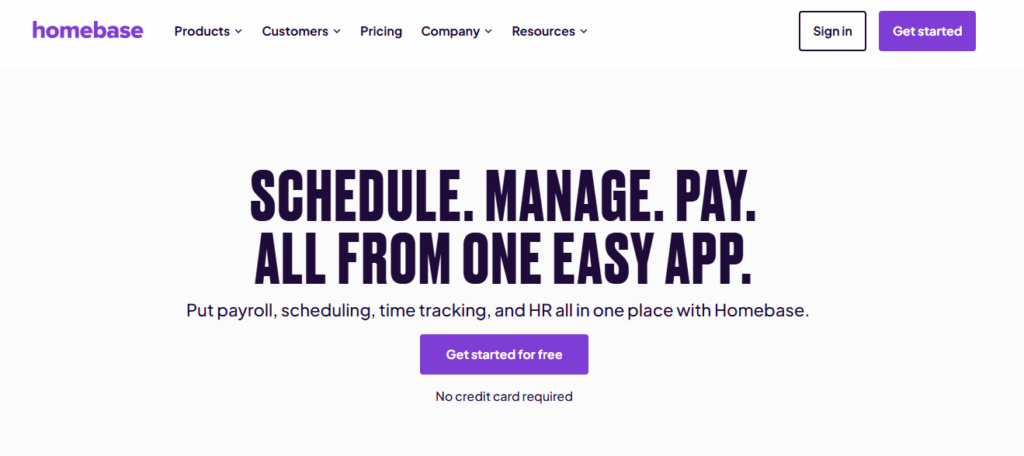
Homebase remains one of the most complete and accessible time clock and scheduling solutions for businesses with hourly workers heading into 2026. It brings together time tracking, employee scheduling, team communication, HR tools, and even built-in payroll processing into a single platform that feels designed for real managers, not software engineers.
The free plan continues to stand out as genuinely useful rather than just a stripped-down teaser. It supports unlimited employees at a single location — a rarity in this industry — and includes core scheduling and time tracking features that many competitors charge for. Paid tiers unlock additional locations, advanced reporting, hiring tools, and full payroll processing.
What makes Homebase particularly powerful is how tightly its time clock and scheduling features are integrated. Managers can build a weekly schedule, publish it instantly to employee phones, and immediately see labor cost estimates based on actual wage data. When employees clock in late, leave early, or miss a shift entirely, managers receive instant alerts.
The mobile experience is polished and consistently well-rated. Employees check schedules, clock in and out, submit time-off requests, and pick up open shifts directly from the app. GPS-enabled clock-in ensures accountability even for workers who are not always in a fixed location.
Homebase has also invested meaningfully in its AI scheduling suggestions, helping managers identify the most cost-effective coverage patterns based on historical sales data and team availability. Integrations cover all major payroll platforms including Gusto, QuickBooks, ADP, and Paychex.
Best for: Restaurants, retail stores, service businesses, small to mid-sized teams Standout feature: Genuinely functional free plan with real scheduling and time tracking included Limitation: Some advanced HR and multi-location features require higher-tier paid plans
2. When I Work — Best for Shift-Based Scheduling
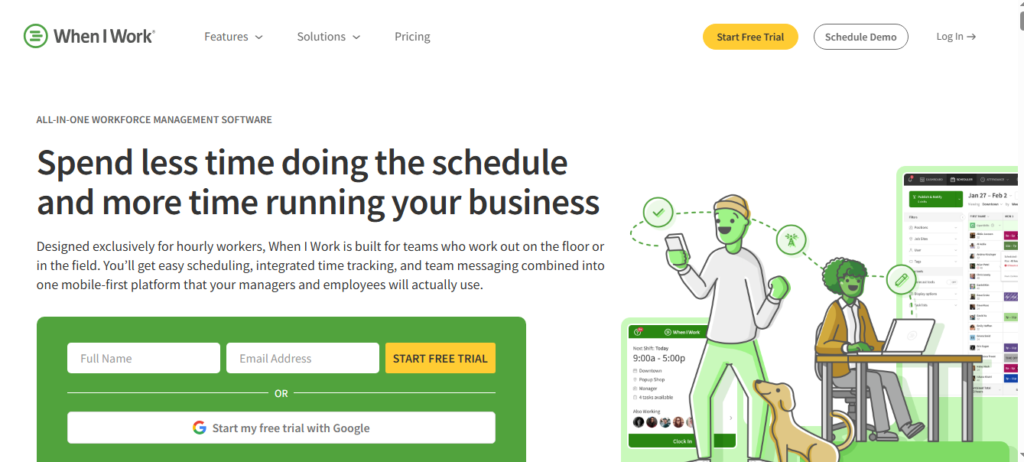
When I Work has built its entire identity around one core promise: making shift scheduling as simple and painless as possible, regardless of how many locations, departments, or roles you are managing. In 2026, it continues to deliver on that promise better than almost any competitor.
The scheduling interface is outstanding. Managers see the full week at a glance, drag and drop shifts into position, set availability rules per employee, and receive instant alerts when schedules conflict with approved time-off requests or stated availability. Employees get schedule notifications via text message or the app, and shift trade requests can be approved or denied in seconds without a single phone call.
Time clock functionality is genuinely built in rather than added as an afterthought. Employees clock in through the mobile app or a shared kiosk device. GPS verification confirms their location, and managers can define acceptable clock-in windows to prevent early punching that inflates labor costs.
When I Work has also expanded its analytics capabilities significantly in recent updates, giving managers clearer visibility into schedule adherence, overtime trends, and labor cost patterns across locations and departments. The built-in messaging system eliminates the need for a separate team communication app.
Best for: Multi-location businesses, retail chains, hospitality operations, healthcare staffing Standout feature: Arguably the most intuitive and powerful shift scheduling interface on the market Limitation: Per-employee pricing can climb quickly for larger teams
3. Deputy — Best for Compliance-Heavy Industries
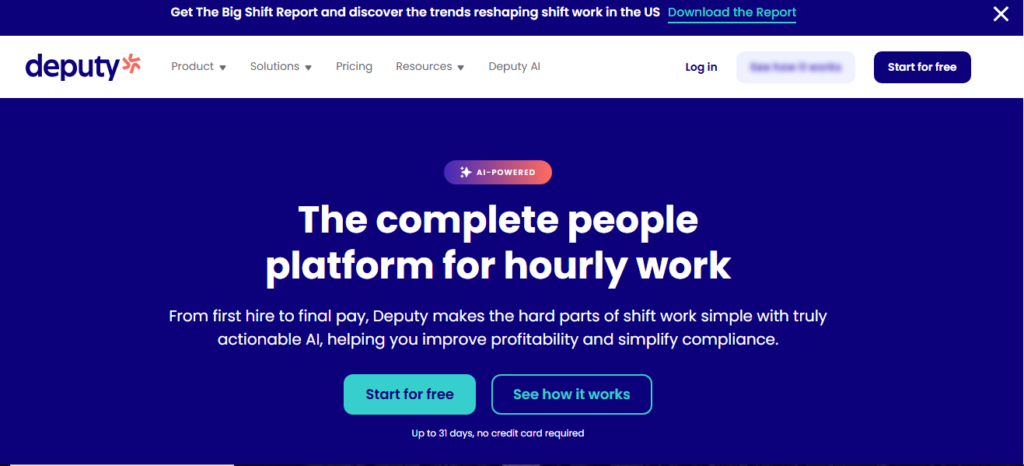
Deputy is a sophisticated workforce management platform that takes labor law compliance more seriously than virtually any competitor in 2026. It is designed for industries where a single compliance violation can trigger significant legal and financial consequences — healthcare, aged care, large hospitality groups, and enterprise-scale retail operations.
The scheduling engine is genuinely intelligent. Deputy can auto-generate complete schedules based on demand forecasts pulled from integrated POS or reservation systems, employee qualifications and certifications, labor cost targets, and jurisdiction-specific legal work-hour restrictions. For managers juggling complex rotating shifts and certification expiry tracking, this level of automation is transformative.
Deputy’s time clock features include AI-powered facial recognition via the employee’s smartphone camera, GPS location tracking, and configurable geofencing — a combination that makes unauthorized clock-ins essentially impossible and gives compliance auditors a clean, verifiable paper trail.
The platform monitors meal break compliance in real time and pushes alerts to managers when employees approach overtime thresholds that could trigger additional costs or legal obligations. With labor regulations growing more complex in multiple jurisdictions in 2026, this proactive compliance layer is an increasingly valuable feature.
Deputy connects with over 300 payroll, POS, and HR platforms, making it genuinely flexible for businesses that have established and complex technology stacks.
Best for: Healthcare, large retail, hospitality groups, businesses in heavily regulated industries Standout feature: AI-powered scheduling optimization with deep, automated compliance tracking Limitation: Higher price point and more complexity than most small businesses actually need
4. ClockShark — Best for Field Service and Construction
ClockShark was designed from the ground up for businesses where employees spend their workdays in the field rather than in an office or retail location. Construction crews, landscaping companies, field service technicians, HVAC businesses, and similar operations have fundamentally different tracking needs — and ClockShark addresses those needs better than any general-purpose competitor.
The GPS tracking capability is exceptional. Managers see exactly where each employee is located in real time, review the route they have traveled throughout the day, and confirm that every clock-in event occurred at the correct job site. The platform supports job-based time tracking, meaning hours can be assigned to specific projects, clients, tasks, or cost codes — a critical feature for accurate project billing, job costing, and client invoicing.
Scheduling in ClockShark is practical and field-oriented. Managers assign shifts to specific job sites rather than just general time slots, ensuring that every employee knows precisely where they need to be and when. The mobile app is engineered to function in low-connectivity environments, storing clock events locally and syncing automatically once a network signal is restored.
QuickBooks integration is particularly deep, making ClockShark a natural fit for the large number of construction and trades businesses that already rely on QuickBooks for project accounting and financial management.
Best for: Construction, field service operations, landscaping, any workforce that works across multiple job sites Standout feature: Detailed job-site GPS tracking with complete location history per employee Limitation: Less suitable for office-based, retail, or single-location businesses
5. QuickBooks Time — Best for Businesses in the QuickBooks Ecosystem
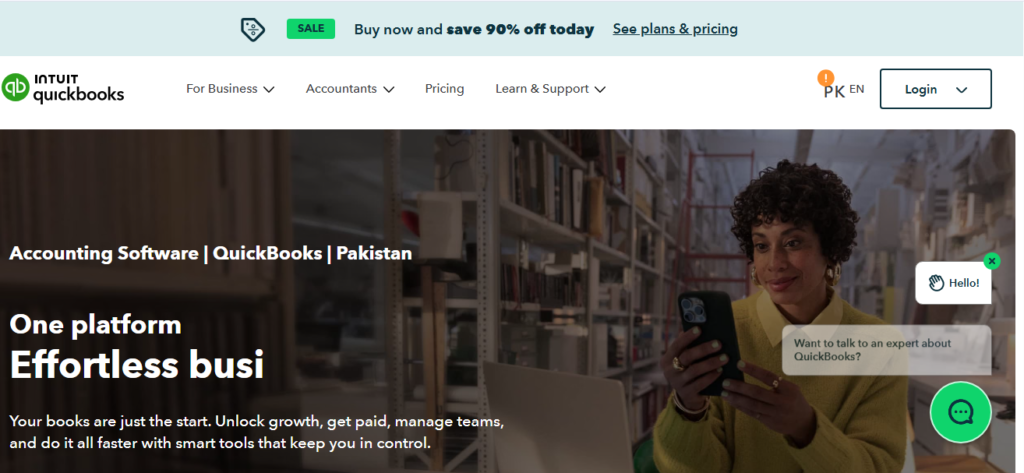
If your business already runs on QuickBooks for payroll and accounting — and a very large number of small and mid-sized businesses do — QuickBooks Time is the logical time tracking partner. The integration is extraordinarily deep and seamless. Hours flow directly into QuickBooks payroll, job costing modules, and client invoicing without any manual export steps, data entry, or risk of transcription error.
Beyond the QuickBooks connection itself, the platform offers solid core functionality. Employees clock in via mobile app, web browser, or a dial-in phone system, making it accessible to virtually any type of workforce in any situation. GPS tracking and configurable geofencing ensure location accuracy for remote and field-based workers.
Scheduling tools have matured meaningfully in recent updates. Managers build and publish schedules, see a live view of who is currently on shift, and receive alerts when employees do not clock in as expected. The who’s-working dashboard gives real-time visibility across the entire workforce.
Project and job tracking is a genuine strength of QuickBooks Time. Hours can be tagged to specific clients, projects, service types, or billable activities, making it particularly valuable for professional services firms, contractors, and consultants who need granular time records for accurate client billing.
Best for: Businesses already using QuickBooks, professional services firms, contractors, consultants Standout feature: The deepest and most seamless QuickBooks payroll and accounting integration available Limitation: Notably less compelling for businesses that do not use QuickBooks as their primary financial platform
6. Connecteam — Best for Deskless Workforce Management
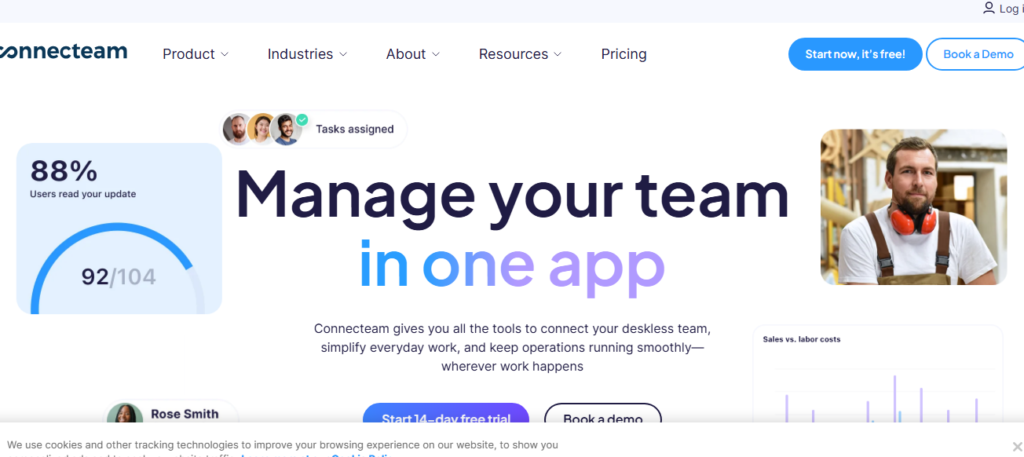
Connecteam approaches time tracking and scheduling as components of a broader employee management platform built explicitly and intentionally for deskless workers — people who do not spend their day at a desk with a computer. This focus makes it an outstanding fit for industries including hospitality, construction, logistics, cleaning services, security operations, and healthcare support.
The time clock supports GPS tracking, geofencing, and digital timesheets with configurable manager approval workflows. Employees clock in from their personal smartphones, and the data flows automatically into digital timesheets that calculate total hours, break durations, and overtime without any manual calculation.
The scheduling module is visual, flexible, and approachable even for managers with no technical background or prior scheduling software experience. Schedule templates allow recurring weekly patterns to be configured once and reused indefinitely, dramatically reducing the time spent on schedule creation each week. Employees receive push notifications when new schedules are published, can indicate their availability in advance, and can request shift swaps directly through the same app.
What sets Connecteam apart most clearly from the rest of the field is the breadth of additional employee management capabilities bundled within the same platform. Internal communication channels, employee training and onboarding modules, task management, digital forms and inspection checklists, HR document storage, and a company knowledge base are all included. For smaller businesses looking to consolidate multiple software subscriptions into one unified tool, this all-in-one approach delivers exceptional value.
Best for: Deskless and mobile workforces across multiple industries, businesses seeking an all-in-one employee management platform Standout feature: Comprehensive deskless worker management that extends well beyond time tracking and scheduling Limitation: The sheer breadth of features can feel complex and overwhelming for teams that only need basic time tracking
7. Rippling — Best for Fast-Growing and Enterprise Companies
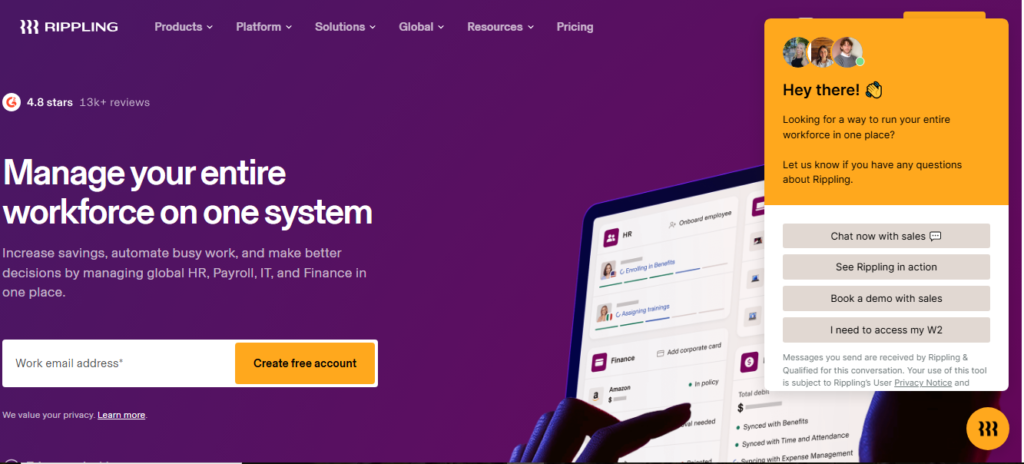
Rippling operates in a different category from the other platforms on this list. It is not simply a time clock or employee scheduling tool. It is a unified workforce management system that handles HR, payroll, IT device management, benefits administration, and compliance within a single deeply integrated platform. Time and attendance tracking is one powerful module within a much larger and more comprehensive ecosystem.
For growing businesses that are exhausted by the complexity of managing six or eight separate software tools that do not communicate with each other, Rippling’s fully unified approach is genuinely transformative. When an employee’s information is updated in one place — a new compensation rate, a promotion, a location transfer, a new bank account — that change propagates automatically and instantly through every relevant module across the entire platform.
The time tracking and scheduling capabilities within Rippling are robust and comprehensive. Employees clock in via mobile or web, GPS verification is available for field workers, and scheduling tools support complex multi-location configurations. But the genuine power of Rippling emerges from the total integration — hours flow directly into payroll, payroll data flows into financial reporting, and compliance documentation pulls from a single authoritative source of truth.
Rippling is not the most budget-friendly option on this list, and it is almost certainly overkill for very small businesses with simple needs. But for mid-market and enterprise companies that want to eliminate the administrative chaos of managing disconnected HR and workforce tools, Rippling is difficult to beat in 2026.
Best for: Mid-market and enterprise businesses, fast-growing companies, teams that want a single platform for HR and workforce management Standout feature: Fully unified HR, payroll, IT management, and workforce operations in one deeply integrated system Limitation: Higher cost and implementation complexity; not the right fit for very small or simple operations
How to Choose the Right Time Clock Software for Your Business in 2026
With so many capable options available, the right choice depends heavily on the specific context of your business. Here is a practical decision framework for narrowing down your options without getting paralyzed by feature comparisons.
Start with your industry. Field service and construction businesses have fundamentally different tracking needs than restaurant groups, healthcare organizations, or professional services firms. Prioritize platforms designed with your type of operation in mind, or at minimum, platforms that specifically address the pain points most common in your industry.
Be honest about team size and growth trajectory. Some platforms use per-employee pricing, which is affordable at small scale but expensive as headcount grows. Others charge a flat fee by location or feature tier, which becomes increasingly cost-effective at scale. Project your team size twelve to twenty-four months into the future before making a commitment.
Map your existing technology stack before shopping. If your business runs QuickBooks, Gusto, or ADP for payroll, verify that your shortlisted time clock platforms integrate cleanly with those systems before you spend time in a trial. The best time tracking software in the world creates problems, not solutions, if it cannot connect to your payroll system.
Test the mobile experience seriously. For most hourly and deskless workforces, the smartphone is the only computing device employees will ever use to interact with the software. During any free trial period, have actual employees test the clock-in process on their real devices. A clunky or confusing mobile app defeats the entire purpose of implementing digital time tracking.
Weight compliance appropriately for your situation. If you operate in a state with complex overtime rules, mandatory rest period requirements, or strict record-keeping obligations, invest in a platform with strong compliance automation. The cost of a single wage-and-hour dispute or regulatory penalty far exceeds the premium pricing of a compliance-focused platform over several years.
Use free trials as real pilots, not demos. Configure actual locations, set up real employees, publish a genuine schedule, and process a practice payroll export during your trial period. Real-world pilot testing reveals friction and limitations that polished demo videos and feature comparison charts never will.
Common Mistakes to Avoid When Implementing Time Clock Software
Even excellent software fails when the rollout is poorly planned and executed. These are the most common and costly implementation mistakes businesses make when deploying new time tracking systems.
Rushing through the configuration. Most platforms require deliberate setup before they generate accurate, useful data. Locations, departments, pay rates, overtime rules, break policies, and payroll integrations all need to be configured correctly before employees begin using the system. Sloppy setup leads to inaccurate timesheets and payroll errors that are painful to untangle.
Skipping employee onboarding. Even intuitive software benefits from a brief employee walkthrough. Employees need to know how to clock in correctly, how to submit time-off requests, what to do when something goes wrong, and who to contact with questions. Ten minutes of upfront training prevents most day-one problems.
Collecting data but never acting on it. Time clock software generates valuable reports on labor costs, overtime trends, attendance patterns, and schedule adherence. Businesses that collect this data but never review or act on it are leaving significant money and operational insight on the table every single week.
Making the decision based on price alone. The least expensive option is rarely the best option when it comes to workforce management. A platform that saves a manager ten minutes of administrative work per day easily pays for itself within a month. A platform that causes payroll errors or creates compliance exposure costs far more than any subscription fee.
Failing to communicate the purpose to employees. Employees sometimes perceive new time tracking tools as surveillance rather than as a benefit. Be transparent and direct about why the system is being implemented — accurate pay processing, simpler scheduling, clearer communication, better compliance — and the adoption process will go significantly smoother.
Time Clock Software Pricing: What to Expect in 2026
Pricing structures vary considerably across the industry. Understanding the different models helps you make accurate total-cost comparisons rather than being misled by low headline prices that do not reflect real-world costs.
Per-employee per-month pricing remains the most common model across the industry. Rates typically range from two dollars to twelve dollars per employee per month depending on the feature tier and platform. This model is cost-effective at small headcount but can become a meaningful expense as teams grow.
Flat monthly fee by location works well for businesses with multiple sites and larger teams at each location. A fixed rate per location regardless of employee count makes costs more predictable and generally favors businesses with larger per-location headcounts.
Freemium tiers offer genuine functionality at no cost with limits on features, integrations, locations, or support access. Homebase continues to offer the most functional free tier in the industry. These plans are excellent starting points for very small businesses that need real tools without initial investment.
Enterprise pricing for large-scale or complex deployments is typically custom-quoted based on employee count, feature requirements, integration complexity, and contract length. These arrangements often include dedicated implementation support, custom integration development, and service-level guarantees.
When comparing costs, always factor in the full picture — monthly subscription, onboarding fees, integration costs, and the internal staff time that will be saved or consumed by the platform. A slightly more expensive tool that saves your operations manager three hours of administrative work every week is almost always the better financial decision when you account for the full value equation.
The Future of Time Clock and Scheduling Software: What Is Coming Next
The category is evolving rapidly in 2026, driven by continued advances in artificial intelligence, deeper mobile integration, and fundamentally shifting workforce expectations.
Predictive scheduling powered by machine learning is becoming a standard expectation rather than a premium differentiator. The leading platforms are moving beyond reactive scheduling toward genuinely predictive tools that recommend optimal staffing levels days or weeks in advance based on integrated demand signals — POS transaction data, reservation volumes, historical traffic patterns, and even calendar events.
Conversational AI interfaces are beginning to appear in workforce management platforms, allowing managers to build schedules, pull reports, and respond to staffing changes using natural language input rather than navigating traditional menu-based interfaces. This shift lowers the training barrier significantly and accelerates adoption across less technically experienced management teams.
Real-time labor cost intelligence is becoming embedded throughout the scheduling experience. Rather than reviewing labor costs after the fact in a weekly report, managers in 2026 are increasingly making scheduling decisions with live cost projections displayed alongside each scheduling choice they make.
Deeper cross-platform integration continues to accelerate. The strongest platforms are building tighter native connections not just with payroll systems but with POS platforms, demand forecasting tools, HR information systems, and financial planning software — creating more complete and actionable pictures of workforce productivity, cost, and utilization.
Businesses that invest in capable time clock and scheduling software in 2026 are not simply solving a current administrative frustration. They are building the data foundation, the operational discipline, and the workforce intelligence that will power smarter, faster, and more competitive business decisions for years to come.
Final Verdict: Best Time Clock Software for Employee Scheduling in 2026
There is no single best time clock software for every business. But there are clear winners for each type of operation.
For small businesses with hourly workers who want maximum value with minimal upfront cost, Homebase is the strongest starting point in 2026. The free plan is genuinely capable, and the paid tiers remain among the most affordable in the category.
For businesses where scheduling complexity is the primary challenge — multiple locations, shifting demand, rotating shifts across many roles — When I Work or Deputy will serve you better than almost any alternative.
For field service, construction, and mobile workforces where location accountability and job-based time tracking are critical, ClockShark is purpose-built and unmatched for those specific needs.
For businesses already running on QuickBooks who want the smoothest possible path from tracked hours to processed payroll, QuickBooks Time is the natural and logical choice.
For deskless workforces who need a complete employee management platform rather than just a standalone time clock, Connecteam delivers outstanding all-in-one value.
For fast-growing mid-market and enterprise companies that are ready to unify their entire HR and workforce management stack into a single platform, Rippling is the most powerful and comprehensive solution available in 2026.
The right choice is the one that fits your team size, your industry, your existing technology stack, and the specific operational problems keeping you up at night. Start with a free trial, test it with real employees, and let the actual experience guide your final decision. The perfect time clock software for your business is not the one with the most features or the lowest price — it is the one your team will actually use every single day.

Usman Hakim is an SEO specialist at RankWithLinks, focusing on link building and organic growth. He helps brands improve search rankings through white-hat strategies, including guest posting and authority backlinks.